Recognition: unknown
Confronting Color Glass Condensate at next-to-leading order with HERA data
Pith reviewed 2026-05-08 11:13 UTC · model grok-4.3
The pith
Global fit to HERA data determines the non-perturbative initial condition for the next-to-leading order Balitsky-Kovchegov equation.
A machine-rendered reading of the paper's core claim, the machinery that carries it, and where it could break.
Core claim
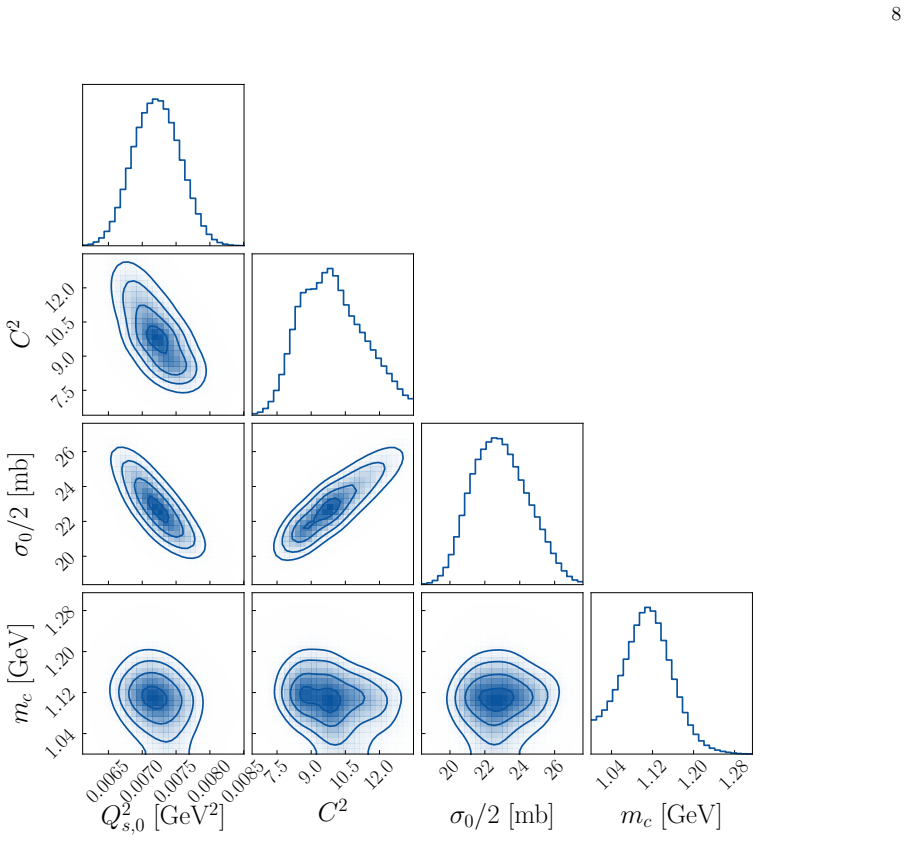
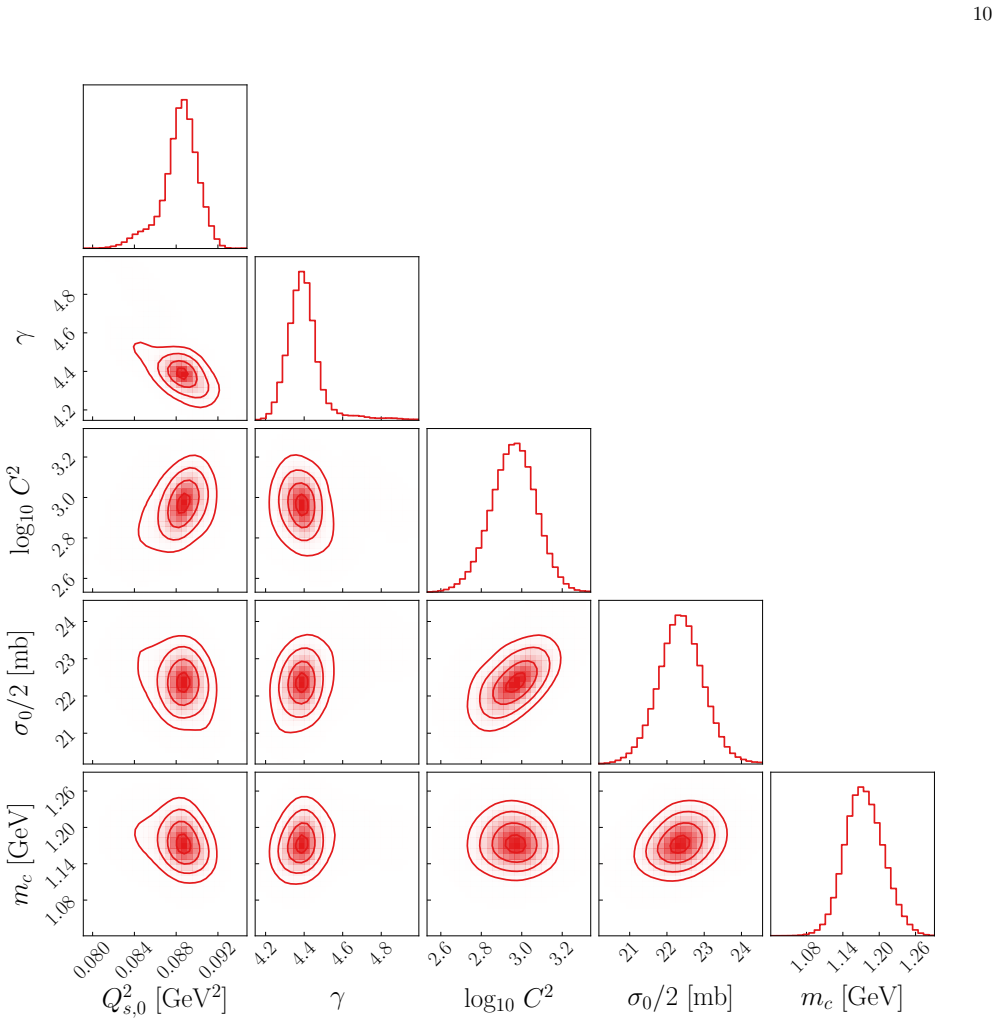
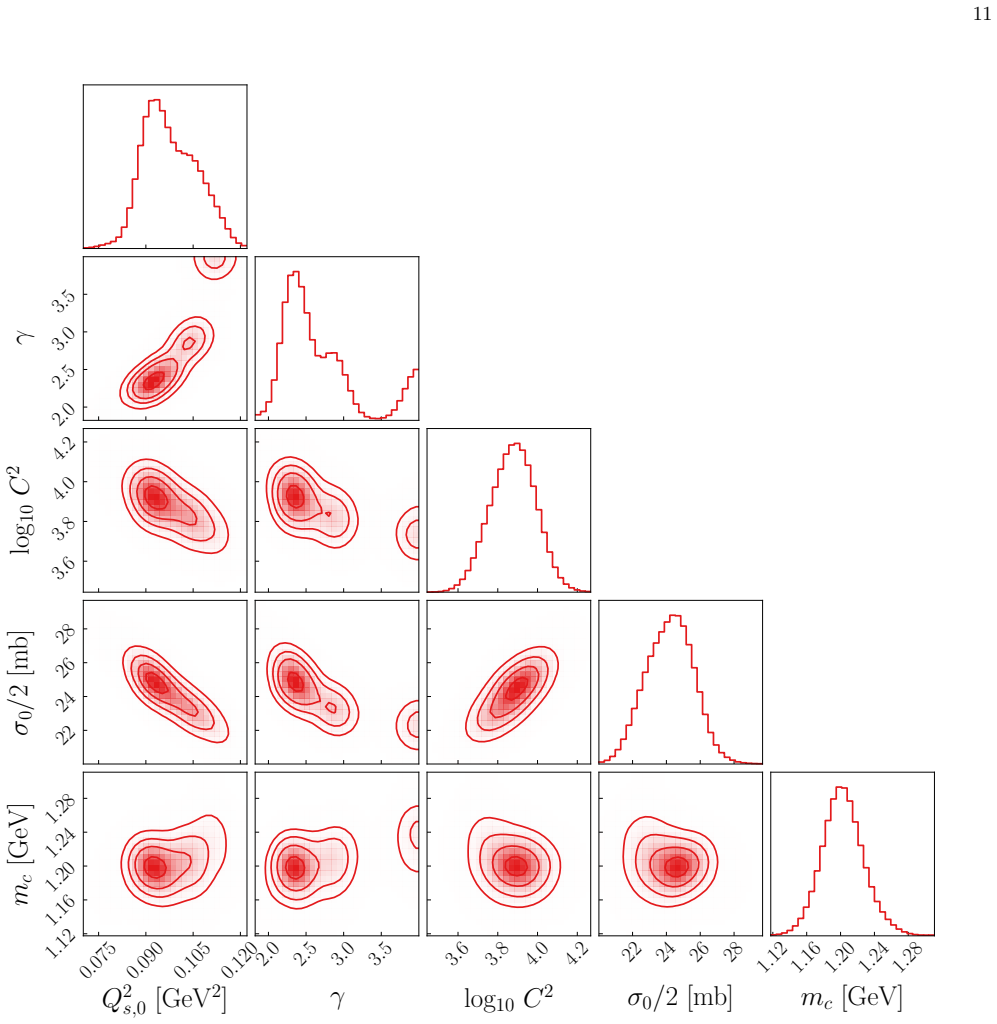
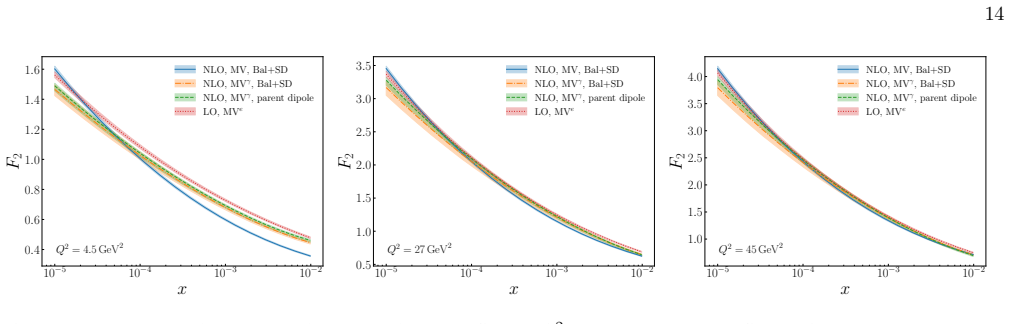
We perform a global analysis of HERA total inclusive cross section and charm quark production data to extract the non-perturbative initial condition for the next-to-leading order Balitsky-Kovchegov (BK) equation. We extend our previous analyses to full next-to-leading order plus next-to-leading logarithm accuracy by combining the NLO DIS impact factors with the NLO BK equation that includes the resummation of large double and single logarithms. The developed Bayesian setup extracts the posterior that describes the distribution of the parameters that best fit the data.
What carries the argument
The Bayesian posterior distribution over the parameters of the non-perturbative initial condition for the NLO Balitsky-Kovchegov equation, which directly supplies the dipole amplitude and its uncertainty.
If this is right
- NLO color-glass-condensate calculations of scattering processes can now carry a documented uncertainty band coming from the initial condition.
- The same initial-condition posterior can be reused for predictions at the future Electron-Ion Collider without refitting.
- Consistency checks between the fitted dipole amplitude and independent small-x observables become possible at the same perturbative order.
- The method supplies a template for propagating initial-condition uncertainties into nuclear or heavy-ion calculations performed at NLO.
Where Pith is reading between the lines
- The posterior can be sampled to generate an ensemble of dipole amplitudes for use in Monte-Carlo event generators that incorporate NLO CGC dynamics.
- If the fit quality remains high when additional HERA or LHC data are included, it would indicate that the resummed NLO framework already captures the dominant small-x dynamics in the measured region.
- The extracted initial condition provides a concrete benchmark against which future analytic or lattice determinations of the same non-perturbative input can be compared.
Load-bearing premise
The NLO Balitsky-Kovchegov equation with resummation of large logarithms, when used together with NLO deep-inelastic scattering impact factors, describes the HERA data in the measured kinematic range without large missing higher-order or non-CGC contributions.
What would settle it
A clear mismatch between the model's predictions for a new observable, such as forward hadron or dijet production at the LHC, and measured cross sections that lies outside the uncertainty band derived from the posterior would falsify the central claim.
Figures





read the original abstract
We perform a global analysis of HERA total inclusive cross section and charm quark production data to extract the non-perturbative initial condition for the next-to-leading order Balitsky-Kovchegov (BK) equation. We extend our previous analyses to full next-to-leading order + next-to-leading logarithm (NLO+NLL) accuracy by combining the NLO DIS impact factors with the NLO BK equation that includes the resummation of large double and single logarithms. The developed Bayesian setup extracts the posterior that describes the distribution of the parameters that best fit the data. The posterior distribution allows for estimates of the theoretical uncertainty of the dipole amplitude and, hence, offers a streamlined method for propagating uncertainties in the BK initial condition in NLO CGC calculations.
Editorial analysis
A structured set of objections, weighed in public.
Referee Report
Summary. The paper performs a global Bayesian analysis of HERA total inclusive cross section and charm quark production data to extract the non-perturbative initial condition parameters for the next-to-leading order Balitsky-Kovchegov (BK) equation including resummation of large double and single logarithms, combined with NLO DIS impact factors. The resulting posterior distribution on these parameters is used to estimate theoretical uncertainties on the dipole amplitude, providing a method to propagate uncertainties in the BK initial condition for NLO CGC calculations.
Significance. If the NLO+NLL BK evolution accurately describes the HERA data, this work supplies a practical Bayesian framework for uncertainty quantification in small-x phenomenology, which is a clear strength for propagating non-perturbative input uncertainties in future CGC predictions.
major comments (1)
- [numerical results and Bayesian analysis] The central claim that the posterior furnishes reliable data-driven uncertainties on the dipole amplitude requires that the NLO BK equation plus NLO impact factors yields a statistically acceptable description of the HERA data. However, no chi-squared values, degrees of freedom, or goodness-of-fit metrics are reported for the Bayesian fit (see abstract and the description of the numerical analysis). Without these, it is impossible to rule out that the posterior width is dominated by model mismatch or the prior rather than data constraints, undermining the advertised uncertainty-propagation method.
Simulated Author's Rebuttal
We thank the referee for their careful reading of the manuscript and for highlighting the importance of goodness-of-fit metrics in validating the Bayesian analysis. We address the major comment below and will revise the manuscript accordingly.
read point-by-point responses
-
Referee: [numerical results and Bayesian analysis] The central claim that the posterior furnishes reliable data-driven uncertainties on the dipole amplitude requires that the NLO BK equation plus NLO impact factors yields a statistically acceptable description of the HERA data. However, no chi-squared values, degrees of freedom, or goodness-of-fit metrics are reported for the Bayesian fit (see abstract and the description of the numerical analysis). Without these, it is impossible to rule out that the posterior width is dominated by model mismatch or the prior rather than data constraints, undermining the advertised uncertainty-propagation method.
Authors: We agree that explicit goodness-of-fit metrics are necessary to substantiate the reliability of the extracted posterior and the associated uncertainty estimates. In the revised manuscript we will report the chi-squared value evaluated at the maximum a posteriori (MAP) point together with the number of degrees of freedom for both the inclusive and charm data sets. We will also quote the reduced chi-squared and briefly discuss its interpretation in the context of the Bayesian sampling. In addition, we will add a short paragraph describing posterior predictive checks performed on a subset of the HERA data points to demonstrate that the model predictions are statistically consistent with the measurements. These additions will directly address the concern that the posterior width might be dominated by prior or model mismatch rather than data constraints. revision: yes
Circularity Check
No significant circularity; standard data-driven extraction of non-perturbative input
full rationale
The paper performs an explicit global fit of the BK initial-condition parameters to external HERA inclusive and charm data using the NLO BK equation plus NLO impact factors. This is a phenomenological extraction whose output (posterior on the dipole amplitude) is defined by the fit to independent data rather than by any internal self-definition or renaming. No load-bearing step reduces by construction to the inputs: the evolution equation and impact factors are taken as given (with resummation), the data are external, and the Bayesian posterior propagates fit uncertainties in the standard way. Self-citations to prior analyses exist but are not load-bearing for the central claim, which adds NLO+NLL accuracy and charm data. The result is self-contained against the HERA benchmark and does not manufacture predictions from fitted quantities.
Axiom & Free-Parameter Ledger
free parameters (1)
- Parameters of the non-perturbative BK initial condition
axioms (1)
- domain assumption NLO BK equation with NLL resummation of large double and single logarithms accurately models small-x evolution for HERA kinematics
Reference graph
Works this paper leans on
-
[1]
−1 + 1 x2 12 αs(x2 12) αs(x2
-
[2]
−1 −K sub +K fin 1 ,(13) whereK sub removes theO(α 2 s) contribution ofK STL that appears inK 2 in exact kinematics. Meanwhile,K fin 1 con- tains the remaining finiteα 2 s terms that are not enhanced by large transverse logarithms. See Ref. [23] for explicit expressions. In Eq. (13), we have used the Balitsky prescription for the running coupling in the B...
-
[3]
The Color Glass Condensate and High Energy Scattering in QCD
E. Iancu and R. Venugopalan,The Color glass condensate and high-energy scattering in QCD, pp. 249–3363. World Scientific, 2003. arXiv:hep-ph/0303204. InQuark-gluon plasma 4(eds. R.C. Hwa and X.-N. Wang)
work page Pith review arXiv 2003
-
[4]
Science Requirements and Detector Concepts for the Electron-Ion Collider: EIC Yellow Report
R. Abdul Khaleket. al.,Science Requirements and Detector Concepts for the Electron-Ion Collider: EIC Yellow Report,Nucl. Phys. A1026(2022) 122447 [arXiv:2103.05419 [physics.ins-det]]
work page internal anchor Pith review arXiv 2022
- [5]
-
[6]
Operator expansion for high-energy scattering
I. Balitsky,Operator expansion for high-energy scattering,Nucl. Phys. B463(1996) 99 [arXiv:hep-ph/9509348]
work page Pith review arXiv 1996
-
[7]
Y. V. Kovchegov,Smallx F 2 structure function of a nucleus including multiple pomeron exchanges,Phys. Rev. D60(1999) 034008 [arXiv:hep-ph/9901281]
work page Pith review arXiv 1999
-
[8]
A. Morreale and F. Salazar,Mining for Gluon Saturation at Colliders,Universe7(2021) no. 8 312 [arXiv:2108.08254 [hep-ph]]
-
[9]
B. Duclou´ e, H. H¨ anninen, T. Lappi and Y. Zhu,Deep inelastic scattering in the dipole picture at next-to-leading order,Phys. Rev. D96(2017) no. 9 094017 [arXiv:1708.07328 [hep-ph]]
-
[10]
H. M¨ antysaari and J. Penttala,Exclusive heavy vector meson production at next-to-leading order in the dipole picture,Phys. Lett. B823(2021) 136723 [arXiv:2104.02349 [hep-ph]]
-
[11]
H. M¨ antysaari and J. Penttala,Complete calculation of exclusive heavy vector meson production at next-to-leading order in the dipole picture,JHEP08 (2022) 247 [arXiv:2204.14031 [hep-ph]]
-
[12]
A. Kaushik, H. M¨ antysaari and J. Penttala,Diffractive deep inelastic scattering in the dipole picture: Theq¯qg contribution in exact kinematics,Phys. Rev. D113 (2026) no. 7 074012 [arXiv:2510.24171 [hep-ph]]
work page internal anchor Pith review Pith/arXiv arXiv 2026
- [13]
-
[14]
I. Balitsky and G. A. Chirilli,Photon impact factor in the next-to-leading order,Phys. Rev. D83(2011) 031502 [arXiv:1009.4729 [hep-ph]]
-
[15]
Beuf,NLO corrections for the dipole factorization of DIS structure functions at low x,Phys
G. Beuf,NLO corrections for the dipole factorization of DIS structure functions at low x,Phys. Rev. D85 (2012) 034039 [arXiv:1112.4501 [hep-ph]]
-
[16]
I. Balitsky and G. A. Chirilli,Photon impact factor and kT -factorization for DIS in the next-to-leading order, Phys. Rev. D87(2013) no. 1 014013 [arXiv:1207.3844 [hep-ph]]
-
[17]
G. Beuf,Dipole factorization for DIS at NLO: Loop correction to theγ ∗ T ,L →q qlight-front wave functions, Phys. Rev. D94(2016) no. 5 054016 [arXiv:1606.00777 [hep-ph]]
-
[18]
H. H¨ anninen, T. Lappi and R. Paatelainen,One-loop corrections to light cone wave functions: the dipole picture DIS cross section,Annals Phys.393(2018) 358 [arXiv:1711.08207 [hep-ph]]
-
[19]
Beuf,Dipole factorization for DIS at NLO: Combining theq¯qandq¯qgcontributions,Phys
G. Beuf,Dipole factorization for DIS at NLO: Combining theq¯qandq¯qgcontributions,Phys. Rev. D 96(2017) no. 7 074033 [arXiv:1708.06557 [hep-ph]]. 15
- [20]
- [21]
- [22]
-
[23]
I. Balitsky and G. A. Chirilli,Next-to-leading order evolution of color dipoles,Phys. Rev. D77(2008) 014019 [arXiv:0710.4330 [hep-ph]]
-
[24]
T. Lappi and H. M¨ antysaari,Direct numerical solution of the coordinate space Balitsky-Kovchegov equation at next to leading order,Phys. Rev. D91(2015) no. 7 074016 [arXiv:1502.02400 [hep-ph]]
-
[25]
T. Lappi and H. M¨ antysaari,Next-to-leading order Balitsky-Kovchegov equation with resummation,Phys. Rev. D93(2016) no. 9 094004 [arXiv:1601.06598 [hep-ph]]
-
[26]
J. Cepila, J. G. Contreras, M. Matas and M. Vaculciak, Impact-parameter-dependent solutions to the Balitsky-Kovchegov equation at next-to-leading order, Phys. Rev. D111(2025) no. 9 096015 [arXiv:2412.08571 [hep-ph]]. [25]H1, ZEUScollaboration, H. Abramowiczet. al., Combination of measurements of inclusive deep inelastic e±pscattering cross sections and QC...
-
[27]
L. D. McLerran and R. Venugopalan,Computing quark and gluon distribution functions for very large nuclei, Phys. Rev. D49(1994) 2233 [arXiv:hep-ph/9309289]
work page Pith review arXiv 1994
-
[28]
K. J. Golec-Biernat and M. Wusthoff,Saturation effects in deep inelastic scattering at lowQ 2 and its implications on diffraction,Phys. Rev.D59(1998) 014017 [arXiv:hep-ph/9807513 [hep-ph]]
work page Pith review arXiv 1998
- [29]
- [30]
-
[31]
T. Lappi and H. M¨ antysaari,Single inclusive particle production at high energy from HERA data to proton-nucleus collisions,Phys. Rev. D88(2013) 114020 [arXiv:1309.6963 [hep-ph]]
- [32]
-
[33]
H. H¨ anninen, H. M¨ antysaari, R. Paatelainen and J. Penttala,Proton Structure Functions at Next-to-Leading Order in the Dipole Picture with Massive Quarks,Phys. Rev. Lett.130(2023) no. 19 192301 [arXiv:2211.03504 [hep-ph]]
- [34]
-
[35]
Beuf,Improving the kinematics for low-xQCD evolution equations in coordinate space,Phys
G. Beuf,Improving the kinematics for low-xQCD evolution equations in coordinate space,Phys. Rev. D 89(2014) no. 7 074039 [arXiv:1401.0313 [hep-ph]]
- [36]
-
[37]
A numerical implementation of the NLO DIS structure functions in the dipole picture
H. H¨ anninen, H. M¨ antysaari and J. Penttala,A numerical implementation of the NLO DIS structure functions in the dipole picture,arXiv:2604.09071 [hep-ph]
work page internal anchor Pith review Pith/arXiv arXiv
-
[38]
H. M¨ antysaari and P. Zurita,In depth analysis of the combined HERA data in the dipole models with and without saturation,Phys. Rev. D98(2018) 036002 [arXiv:1804.05311 [hep-ph]]
-
[39]
J. Berger and A. M. Stasto,Smallxnonlinear evolution with impact parameter and the structure function data, Phys. Rev. D84(2011) 094022 [arXiv:1106.5740 [hep-ph]]
-
[40]
H. M¨ antysaari and B. Schenke,Confronting impact parameter dependent JIMWLK evolution with HERA data,Phys. Rev. D98(2018) no. 3 034013 [arXiv:1806.06783 [hep-ph]]
-
[41]
H. M¨ antysaari, J. Penttala, F. Salazar and B. Schenke, Finite-size effects on small-x evolution and saturation in proton and nuclear targets,Phys. Rev. D111 (2025) no. 5 054033 [arXiv:2411.13533 [hep-ph]]
- [42]
- [43]
-
[44]
Balitsky,Quark contribution to the small-x evolution of color dipole,Phys
I. Balitsky,Quark contribution to the small-x evolution of color dipole,Phys. Rev. D75(2007) 014001 [arXiv:hep-ph/0609105]
-
[45]
Scikit-learn: Machine Learning in Python
F. Pedregosa, G. Varoquaux, A. Gramfort, V. Michel, B. Thirion, O. Grisel, M. Blondel, P. Prettenhofer, R. Weiss, V. Dubourg, J. Vanderplas, A. Passos, D. Cournapeau, M. Brucher, M. Perrot and E. Duchesnay,Scikit-learn: Machine learning in Python, Journal of Machine Learning Research12(2011) 2825 [arXiv:1201.0490]
work page Pith review arXiv 2011
-
[46]
D. Foreman-Mackey, D. W. Hogg, D. Lang and J. Goodman,emcee: The mcmc hammer,PASP125 (2013) 306 [arXiv:1202.3665]
work page internal anchor Pith review arXiv 2013
-
[47]
C. Casuga and H. M¨ antysaari,Posterior Samples from Confronting Color Glass Condensate at next-to-leading order with HERA data, GitHub repository: camcasuga/nlobk-nlodisft, . https://doi.org/10.5281/zenodo.19695674
- [48]
-
[49]
T. Lappi and H. M¨ antysaari,On the running coupling in the JIMWLK equation,Eur. Phys. J. C73 (2013) no. 2 2307 [arXiv:1212.4825 [hep-ph]]. [50]H1collaboration, C. Alexaet. al.,Elastic and Proton-Dissociative Photoproduction ofJ/ψMesons at HERA,Eur. Phys. J. C73(2013) no. 6 2466 [arXiv:1304.5162 [hep-ex]]. [51]ZEUScollaboration, S. Chekanovet. al.,Exclusi...
- [50]
-
[51]
H. M¨ antysaari and Y. Tawabutr,Complete next-to-leading order calculation of single inclusiveπ0 production in forward proton-nucleus collisions,Phys. Rev. D109(2024) no. 3 034018 [arXiv:2310.06640 [hep-ph]]
-
[52]
H¨ anninen,Deep inelastic scattering in the dipole picture at next-to-leading order
H. H¨ anninen,Deep inelastic scattering in the dipole picture at next-to-leading order. PhD thesis, Jyvaskyla U, Jyvaskyla U., 2021.arXiv:2112.08818 [hep-ph]
- [53]
-
[54]
H. H¨ anninen, A. Kykk¨ anen and H. Schl¨ uter, Reconstruction of the dipole amplitude in the dipole picture as a mathematical inverse problem,Phys. Rev. D 112(2025) no. 9 094026 [arXiv:2509.05005 [hep-ph]]. [57]H1collaboration, V. Andreevet. al.,Measurement of inclusiveepcross sections at highQ 2 at √s=225 and 252 GeV and of the longitudinal proton struc...
- [55]
-
[56]
M. Bertilsson, T. Lappi, H. M¨ antysaari and X.-B. Tong, The DIS dipole picture cross section in exact kinematics,arXiv:2601.07302 [hep-ph]
-
[57]
T. Altinoluk, G. Beuf and S. Mulani,Parton model contributions as next-to-eikonal corrections to the dipole factorization of DIS and SIDIS at lowx Bj,Phys. Rev. D113(2026) no. 3 034011 [arXiv:2510.13571 [hep-ph]]
-
[58]
P. Agostini, T. Altinoluk and N. Armesto, Next-to-eikonal corrections to dijet production in Deep Inelastic Scattering in the dilute limit of the Color Glass Condensate,JHEP07(2024) 137 [arXiv:2403.04603 [hep-ph]]
-
[59]
P. Agostini, T. Altinoluk, N. Armesto, G. Beuf, F. Cougoulic and S. Mulani,Dijet production in DIS off a large nucleus at next-to-eikonal accuracy in a Gaussian model within the CGC framework,Phys. Rev. D113(2026) no. 5 054035 [arXiv:2512.17848 [hep-ph]]
- [60]
discussion (0)
Sign in with ORCID, Apple, or X to comment. Anyone can read and Pith papers without signing in.