Recognition: unknown
Spiral, target, stripe, and disordered waves in active six-state Potts models
Pith reviewed 2026-05-08 09:39 UTC · model grok-4.3
The pith
In six-state active Potts models, spiral waves of even or odd states propagate forward or backward depending on flip steps at boundaries, with first-order transitions between them.
A machine-rendered reading of the paper's core claim, the machinery that carries it, and where it could break.
Core claim
The active six-state Potts model generates multiple wave modes through state-dependent interactions. Disordered waves occur with weak nonflip repulsions, spiral waves with strong ones, and target and stripe waves with stronger repulsions. The spiral modes using states s=0,2,4 or s=1,3,5 require diagonal repulsion and nonflip attraction. Forward waves cycle as s=1 to 3 to 5 to 1 with two-step boundary moves, while backward waves cycle as s=1 to 5 to 3 to 1 with four-step moves. Transitions between these even and odd waves are first-order.
What carries the argument
The spiral wave modes of three even- or odd-numbered states, distinguished by forward waves moving via two-step flips and backward waves via four-step flips at domain boundaries.
If this is right
- SP, TG, and ST waves coexist temporally in small systems near transition points but stabilize separately in large systems.
- SP waves appear as an intermediate stage during coarsening from random mixtures to ST waves.
- The even- and odd-numbered state waves transition via a first-order process for both forward and backward types.
- Domain boundaries in forward waves advance by two-step flips, while backward waves use four-step flips.
Where Pith is reading between the lines
- The distinction in flip mechanisms suggests that propagation direction can be controlled by tuning local interaction rules in similar lattice models.
- Persistence of first-order transitions in larger systems would allow for sharp switches in wave types in extended active matter simulations.
- These patterns may inform studies of wave propagation in other nonequilibrium Potts-like systems without requiring explicit size scaling in initial analyses.
Load-bearing premise
The wave coexistence, coarsening behavior, and first-order transitions seen in finite lattices will not change qualitatively in the thermodynamic limit or with continuous-time dynamics.
What would settle it
Performing simulations on lattices several times larger and observing whether the first-order character of the even-odd wave transition remains or smooths into a continuous change.
Figures





read the original abstract
Wave propagation can be observed in various nonequilibrium systems. In this study, we investigated the properties of several wave modes in active six-state Potts models using Monte Carlo simulations of square and hexagonal lattices. Disordered and spiral (SP) waves of six states are formed under weak and strong repulsions at nonflip contacts, respectively. The target (TG) and stripe (ST) waves were found to emerge under stronger repulsion. These three wave modes (SP, TG, and ST) can temporally coexist in small systems near the transition points but they do not switch in large systems or far from these transition points. During coarsening from randomly mixed states to ST waves, SP waves appear at an intermediate stage. The SP wave modes of three even- or odd-numbered states (states $s=0,2,4$ or $s=1,3,5$) emerge under two conditions: repulsion at the diagonal contact and attraction at nonflip contacts. Previously thought to be identical for both conditions, the wave types were found to differ, comprising forward and backward waves ($s=1\to 3\to 5\to 1$ or $s=1\to 5\to 3\to 1$), whose domain boundaries move by the two-step and four-step forward flips, respectively. The transition between the waves of the even- and odd-numbered states is first-order for both the forward and backward waves.
Editorial analysis
A structured set of objections, weighed in public.
Referee Report
Summary. The manuscript reports Monte Carlo simulations of active six-state Potts models on square and hexagonal lattices. It identifies disordered waves under weak repulsion, spiral (SP) waves under strong repulsion, and target (TG) and stripe (ST) waves under even stronger repulsion. SP waves restricted to three even-numbered (s=0,2,4) or odd-numbered (s=1,3,5) states emerge when diagonal contacts are repulsive and nonflip contacts are attractive; these waves are shown to be either forward (two-step flips) or backward (four-step flips) propagating, and the transition between even- and odd-numbered modes is claimed to be first-order for both directions. Coexistence and coarsening pathways are described, with the note that modes do not switch in large systems.
Significance. If the forward/backward distinction and first-order character of the even/odd transitions hold beyond finite-size effects, the work contributes concrete examples of multiple coexisting wave modes and coarsening dynamics in nonequilibrium lattice models. The direct simulation approach (no fitted parameters or self-referential equations) supplies reproducible illustrations of how contact rules select wave type and direction, which may inform studies of active matter and pattern formation.
major comments (2)
- [Sections describing the even/odd wave transitions and first-order claims] The central claim that the transition between forward (and separately backward) waves of even- versus odd-numbered states is first-order rests on observations of coexistence, hysteresis, and non-switching in large but finite lattices. No finite-size scaling of order-parameter jumps, susceptibility peaks, or Binder cumulants is reported, nor is any continuum or hydrodynamic limit analysis provided. In lattice Potts models, apparent first-order signatures on finite L can arise from slow domain-wall dynamics or metastable trapping and may cross over to continuous transitions in the thermodynamic limit.
- [Discussion of SP wave modes of even- and odd-numbered states] The distinction that forward waves advance by two-step flips while backward waves advance by four-step flips is demonstrated only on discrete lattices. The manuscript does not examine whether this two-step versus four-step boundary motion persists under continuous-time dynamics or in a coarse-grained description, which is load-bearing for the claim that the wave types 'differ' under the two stated conditions.
minor comments (2)
- The abstract and methods section supply no information on lattice sizes L, number of independent runs, equilibration times, or error estimation procedures used to identify transition points and wave coexistence. These details are required for reproducibility and to evaluate the finite-size caveats already noted.
- [Figure captions] Figure captions and legends should explicitly state the repulsion strengths, lattice type (square or hexagonal), and initial conditions for each panel showing SP, TG, ST, or disordered waves.
Simulated Author's Rebuttal
We thank the referee for the detailed and constructive report. The two major comments raise valid points about the strength of evidence for first-order transitions and the lattice-specific nature of the wave propagation mechanisms. We address each below with honest assessment of our current results and planned revisions.
read point-by-point responses
-
Referee: [Sections describing the even/odd wave transitions and first-order claims] The central claim that the transition between forward (and separately backward) waves of even- versus odd-numbered states is first-order rests on observations of coexistence, hysteresis, and non-switching in large but finite lattices. No finite-size scaling of order-parameter jumps, susceptibility peaks, or Binder cumulants is reported, nor is any continuum or hydrodynamic limit analysis provided. In lattice Potts models, apparent first-order signatures on finite L can arise from slow domain-wall dynamics or metastable trapping and may cross over to continuous transitions in the thermodynamic limit.
Authors: We agree that the absence of finite-size scaling (FSS) analysis, such as Binder cumulants or susceptibility peaks, leaves open the possibility that the apparent first-order signatures could be influenced by finite-size effects or slow domain-wall dynamics. Our evidence consists of direct observations of hysteresis in the even/odd order parameter when sweeping the repulsion strength, stable coexistence of even and odd modes in finite systems, and the lack of spontaneous switching between modes in lattices up to L=128 over long simulation times. These are consistent with first-order behavior but do not constitute a rigorous proof in the thermodynamic limit. In the revised manuscript we will add an explicit discussion of this limitation, including a statement that FSS or hydrodynamic analysis would be required to confirm the transition order beyond finite-size effects. We do not claim the transition is definitively first-order in the infinite-volume limit based solely on the present data. revision: partial
-
Referee: [Discussion of SP wave modes of even- and odd-numbered states] The distinction that forward waves advance by two-step flips while backward waves advance by four-step flips is demonstrated only on discrete lattices. The manuscript does not examine whether this two-step versus four-step boundary motion persists under continuous-time dynamics or in a coarse-grained description, which is load-bearing for the claim that the wave types 'differ' under the two stated conditions.
Authors: The model is defined as a discrete lattice system with Monte Carlo dynamics, so the two-step versus four-step flip mechanisms are intrinsic consequences of the state-update rules under the two interaction conditions (repulsive diagonal contacts with attractive nonflip contacts). These mechanisms directly determine the propagation direction and speed of the even- and odd-numbered SP waves in our simulations. We will revise the manuscript to state more clearly that the distinction is specific to the discrete lattice dynamics and to explain why the two conditions produce qualitatively different boundary motions. While continuous-time or coarse-grained limits are interesting extensions, they lie outside the scope of the present lattice-based study; the reported differences remain valid within the model's defined framework. revision: partial
Circularity Check
No circularity: results are direct outputs of Monte Carlo simulations on defined lattice rules
full rationale
The paper reports wave modes, coexistence, coarsening, and apparent first-order transitions exclusively from stochastic Monte Carlo runs on square and hexagonal lattices with explicitly stated interaction energies (repulsion at diagonal contacts, attraction at nonflip contacts). No analytical derivation chain, fitted parameters renamed as predictions, self-citation load-bearing uniqueness theorems, or ansatz smuggling is present. The even/odd state wave distinction and forward/backward modes follow directly from the simulation dynamics and flip rules; they are not constructed by redefinition or by reducing to prior self-citations. Finite-size observations are acknowledged as such, with no claim that they constitute a thermodynamic-limit proof.
Axiom & Free-Parameter Ledger
axioms (2)
- domain assumption The dynamics follow standard single-site Monte Carlo updates with Metropolis acceptance based on local energy changes from repulsion and attraction at contacts.
- domain assumption Finite lattices with periodic boundaries are sufficient to observe the reported wave modes and transitions.
Reference graph
Works this paper leans on
-
[1]
In the DS waves, the domains do not have a spiral shape, since the boundaries of nonflip contacts (s=kand [k+2] or [k+3]) do not move ballisti- cally, as shown in Fig
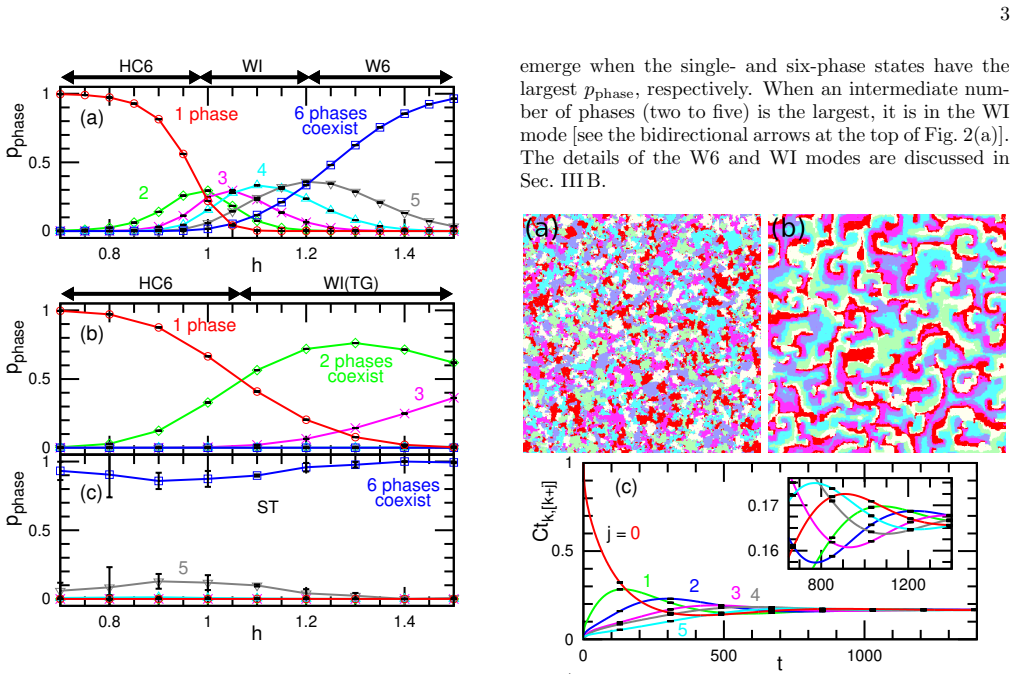
Disordered (DS) and Spiral (SP) Waves In the W6 mode, DS and SP waves are formed by the contact interactions of the standard Potts model (Jnf = 0) and repulsive interactions for nonflip contacts (Jnf ≃ −2), respectively. In the DS waves, the domains do not have a spiral shape, since the boundaries of nonflip contacts (s=kand [k+2] or [k+3]) do not move ba...
-
[2]
When SP waves or randomly mixed states are used as initial states, ST waves are formed [see Movie S3 and the right snapshots in Figs
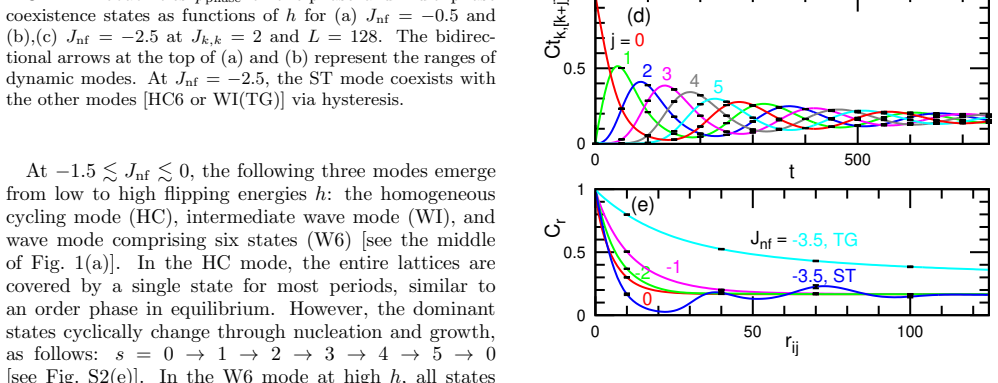
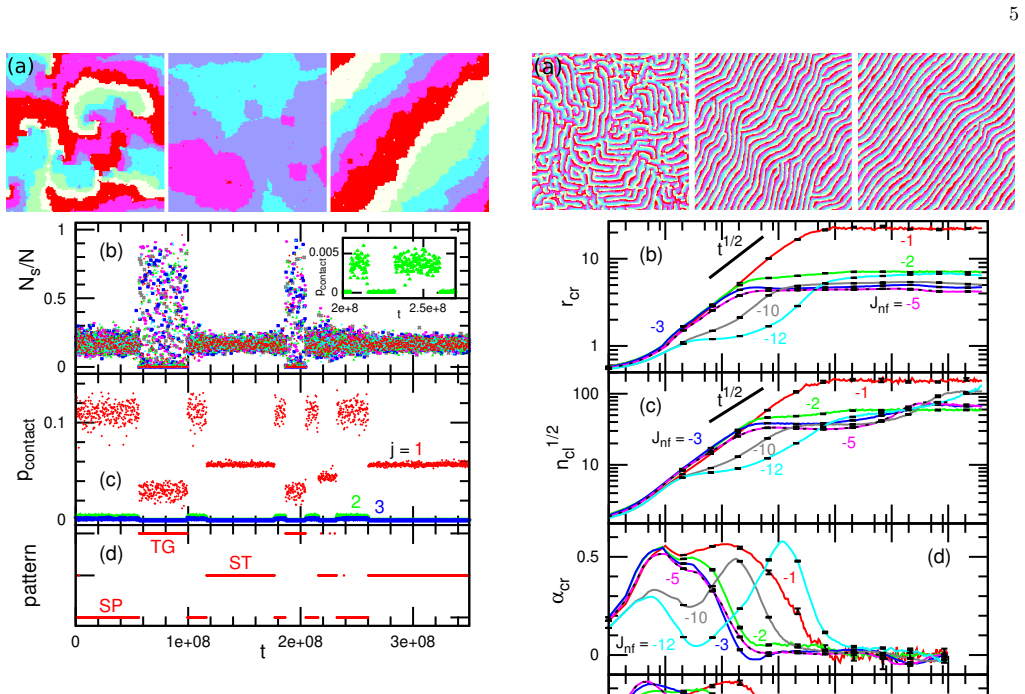
Target (TG) and Stripe (ST) Waves Under very strong repulsion at the nonflip contacts (Jnf ≲−3) forh= 1.5, the SP waves are suppressed, since nonflip contacts occur at the centers of spiral shapes. When SP waves or randomly mixed states are used as initial states, ST waves are formed [see Movie S3 and the right snapshots in Figs. 5(a) and 6(a)]. In con- t...
2048
-
[3]
Ac- cordingly, forh= 0, both the correlation lengthr cr and cluster lengthn cl1/2 (the root of the cluster size) are pro- portional tot 1/2 (see the red lines in Fig
Coarsening Dynamics In the Potts models, coarsening into an equilibrium state follows the LAC law (ℓ∝t 1/2) [29, 33, 67]. Ac- cordingly, forh= 0, both the correlation lengthr cr and cluster lengthn cl1/2 (the root of the cluster size) are pro- portional tot 1/2 (see the red lines in Fig. S6). Forh̸= 0, these lengths saturate into the characteristic length...
-
[4]
Transitions from Wave to Mixing Modes As the attractionJ k,k between the same states de- creases atJ nf =−2, the domains become smaller, their boundaries fluctuate more widely, and subsequently, all states are mixed as small clusters (M6) [see Fig. 7(a)]. Since nonflip contacts are still avoided, the TG waves are formed in an intermediate range ofJk,k [se...
2048
-
[5]
Nicolis and I
G. Nicolis and I. Prigogine,Self-organization in nonequi- librium systems : From dissipative structures to order through fluctuations(Wiley, New York, 1977)
1977
-
[6]
Haken,Synergetics : Introduction and advanced topics (Springer, Berlin, 2004)
H. Haken,Synergetics : Introduction and advanced topics (Springer, Berlin, 2004)
2004
-
[7]
Mikhailov,Foundations of synergetics I: Distributed active systems, 2nd ed
A. Mikhailov,Foundations of synergetics I: Distributed active systems, 2nd ed. (Springer, Berlin, 1994)
1994
-
[8]
Kuramoto,Chemical oscillations, waves, and turbu- lence(Springer, Berlin, 1984)
Y. Kuramoto,Chemical oscillations, waves, and turbu- lence(Springer, Berlin, 1984)
1984
-
[9]
J. D. Murray,Mathematical biology II: Spatial models and biomedical applications, 3rd ed. (Springer, New York, 2003)
2003
-
[10]
Beta and K
C. Beta and K. Kruse, Annu. Rev. Condens. Matter Phys.8, 239 (2017)
2017
-
[11]
Bailles, E
A. Bailles, E. W. Gehrels, and T. Lecuit, Annu. Rev. Cell Dev. Biol.38, 321 (2022)
2022
-
[12]
E. M. Cherry and F. H. Fenton, New J. Phys.10, 125016 (2008)
2008
-
[13]
P. N. Devreotes, S. Bhattacharya, M. Edwards, P. A. Iglesias, T. Lampert, and Y. Miao, Annu. Rev. Cell Dev. Biol.33, 103 (2017)
2017
-
[14]
V. E. Deneke and S. D. Talia, J. Cell Biol.217, 1193 (2018)
2018
-
[15]
Noguchi, ChemSystemsChem7, e202400042 (2025)
H. Noguchi, ChemSystemsChem7, e202400042 (2025)
2025
-
[16]
Szolnoki, M
A. Szolnoki, M. Mobilia, L.-L. Jiang, B. Szczesny, A. M. Rucklidge, and M. Perc, J. R. Soc. Interface11, 20140735 (2014)
2014
-
[17]
Reichenbach, M
T. Reichenbach, M. Mobilia, and E. Frey, Nature448, 1046 (2007)
2007
-
[18]
Szczesny, M
B. Szczesny, M. Mobilia, and A. M. Rucklidge, EPL102, 28012 (2013)
2013
-
[19]
E. D. Kelsic, J. Zhao, K. Vetsigian, and R. Kishony, Nature521, 516 (2015)
2015
-
[20]
Dobramysl, M
U. Dobramysl, M. Mobilia, M. Pleimling, and U. C. T¨ auber, J. Phys. A: Math. Theor.51, 063001 (2018)
2018
-
[21]
Szab´ o, A
G. Szab´ o, A. Szolnoki, and I. Borsos, Phys. Rev. E77, 041919 (2008)
2008
-
[22]
Bazeia, B
D. Bazeia, B. F. de Oliveira, and A. Szolnoki, Phys. Rev. E99, 052408 (2019)
2019
-
[23]
Menezes, S
J. Menezes, S. Rodrigues, and S. Batista, Ecol. Complex. 52, 101028 (2022)
2022
-
[24]
R. K. Yang and J. Park, Chaos Soliton. Fract.175, 113949 (2023)
2023
-
[25]
Szolnoki and X
A. Szolnoki and X. Chen, Sci. Rep.13, 8472 (2023)
2023
-
[26]
Cliff, Chaos Soliton
D. Cliff, Chaos Soliton. Fract.190, 115702 (2025)
2025
-
[27]
Noguchi, F
H. Noguchi, F. van Wijland, and J.-B. Fournier, J. Chem. Phys.161, 025101 (2024)
2024
-
[28]
Noguchi and J.-B
H. Noguchi and J.-B. Fournier, New J. Phys.26, 093043 (2024)
2024
-
[29]
Noguchi, Sci
H. Noguchi, Sci. Rep.15, 674 (2025)
2025
-
[30]
Noguchi, Soft Matter21, 1113 (2025)
H. Noguchi, Soft Matter21, 1113 (2025)
2025
-
[31]
Noguchi, Phys
H. Noguchi, Phys. Rev. Res.7, 033243 (2025)
2025
-
[32]
Noguchi, Phys
H. Noguchi, Phys. Rev. E113, 034210 (2026)
2026
- [33]
-
[34]
I. M. Lifshitz and V. V. Slyozov, J. Phys. Chem. Solids 19, 35 (1961)
1961
-
[35]
Puri and V
S. Puri and V. Wadhawan, eds.,Kinetics of phase tran- sitions(CRC Press, Boca Raton, 1982)
1982
-
[36]
Furukawa, Adv
H. Furukawa, Adv. Phys.34, 703 (1985)
1985
-
[37]
A. J. Bray, Adv. Phys.43, 357 (1994)
1994
-
[38]
Tanaka, J
H. Tanaka, J. Phys.: Condens. Matter12, R207 (2000)
2000
-
[39]
Tanaka and T
H. Tanaka and T. Araki, Phys. Rev. Lett.78, 4966 (1997)
1997
-
[40]
Tateno and H
M. Tateno and H. Tanaka, Nat. Commun.12, 912 (2021)
2021
-
[41]
Yuan and H
J. Yuan and H. Tanaka, Nat. Commun.16, 1517 (2025)
2025
-
[42]
Mishra, S
S. Mishra, S. Puri, and S. Ramaswamy, Philos. Trans. R. Soc. A372, 20130364 (2014)
2014
-
[43]
S. Saha, J. Agudo-Canalejo, and R. Golestanian, Phys. Rev. X10, 041009 (2020)
2020
-
[44]
Katyal, S
N. Katyal, S. Dey, D. Das, and S. Puri, Eur. Phys. J. E 43, 10 (2020)
2020
-
[45]
Pattanayak, S
S. Pattanayak, S. Mishra, and S. Puri, Phys. Rev. E 104, 014606 (2021)
2021
-
[46]
Lifshitz, Sov
I. Lifshitz, Sov. Phys. JETP15, 939 (1962). 12
1962
-
[47]
S. M. Allen and J. W. Cahn, Acta Metall.27, 1085 (1979)
1979
-
[48]
F. Y. Wu, Rev. Mod. Phys.54, 235 (1982)
1982
-
[49]
R. B. Potts, Proc. Camb. Phil. Soc.48, 106 (1952)
1952
-
[50]
Ertl, Angew
G. Ertl, Angew. Chem. Int. Ed.47, 3524 (2008)
2008
-
[51]
Br¨ ar, N
M. Br¨ ar, N. Gottschalk, M. Eiswirth, and G. Ertl, J. Chem. Phys.100, 1202 (1994)
1994
-
[52]
Gorodetskii, J
V. Gorodetskii, J. Lauterbach, H.-H. Rotermund, J. H. Block, and G. Ertl, Nature370, 276 (1994)
1994
-
[53]
Barroo, Z.-J
C. Barroo, Z.-J. Wang, R. Schlr¨ ogl, and M.-G. Willinger, Nat. Catal.3, 30 (2020)
2020
-
[54]
Zeininger and et al., ACS Catal.12, 11974 (2022)
J. Zeininger and et al., ACS Catal.12, 11974 (2022)
2022
-
[55]
Tabe and H
Y. Tabe and H. Yokoyama, Nat. Mater.2, 806 (2003)
2003
-
[56]
Miele, Z
Y. Miele, Z. Medveczky, G. Holl´ o, B. Tegze, I. Der´ enyi, Z. H´ orv¨ olgyi, E. Altamura, I. Lagzi, and F. Rossi, Chem. Sci.11, 3228 (2020)
2020
-
[57]
Holl´ o, Y
G. Holl´ o, Y. Miele, F. Rossi, and I. Lagzi, Phys. Chem. Chem. Phys.23, 4262 (2021)
2021
-
[58]
K. M. Nakagawa and H. Noguchi, Soft Matter14, 1397 (2018)
2018
-
[59]
Noguchi, Soft Matter19, 679 (2023)
H. Noguchi, Soft Matter19, 679 (2023)
2023
-
[60]
Herpich, J
T. Herpich, J. Thingna, and M. Esposito, Phys. Rev. X 8, 031056 (2018)
2018
-
[61]
Meibohm and M
J. Meibohm and M. Esposito, Phys. Rev. E110, 044114 (2024)
2024
-
[62]
Ptaszy´ nski and M
K. Ptaszy´ nski and M. Esposito, Phys. Rev. Lett.135, 057401 (2025)
2025
-
[63]
Y. Avni, M. Fruchart, D. Martin, D. Seara, and V. Vitelli, Phys. Rev. Lett.134, 117103 (2025)
2025
-
[64]
R. V. Ditzian, J. R. Banavar, G. S. Grest, and L. P. Kadanoff, Phys. Rev. B22, 2542 (1980)
1980
-
[65]
G. S. Grest and M. Widom, Phys. Rev. B24, 6508 (1981)
1981
-
[66]
J. A. Plascak and F. C. S. Barreto, J. Phys. A: Math. Gen.19, 2195 (1986)
1986
-
[67]
Benayad, A
N. Benayad, A. Benyoussef, N. Boccara, and A. E. Kenz, J. Phys. C: Solid State Phys.21, 5747 (1988)
1988
-
[68]
Takahashi and A
J. Takahashi and A. W. Sandvik, Phys. Rev. Res.2, 033459 (2020)
2020
-
[69]
Z. Qu, Am. J. Physiol. Heart Circ. Physiol.290, H255 (2006)
2006
-
[70]
Sugimura and H
K. Sugimura and H. Kori, Phys. Rev. E92, 062915 (2015)
2015
-
[71]
G. S. Grest, M. P. Anderson, and D. J. Srolovitz, Phys. Rev. B38, 4752 (1988)
1988
-
[72]
D. A. Huse, Phys. Rev. B34, 7845 (1986)
1986
-
[73]
Binder, Rep
K. Binder, Rep. Prog. Phys.50, 783 (987)
-
[74]
Binder and D
K. Binder and D. P. Landau, Phys. Rev. B30, 1477 (1984)
1984
-
[75]
Olejarz, P
J. Olejarz, P. L. Krapivsky, and S. Redner, J. Stat. Mech. 2013, P06018 (2013)
2013
-
[76]
Denholm, Phys
J. Denholm, Phys. Rev. E103, 012119 (2021)
2021
discussion (0)
Sign in with ORCID, Apple, or X to comment. Anyone can read and Pith papers without signing in.