Quiescent fractions in high-redshift galaxy groups reflect their hot-or-cold state of gas accretion
Pith reviewed 2026-05-08 11:00 UTC · model grok-4.3
The pith
Quiescent fractions reach about 50 percent in high-redshift galaxy groups accreting gas in the hot mode and near zero in the cold mode.
A machine-rendered reading of the paper's core claim, the machinery that carries it, and where it could break.
Core claim
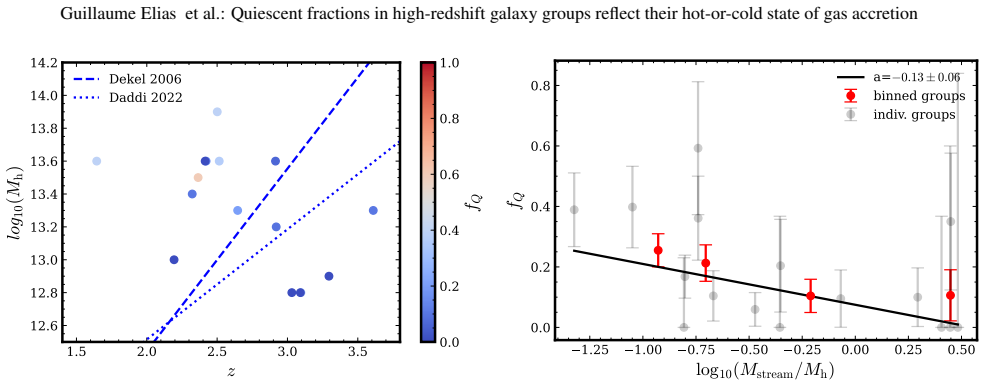
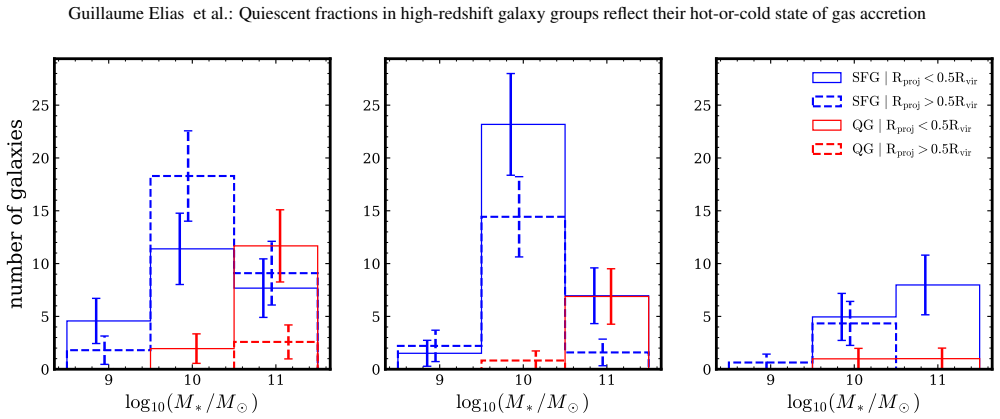
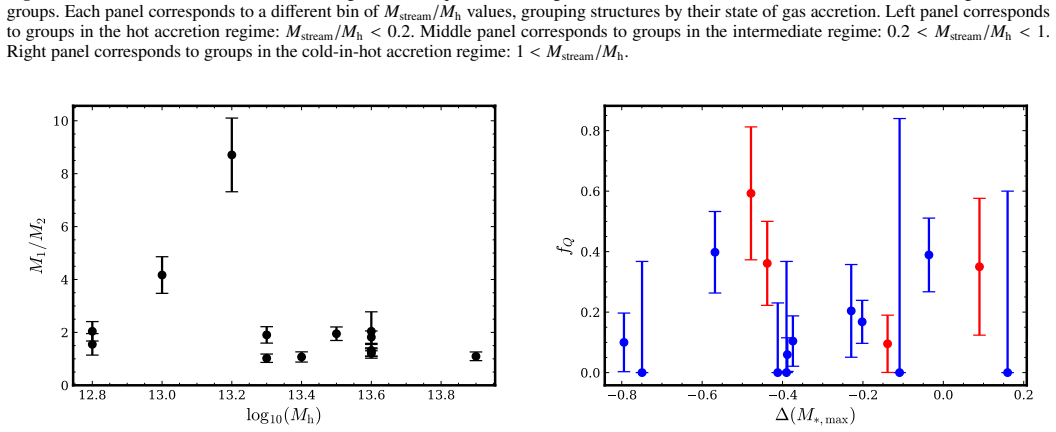
Quiescent fractions reach about 50 percent in groups in the hot-accretion regime and are consistent with zero in groups in the cold-accretion regime. In mature hot-accreting groups, massive quiescent galaxies are preferentially found in the inner regions with a 4.4-sigma excess relative to the outskirts. Most groups lack a clearly established brightest group galaxy and instead show small stellar-mass gaps, typically M*,1/M*,2 < 3, indicating that they remain in an active assembly phase rather than being dynamically evolved systems. The stellar-mass excess of the dominant galaxy relative to the SHMR expectation does not predict the group quiescent fraction.
What carries the argument
The classification of each halo's accretion regime as hot or cold from its mass and redshift, used to predict and compare against the observed fraction of quiescent galaxies identified via SED fitting and membership probabilities.
If this is right
- The cold-to-hot transition in gas accretion contributes to the onset of quiescence.
- Quenching occurs through inside-out starvation associated with filament disruption in shock-heated intra-group gas.
- Environment plays a greater role than internal processes in shaping the quiescent galaxy population in these structures.
- Most groups remain in an active assembly phase without a settled brightest group galaxy.
Where Pith is reading between the lines
- Galaxy evolution models should treat the thermal state of accreting gas as a primary control on quenching in group environments at these redshifts.
- Targeted X-ray or kinematic observations of the same groups could directly confirm the hot or cold state and strengthen the causal link to quiescence.
- The pattern may extend to lower redshifts, where the same accretion-mode transition could explain the continued build-up of the red sequence in denser environments.
Load-bearing premise
The assignment of each group to the hot or cold accretion regime based on halo mass and redshift, together with the accuracy of SED-based quiescent classification and membership probabilities for the 16 groups.
What would settle it
Finding quiescent fractions significantly above zero in cold-accretion regime groups or near zero in hot-accretion regime groups at comparable redshifts and masses would falsify the reported correlation.
Figures




read the original abstract
Cold accretion and quenching are closely related aspects of galaxy evolution, as sustained gas supply is required to maintain star formation. High-redshift galaxy groups therefore provide a valuable laboratory for testing how the thermal state of accreting gas relates to the emergence of quiescence. We measure quiescent fractions in a sample of 16 spectroscopically confirmed galaxy groups at $1.6<z<3.6$, spanning halo masses from $10^{12.8},{\rm M_\odot}$ to $10^{13.9},{\rm M_\odot}$, by fitting the SEDs of candidate member galaxies selected from the COSMOS2020 catalog and using a membership-probability approach to estimate group quiescent fractions. We compare these quiescent fractions to the expected cold or hot accretion state of each halo and find evidence for a correlation: quiescent fractions reach about 50 percent in groups in the hot-accretion regime and are consistent with zero in groups in the cold-accretion regime. In mature hot-accreting groups, massive quiescent galaxies are preferentially found in the inner regions ($R<0.5R_{\rm vir}$), with a 4.4-sigma excess relative to the outskirts. Most groups lack a clearly established brightest group galaxy and instead show small stellar-mass gaps, typically $M_{*,1}/M_{*,2}<3$, indicating that they remain in an active assembly phase rather than being dynamically evolved systems. Consistently, the stellar-mass excess of the dominant galaxy, measured relative to the SHMR expectation, does not predict the group quiescent fraction. Taken together, our results support a picture in which the cold-to-hot transition in gas accretion contributes to the onset of quiescence, possibly through inside-out starvation associated with filament disruption in shock-heated intra-group gas, and suggest that environment plays a greater role than internal processes in shaping the quiescent galaxy population in these structures.
Editorial analysis
A structured set of objections, weighed in public.
Referee Report
Summary. The manuscript measures quiescent fractions in 16 spectroscopically confirmed galaxy groups at 1.6<z<3.6 (halo masses 10^{12.8} to 10^{13.9} M_⊙) via SED fitting of COSMOS2020 candidates and a membership-probability estimator. It reports a correlation with accretion regime: quiescent fractions reach ~50% in hot-accretion groups and are consistent with zero in cold-accretion groups. It additionally finds a 4.4σ excess of massive quiescent galaxies within R<0.5 R_vir in hot groups, small stellar-mass gaps (M_{*,1}/M_{*,2}<3) indicating ongoing assembly, and no predictive power from the dominant galaxy's stellar-mass excess relative to the SHMR.
Significance. If the correlation survives error propagation and boundary tests, the result would strengthen the observational case that the cold-to-hot accretion transition contributes to quenching at high redshift, with environment (filament disruption and inside-out starvation) outweighing internal processes. The spectroscopic confirmation, membership-probability approach, and inner-region excess analysis are concrete strengths that could inform semi-analytic models and hydrodynamical simulations of group-scale quenching.
major comments (3)
- [Abstract] Abstract: the headline claim that quiescent fractions reach ~50% in hot-accretion groups versus consistent with zero in cold-accretion groups is presented without error bars on the fractions, without the explicit functional form or literature reference for the hot/cold transition line, and without any Monte-Carlo propagation of the 0.3–0.5 dex halo-mass uncertainties that are standard for abundance-matching and group-finding at these redshifts.
- [Results / group classification] The section describing the group-to-regime assignment: with only 16 systems, the reported contrast is sensitive to reclassification of even 3–4 groups. No test of alternative transition prescriptions (e.g., different shock-heating thresholds from the literature) or of the effect of mass errors on the quiescent-fraction difference is reported, leaving the central correlation vulnerable to systematic shifts in the boundary.
- [Results / spatial distribution] The paragraph reporting the 4.4σ inner excess: it is unclear whether the significance accounts for membership probabilities, whether the radial bins are chosen post-hoc, or how SED-fitting choices (e.g., dust-law or SFH priors) propagate into the quiescent classification used for the excess statistic.
minor comments (2)
- [Abstract] The halo-mass range is written as 10^{12.8},M_⊙ to 10^{13.9},M_⊙; consistent solar-mass notation and spacing should be used throughout the text and figures.
- [Results / assembly phase] The statement that 'most groups lack a clearly established brightest group galaxy' would benefit from a quantitative definition of 'clearly established' (e.g., a specific mass-gap threshold) rather than the qualitative M_{*,1}/M_{*,2}<3 criterion alone.
Simulated Author's Rebuttal
We thank the referee for their constructive report and positive assessment of the work's potential impact. We address each major comment below with targeted revisions that strengthen the presentation of uncertainties, robustness, and methodology while preserving the core results. All changes are documented in the revised manuscript.
read point-by-point responses
-
Referee: [Abstract] Abstract: the headline claim that quiescent fractions reach ~50% in hot-accretion groups versus consistent with zero in cold-accretion groups is presented without error bars on the fractions, without the explicit functional form or literature reference for the hot/cold transition line, and without any Monte-Carlo propagation of the 0.3–0.5 dex halo-mass uncertainties that are standard for abundance-matching and group-finding at these redshifts.
Authors: We agree that the abstract should be more precise. We have added binomial error bars to the reported quiescent fractions (~50% and ~0%). The hot/cold transition follows the standard shock-heating threshold of Dekel et al. (2009), M_halo ~ 10^{12.5} (1+z)^{-1.5} M_⊙; we now state this functional form explicitly and cite the reference. For halo-mass uncertainties, we performed a Monte Carlo test drawing 1000 realizations of each group's mass within the quoted 0.3–0.5 dex scatter and re-computing the quiescent-fraction contrast; the separation between regimes remains >3.5σ in >90% of realizations. These results and the updated abstract are included in the revision. revision: yes
-
Referee: [Results / group classification] The section describing the group-to-regime assignment: with only 16 systems, the reported contrast is sensitive to reclassification of even 3–4 groups. No test of alternative transition prescriptions (e.g., different shock-heating thresholds from the literature) or of the effect of mass errors on the quiescent-fraction difference is reported, leaving the central correlation vulnerable to systematic shifts in the boundary.
Authors: We acknowledge the small-sample caveat. We have added two new tests: (1) variation of the transition mass by ±0.2 dex around the Dekel et al. (2009) value, which preserves a >3σ difference in quiescent fractions; (2) a bootstrap resampling that simultaneously perturbs halo masses within their uncertainties and re-assigns regimes, yielding a median quiescent-fraction contrast of 0.48 ± 0.15. Both tests are now reported in a new subsection of the results and confirm the correlation is not driven by boundary choices. revision: yes
-
Referee: [Results / spatial distribution] The paragraph reporting the 4.4σ inner excess: it is unclear whether the significance accounts for membership probabilities, whether the radial bins are chosen post-hoc, or how SED-fitting choices (e.g., dust-law or SFH priors) propagate into the quiescent classification used for the excess statistic.
Authors: The 4.4σ value was obtained via a weighted bootstrap that explicitly uses membership probabilities as weights for each galaxy. The R < 0.5 R_vir boundary was selected a priori from the expected scale of filament disruption in hot halos, not optimized post-hoc. We have added a robustness subsection testing two alternative dust laws (Calzetti vs. SMC) and two SFH priors (delayed-τ vs. double power-law); the inner excess remains >4σ in all cases. These clarifications and the new tests are now included in the methods and results. revision: yes
Circularity Check
No significant circularity: observational comparison of independently measured quiescent fractions to literature-based accretion regimes
full rationale
The paper's central result is an empirical correlation obtained by measuring quiescent fractions via SED fitting and membership probabilities on COSMOS2020 galaxies, then comparing those fractions to accretion regimes assigned from each group's halo mass and redshift against an external theoretical transition line. No equation or step defines a quantity in terms of itself, renames a fitted parameter as a prediction, or loads the conclusion on a self-citation chain; the assignment of regimes and the quiescent classification are independent inputs. The derivation chain therefore remains self-contained against external benchmarks and does not reduce to its own inputs by construction.
Axiom & Free-Parameter Ledger
free parameters (1)
- halo mass thresholds separating hot and cold accretion
axioms (2)
- standard math Lambda-CDM cosmology for converting redshifts to halo masses and virial radii
- domain assumption SED fitting reliably separates quiescent from star-forming galaxies at 1.6<z<3.6
Reference graph
Works this paper leans on
- [1]
-
[2]
2025, MNRAS, 539, 3568 Aragon Calvo, M
Almaini, O., Wild, V ., Maltby, D., et al. 2025, MNRAS, 539, 3568 Aragon Calvo, M. A., Neyrinck, M. C., & Silk, J. 2019, The Open Journal of Astrophysics, 2, 7
work page 2025
-
[3]
C., Ilbert, O., Ciesla, L., et al
Arango-Toro, R. C., Ilbert, O., Ciesla, L., et al. 2025, A&A, 696, A159
work page 2025
- [4]
-
[5]
M., Lim, S., D’Eugenio, F., et al
Baker, W. M., Lim, S., D’Eugenio, F., et al. 2025, MNRAS, 539, 557
work page 2025
-
[6]
Baldry, I. K., Balogh, M. L., Bower, R. G., et al. 2006, MNRAS, 373, 469
work page 2006
-
[7]
K., Glazebrook, K., Brinkmann, J., et al
Baldry, I. K., Glazebrook, K., Brinkmann, J., et al. 2004, ApJ, 600, 681
work page 2004
-
[8]
Balogh, M. L., Morris, S. L., Yee, H. K. C., Carlberg, R. G., & Ellingson, E. 1999, ApJ, 527, 54
work page 1999
-
[9]
Behroozi, P., Wechsler, R. H., Hearin, A. P., & Conroy, C. 2019, MNRAS, 488, 3143
work page 2019
- [10]
-
[11]
Bond, J. R., Kofman, L., & Pogosyan, D. 1996, Nature, 380, 603
work page 1996
- [12]
- [13]
- [14]
- [15]
-
[16]
Cantalupo, S., Arrigoni-Battaia, F., Prochaska, J. X., Hennawi, J. F., & Madau, P. 2014, Nature, 506, 63
work page 2014
-
[17]
A., Gebhardt, K., & Henriques, B
Chiang, Y .-K., Overzier, R. A., Gebhardt, K., & Henriques, B. 2017, ApJ, 844, L23
work page 2017
- [18]
-
[19]
Coogan, R. T., Daddi, E., Sargent, M. T., et al. 2018, MNRAS, 479, 703
work page 2018
-
[20]
D., Boulanger, F., & Guillard, P
Cornuault, N., Lehnert, M. D., Boulanger, F., & Guillard, P. 2018, A&A, 610, A75
work page 2018
-
[21]
Croton, D. J., Springel, V ., White, S. D. M., et al. 2006, MNRAS, 365, 11
work page 2006
-
[22]
Daddi, E., Dickinson, M., Morrison, G., et al. 2007, ApJ, 670, 156
work page 2007
- [23]
- [24]
-
[25]
Danovich, M., Dekel, A., Hahn, O., Ceverino, D., & Primack, J. 2015, MNRAS, 449, 2087
work page 2015
-
[26]
A., Raychaudhury, S., Ponman, T
Dariush, A. A., Raychaudhury, S., Ponman, T. J., et al. 2010, MNRAS, 405, 1873
work page 2010
-
[27]
Darvish, B., Mobasher, B., Sobral, D., et al. 2016, ApJ, 825, 113
work page 2016
- [28]
-
[29]
Davies, L. J. M., Robotham, A. S. G., Driver, S. P., et al. 2016, MNRAS, 455, 4013 de Lapparent, V ., Geller, M. J., & Huchra, J. P. 1986, ApJ, 302, L1
work page 2016
- [30]
- [31]
-
[32]
Donnari, M., Pillepich, A., Nelson, D., et al. 2021, MNRAS, 506, 4760
work page 2021
-
[33]
Donnari, M., Pillepich, A., Nelson, D., et al. 2019, MNRAS, 485, 4817
work page 2019
- [34]
-
[35]
Dubois, Y ., Beckmann, R., Bournaud, F., et al. 2021, A&A, 651, A109
work page 2021
-
[36]
Eckert, D., Gastaldello, F., O’Sullivan, E., et al. 2024, Galaxies, 12, 24
work page 2024
- [37]
- [38]
- [39]
-
[40]
Esposito, M., Borgani, S., Strazzullo, V ., et al. 2025, A&A, 697, A142
work page 2025
- [41]
-
[42]
Feigelson, E. D. & Babu, G. J. 2012, Modern Statistical Methods for Astronomy
work page 2012
- [43]
- [44]
-
[45]
Guetzoyan, P., Aird, J., Georgakakis, A., et al. 2025, MNRAS, 536, 79
work page 2025
-
[46]
2025, arXiv e-prints, arXiv:2510.01421
Guo, S., Daddi, E., Gobat, R., et al. 2025, arXiv e-prints, arXiv:2510.01421
-
[47]
Harrison, C. M. 2017, Nature Astronomy, 1, 0165
work page 2017
- [48]
- [49]
- [50]
- [51]
-
[52]
S., Daddi, E., Bournaud, F., et al
Kalita, B. S., Daddi, E., Bournaud, F., et al. 2022, A&A, 666, A44
work page 2022
-
[53]
Khostovan, A. A., Kartaltepe, J. S., Salvato, M., et al. 2026, ApJS, 282, 6
work page 2026
-
[54]
Kraljic, K., Pichon, C., Codis, S., et al. 2020, MNRAS, 491, 4294
work page 2020
-
[55]
Kriek, M., van Dokkum, P. G., Labbé, I., et al. 2009, ApJ, 700, 221
work page 2009
- [56]
-
[57]
2018, MNRAS, 474, 5437 Le Bail, A., Daddi, E., Elbaz, D., et al
Laigle, C., Pichon, C., Arnouts, S., et al. 2018, MNRAS, 474, 5437 Le Bail, A., Daddi, E., Elbaz, D., et al. 2024, A&A, 688, A53
work page 2018
-
[58]
2025, Nature Astronomy, 9, 128
Lu, S., Daddi, E., Maraston, C., et al. 2025, Nature Astronomy, 9, 128
work page 2025
- [59]
-
[60]
Mandelker, N., Nagai, D., Aung, H., et al. 2020, MNRAS, 494, 2641
work page 2020
- [61]
-
[62]
C., Matuszewski, M., Morrissey, P., et al
Martin, D. C., Matuszewski, M., Morrissey, P., et al. 2015, Nature, 524, 192
work page 2015
-
[63]
McConachie, I., Wilson, G., Forrest, B., et al. 2022, ApJ, 926, 37
work page 2022
-
[64]
McDonald, M., Allen, S. W., Bayliss, M., et al. 2017, ApJ, 843, 28
work page 2017
-
[65]
McDonald, M., Gaspari, M., McNamara, B. R., & Tremblay, G. R. 2018, ApJ, 858, 45
work page 2018
- [66]
-
[67]
Medlock, I., Nagai, D., Mandelker, N., et al. 2025, arXiv e-prints, arXiv:2511.21814
-
[68]
Merloni, A., Bongiorno, A., Bolzonella, M., et al. 2010, ApJ, 708, 137
work page 2010
-
[69]
2025, arXiv e-prints, arXiv:2511.05925
Mondelin, M., Codis, S., Cuillandre, J.-C., et al. 2025, arXiv e-prints, arXiv:2511.05925
-
[70]
R., Daddi, E., Béthermin, M., et al
Mullaney, J. R., Daddi, E., Béthermin, M., et al. 2012, ApJ, 753, L30
work page 2012
-
[71]
Muzzin, A., Marchesini, D., Stefanon, M., et al. 2013, ApJ, 777, 18
work page 2013
- [72]
-
[73]
P., Rasmussen, J., Toft, S., & Zirm, A
Olsen, K. P., Rasmussen, J., Toft, S., & Zirm, A. W. 2013, ApJ, 764, 4
work page 2013
- [74]
-
[75]
Overzier, R. A. 2016, A&A Rev., 24, 14
work page 2016
-
[76]
Pacifici, C., da Cunha, E., Charlot, S., et al. 2015, MNRAS, 447, 786
work page 2015
-
[77]
Pacifici, C., Iyer, K. G., Mobasher, B., et al. 2023, ApJ, 944, 141
work page 2023
-
[78]
Pan, R., Suess, K. A., Marchesini, D., et al. 2025, ApJ, 990, L24
work page 2025
-
[79]
J., Pistis, F., Figueira, M., et al
Pearson, W. J., Pistis, F., Figueira, M., et al. 2023, A&A, 679, A35
work page 2023
-
[80]
Peng, Y .-j., Lilly, S. J., Kovaˇc, K., et al. 2010, ApJ, 721, 193 Planck Collaboration, Aghanim, N., Akrami, Y ., et al. 2020, A&A, 641, A6
work page 2010
discussion (0)
Sign in with ORCID, Apple, or X to comment. Anyone can read and Pith papers without signing in.