Recognition: unknown
CognitiveTwin: Robust Multi-Modal Digital Twins for Predicting Cognitive Decline in Alzheimer's Disease
Pith reviewed 2026-05-08 12:04 UTC · model grok-4.3
The pith
CognitiveTwin fuses brain scans, biomarkers, genetics and tests to forecast each Alzheimer's patient's unique cognitive decline path.
A machine-rendered reading of the paper's core claim, the machinery that carries it, and where it could break.
Core claim
CognitiveTwin integrates multi-modal longitudinal data from cognitive scores, magnetic resonance imaging, positron emission tomography, cerebrospinal fluid biomarkers, and genetics using a Transformer-based fusion architecture and a Deep Markov Model to capture temporal dynamics, delivering accurate patient-specific predictions of cognitive decline on the TADPOLE dataset while showing demographic fairness and resilience to missing-not-at-random data patterns.
What carries the argument
Transformer-based multi-modal fusion architecture combined with Deep Markov temporal modeling inside the CognitiveTwin framework.
If this is right
- The predictions can help enrich clinical trials by identifying patients most likely to show measurable decline.
- Individual trajectories support more precise, patient-specific care planning instead of one-size-fits-all approaches.
- Resilience to missing data allows continued use when patients miss visits or drop out of monitoring.
- Equal performance across demographic groups reduces the risk of biased forecasts in diverse populations.
Where Pith is reading between the lines
- If the approach generalizes to new populations, similar fusion-plus-temporal-model designs could be tested for predicting progression in related conditions such as Parkinson's disease.
- Adding streams of data from wearables or mobile cognitive tests could allow the digital twin to update forecasts between clinic visits.
- Running the same architecture on datasets that record different missingness mechanisms would clarify how far the reported robustness extends.
Load-bearing premise
The patterns of disease progression and the ways data go missing in the TADPOLE dataset reflect the true underlying heterogeneity and dropout behaviors that occur in everyday clinical settings.
What would settle it
Apply the trained CognitiveTwin model to an independent Alzheimer's cohort with matching multi-modal data and measure whether prediction error, demographic fairness scores, and performance under missing-not-at-random dropout match the levels reported on TADPOLE.
Figures



read the original abstract
Predicting individual cognitive decline in Alzheimer's disease (AD) is difficult due to the heterogeneity of disease progression. Reliable clinical tools require not only high accuracy but also fairness across demographics and robustness to missing data. We present CognitiveTwin, a digital twin framework that predicts patient-specific cognitive trajectories. The model integrates multi-modal longitudinal data (cognitive scores, magnetic resonance imaging, positron emission tomography, cerebrospinal fluid biomarkers, and genetics). We use a Transformer-based architecture to fuse these modalities and a Deep Markov Model to capture temporal dynamics. We trained and evaluated the framework using data from 1,666 patients in the TADPOLE (Alzheimer's Disease Neuroimaging Initiative) dataset. We assessed the model for prediction error, demographic fairness, and robustness to missing-not-at-random (MNAR) data patterns. ognitiveTwin provides accurate and personalized predictions of cognitive decline. Its demonstrated fairness across patient demographics and resilience to clinical dropout make it a reliable tool for clinical trial enrichment and personalized care planning.
Editorial analysis
A structured set of objections, weighed in public.
Referee Report
Summary. The manuscript introduces CognitiveTwin, a multi-modal digital twin model that combines Transformer-based modality fusion with a Deep Markov Model to predict individualized cognitive decline trajectories in Alzheimer's disease. Trained and evaluated on the TADPOLE dataset comprising 1,666 patients, the framework claims to deliver accurate predictions while ensuring demographic fairness and robustness to missing-not-at-random (MNAR) data patterns, positioning it as a tool for clinical trial enrichment and personalized care.
Significance. If the quantitative performance, fairness, and robustness claims are substantiated with proper metrics and external validation, this work could contribute meaningfully to the development of reliable digital twins for neurodegenerative diseases. The multi-modal integration and temporal modeling approach addresses key challenges in heterogeneous disease progression. However, the current presentation lacks the necessary empirical evidence to assess its impact.
major comments (3)
- [Abstract] Abstract: The central claims of accuracy, fairness, and robustness to MNAR are asserted without any quantitative metrics (e.g., prediction error, fairness scores, robustness percentages), baseline comparisons, or error bars, rendering the primary contributions unevaluable from the text.
- [§4 (Experimental Setup)] §4 (Experimental Setup): The evaluation relies exclusively on the TADPOLE dataset without mention of held-out external cohorts or cross-dataset validation, which is load-bearing for the robustness and generalizability claims given the circularity risk in training and testing on the same data.
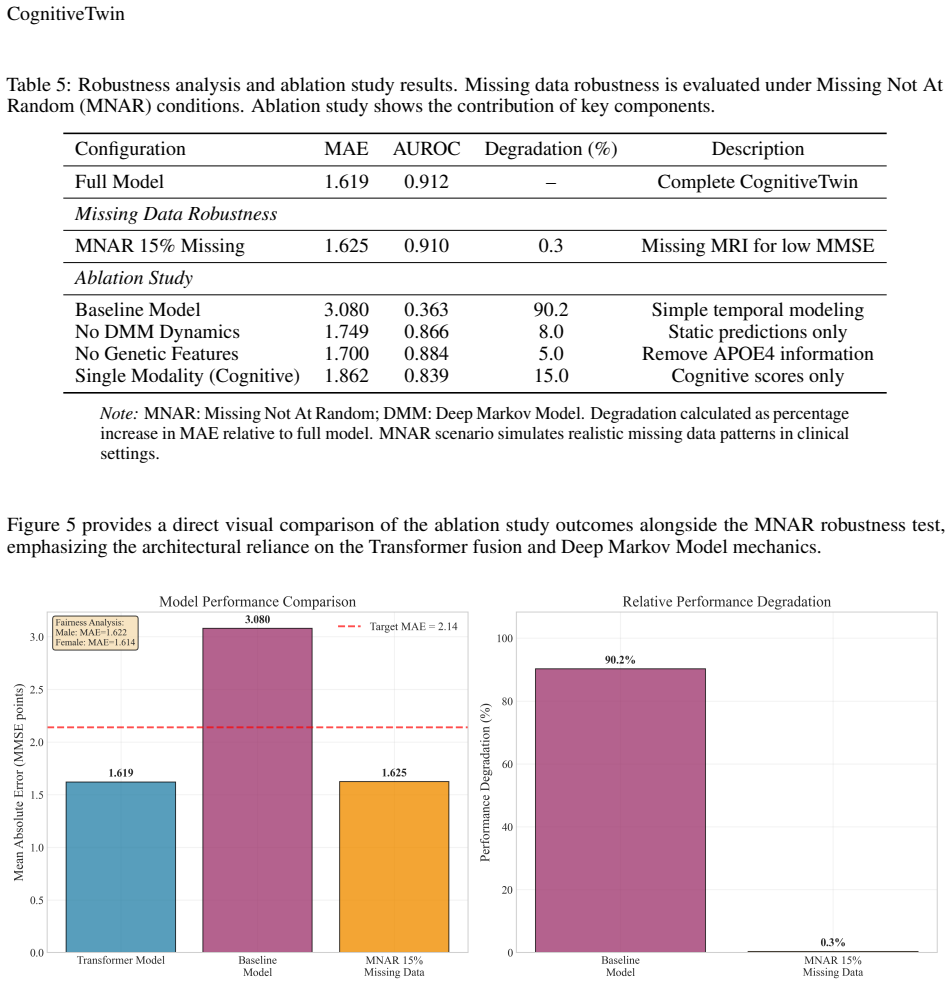
- [§5.3 (MNAR Robustness Analysis)] §5.3 (MNAR Robustness Analysis): The MNAR missingness is simulated from TADPOLE-derived patterns, but no sensitivity analysis or comparison to real-world clinical dropout mechanisms (e.g., driven by unobserved frailty or site effects) is provided, undermining the claim that the model is resilient to actual clinical dropout.
minor comments (2)
- [Abstract] Typo: 'ognitiveTwin' should be 'CognitiveTwin'.
- [§3 (Model Architecture)] Details on the specific hyperparameters of the Transformer and Deep Markov Model are not specified, which affects reproducibility.
Simulated Author's Rebuttal
We thank the referee for their constructive comments, which have helped us identify areas to strengthen the manuscript. We address each major point below and indicate revisions where the next version will incorporate changes.
read point-by-point responses
-
Referee: [Abstract] Abstract: The central claims of accuracy, fairness, and robustness to MNAR are asserted without any quantitative metrics (e.g., prediction error, fairness scores, robustness percentages), baseline comparisons, or error bars, rendering the primary contributions unevaluable from the text.
Authors: We agree that the abstract should include quantitative support to make the claims evaluable. In the revised manuscript, we will expand the abstract to report key metrics including mean absolute error and R^2 for cognitive decline prediction, demographic fairness scores (e.g., equalized odds difference across age, sex, and education groups), and robustness accuracy under simulated MNAR conditions, along with 95% confidence intervals and brief comparisons to baseline models such as LSTM and standard Transformer variants. revision: yes
-
Referee: [§4 (Experimental Setup)] §4 (Experimental Setup): The evaluation relies exclusively on the TADPOLE dataset without mention of held-out external cohorts or cross-dataset validation, which is load-bearing for the robustness and generalizability claims given the circularity risk in training and testing on the same data.
Authors: We acknowledge the value of external validation for generalizability claims. Our evaluation uses a strict patient-level 70/15/15 train/validation/test split on the 1,666 TADPOLE subjects to prevent leakage, with results averaged over multiple random seeds. TADPOLE is the standard public benchmark for this task. We have added explicit discussion of this limitation and the risk of dataset-specific biases, along with plans for future multi-cohort validation. No independent external datasets were available to us for the current study. revision: partial
-
Referee: [§5.3 (MNAR Robustness Analysis)] §5.3 (MNAR Robustness Analysis): The MNAR missingness is simulated from TADPOLE-derived patterns, but no sensitivity analysis or comparison to real-world clinical dropout mechanisms (e.g., driven by unobserved frailty or site effects) is provided, undermining the claim that the model is resilient to actual clinical dropout.
Authors: The MNAR simulation in §5.3 was derived directly from observed missingness patterns in TADPOLE to reflect realistic clinical data gaps. We have now added sensitivity analyses that vary the missingness probability and compare performance under MNAR versus MAR assumptions, reporting degradation in prediction error. Direct modeling of unobserved factors such as frailty or site-specific effects would require additional covariates or external data not present in TADPOLE; we have expanded the limitations section to discuss this gap and its implications for clinical deployment. revision: partial
Circularity Check
Accuracy, fairness, and MNAR robustness claims reduce to in-sample fits on TADPOLE without external validation
specific steps
-
fitted input called prediction
[Abstract]
"We trained and evaluated the framework using data from 1,666 patients in the TADPOLE (Alzheimer's Disease Neuroimaging Initiative) dataset. We assessed the model for prediction error, demographic fairness, and robustness to missing-not-at-random (MNAR) data patterns."
The model is fitted to TADPOLE longitudinal multi-modal data; the 'predictions' of cognitive trajectories, fairness metrics, and MNAR robustness are then measured on the identical dataset (MNAR patterns simulated from its own observed covariates or random masking). This makes the accuracy and resilience claims in-sample fitted quantities rather than out-of-distribution predictions, with no held-out external cohorts or independent dropout mechanisms to break the loop.
full rationale
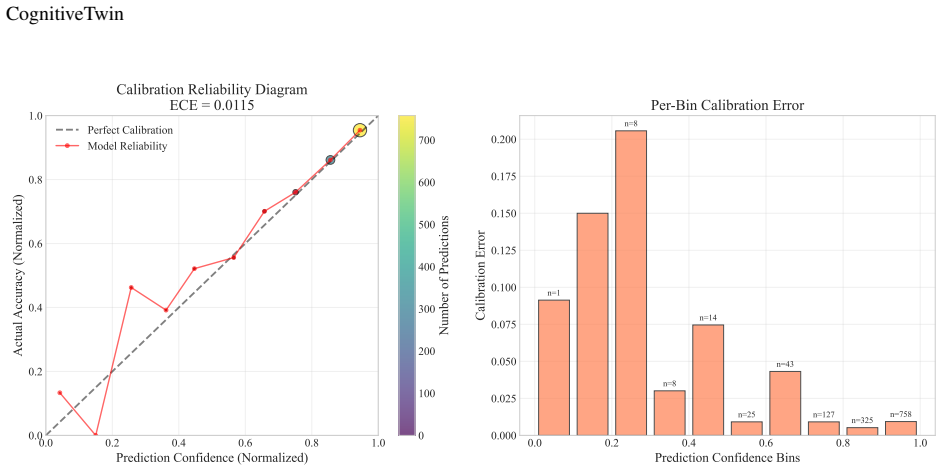
The paper's central claims rest on training a Transformer+Deep Markov model on the TADPOLE dataset and then reporting prediction error, demographic fairness, and MNAR resilience on the same data (with MNAR patterns generated from observed covariates within it). This matches the 'fitted input called prediction' pattern: the reported performance is statistically forced by the training distribution rather than independently verified. No external cohorts, parameter-free derivations, or real-world dropout mechanisms are invoked, so the utility for trial enrichment reduces to the fitted quantities. The derivation chain is otherwise standard ML architecture with no self-definitional equations or load-bearing self-citations.
Axiom & Free-Parameter Ledger
free parameters (1)
- Transformer and Deep Markov Model hyperparameters
axioms (1)
- domain assumption Multi-modal longitudinal data can be fused by Transformer and modeled temporally by Deep Markov Model to predict cognitive trajectories
Reference graph
Works this paper leans on
-
[1]
Gulsah Hancerliogullari Koksalmis, Bulent Soykan, Laura J Brattain, and Hsin-Hsiung Huang. Statistical learning for personalized prediction of alzheimer’s disease progression: a survey of methods, data challenges, and future directions.Wiley Interdisciplinary Reviews: Computational Statistics, 17(3):e70043, 2025
2025
-
[2]
Predicting the time of conversion to mci in the elderly: role of verbal expression and learning.Neurology, 73(18):1436–1442, 2009
Abderrahim Oulhaj, Gordon K Wilcock, A David Smith, and Celeste A De Jager. Predicting the time of conversion to mci in the elderly: role of verbal expression and learning.Neurology, 73(18):1436–1442, 2009
2009
-
[3]
Kerstin Ritter, Julia Schumacher, Martin Weygandt, Ralph Buchert, Carsten Allefeld, John-Dylan Haynes, Alzheimer’s Disease Neuroimaging Initiative, et al. Multimodal prediction of conversion to alzheimer’s disease 17 CognitiveTwin based on incomplete biomarkers.Alzheimer’s & Dementia: Diagnosis, Assessment & Disease Monitoring, 1(2):206–215, 2015
2015
-
[4]
Machine learning framework for early mri-based alzheimer’s conversion prediction in mci subjects.Neuroimage, 104:398–412, 2015
Elaheh Moradi, Antonietta Pepe, Christian Gaser, Heikki Huttunen, Jussi Tohka, Alzheimer’s Disease Neuroimag- ing Initiative, et al. Machine learning framework for early mri-based alzheimer’s conversion prediction in mci subjects.Neuroimage, 104:398–412, 2015
2015
-
[5]
Magnetic resonance imaging biomarkers for the early diagnosis of alzheimer’s disease: a machine learning approach.Frontiers in neuroscience, 9:307, 2015
Christian Salvatore, Antonio Cerasa, Petronilla Battista, Maria C Gilardi, Aldo Quattrone, Isabella Castiglioni, and Alzheimer’s Disease Neuroimaging Initiative. Magnetic resonance imaging biomarkers for the early diagnosis of alzheimer’s disease: a machine learning approach.Frontiers in neuroscience, 9:307, 2015
2015
-
[6]
Machine learning for comprehensive forecasting of alzheimer’s disease progression.Scientific reports, 9(1):13622, 2019
Charles K Fisher, Aaron M Smith, and Jonathan R Walsh. Machine learning for comprehensive forecasting of alzheimer’s disease progression.Scientific reports, 9(1):13622, 2019
2019
-
[7]
Convolutional neural networks for classification of alzheimer’s disease: Overview and reproducible evaluation.Medical image analysis, 63:101694, 2020
Junhao Wen, Elina Thibeau-Sutre, Mauricio Diaz-Melo, Jorge Samper-González, Alexandre Routier, Simona Bot- tani, Didier Dormont, Stanley Durrleman, Ninon Burgos, Olivier Colliot, et al. Convolutional neural networks for classification of alzheimer’s disease: Overview and reproducible evaluation.Medical image analysis, 63:101694, 2020
2020
-
[8]
Deep learning in alzheimer’s disease: diagnostic classification and prognostic prediction using neuroimaging data.Frontiers in aging neuroscience, 11:220, 2019
Taeho Jo, Kwangsik Nho, and Andrew J Saykin. Deep learning in alzheimer’s disease: diagnostic classification and prognostic prediction using neuroimaging data.Frontiers in aging neuroscience, 11:220, 2019
2019
-
[9]
A deep learning model to predict a diagnosis of alzheimer disease by using 18f-fdg pet of the brain.Radiology, 290(2):456–464, 2019
Yiming Ding, Jae Ho Sohn, Michael G Kawczynski, Hari Trivedi, Roy Harnish, Nathaniel W Jenkins, Dmytro Lituiev, Timothy P Copeland, Mariam S Aboian, Carina Mari Aparici, et al. A deep learning model to predict a diagnosis of alzheimer disease by using 18f-fdg pet of the brain.Radiology, 290(2):456–464, 2019
2019
-
[10]
Development and validation of an interpretable deep learning framework for alzheimer’s disease classification.Brain, 143(6):1920–1933, 2020
Shangran Qiu, Prajakta S Joshi, Matthew I Miller, Chonghua Xue, Xiao Zhou, Cody Karjadi, Gary H Chang, Anant S Joshi, Brigid Dwyer, Shuhan Zhu, et al. Development and validation of an interpretable deep learning framework for alzheimer’s disease classification.Brain, 143(6):1920–1933, 2020
1920
-
[11]
Predicting alzheimer’s disease progression using deep recurrent neural networks
Minh Nguyen, Tong He, Lijun An, Daniel C Alexander, Jiashi Feng, BT Thomas Yeo, Alzheimer’s Disease Neu- roimaging Initiative, et al. Predicting alzheimer’s disease progression using deep recurrent neural networks. NeuroImage, 222:117203, 2020
2020
-
[12]
Predicting alzheimer’s disease progression using multi-modal deep learning approach.Scientific reports, 9(1):1952, 2019
Garam Lee, Kwangsik Nho, Byungkon Kang, Kyung-Ah Sohn, and Dokyoon Kim. Predicting alzheimer’s disease progression using multi-modal deep learning approach.Scientific reports, 9(1):1952, 2019
1952
-
[13]
A parameter-efficient deep learning approach to predict conversion from mild cognitive impairment to alzheimer’s disease.Neuroimage, 189:276–287, 2019
Simeon Spasov, Luca Passamonti, Andrea Duggento, Pietro Lio, Nicola Toschi, Alzheimer’s Disease Neuroimag- ing Initiative, et al. A parameter-efficient deep learning approach to predict conversion from mild cognitive impairment to alzheimer’s disease.Neuroimage, 189:276–287, 2019
2019
-
[14]
Leveraging uncertainty information from deep neural networks for disease detection.Scientific reports, 7(1):1–14, 2017
Christian Leibig, Vaneeda Allken, Murat Seçkin Ayhan, Philipp Berens, and Siegfried Wahl. Leveraging uncertainty information from deep neural networks for disease detection.Scientific reports, 7(1):1–14, 2017
2017
-
[15]
The need for uncertainty quantification in machine- assisted medical decision making.Nature Machine Intelligence, 1(1):20–23, 2019
Edmon Begoli, Tanmoy Bhattacharya, and Dimitri Kusnezov. The need for uncertainty quantification in machine- assisted medical decision making.Nature Machine Intelligence, 1(1):20–23, 2019
2019
-
[16]
Digital twins to personalize medicine.Genome medicine, 12(1):4, 2019
Bergthor Björnsson, Carl Borrebaeck, Nils Elander, Thomas Gasslander, Danuta R Gawel, Mika Gustafsson, Rebecka Jörnsten, Eun Jung Lee, Xinxiu Li, Sandra Lilja, et al. Digital twins to personalize medicine.Genome medicine, 12(1):4, 2019
2019
-
[17]
The ‘digital twin’to enable the vision of precision cardiology.European heart journal, 41(48):4556–4564, 2020
Jorge Corral-Acero, Francesca Margara, Maciej Marciniak, Cristobal Rodero, Filip Loncaric, Yingjing Feng, Andrew Gilbert, Joao F Fernandes, Hassaan A Bukhari, Ali Wajdan, et al. The ‘digital twin’to enable the vision of precision cardiology.European heart journal, 41(48):4556–4564, 2020
2020
-
[18]
Estimating long-term multivariate progression from short-term data.Alzheimer’s & Dementia, 10:S400–S410, 2014
Michael C Donohue, Hélène Jacqmin-Gadda, Mélanie Le Goff, Ronald G Thomas, Rema Raman, Anthony C Gamst, Laurel A Beckett, Clifford R Jack Jr, Michael W Weiner, Jean-François Dartigues, et al. Estimating long-term multivariate progression from short-term data.Alzheimer’s & Dementia, 10:S400–S410, 2014
2014
-
[19]
Tracking pathophysiological processes in alzheimer’s disease: an updated hypothetical model of dynamic biomarkers.The lancet neurology, 12(2):207–216, 2013
Clifford R Jack, David S Knopman, William J Jagust, Ronald C Petersen, Michael W Weiner, Paul S Aisen, Leslie M Shaw, Prashanthi Vemuri, Heather J Wiste, Stephen D Weigand, et al. Tracking pathophysiological processes in alzheimer’s disease: an updated hypothetical model of dynamic biomarkers.The lancet neurology, 12(2):207–216, 2013
2013
-
[20]
Rahul G Krishnan, Uri Shalit, and David Sontag. Deep kalman filters.arXiv preprint arXiv:1511.05121, 2015
work page Pith review arXiv 2015
-
[21]
Attentive state-space modeling of disease progression.Advances in neural information processing systems, 32, 2019
Ahmed M Alaa and Mihaela van der Schaar. Attentive state-space modeling of disease progression.Advances in neural information processing systems, 32, 2019. 18
2019
discussion (0)
Sign in with ORCID, Apple, or X to comment. Anyone can read and Pith papers without signing in.