Recognition: unknown
Hybrid weather prediction using spectral nudging toward machine-learning forecasts
Pith reviewed 2026-05-08 08:56 UTC · model grok-4.3
The pith
Spectral nudging of large scales from machine-learning forecasts into a physics-based model improves overall weather prediction skill while keeping small-scale behavior intact.
A machine-rendered reading of the paper's core claim, the machinery that carries it, and where it could break.
Core claim
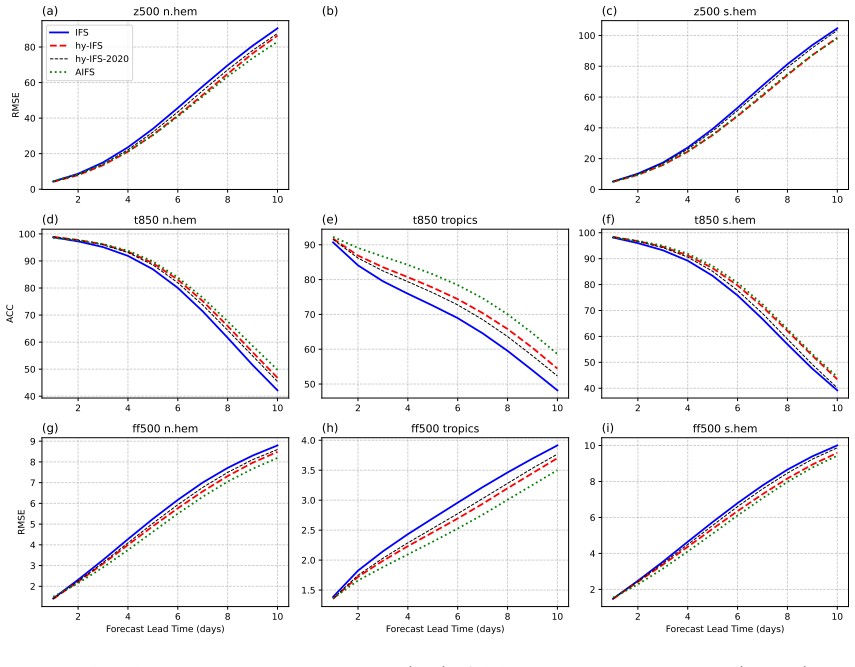
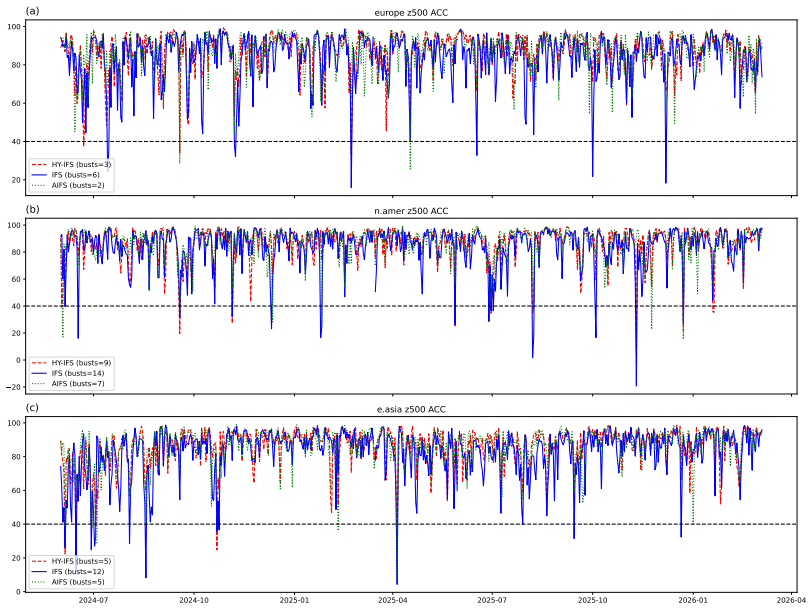
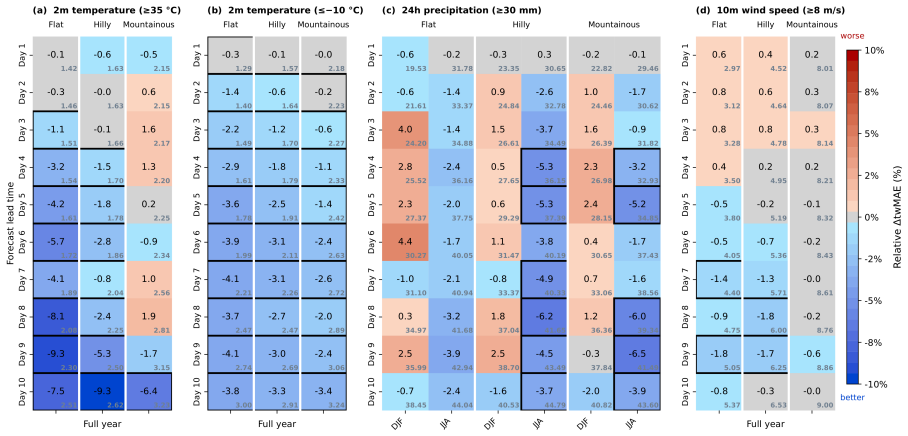
Scale-selective spectral nudging applied only to the large scales of virtual temperature and vorticity in the ECMWF IFS model toward a machine-learned forecast raises large-scale forecast skill by up to 1.5 days in the tropics and 12-18 hours in the extra-tropics, reduces the number of busts, preserves forecast variability and the representation of extremes, and improves tropical cyclone track forecasts while leaving intensity and small-scale physics consistent with the original physics-based model.
What carries the argument
Scale-selective spectral nudging, which relaxes only the large-scale spectral coefficients of virtual temperature and vorticity in the physics-based model toward the machine-learning solution at each time step.
If this is right
- Large-scale forecast skill improves relative to the free-running physics model.
- The frequency of forecast busts decreases.
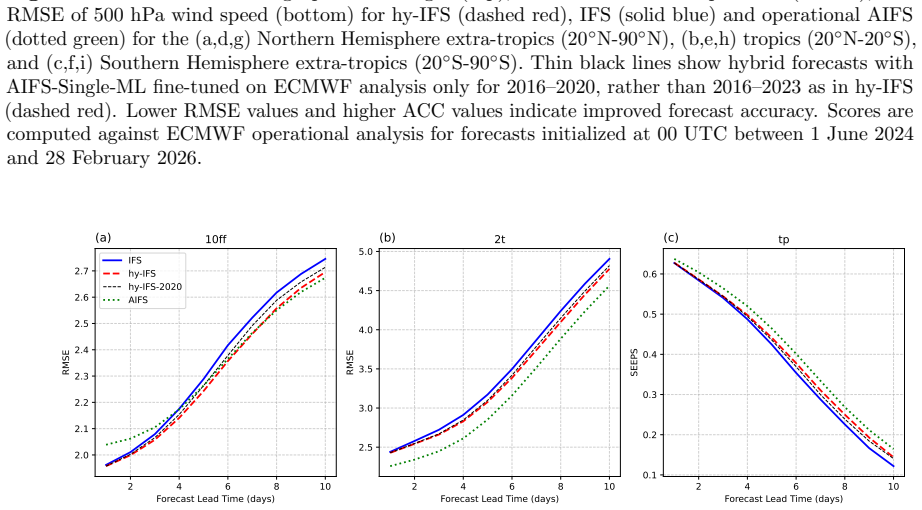
- Forecast variability and the representation of extreme near-surface weather remain comparable to the physics-only model.
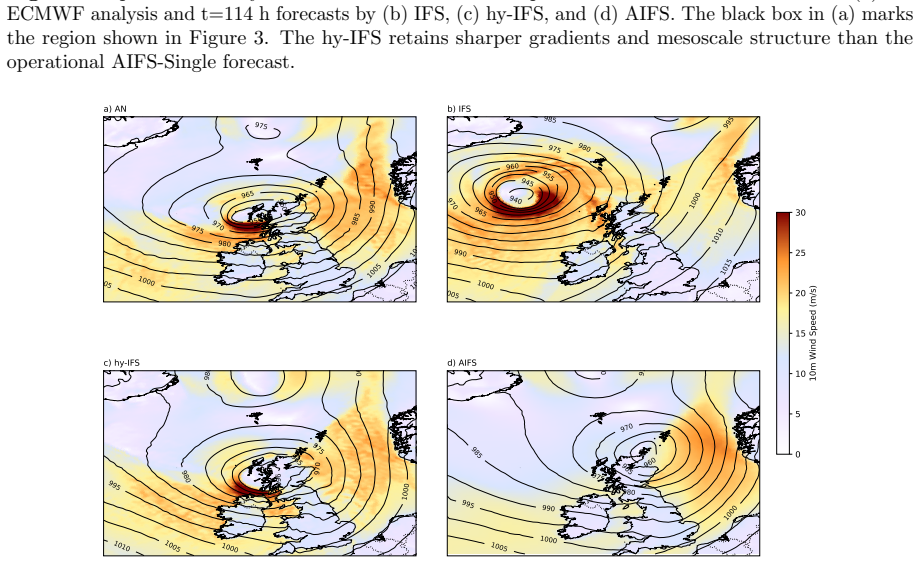
- Tropical cyclone tracks benefit from the improved large-scale steering flow while intensity stays physically consistent with the physics model.
- The hybrid setup offers a practical route to combine machine-learning and physics-based systems without replacing either entirely.
Where Pith is reading between the lines
- The same nudging strategy could be tested with other machine-learning models or applied to additional large-scale variables to see if further gains appear.
- If machine-learning models continue to improve at large scales, the hybrid approach might allow physics models to focus computational effort on smaller scales.
- Operational centers could adopt the method incrementally by nudging only selected variables or regions first.
Load-bearing premise
Nudging applied only to the large scales of virtual temperature and vorticity will preserve the dynamical and physical behaviour of the underlying physics-based model at smaller scales.
What would settle it
A direct comparison showing that the hybrid run produces statistically different small-scale variability, different distributions of extreme near-surface variables, or physically inconsistent tropical cyclone intensities relative to the free-running IFS would falsify the preservation claim.
Figures





read the original abstract
A hybrid approach to numerical weather prediction is investigated, in which the unperturbed physics-based ECMWF Integrated Forecasting System (IFS) is spectrally nudged toward forecasts from a machine-learned weather forecast model, trained to forecast on model levels. Nudging is applied only to the large scales of virtual temperature and vorticity, with the objective of improving large-scale forecast skill while preserving the dynamical and physical behaviour of the underlying physics-based model at smaller scales. Consistent with previous studies, spectral nudging substantially improves large-scale forecast skill relative to the free-running IFS, with gains of up to 1.5 days in the tropics and 12-18 hours in the extra-tropics, and a reduced frequency of forecast busts. These improvements are achieved while preserving forecast variability. The representation of extreme near-surface weather is maintained or improved. Tropical cyclone track forecasts benefit from improved large-scale steering flow, while storm intensity remains comparable to that of the physics-based model and more physically consistent than in pure machine-learned weather forecast models. These results confirm that scale-selective spectral nudging provides a practical pathway for combining machine-learning and physics-based forecasting systems.
Editorial analysis
A structured set of objections, weighed in public.
Referee Report
Summary. The paper proposes and tests a hybrid NWP system in which the free-running ECMWF IFS is spectrally nudged toward a machine-learned forecast model (trained on model levels). Nudging is restricted to the large scales of virtual temperature and vorticity. The central claim is that this scale-selective nudging improves large-scale forecast skill (up to 1.5 days in the tropics, 12-18 h in the extratropics, fewer busts) while preserving the IFS's small-scale dynamical and physical behaviour, forecast variability, extreme near-surface weather, and tropical-cyclone intensity.
Significance. If the preservation of small-scale behaviour can be demonstrated, the work supplies a concrete, immediately usable route for injecting ML large-scale skill into an operational physics-based model without discarding the model's small-scale physics and variability. The reported skill gains and reduced bust frequency are practically relevant; the maintenance of TC intensity and extremes is a non-trivial positive result.
major comments (2)
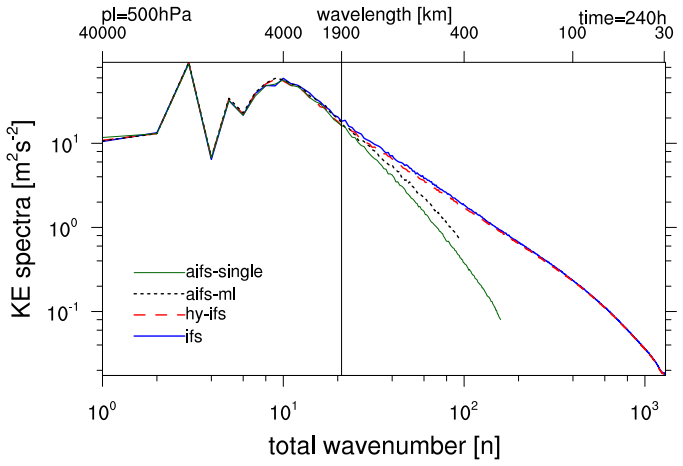
- [Abstract / Results] Abstract and Results: The claim that 'the dynamical and physical behaviour of the underlying physics-based model at smaller scales' is preserved rests on aggregate diagnostics (forecast variability, representation of extreme near-surface weather). No scale-decomposed diagnostics—kinetic-energy spectra, cross-scale energy fluxes, or statistics of parameterized processes (convection, boundary-layer turbulence)—are shown to confirm that small-scale behaviour remains statistically indistinguishable from the free-running IFS. This verification is load-bearing for the 'practical pathway' conclusion.
- [Methods] Methods: The precise spectral cutoff, nudging strength, and vertical structure of the nudging operator are not stated with sufficient quantitative detail to allow reproduction or to assess possible leakage into the small scales. Without these parameters, it is impossible to judge whether the reported preservation is robust or specific to the chosen cutoff.
minor comments (2)
- [Abstract] The abstract states gains 'of up to 1.5 days' and '12-18 hours' but does not indicate the verification metric (e.g., anomaly correlation, RMSE) or the exact lead times at which these gains are measured.
- [Results] Baseline comparison is only against the free-running IFS; a direct comparison against the pure ML model on the same small-scale diagnostics would strengthen the claim that the hybrid retains physical consistency advantages.
Simulated Author's Rebuttal
We thank the referee for their constructive and positive review, which highlights the practical relevance of the hybrid approach. We address each major comment below and will revise the manuscript accordingly to strengthen the presentation and evidence.
read point-by-point responses
-
Referee: [Abstract / Results] Abstract and Results: The claim that 'the dynamical and physical behaviour of the underlying physics-based model at smaller scales' is preserved rests on aggregate diagnostics (forecast variability, representation of extreme near-surface weather). No scale-decomposed diagnostics—kinetic-energy spectra, cross-scale energy fluxes, or statistics of parameterized processes (convection, boundary-layer turbulence)—are shown to confirm that small-scale behaviour remains statistically indistinguishable from the free-running IFS. This verification is load-bearing for the 'practical pathway' conclusion.
Authors: We appreciate the referee's emphasis on the need for more direct verification of small-scale preservation. The manuscript currently supports the claim through multiple aggregate but physically relevant diagnostics, including preserved forecast variability (which reflects small-scale energy), maintained or improved representation of extreme near-surface weather (a small-scale phenomenon), and comparable tropical-cyclone intensity with more physical consistency than pure ML models. Nevertheless, we agree that explicit scale-decomposed diagnostics would provide stronger, more targeted evidence. In the revised manuscript we will add kinetic-energy spectra for the nudged and free-running IFS runs, and we will include basic statistics on parameterized processes where these can be extracted from the model output. revision: yes
-
Referee: [Methods] Methods: The precise spectral cutoff, nudging strength, and vertical structure of the nudging operator are not stated with sufficient quantitative detail to allow reproduction or to assess possible leakage into the small scales. Without these parameters, it is impossible to judge whether the reported preservation is robust or specific to the chosen cutoff.
Authors: We acknowledge that the original submission did not present the nudging parameters with the quantitative precision required for full reproducibility. The revised Methods section will explicitly state the spectral cutoff wavenumber, the nudging relaxation coefficient (including its units and time scale), and the vertical structure of the nudging operator (including any tapering or level-dependent weighting). These details will be accompanied by a brief justification of the chosen values and a note on how the cutoff was selected to minimize leakage into smaller scales. revision: yes
Circularity Check
No significant circularity: empirical comparisons to free-running IFS
full rationale
The paper reports an experimental hybrid forecasting setup in which spectral nudging is applied to selected large-scale fields of the IFS toward an independently trained ML model. Forecast skill, variability, extreme-event statistics, and tropical-cyclone properties are then measured directly against the un-nudged IFS baseline. No equations, parameters, or central claims are shown to reduce to fitted inputs or prior self-citations by construction; the reported gains (e.g., 1.5 days in the tropics) are obtained from fresh integrations and verified against external observables. Self-citations to earlier nudging studies are present but serve only as background and are not invoked to establish uniqueness or to substitute for the present empirical evidence.
Axiom & Free-Parameter Ledger
axioms (1)
- domain assumption Large-scale components of virtual temperature and vorticity can be adjusted via nudging without adversely affecting small-scale dynamical and physical behaviour.
Reference graph
Works this paper leans on
-
[1]
Evaluation of tropical cyclone track and intensity forecasts from artificial intelligence weather prediction (aiwp) models.arXiv preprint arXiv:2409.06735doi:https://doi.org/10. 48550/arXiv.2409.06735. Diamantakis M, V´ aˇ na F. 2022. A fast converging and concise algorithm for computing the departure points in semi-lagrangian weather and climate models.Q...
-
[2]
Indices for monitoring changes in extremes based on daily temperature and precipitation data.WIREs Climate Change2(6): 851–870, doi:10.1002/wcc.147. 21
discussion (0)
Sign in with ORCID, Apple, or X to comment. Anyone can read and Pith papers without signing in.