Recognition: unknown
Demographics of Mesoscale Eddies in an Eddy-Permitting Ocean Model and Reanalysis
Pith reviewed 2026-05-08 09:06 UTC · model grok-4.3
The pith
Eddy-permitting ocean models and reanalysis data miss nearly 30 percent of the mesoscale eddies detected in satellite altimetry and produce eddies that live longer, grow larger, and remain weaker.
A machine-rendered reading of the paper's core claim, the machinery that carries it, and where it could break.
Core claim
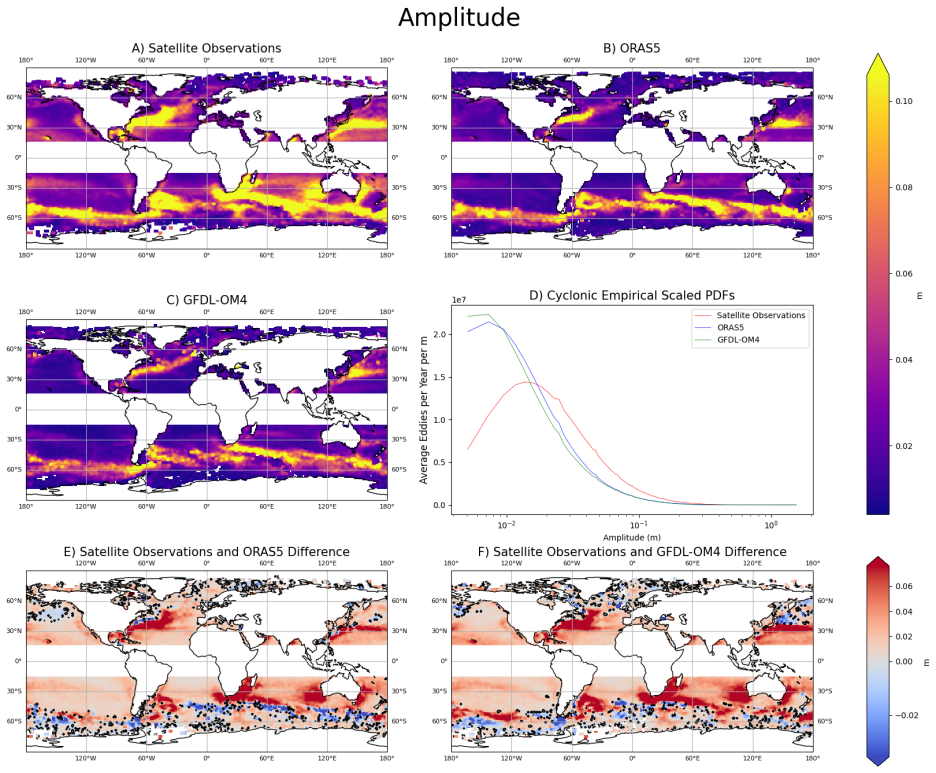
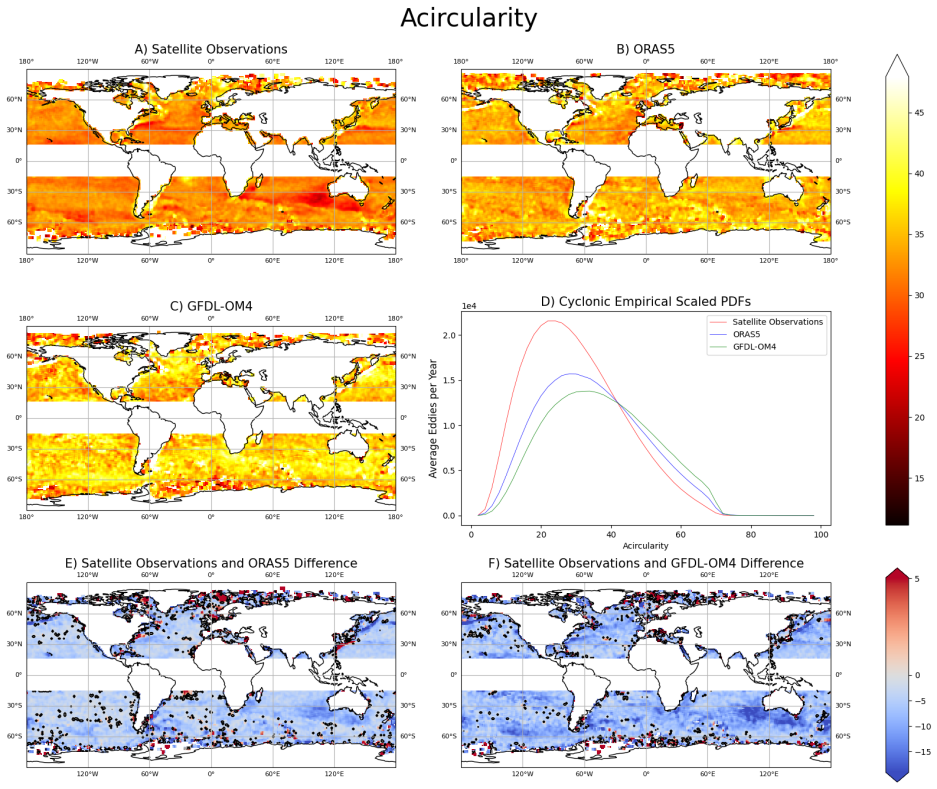
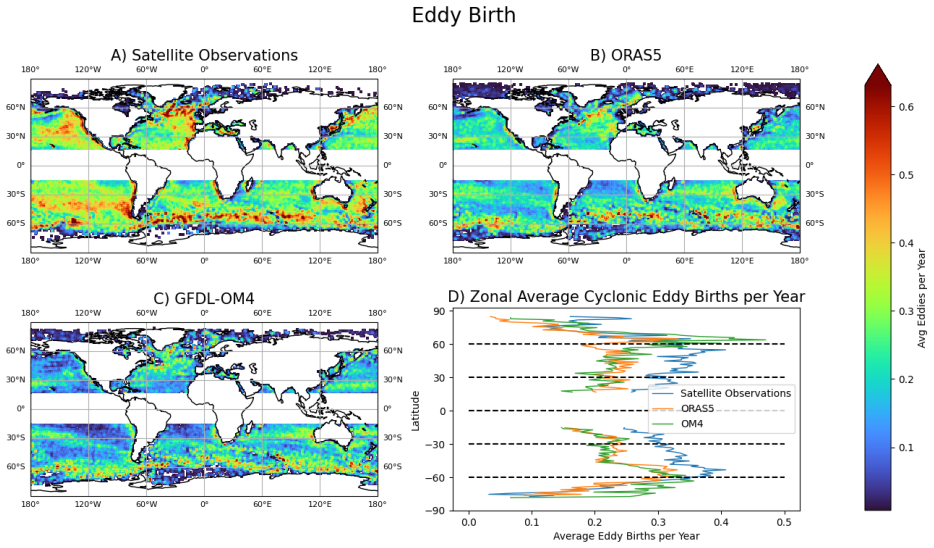
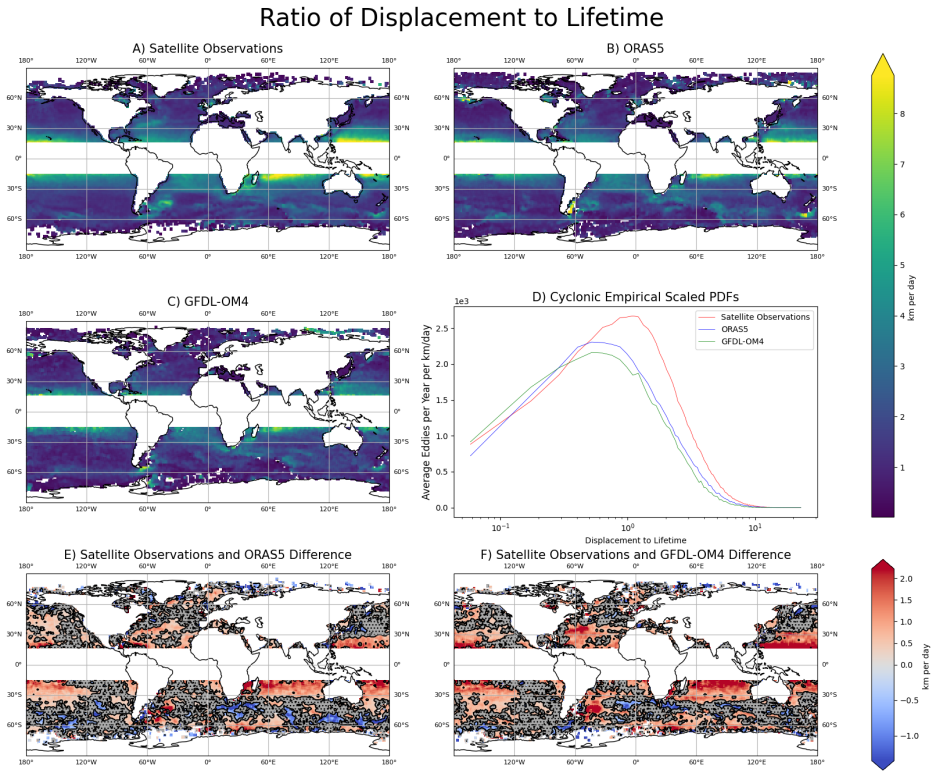
When compared to eddies observed in satellite altimetry data, eddies in reanalysis data and ocean model output are missing almost 30% of the number of eddy trajectories. In addition to missing eddy trajectories, the characteristics of eddies in reanalysis data and ocean model output differ from eddies observed in satellite altimetry data. At a high level, eddies in reanalysis data and ocean model output tend to live longer, are larger, and are weaker than eddies in observed altimetry data. This paper presents a variety of statistics describing these differences both spatially and in global aggregate.
What carries the argument
Consistent application of an eddy detection and tracking algorithm to sea-surface height fields drawn from satellite altimetry, reanalysis, and eddy-permitting ocean model output at identical 1/4-degree resolution.
If this is right
- Climate projections that rely on eddy-permitting ocean components will undercount the total number of mesoscale eddies active in the real ocean.
- Longer-lived eddies in the simulations may cause models to overestimate the cumulative distance and time over which individual eddies influence tracer transport.
- Larger yet weaker eddies alter estimates of horizontal mixing and vertical velocities that control heat uptake and nutrient distribution.
- Spatial variations in the reported biases imply that regional ocean forecasts and marine heat-wave predictions carry geographically uneven errors.
- Any hypothesis test involving eddy-driven biogeochemistry or air-sea exchange in these models rests on the unverified assumption that the resolved eddies are statistically realistic.
Where Pith is reading between the lines
- The shortfall could shrink in next-generation models that incorporate improved data assimilation or explicit sub-grid eddy parameterizations tuned against the same altimetry record.
- Weaker modeled eddies may lead to underprediction of eddy-induced upwelling and its effects on surface productivity and carbon export in ecosystem models.
- A direct test would compare eddy statistics from the same model run at both 1/4-degree and 1/12-degree resolution to isolate whether the bias is primarily a resolution or a representation issue.
Load-bearing premise
The detection and tracking algorithm yields unbiased, directly comparable eddy populations and properties when applied across observational, reanalysis, and model-generated fields despite differences in noise, resolution artifacts, and how the underlying height fields are produced.
What would settle it
Repeating the identical tracking procedure on an independent eddy-detection algorithm or on higher-resolution altimetry data that still shows the same 30 percent shortfall and the same shifts toward longer, larger, weaker eddies would confirm the result; if those differences vanish under the new method or data, the reported demographic mismatch would be falsified.
Figures







read the original abstract
Ocean mesoscale eddies can be thought of as the "weather" of the ocean and strongly influence the ocean's physics, chemistry, and biology; they influence other components of the Earth system via air-sea and sea-ice interactions, and are crucial drivers of marine heat waves. Thus, proper modeling of eddies in both historical and future climates is crucial to accurately capturing the Earth system. Climate projections using global coupled models with eddying ocean components are only recently starting to be more widely used. Despite their critical role in understanding and forecasting climate characteristics, these so-called eddy-permitting models have not been explored to verify that resolved eddies are realistic, and thus any downstream scientific testing of hypotheses in biogeochemistry, ocean physics or other associated Earth systems impacted by eddies hinge on this critical assumption. This paper compares observed eddies with lifetimes longer than 6 weeks present in $1/4^\circ$ satellite altimetry data with observed eddies in $1/4^\circ$ reanalysis data and ocean model output. When compared to eddies observed in satellite altimetry data, eddies in reanalysis data and ocean model output are missing almost 30% of the number of eddy trajectories. In addition to missing eddy trajectories, the characteristics of eddies in reanalysis data and ocean model output differ from eddies observed in satellite altimetry data. At a high level, eddies in reanalysis data and ocean model output tend to live longer, are larger, and are weaker than eddies in observed altimetry data. This paper presents a variety of statistics describing these differences both spatially and in global aggregate.
Editorial analysis
A structured set of objections, weighed in public.
Referee Report
Summary. The manuscript compares mesoscale eddies (lifetimes >6 weeks) detected via a single algorithm in 1/4° satellite altimetry against those in reanalysis and an eddy-permitting ocean model. It reports that reanalysis and model output contain ~30% fewer eddy trajectories than altimetry and that the detected eddies in the latter are longer-lived, larger, and weaker, with supporting spatial and global aggregate statistics.
Significance. If the detection pipeline is shown to be unbiased across data regimes, the quantitative demographics would provide valuable benchmarks for validating eddy-permitting models used in climate projections, directly informing studies of ocean transport, biogeochemistry, air-sea interactions, and marine heat waves.
major comments (2)
- [Methods] Methods (eddy detection and tracking section): The paper applies one fixed algorithm and lifetime cutoff (>6 weeks) to noisy altimetry, smoother reanalysis, and model fields but provides no synthetic-eddy tests, noise-injection experiments, or cross-filtering controls to demonstrate that detection thresholds and tracking criteria return comparable statistics across these regimes. This directly affects the central ~30% trajectory deficit and the reported shifts in lifetime, size, and amplitude.
- [Results] Results (global and spatial comparisons): The headline differences in eddy counts and properties are presented as physical but rest on the untested assumption that the algorithm's sensitivity to small-scale fluctuations (present in altimetry but absent in model/reanalysis) does not systematically suppress short-lived or weak features in the noisier dataset.
minor comments (2)
- [Methods] Clarify the precise definition of 'eddy amplitude' and 'radius' used in the tracking algorithm and whether any post-processing filters differ across the three datasets.
- [Figures] Figure captions should explicitly state the number of trajectories and the exact time period analyzed for each data source to allow direct reproducibility.
Simulated Author's Rebuttal
We thank the referee for their insightful comments on our manuscript comparing mesoscale eddy demographics across satellite altimetry, reanalysis, and ocean model data. We address each of the major comments below and indicate the revisions we plan to implement in the updated version of the paper.
read point-by-point responses
-
Referee: [Methods] Methods (eddy detection and tracking section): The paper applies one fixed algorithm and lifetime cutoff (>6 weeks) to noisy altimetry, smoother reanalysis, and model fields but provides no synthetic-eddy tests, noise-injection experiments, or cross-filtering controls to demonstrate that detection thresholds and tracking criteria return comparable statistics across these regimes. This directly affects the central ~30% trajectory deficit and the reported shifts in lifetime, size, and amplitude.
Authors: We acknowledge the validity of this concern. Our study utilizes a consistent eddy detection and tracking algorithm with identical parameters across all three datasets to facilitate a fair comparison. While we did not include synthetic tests in the original submission, we note that the algorithm has been validated in previous literature for both observational and modeled sea surface height fields. To directly address the referee's point, we will add a new subsection in the Methods discussing the potential impacts of data noise characteristics on detection sensitivity and will include results from a sensitivity test varying the amplitude and lifetime thresholds to demonstrate that the reported ~30% deficit and property shifts are robust to reasonable parameter choices. revision: yes
-
Referee: [Results] Results (global and spatial comparisons): The headline differences in eddy counts and properties are presented as physical but rest on the untested assumption that the algorithm's sensitivity to small-scale fluctuations (present in altimetry but absent in model/reanalysis) does not systematically suppress short-lived or weak features in the noisier dataset.
Authors: We agree that this assumption underlies our interpretation and that it should be more explicitly discussed. In the revised manuscript, we will modify the Results section to present the differences as those in the detected eddy populations rather than purely physical, and we will add text in the Discussion section acknowledging that some portion of the observed differences may arise from detection biases due to noise levels. This will provide a more balanced view while preserving the value of the quantitative comparison as a benchmark for model evaluation. revision: yes
Circularity Check
No circularity: direct empirical comparison of detected eddies
full rationale
The paper applies one fixed eddy detection and tracking algorithm to three independent data sources (1/4° altimetry, reanalysis, and model output) and reports counts and statistics of the resulting trajectories. No derivation chain, fitted parameters, or equations are present; the ~30% deficit and shifts in lifetime/size/amplitude are raw outputs of the same pipeline on different inputs. The algorithm itself is treated as an external tool rather than derived within the paper, and no self-citation supplies a uniqueness theorem or ansatz that the results reduce to. The comparison is therefore self-contained and externally falsifiable by re-running the detector on the source fields.
Axiom & Free-Parameter Ledger
Reference graph
Works this paper leans on
-
[1]
doi:https://doi.org/10.1038/s41586-022-05162-6. C. Pegliasco, A. Delepoulle, E. Mason, R. Morrow, Y. Faug´ ere, and G. Dibarboure. Meta3.1exp: a new global mesoscale eddy trajectory atlas derived from altimetry.Earth System Science Data, 14(3):1087– 1107, 2022a. doi:https://doi.org/10.5194/essd-14-1087-2022. Qinbiao Ni, Xiaoming Zhai, Zhibin Yang, and Dak...
-
[2]
doi:https://doi.org/10.1016/j.pocean.2008.10.013. 30 Reindert J Haarsma, Malcolm J Roberts, Pier Luigi Vidale, Catherine A Senior, Alessio Bellucci, Qing Bao, Ping Chang, Susanna Corti, Neven S Fuˇ ckar, Virginie Guemas, et al. High resolution model intercom- parison project (highresmip v1. 0) for cmip6.Geoscientific Model Development, 9(11):4185–4208, 20...
-
[3]
Issued by CLS under ser- vice contract 2022/C3S2 312b MOi/SC1
URLhttps://dast.copernicus-climate.eu/documents/satellite-sea-level/vDT2024/ C3S2-D312b-WP2-FDDP-SL-v3.0-202411-PQAR-of-vDT2024-v1.1_Final.pdf. Issued by CLS under ser- vice contract 2022/C3S2 312b MOi/SC1. Maxime Ballarotta, Cl´ ement Ubelmann, Marie-Isabelle Pujol, Guillaume Taburet, Florent Fournier, Jean- Fran¸ cois Legeais, Yannice Faug` ere, Antoine...
work page doi:10.5194/os- 2022
-
[4]
Controlling the False Discovery Rate: A Practical and Powerful Approach to Multiple Testing,
doi:https://doi.org/10.1111/j.2517-6161.1995.tb02031.x. Daniel S. Wilks. “the stippling shows statistically significant grid points”: How research results are routinely overstated and overinterpreted, and what to do about it.Bulletin of the American Meteorological Society, 97(12):2263–2273, 2016. doi:https://doi.org/10.1175/BAMS-D-15-00267.1. N. I. Fisher...
-
[5]
32 Elizabeth Yankovsky, Scott Bachman, K Shafer Smith, and Laure Zanna
doi:https://doi.org/10.1016/j.ocemod.2023.102265. 32 Elizabeth Yankovsky, Scott Bachman, K Shafer Smith, and Laure Zanna. Vertical structure and energetic constraints for a backscatter parameterization of ocean mesoscale eddies.J. Adv. Model. Earth Syst., 16 (7):e2023MS004093, 2024. doi:https://doi.org/10.1029/2023MS004093. Laure Zanna and Thomas Bolton. ...
discussion (0)
Sign in with ORCID, Apple, or X to comment. Anyone can read and Pith papers without signing in.