Recognition: unknown
A Quasar--Companion System Without AGN Outflow at z sim 6: The Case of PSO J083+11
Pith reviewed 2026-05-08 10:53 UTC · model grok-4.3
The pith
A z=6.34 quasar and companion show ordered gas rotation with no outflow signatures, interpreted as a pre-feedback accretion phase.
A machine-rendered reading of the paper's core claim, the machinery that carries it, and where it could break.
Core claim
The central claim is that the quasar PSO J083.8371+11.8482 at z=6.34 and its companion exhibit [C II] emission with ordered rotational kinematics, velocity dispersions below typical outflow values, and no significant morphological asymmetries or disturbed velocity fields, so the system is interpreted as being observed in a pre-outflow accretion phase where rapid supermassive black hole growth precedes the development of large-scale AGN feedback.
What carries the argument
The [C II] 158 μm moment maps and derived velocity dispersion fields, which trace the spatial distribution and kinematics of cold interstellar gas to test for outflow signatures.
If this is right
- Rapid supermassive black hole accretion can occur before large-scale AGN feedback affects the circumgalactic medium.
- Star formation in the quasar host proceeds at high rates without suppression from outflows.
- The companion galaxy at 18 kpc projected distance remains unaffected by quasar-driven winds in the current epoch.
- High-redshift quasar systems may commonly pass through this pre-outflow stage before feedback becomes observable.
Where Pith is reading between the lines
- Feedback models for the reionization epoch may need to incorporate a delay between the start of black hole accretion and the launch of large-scale outflows.
- Targeted deeper observations of marginal high-velocity channels in this and similar systems could reveal the onset of feedback.
- If pre-outflow phases are common, the duty cycle of observable AGN feedback at z greater than 6 would be shorter than often assumed.
Load-bearing premise
The lack of asymmetries, disturbed velocities, and high dispersions shows that AGN-driven outflows are absent rather than simply undetectable due to viewing angle, timing, or current data sensitivity.
What would settle it
Detection of broad [C II] line wings exceeding 300 km/s or clear velocity-field disturbances in deeper ALMA data on this same system would show that outflows are present.
Figures




read the original abstract
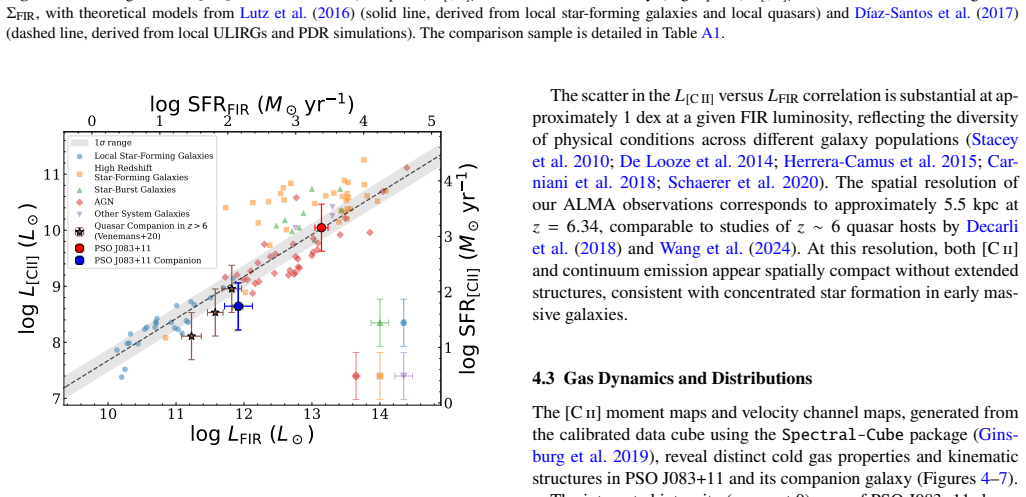
PSO J083.8371+11.8482, a quasar at $z = 6.34$ with a nearby companion galaxy, provides an opportunity to study the impact of active galactic nucleus (AGN) activity on the surrounding environment during the epoch of reionization. We analyze ALMA observations of the [C\,\textsc{ii}] 158~$\mu$m emission line and the far-infrared (FIR) continuum, which trace cold interstellar gas and dust-reprocessed radiation from star formation and AGN heating. The quasar host shows star formation rates (SFRs) of $544$--$3764~\mathrm{M_{\odot}~yr^{-1}}$ from [C\,\textsc{ii}] and $1861$--$2932~\mathrm{M_{\odot}~yr^{-1}}$ from FIR emission, while the companion galaxy exhibits lower SFRs of $21$--$145$ and $76$--$211~\mathrm{M_{\odot}~yr^{-1}}$ from the same diagnostics. Both galaxies follow typical $L_{\mathrm{[C\,II]}}/L_{\mathrm{FIR}}$ ratios observed in star-forming galaxies and show no evidence for a [C\,\textsc{ii}] deficit, indicating that stellar heating dominates the interstellar medium energetics. The [C\,\textsc{ii}] moment maps reveal compact emission with centrally peaked intensity and ordered rotational kinematics in both systems. Velocity dispersions remain well below values associated with powerful AGN-driven outflows, and no significant morphological asymmetries or disturbed velocity fields indicative of AGN feedback or major mergers are detected, although marginal kinematic substructure in the quasar's high-velocity channels warrants further investigation. Although the companion lies at a projected distance of $18.248 \pm 0.277$~kpc within the quasar proximity zone, neither morphological nor kinematic signatures indicate AGN-driven outflows affecting the circumgalactic medium. We therefore interpret this system as being observed in a pre-outflow accretion phase, where rapid supermassive black hole growth precedes the development of large-scale AGN feedback.
Editorial analysis
A structured set of objections, weighed in public.
Referee Report
Summary. The manuscript presents ALMA observations of the [C II] 158 μm emission line and FIR continuum toward the z=6.34 quasar PSO J083.8371+11.8482 and its companion galaxy at a projected separation of 18.248 ± 0.277 kpc. The authors derive SFRs of 544–3764 M⊙ yr⁻¹ (quasar host) and 21–145 M⊙ yr⁻¹ (companion) from [C II], with consistent but somewhat lower values from the FIR continuum. Both systems exhibit L_[C II]/L_FIR ratios typical of star-forming galaxies with no [C II] deficit. The [C II] moment maps show compact, centrally peaked emission, ordered rotation, and velocity dispersions below those commonly associated with powerful outflows; no morphological asymmetries or disturbed velocity fields are reported. The authors interpret the system as being observed in a pre-outflow accretion phase in which rapid supermassive black hole growth precedes large-scale AGN feedback.
Significance. If the non-detection of outflow signatures can be placed on a quantitative footing, the result would provide direct observational support for a temporal offset between rapid black-hole accretion and the onset of galaxy-scale feedback at z∼6. Such a phase is predicted by some semi-analytic and cosmological simulations but remains sparsely constrained by observations during the epoch of reionization. The dual-tracer approach ([C II] plus FIR) and the presence of a companion within the quasar proximity zone add value for studies of early AGN–galaxy co-evolution.
major comments (3)
- [Kinematic analysis and discussion] The central claim that the system is observed in a pre-outflow phase rests on the assertion that velocity dispersions are “well below values associated with powerful AGN-driven outflows” and that no morphological or kinematic disturbances are present. However, the manuscript provides neither explicit numerical thresholds from the literature nor a quantitative assessment of the minimum detectable outflow velocity or mass-loading factor given the achieved sensitivity, beam size, and channel width. Without these limits it is not possible to distinguish absence of outflows from non-observability.
- [Results and discussion] The abstract notes “marginal kinematic substructure in the quasar’s high-velocity channels” that “warrants further investigation,” yet the text does not report a statistical significance test, moment-1/2 map residuals, or comparison against simple outflow toy models. This substructure is directly relevant to the no-outflow conclusion and must be quantified before the interpretation can be considered secure.
- [Companion galaxy analysis] The companion galaxy at 18 kpc shows no [C II] disturbance, but the paper does not derive upper limits on possible outflow mass or velocity that could be ruled out at the observed sensitivity. Projection effects (outflow along the line of sight or perpendicular to the disk) and the fact that [C II] primarily traces neutral gas while outflows are often multiphase are not addressed, weakening the claim that the circumgalactic medium is unaffected.
minor comments (2)
- [SFR derivation] The reported SFR ranges from [C II] (544–3764 M⊙ yr⁻¹ for the quasar) are unusually broad; the text should clarify whether these bounds reflect different conversion factors, excitation assumptions, or spatial apertures.
- [Discussion] The manuscript would benefit from a brief comparison table placing the observed velocity dispersions and L_[C II]/L_FIR ratios against literature samples of both star-forming galaxies and known high-z quasar outflows.
Simulated Author's Rebuttal
We thank the referee for their thoughtful and constructive report. The comments highlight important areas where the kinematic analysis and interpretation can be placed on a firmer quantitative footing. We address each major comment below and will revise the manuscript accordingly.
read point-by-point responses
-
Referee: [Kinematic analysis and discussion] The central claim that the system is observed in a pre-outflow phase rests on the assertion that velocity dispersions are “well below values associated with powerful AGN-driven outflows” and that no morphological or kinematic disturbances are present. However, the manuscript provides neither explicit numerical thresholds from the literature nor a quantitative assessment of the minimum detectable outflow velocity or mass-loading factor given the achieved sensitivity, beam size, and channel width. Without these limits it is not possible to distinguish absence of outflows from non-observability.
Authors: We agree that explicit thresholds and sensitivity limits are needed to support the no-outflow interpretation. In the revised manuscript we will (i) cite specific literature values for velocity dispersions and mass-loading factors associated with powerful AGN-driven outflows at high redshift, and (ii) provide a quantitative estimate of the minimum detectable outflow velocity and mass-loading factor using the measured rms noise, beam size, and channel width. This will include a calculation of the flux upper limit for a hypothetical broad-line component and the corresponding mass-loading factor that could be ruled out. revision: yes
-
Referee: [Results and discussion] The abstract notes “marginal kinematic substructure in the quasar’s high-velocity channels” that “warrants further investigation,” yet the text does not report a statistical significance test, moment-1/2 map residuals, or comparison against simple outflow toy models. This substructure is directly relevant to the no-outflow conclusion and must be quantified before the interpretation can be considered secure.
Authors: We will quantify the marginal kinematic substructure in the revised version. This will include a statistical significance assessment of the high-velocity channel features, residuals from the moment-1 and moment-2 maps relative to a rotating-disk model, and a brief comparison to simple outflow toy models (e.g., a biconical outflow with varying opening angle and velocity). These additions will be placed in the results and discussion sections to clarify whether the substructure is consistent with noise or requires further data. revision: yes
-
Referee: [Companion galaxy analysis] The companion galaxy at 18 kpc shows no [C II] disturbance, but the paper does not derive upper limits on possible outflow mass or velocity that could be ruled out at the observed sensitivity. Projection effects (outflow along the line of sight or perpendicular to the disk) and the fact that [C II] primarily traces neutral gas while outflows are often multiphase are not addressed, weakening the claim that the circumgalactic medium is unaffected.
Authors: We will add upper limits on outflow mass and velocity for the companion galaxy based on the achieved sensitivity and beam size. The revised text will explicitly discuss projection effects, noting that an outflow aligned with the line of sight or perpendicular to the disk plane could remain undetected in the [C II] data, and will acknowledge that [C II] primarily traces neutral gas while AGN outflows are often multiphase. These caveats will be incorporated into the interpretation of the circumgalactic medium. revision: yes
Circularity Check
No significant circularity in purely observational analysis
full rationale
The paper reports direct ALMA measurements of [CII] 158 μm line and FIR continuum for PSO J083+11 and its companion, deriving SFRs, L_[CII]/L_FIR ratios, moment maps, velocity dispersions, and morphological properties. These are compared against external literature benchmarks for star-forming galaxies and typical AGN-outflow signatures. The pre-outflow interpretation follows from non-detection of expected kinematic disturbances and asymmetries, without any fitted parameters, self-defined models, or self-citation chains that reduce the central claim to its own inputs by construction. The derivation remains self-contained against independent observational standards.
Axiom & Free-Parameter Ledger
axioms (3)
- domain assumption [C II] 158 μm emission traces cold interstellar gas and star formation rates in galaxies
- domain assumption FIR continuum emission traces dust-reprocessed radiation from star formation and AGN heating
- domain assumption Velocity dispersions and kinematic maps reliably indicate presence or absence of AGN-driven outflows when compared to known signatures
Reference graph
Works this paper leans on
-
[1]
write newline
" write newline "" before.all 'output.state := FUNCTION fin.entry write newline FUNCTION new.block output.state before.all = 'skip after.block 'output.state := if FUNCTION new.sentence output.state after.block = 'skip output.state before.all = 'skip after.sentence 'output.state := if if FUNCTION not #0 #1 if FUNCTION and 'skip pop #0 if FUNCTION or pop #1...
-
[2]
write newline
" write newline "" before.all 'output.state := FUNCTION fin.entry write newline FUNCTION new.block output.state before.all = 'skip after.block 'output.state := if FUNCTION new.sentence output.state after.block = 'skip output.state before.all = 'skip after.sentence 'output.state := if if FUNCTION not #0 #1 if FUNCTION and 'skip pop #0 if FUNCTION or pop #1...
-
[3]
T., et al., 2020, @doi [ ] 10.48550/arXiv.2009.07784 , 903, 34
Andika I. T., et al., 2020, @doi [ ] 10.48550/arXiv.2009.07784 , 903, 34
-
[4]
Arp H., 1981, @doi [ ] 10.1086/159345 , 250, 31
-
[5]
Astropy Collaboration et al., 2013, @doi [ ] 10.1051/0004-6361/201322068 , 558, A33
-
[6]
Astropy Collaboration et al., 2018, @doi [ ] 10.3847/1538-3881/aabc4f , 156, 123
-
[7]
Astropy Collaboration et al., 2022, @doi [ ] 10.3847/1538-4357/ac7c74 , 935, 167
-
[8]
Barai P., Gallerani S., Pallottini A., Ferrara A., Marconi A., Cicone C., Maiolino R., Carniani S., 2018, @doi [ ] 10.1093/mnras/stx2563 , 473, 4003
-
[9]
Bañados E., et al., 2018, @doi [ ] 10.1038/nature25180 , 553, 473
-
[10]
Bañados E., et al., 2019, @doi [ ] 10.3847/2041-8213/ab3659 , 881, L23
-
[11]
Beelen A., Cox P., Benford D. J., Dowell C. D., Kovács A., Bertoldi F., Omont A., Carilli C. L., 2006, @doi [ ] 10.1086/500636 , 642, 694
-
[12]
V., Cooper J
Bicknell G. V., Cooper J. L., Sutherland R. S., 2010, in Antonuccio-Delogu V., Silk J., eds, , AGN feedback in galaxy formation. Cambridge University Press, pp 165--174
2010
-
[13]
Bischetti M., et al., 2024, @doi [ ] 10.3847/1538-4357/ad4a77 , 970, 9
-
[14]
J., Spoon H., Hailey-Dunsheath S., Verma A., 2015, @doi [ ] 10.1088/0004-637X/799/1/13 , 799, 13
Brisbin D., Ferkinhoff C., Nikola T., Parshley S., Stacey G. J., Spoon H., Hailey-Dunsheath S., Verma A., 2015, @doi [ ] 10.1088/0004-637X/799/1/13 , 799, 13
-
[15]
Bromm V., Yoshida N., 2011, @doi [ ] 10.1146/annurev-astro-081710-102608 , 49, 373
-
[16]
Butler K. M., van der Werf P. P., Topkaras T., Rybak M., Venemans B. P., Walter F., Decarli R., 2023, @doi [ ] 10.3847/1538-4357/acad03 , 944, 134
-
[17]
Carilli C. L., Walter F., 2013, @doi [ ] 10.1146/annurev-astro-082812-140953 , 51, 105
-
[18]
Carniani S., et al., 2013, @doi [ ] 10.1051/0004-6361/201322320 , https://ui.adsabs.harvard.edu/abs/2013A&A...559A..29C 559, A29
-
[19]
Carniani S., et al., 2018, @doi [ ] 10.1093/mnras/sty1088 , 478, 1170
-
[20]
Carniani S., et al., 2020, @doi [ ] 10.1093/mnras/staa3178 , 499, 5136
-
[21]
Dusty Star-Forming Galaxies at High Redshift
Casey C. M., Narayanan D., Cooray A., 2014, @doi [Phys. Rep.] 10.1016/j.physrep.2014.02.009 , 541, 45
work page Pith review doi:10.1016/j.physrep.2014.02.009 2014
-
[22]
Cicone C., et al., 2014, @doi [ ] 10.1051/0004-6361/201322464 , 562, A21
-
[23]
Cicone C., et al., 2015, @doi [ ] 10.1051/0004-6361/201424980 , 574, A14
-
[24]
Connor T., et al., 2020, @doi [ ] 10.3847/1538-4357/abaab9 , 900, 189
-
[25]
Costa T., Sijacki D., Haehnelt M. G., 2014, @doi [ ] 10.1093/mnras/stu1632 , 444, 2355
-
[26]
Costa T., Sijacki D., Haehnelt M. G., 2015, @doi [ ] 10.1093/mnrasl/slu193 , 448, L30
-
[27]
V., et al., 2012, @doi [ ] 10.1088/0004-637X/747/1/81 , 747, 81
Croxall K. V., et al., 2012, @doi [ ] 10.1088/0004-637X/747/1/81 , 747, 81
-
[28]
Davies F. B., Hennawi J. F., Eilers A.-C., 2019, @doi [ ] 10.1093/mnras/stz3303 , 493, 1330
-
[29]
De Breuck C., Maiolino R., Caselli P., Coppin K., Hailey-Dunsheath S., Nagao T., 2011, @doi [ ] 10.48550/arXiv.1104.5250 , 530, L8
-
[30]
De Looze I., et al., 2014, @doi [ ] 10.1051/0004-6361/201322489 , 568, A62
-
[31]
Decarli R., Falomo R., Treves A., Barattini M., 2010, @doi [ ] 10.1051/0004-6361/200913760 , 511, A27
-
[32]
Decarli R., et al., 2017, @doi [ ] 10.1038/nature22358 , 545, 457
-
[33]
Decarli R., et al., 2018, @doi [ ] 10.3847/1538-4357/aaa5aa , 854, 97
-
[34]
Decarli R., et al., 2024, @doi [ ] 10.1051/0004-6361/202449239 , 689, A219
-
[35]
Dubois Y., Pichon C., Devriendt J., Silk J., Haehnelt M., Kimm T., Slyz A., 2013, @doi [ ] 10.1093/mnras/sts224 , 428, 2885
-
[36]
2003, MNRAS, 339, 937, doi: 10.1046/j.1365-8711.2003.06241.x G¨ otberg, Y., de Mink, S
Dunne L., Eales S. A., Edmunds M. G., 2003, @doi [ ] 10.1046/j.1365-8711.2003.06440.x , 341, 589
-
[37]
Díaz-Santos T., et al., 2017, @doi [ ] 10.3847/1538-4357/aa81d7 , 846, 32
-
[38]
Ebagezio S., Seifried D., Walch S., Bisbas T. G., 2024, @doi [ ] 10.1051/0004-6361/202449682 , 692, A58
-
[39]
ApJ840(1), 24 (2017) https://doi.org/10
Eilers A.-C., Davies F. B., Hennawi J. F., Prochaska J. X., Lukić Z., Mazzucchelli C., 2017, @doi [ ] 10.48550/arXiv.1703.02539 , 840, 24
-
[40]
Observational Evidence of AGN Feedback
Fabian A. C., 2012, @doi [ ] 10.1146/annurev-astro-081811-125521 , 50, 455
work page Pith review doi:10.1146/annurev-astro-081811-125521 2012
-
[41]
Fan X., Carilli C., Keating B., 2006, @doi [ ] 10.1146/annurev.astro.44.051905.092514 , 44, 415
-
[42]
Fan X., Ba \ n ados E., Simcoe R. A., 2023, @doi [ ] 10.1146/annurev-astro-052920-102455 , 61, 373
-
[43]
Farina E. P., et al., 2017, @doi [ ] 10.3847/1538-4357/aa8df4 , 848, 78
-
[44]
D., Babu G
Feigelson E. D., Babu G. J., 2012, Modern Statistical Methods for Astronomy. Cambridge University Press
2012
-
[45]
Fensch J., et al., 2017, @doi [ ] 10.1093/mnras/stw2920 , 465, 1934
-
[46]
M., Bournaud F., 2014, @doi [ ] 10.1093/mnras/stu677 , 441, 1615
Gabor J. M., Bournaud F., 2014, @doi [ ] 10.1093/mnras/stu677 , 441, 1615
-
[47]
S.-c., 2019, radio-astro-tools/spectral-cube: v0.4.4, @doi 10.5281/zenodo.2573901 , https://doi.org
Ginsburg A., Robitaille T., Koch E., Naiman J., Rosolowsky E., Beaumont C., Team T. S.-c., 2019, radio-astro-tools/spectral-cube: v0.4.4, @doi 10.5281/zenodo.2573901 , https://doi.org
-
[48]
Gruppioni C., et al., 2020, @doi [ ] 10.1051/0004-6361/202038487 , 643, A8
-
[49]
Gullberg B., et al., 2015, @doi [ ] 10.48550/arXiv.1501.06909 , 449, 2883
-
[50]
L., 2006, @doi [ ] 10.1086/506580 , 650, 7
Haiman Z., Bryan G. L., 2006, @doi [ ] 10.1086/506580 , 650, 7
-
[51]
Haiman Z., Loeb A., 1999, @doi [ ] 10.1086/307393 , 519, 479
-
[52]
Harrison C. M., 2017, @doi [ ] 10.1038/s41550-017-0165 , 1, 0165
-
[53]
Hashimoto T., et al., 2019, @doi [ ] 10.1093/mnras/stz2034 , 488, 5029
-
[54]
Herrera-Camus R., et al., 2015, @doi [ ] 10.1088/0004-637X/800/1/1 , 800, 1
-
[55]
Royal Society Open Science , keywords =
Hodge J. A., da Cunha E., 2020, @doi [R. Soc. Open Sci.] 10.1098/rsos.200556 , 7, 200556
-
[56]
Hopkins P. F., Elvis M., 2010, @doi [ ] 10.1111/j.1365-2966.2009.15643.x , 401, 7
-
[57]
M., et al., 2017, @doi [ ] 10.1051/0004-6361/201629588 , 602, A49
Hughes T. M., et al., 2017, @doi [ ] 10.1051/0004-6361/201629588 , 602, A49
-
[58]
Inayoshi K., Visbal E., Haiman Z., 2019, @doi [ ] 10.48550/arXiv.1911.05791 , 58, 27
-
[59]
Iono D., et al., 2006, @doi [ ] 10.48550/arXiv.astro-ph/0606043 , 645, L97
-
[60]
2012, MNRAS, 423, 600, doi: 10.1111/j.1365-2966.2012.20901.x
Ishibashi W., Fabian A. C., 2012, @doi [ ] 10.1111/j.1365-2966.2012.22074.x , 427, 2998
-
[61]
Kennicutt Jr. R. C., 1998, @doi [ ] 10.1146/annurev.astro.36.1.189 , 36, 189
work page Pith review doi:10.1146/annurev.astro.36.1.189 1998
-
[62]
King A., Pounds K., 2015, @doi [ ] 10.1146/annurev-astro-082214-122316 , 53, 115
-
[63]
Lagache G., Cousin M., Chatzikos M., 2018, @doi [ ] 10.1051/0004-6361/201732019 , 609, A130
-
[64]
Law D. R., Steidel C. C., Erb D. K., Larkin J. E., Pettini M., Shapley A. E., Wright S. A., 2009, @doi [ ] 10.1088/0004-637X/697/2/2057 , 697, 2057
-
[65]
Leroy A. K., et al., 2015, @doi [ ] 10.1088/0004-637X/801/1/25 , 801, 25
-
[66]
L., Satyapal S., Fischer J., Wolfire M
Luhman M. L., Satyapal S., Fischer J., Wolfire M. G., Sturm E., Dudley C. C., Lutz D., Genzel R., 2003, @doi [ ] 10.1086/376965 , 594, 758
-
[67]
Lutz D., et al., 2016, @doi [ ] 10.1051/0004-6361/201527706 , 591, A136
-
[68]
Madau P., Rees M., 2000, @doi [ ] 10.1086/312934 , 542, L69
-
[69]
M., Oliva E., 2003, @doi [ ] 10.1086/379600 , 596, L155
Maiolino R., Juarez Y., Mujica R., Nagar N. M., Oliva E., 2003, @doi [ ] 10.1086/379600 , 596, L155
-
[70]
Malhotra S., et al., 2001, @doi [ ] 10.1086/323046 , 561, 766
-
[71]
Marsden G., Borys C., Chapman S., Halpern M., Scott D., 2005, @doi [ ] 10.1111/j.1365-2966.2005.08837.x , 359, 43
-
[72]
Mazzucchelli C., et al., 2019, @doi [ ] 10.3847/1538-4357/ab2f75 , 881, 163
-
[73]
Mazzucchelli C., et al., 2025, @doi [ ] 10.1051/0004-6361/202451290 , 694, A171
-
[74]
McGreer I. D., Fan X., Strauss M. A., Haiman Z., Richards G. T., Jiang L., Bian F., Schneider D. P., 2014, @doi [ ] 10.1088/0004-6256/148/4/73 , 148, 73
-
[75]
P., Waters B., Schiebel D., Young W., Golap K., 2007, in Astronomical Data Analysis Software and Systems XVI
McMullin J. P., Waters B., Schiebel D., Young W., Golap K., 2007, in Astronomical Data Analysis Software and Systems XVI. p. 127
2007
-
[76]
Springer
Mesinger A., 2016, Understanding the Epoch of Reionization through Observations and Theory. Springer
2016
-
[77]
C., Wang R., Shangguan J., Bauer F
Molina J., Ho L. C., Wang R., Shangguan J., Bauer F. E., Treister E., 2023, @doi [ ] 10.3847/1538-4357/acaa9b , 944, 30
-
[78]
J., et al., 2024, @doi [ ] 10.1093/mnras/stad3133 , 527, 4420
Molyneux S. J., et al., 2024, @doi [ ] 10.1093/mnras/stad3133 , 527, 4420
-
[79]
Morganti R., 2017, @doi [Frontiers] 10.48550/arXiv.1712.05301 , 4
-
[80]
Mortlock D. J., et al., 2011, @doi [ ] 10.1038/nature10159 , 474, 616
discussion (0)
Sign in with ORCID, Apple, or X to comment. Anyone can read and Pith papers without signing in.