Recognition: 2 theorem links
· Lean TheoremOn the rank of quaternion Hankel matrices
Pith reviewed 2026-05-13 07:45 UTC · model grok-4.3
The pith
For quaternion Hankel matrices the left rank equals the right rank.
A machine-rendered reading of the paper's core claim, the machinery that carries it, and where it could break.
Core claim
The central discovery is that the left and right ranks of any quaternion Hankel matrix are equal. This stands in contrast to arbitrary quaternion matrices, for which the two ranks may differ. The paper further shows that a sequence of quaternions admits a linear recurrence relation with quaternion coefficients if and only if the associated Hankel matrix has low rank.
What carries the argument
Quaternion Hankel matrix with constant anti-diagonals, together with its left and right ranks as dimensions of row and column spaces over the quaternion skew field.
If this is right
- Rank-revealing algorithms for quaternion Hankel matrices can treat left and right rank as a single number.
- The order of the shortest linear recurrence for a quaternion sequence is exactly the rank of its Hankel matrix.
- Low-rank approximations and factorizations of quaternion Hankel matrices become simpler because no separate left and right handling is required.
- Computational routines that exploit Hankel low-rank structure in signal processing or system identification over quaternions can drop the distinction between left and right.
Where Pith is reading between the lines
- The equality may extend to other constant-structure matrices such as Toeplitz matrices over quaternions.
- Software libraries for quaternion linear algebra could implement a single rank function for all Hankel matrices without special casing left versus right.
- The result suggests that Hankel structure restores a form of commutativity symmetry for the module dimensions over the skew field.
Load-bearing premise
The constant anti-diagonal structure prevents non-commutative multiplication from making left and right row spaces or column spaces differ in dimension.
What would settle it
Exhibit any concrete quaternion Hankel matrix, even small, whose left row space dimension differs from its right row space dimension.
Figures
read the original abstract
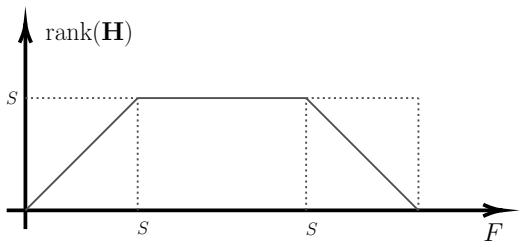
This paper discusses the left and right ranks of quaternion matrices with Hankel structure. While they are in general different for arbitrary quaternion matrices, we show that the left and right ranks of quaternion Hankel matrices are equal. Moreover, we establish the relation between Hankel matrices and the existence of linear recurrence relations with quaternion coefficients and discuss some practical implications for computational methods relying on low-rank properties of quaternion Hankel matrices.
Editorial analysis
A structured set of objections, weighed in public.
Referee Report
Summary. The paper proves that for quaternion Hankel matrices the left and right ranks coincide (unlike the general case for quaternion matrices), establishes a correspondence between the Hankel structure and the existence of linear recurrence relations with quaternion coefficients, and discusses algorithmic consequences for low-rank computations.
Significance. If the central equality holds, the result supplies a useful structural fact for non-commutative Hankel matrices that can be exploited in quaternion signal processing and numerical linear algebra over division rings; the explicit link to recurrence relations also gives a concrete way to certify low rank without separate left/right computations.
major comments (1)
- [§3] §3, Theorem 3.2: the argument that the anti-diagonal constancy forces dim(left row space) = dim(right row space) is sketched via linear dependence, but the step that equates the two dimensions under left versus right multiplication is not written out explicitly enough to confirm that non-commutativity does not introduce extra relations.
minor comments (2)
- [§2] §2: the precise indexing convention for the Hankel entries (i+j = constant) should be stated with an explicit formula to remove any ambiguity about the order of multiplication when entries are quaternions.
- [§4] The discussion of computational implications in §4 would benefit from a small numerical example comparing left and right rank computations on a concrete quaternion Hankel matrix.
Simulated Author's Rebuttal
We thank the referee for the careful reading and the recommendation of minor revision. The single major comment concerns the explicitness of the dimension-equality step in Theorem 3.2; we address it directly below and will incorporate the requested clarification.
read point-by-point responses
-
Referee: [§3] §3, Theorem 3.2: the argument that the anti-diagonal constancy forces dim(left row space) = dim(right row space) is sketched via linear dependence, but the step that equates the two dimensions under left versus right multiplication is not written out explicitly enough to confirm that non-commutativity does not introduce extra relations.
Authors: We agree that the transition from left-linear dependence to right-linear dependence (and the consequent equality of dimensions) can be stated more explicitly. In the revised proof we will insert the following paragraph after the current linear-dependence argument: suppose a left-linear combination ∑ q_i r_i = 0 holds for the rows r_i of the Hankel matrix H. Because every anti-diagonal is constant, the (j,k)-entry of H satisfies h_{j,k} = h_{j+1,k-1}. Multiplying the dependence relation on the right by a suitable quaternion and using the constancy on each anti-diagonal shows that the same coefficients q_i also satisfy a right-linear relation ∑ r_i q_i = 0; the constancy prevents the appearance of additional commutator terms that would otherwise arise in a general matrix. The symmetric argument (starting from a right dependence) likewise yields a left dependence. Consequently the left and right row spaces have identical dimension. This explicit transfer step will be added to the manuscript. revision: yes
Circularity Check
No significant circularity detected
full rationale
The paper establishes equality of left and right ranks for quaternion Hankel matrices via a direct structural argument: the constant anti-diagonals induce linear dependence relations that equate the dimensions of the left and right row/column spaces. This holds without commutativity and does not reduce any claim to a fitted parameter, self-referential definition, or load-bearing self-citation. The derivation is self-contained against the non-commutative setting and supplies independent content relating Hankel structure to recurrence relations.
Axiom & Free-Parameter Ledger
axioms (2)
- standard math Quaternions form a division ring with non-commutative multiplication
- domain assumption Hankel structure means constant anti-diagonals under the appropriate multiplication order
Lean theorems connected to this paper
-
IndisputableMonolith/Foundation/AlexanderDuality.leanalexander_duality_circle_linking (D=3 forcing) unclearTheorem 6. Let H be an arbitrary quaternion Hankel matrix. Then rank_L(H) = rank_R(H). Proof uses symmetric submatrices and Lemma 5 (rank_L(A)=rank_R(A) for symmetric A via χ▷/χ◁ adjoints).
-
IndisputableMonolith/Foundation/ArithmeticFromLogic.leanembed_injective / LogicNat recovery unclearTheorem 14 generalizes Kronecker via m_L = m_R from symmetry of H_∞ and prefix linear combinations.
Reference graph
Works this paper leans on
-
[1]
M. A. Arbib, E. G. Manes, Foundations of System Theory: the Hankel Matrix, Journal of Computer and System Sciences 20 (3) (1980) 330–378. doi:10.1016/0022- 0000(80)90012-4
-
[2]
G. Heinig, K. Rost, Algebraic methods for Toeplitz-like matrices and operators, Vol. 13 of Operator Theory: Advances and Applications, Birkhäuser, 1984. doi:10.1007/978-3- 0348-6241-7
-
[3]
J. Gillard, K. Usevich, Hankel low-rank approximation and completion in time series analysis and forecasting: a brief review, Statistics and Its Interface 16 (2) (2023) 287–
work page 2023
-
[4]
doi:10.4310/22-SII735
-
[5]
N. Golyandina, V. Nekrutkin, A. A. Zhigljavsky, Analysis of time series structure: SSA and related techniques, CRC press, 2001. doi:10.1201/9780367801687
-
[6]
Zhang, Quaternions and matrices of quaternions, Linear Algebra and its Applications 251 (1997) 21–57
F. Zhang, Quaternions and matrices of quaternions, Linear Algebra and its Applications 251 (1997) 21–57. doi:10.1016/0024-3795(95)00543-9
-
[7]
Princeton University Press, Princeton, NJ
L. Rodman, Topics in Quaternion Linear Algebra, Princeton Se- ries in Applied Mathematics, Princeton University Press, 2014. doi:10.23943/princeton/9780691161853.001.0001
work page doi:10.23943/princeton/9780691161853.001.0001 2014
-
[8]
W. R. Hamilton, Theory of quaternions, Proceedings of the Royal Irish Academy (1836-
- [9]
-
[10]
J. Flamant, X. Luciani, S. Miron, Y. Zniyed, Multilinear analysis of quaternion arrays: Theory and computation, SIAM Journal on Matrix Analysis and Applications 47 (1) (2026) 158–184. doi:10.1137/24M1715532
-
[11]
Y. A. Al’pin, The Hankel matrix rank theorem revisited, Linear Algebra and its Appli- cations 534 (2017) 97–101. doi:10.1016/j.laa.2017.08.010
-
[12]
H. Aslaksen, Quaternionic determinants, in: Mathematical Conversations: Selections from The Mathematical Intelligencer, Springer, 2001, pp. 142–156. 11
work page 2001
discussion (0)
Sign in with ORCID, Apple, or X to comment. Anyone can read and Pith papers without signing in.