Recognition: unknown
Resonance Frequency Shift Measurements of SRF Cavities at DESY
Pith reviewed 2026-05-08 09:21 UTC · model grok-4.3
The pith
A dedicated setup measures resonance frequency shifts to determine the electron mean free path in superconducting cavities.
A machine-rendered reading of the paper's core claim, the machinery that carries it, and where it could break.
Core claim
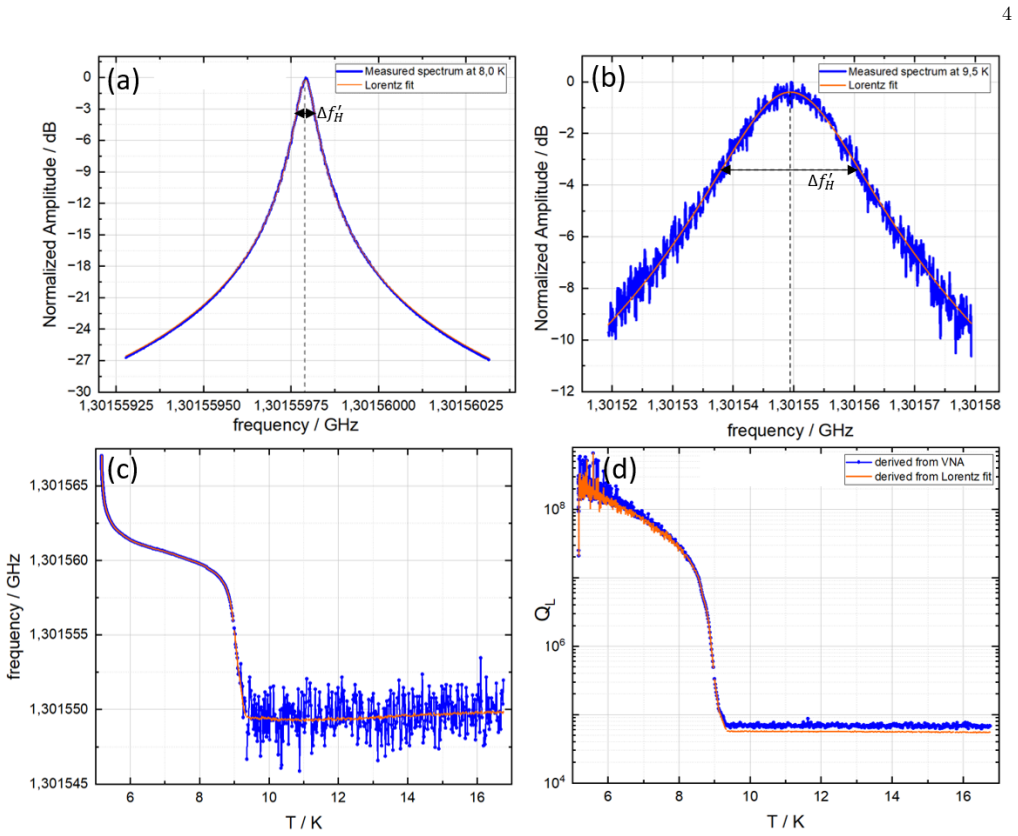
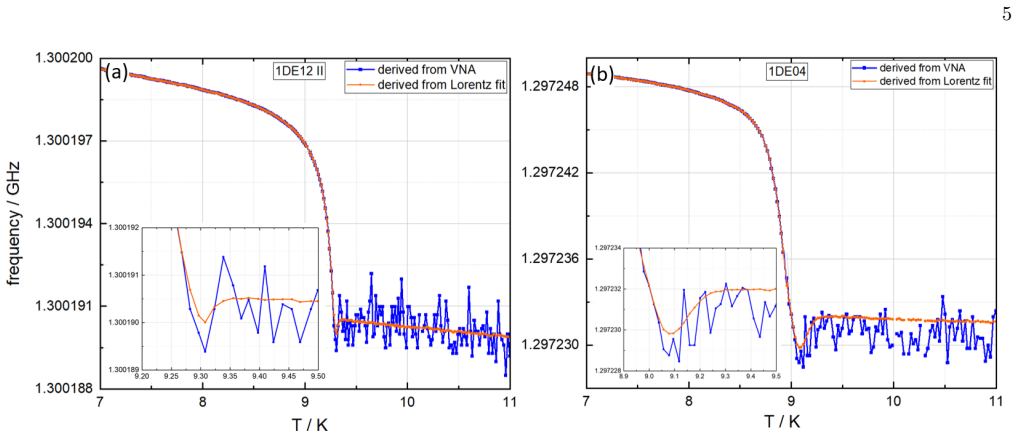
In its initial implementation, the system establishes a precise framework for determining the electron mean free path within both the superconducting penetration depth and the normal-conducting skin depth. It further enables investigation of an anomalous dip in the temperature dependence of the frequency shift near the critical temperature in cavities containing interstitial atoms in the near-surface lattice, a novel phenomenon previously reported in the literature.
What carries the argument
The dedicated frequency-shift measurement setup for SRF cavities during the superconducting-to-normal transition.
If this is right
- Determines electron mean free path in both superconducting penetration depth and normal-conducting skin depth.
- Enables investigation of the anomalous dip in frequency shift near the critical temperature.
- Supports studies of interstitial atom effects on superconducting properties in niobium cavities.
- The upgraded system allows comprehensive frequency shift and quality factor studies over the full temperature range above 7 K.
Where Pith is reading between the lines
- This method could lead to optimized surface treatments that improve cavity performance in particle accelerators.
- The anomalous dip might point to specific near-surface physics that affects superconductivity in modified materials.
- Reproducible measurements may allow standardized testing protocols across different cavity preparations.
Load-bearing premise
That the measured frequency shifts are dominated by changes in the electron mean free path and can be cleanly separated from geometric, surface-resistance, or setup-related contributions during the superconducting-to-normal transition.
What would settle it
A mismatch between observed frequency shifts and predictions from electron mean free path models, or the absence of the anomalous dip in cavities with interstitial atoms, would falsify the framework.
Figures



read the original abstract
The variation of the resonance frequency and intrinsic quality factor of superconducting radio-frequency cavities during the transition from the superconducting to the normal-conducting state provides essential insight into the fundamental superconducting properties of the cavity material. Investigating these transition dynamics is crucial for the continued advancement of niobium cavities whose near-surface regions are intentionally modified through the controlled introduction of interstitial atoms, such as oxygen and nitrogen, leading to the emergence of several novel behaviors whose underlying mechanisms are not yet fully understood. This work reports on the development and commissioning of a dedicated frequency-shift measurement setup. In its initial implementation, the system establishes a precise framework for determining the electron mean free path within both the superconducting penetration depth and the normal-conducting skin depth. It further enables investigation of an anomalous dip in the temperature dependence of the frequency shift near the critical temperature in cavities containing interstitial atoms in the near-surface lattice, a novel phenomenon previously reported in the literature. A recent upgrade, currently in the final stage of validation, significantly improves measurement accuracy and reproducibility. The improved setup enables comprehensive studies of the frequency shift and quality factor over the full temperature range above 7 K, contributing to a deeper understanding of the superconducting properties.
Editorial analysis
A structured set of objections, weighed in public.
Referee Report
Summary. The manuscript describes the development and commissioning of a dedicated frequency-shift measurement setup for SRF cavities at DESY. It claims that the initial implementation establishes a precise framework for determining the electron mean free path within both the superconducting penetration depth and the normal-conducting skin depth, while also enabling investigation of an anomalous dip in the temperature dependence of the frequency shift near Tc in cavities containing interstitial atoms. A recent upgrade is reported to improve accuracy and allow comprehensive studies above 7 K.
Significance. If the measured frequency shifts can be shown to be dominated by the temperature dependence of the electron mean free path with cleanly separable contributions, the setup would provide a useful experimental tool for probing superconducting properties in surface-modified niobium cavities, supporting ongoing advances in SRF technology. The detailed apparatus description and focus on the anomalous dip near Tc represent constructive contributions to the literature on interstitial-atom effects.
major comments (3)
- [Abstract] Abstract: The assertion that the initial implementation 'establishes a precise framework' for determining the electron mean free path l is not supported by any raw frequency-shift data, error budgets, or cross-checks against independent l measurements (e.g., DC resistivity or μSR), leaving the extraction method unverified.
- [Commissioning/results] Commissioning and results description: No quantitative protocol is given for subtracting geometric, residual surface-resistance Rs(T), trapped-flux, or thermal-contraction contributions from the observed Δf(T) during the SC-N transition; this separation is load-bearing for the central claim that Δf(T) is dominated by λ(l,T) and δ(l,T) via BCS or two-fluid relations.
- [Anomalous-dip section] Anomalous-dip discussion: While the setup is said to enable study of the anomalous dip near Tc, no new temperature-dependent frequency-shift curves, fitting results, or comparison to prior literature data are presented to demonstrate the capability.
minor comments (2)
- Notation for penetration depth λ and skin depth δ should be introduced explicitly with their temperature and mean-free-path dependence stated when first used.
- The manuscript would benefit from a dedicated error-analysis subsection or table summarizing uncertainty sources in the frequency-shift measurements.
Simulated Author's Rebuttal
We thank the referee for the thorough review and constructive comments on our manuscript describing the frequency-shift measurement setup for SRF cavities. We address each major comment below and will incorporate revisions to improve clarity and support for the claims.
read point-by-point responses
-
Referee: [Abstract] Abstract: The assertion that the initial implementation 'establishes a precise framework' for determining the electron mean free path l is not supported by any raw frequency-shift data, error budgets, or cross-checks against independent l measurements (e.g., DC resistivity or μSR), leaving the extraction method unverified.
Authors: We agree that the abstract phrasing implies stronger validation than the current text provides. The framework relies on the theoretical mapping from measured Δf(T) to l via BCS and two-fluid models for λ(l,T) and δ(l,T), but no raw data or error analysis is shown to demonstrate the extraction. In revision we will change the abstract to state that the setup 'provides a framework' and add a dedicated subsection with example raw Δf(T) traces, an explicit error budget for the l extraction, and a note that independent cross-checks (e.g., DC resistivity) are planned for future work but not yet available. revision: partial
-
Referee: [Commissioning/results] Commissioning and results description: No quantitative protocol is given for subtracting geometric, residual surface-resistance Rs(T), trapped-flux, or thermal-contraction contributions from the observed Δf(T) during the SC-N transition; this separation is load-bearing for the central claim that Δf(T) is dominated by λ(l,T) and δ(l,T) via BCS or two-fluid relations.
Authors: We accept that a quantitative subtraction protocol is required to justify the dominance of the superconducting contributions. The revised manuscript will include a new subsection detailing the protocol: geometric factors are determined from separate empty-cavity calibrations; Rs(T) is modeled with BCS theory using known material parameters; trapped-flux effects are bounded using the known linear dependence on residual field; and thermal-contraction corrections are applied via tabulated niobium expansion coefficients. Example numerical values and the resulting residual Δf(T) after subtraction will be shown to confirm that the λ and δ terms dominate near Tc. revision: yes
-
Referee: [Anomalous-dip section] Anomalous-dip discussion: While the setup is said to enable study of the anomalous dip near Tc, no new temperature-dependent frequency-shift curves, fitting results, or comparison to prior literature data are presented to demonstrate the capability.
Authors: The current text presents the anomalous dip as a capability enabled by the setup, referencing prior literature on interstitial-doped cavities, but does not include new data. To demonstrate the capability we will add a figure in the revised manuscript showing a representative Δf(T) curve from the commissioning run that exhibits the dip near Tc, together with a brief overlay comparison to published data on similar nitrogen-doped samples and a short discussion of the fitting approach used to quantify the feature. revision: yes
Circularity Check
No significant circularity in experimental setup description
full rationale
The paper describes the development and commissioning of a frequency-shift measurement apparatus for SRF cavities, claiming it establishes a framework for extracting electron mean free path from resonance frequency variations during the SC-N transition and for studying anomalous dips near Tc. No mathematical derivations, predictions, or theoretical chains appear in the provided text. The central claims concern the experimental setup and its intended application rather than any result that reduces by construction to fitted parameters, self-citations, or ansatzes defined within the same work. Assumptions about dominance of mean-free-path effects over geometric or resistance contributions are measurement-validity issues, not circular reductions. This is a standard experimental methods paper whose content is independent of any self-referential derivation.
Axiom & Free-Parameter Ledger
Reference graph
Works this paper leans on
-
[1]
Reschkeet al., Performance in the vertical test of the 832 nine-cell 1.3 GHz cavities for the European XFEL, Physical Review Accelerators and Beams20, 042004 (2017)
D. Reschkeet al., Performance in the vertical test of the 832 nine-cell 1.3 GHz cavities for the European XFEL, Physical Review Accelerators and Beams20, 042004 (2017)
2017
-
[2]
Auneet al., Superconducting TESLA cavities, Phys- ical Review Special Topics – Accelerators and Beams3, 092001 (2000)
B. Auneet al., Superconducting TESLA cavities, Phys- ical Review Special Topics – Accelerators and Beams3, 092001 (2000)
2000
-
[3]
Posenet al., Ultralow surface resistance via vacuum heat treatment of superconducting radio-frequency cavi- ties, Physical Review Applied13, 014024 (2020)
S. Posenet al., Ultralow surface resistance via vacuum heat treatment of superconducting radio-frequency cavi- ties, Physical Review Applied13, 014024 (2020)
2020
-
[4]
H. Itoet al., Influence of furnace baking on Q- E behavior of superconducting accelerating cavities, Progress of Theoretical and Experimental Physics2021, 10.1093/ptep/ptab056 (2021)
-
[5]
Z. Yanget al., Surface resistance effects of medium tem- perature baking of buffered chemical polished 1.3 GHz nine-cell large-grain cavities, Superconductor Science and Technology36, 10.1088/1361-6668/aca12a (2023)
-
[6]
Panet al., High Q and high gradient performance of the first medium-temperature baking 1.3 GHz cryomod- ule, Physical Review Accelerators and Beams27, 092003 (2024)
W. Panet al., High Q and high gradient performance of the first medium-temperature baking 1.3 GHz cryomod- ule, Physical Review Accelerators and Beams27, 092003 (2024)
2024
-
[7]
C. Bateet al., Correlation of SRF performance to oxygen diffusion length of medium-temperature heat- treated cavities, Superconductor Science and Technology 10.1088/1361-6668/ad9fe8 (2024), preprint available at arXiv:2407.07779
-
[8]
J. J. Goedecke, L. Steder, C. Bate, K. Kasprzak, D. Reschke, L. Trelle, H. Weise, and M. Wiencek, En- hancement of medium-temperature heat-treated srf cav- ities for high quality and high gradient, inProceedings of the 22nd International Conference on RF Superconduc- tivity (SRF 2025)(2025) pp. 274–279
2025
-
[9]
Bafiaet al., New insights on nitrogen doping, inPro- ceedings of SRF2019(2019)
D. Bafiaet al., New insights on nitrogen doping, inPro- ceedings of SRF2019(2019)
2019
-
[10]
Gonnella, J
D. Gonnella, J. Kaufman, and M. Liepe, Impact of ni- trogen doping of niobium superconducting cavities on the sensitivity of surface resistance to trapped magnetic flux, Journal of Applied Physics119, 073904 (2016)
2016
-
[11]
X. Fang, D. Gonnella, M. Checchin, S. Posen, Y. Trenikhina, A.-M. Valente-Feliciano, M. Liepe, and A. Grassellino, Understanding mechanism of perfor- mance improvement in nitrogen-doped niobium super- conducting radio frequency cavity, Materials Research Letters11, 108 (2023)
2023
-
[12]
Q. Zhou, F. S. He, W. Pan, S. Zha, M. Bi, and B. Liu, Medium-temperature baking of 1.3 GHz superconduct- ing radio-frequency single-cell cavity, Radiation Detec- tion Technology and Methods4, 507 (2020)
2020
-
[13]
Heet al., Medium-temperature furnace baking of 1.3 GHz 9-cell superconducting cavities at IHEP, Supercon- ductor Science and Technology34, 095005 (2021)
F. Heet al., Medium-temperature furnace baking of 1.3 GHz 9-cell superconducting cavities at IHEP, Supercon- ductor Science and Technology34, 095005 (2021)
2021
-
[14]
L. Stederet al., Further improvement of medium- temperature heat-treated SRF cavities for high gradients (2024), preprint available at arXiv:2407.12570
-
[15]
Dhakalet al., Impact of medium temperature heat treatment on flux trapping sensitivity in SRF cavities (2024)
P. Dhakalet al., Impact of medium temperature heat treatment on flux trapping sensitivity in SRF cavities (2024)
2024
-
[16]
Checchinet al., Electron mean free path dependence of the vortex surface impedance, Superconductor Science and Technology30, 034002 (2017)
M. Checchinet al., Electron mean free path dependence of the vortex surface impedance, Superconductor Science and Technology30, 034002 (2017)
2017
-
[17]
M. T. Gorter and H. Casimir, Zur thermodynamik des supraleitenden zustandes, inArchives du Mus´ ee Teyler (Springer, Dordrecht, 1935) pp. 55–60
1935
-
[18]
L. C. Maier and J. C. Slater, Field strength measure- ments in resonant cavities, Journal of Applied Physics 23, 68 (1952)
1952
-
[19]
Padamsee, J
H. Padamsee, J. Knobloch, and T. Hays,RF Supercon- ductivity for Accelerators, Wiley Series in Beam Physics and Accelerator Technology (Wiley, 1998)
1998
-
[20]
Bafiaet al., The anomalous resonant frequency varia- tion of microwave superconducting niobium cavities near Tc (2021), preprint available at arXiv
D. Bafiaet al., The anomalous resonant frequency varia- tion of microwave superconducting niobium cavities near Tc (2021), preprint available at arXiv
2021
-
[21]
Herman and R
F. Herman and R. Hlubina, Microwave response of su- perconductors that obey local electrodynamics, Physical Review B104, 094519 (2021)
2021
-
[22]
Bafiaet al., Investigation of frequency behavior near Tc of niobium superconducting radio-frequency cavities, inProceedings of SRF2019(2019)
D. Bafiaet al., Investigation of frequency behavior near Tc of niobium superconducting radio-frequency cavities, inProceedings of SRF2019(2019)
2019
-
[23]
Bafiaet al., Investigating the anomalous frequency 14 variations nearT c of Nb SRF cavities, inProceedings of SRF2021(2022) proceedings of SRF2021 Conference
D. Bafiaet al., Investigating the anomalous frequency 14 variations nearT c of Nb SRF cavities, inProceedings of SRF2021(2022) proceedings of SRF2021 Conference
2022
-
[24]
Ghanbariet al., Correlating lambda shift measure- ments with RF performance in Mid-T heat-treated cavi- ties, inProceedings of SRF2023(2023) pp
R. Ghanbariet al., Correlating lambda shift measure- ments with RF performance in Mid-T heat-treated cavi- ties, inProceedings of SRF2023(2023) pp. 124–128
2023
-
[25]
S. M. Moskaitiset al., Anomalous frequency shifts near Tc of fundamental and higher-order modes in medium- velocity 644 MHz superconducting elliptical cavities, inProceedings of the Linear Accelerator Conference (LINAC)(JACoW Publishing, 2024) pp. 352–354
2024
-
[26]
Y. Bozhkoet al., Cryogenics of european XFEL acceler- ator module test facility, inProceedings of the 23rd In- ternational Cryogenic Engineering Conference (ICEC23) (Wroclaw, Poland, 2010) pp. 911–918
2010
-
[27]
Polinskiet al., Design and commissioning of vertical test cryostats for XFEL superconducting cavities mea- surements, inAIP Conference Proceedings, Vol
J. Polinskiet al., Design and commissioning of vertical test cryostats for XFEL superconducting cavities mea- surements, inAIP Conference Proceedings, Vol. 1573 (American Institute of Physics, 2014) pp. 1214–1221
2014
-
[28]
Wenskat and J
M. Wenskat and J. Schaffran, Analysis of the cool down related cavity performance of the european X-ray free electron laser vertical acceptance tests, AIP Advances7, 112014 (2017)
2017
-
[29]
Delheusy, X-ray investigation of Nb/O interfaces (2008)
M. Delheusy, X-ray investigation of Nb/O interfaces (2008)
2008
-
[30]
J. Wolffet al., Impact of medium temperature heat treat- ments on the magnetic flux expulsion behavior of SRF cavities, inProceedings of the 21st International Confer- ence on RF Superconductivity (SRF’23)(Grand Rapids, USA, 2023) accessed October 2025
2023
-
[31]
Wenskatet al., Thermal transmittance measurements of niobium at cryogenic temperatures, Physica C: Super- conductivity and its Applications632, 1354694 (2025)
M. Wenskatet al., Thermal transmittance measurements of niobium at cryogenic temperatures, Physica C: Super- conductivity and its Applications632, 1354694 (2025)
2025
-
[32]
Desorbo, Effect of dissolved gases on some super- conducting properties of niobium, Physical Review130, 1696 (1963)
W. Desorbo, Effect of dissolved gases on some super- conducting properties of niobium, Physical Review130, 1696 (1963)
1963
-
[33]
E. L. Garwin and M. Rabinowitz, Resistivity ratio of nio- bium superconducting cavities, Applied Physics Letters 20, 154 (1972)
1972
-
[34]
A. B. P. Ip,Sound Waves of Finite Amplitude: An Ex- perimental and Theoretical Study of the Relation Between Magnetic Field and Current in a Superconductor, Tech. Rep. (Communications on Applied Mathematics, 1948)
1948
-
[35]
C. P. P. Jr., H. A. Farach, R. J. Creswick, and R. Pro- zorov,Superconductivity(Academic Press, Amsterdam, 2007)
2007
-
[36]
H. Uekiet al., Electromagnetic response of super- conducting RF cavities, Journal of the Physical So- ciety of Japan Conference Proceedings 10.7566/JP- SCP.38.011068 (2023)
work page doi:10.7566/jp- 2023
-
[37]
A. Lebedevaet al., Local limit disorder characteris- tics of superconducting radio frequency cavities (2024), 2409.04203
discussion (0)
Sign in with ORCID, Apple, or X to comment. Anyone can read and Pith papers without signing in.