Recognition: unknown
Synchrotron polarization of anisotropic electron distribution in GRB prompt emission
Pith reviewed 2026-05-08 10:24 UTC · model grok-4.3
The pith
Anisotropic electron pitch-angle distributions lower synchrotron polarization in GRB gamma-ray and X-ray bands relative to isotropic cases.
A machine-rendered reading of the paper's core claim, the machinery that carries it, and where it could break.
Core claim
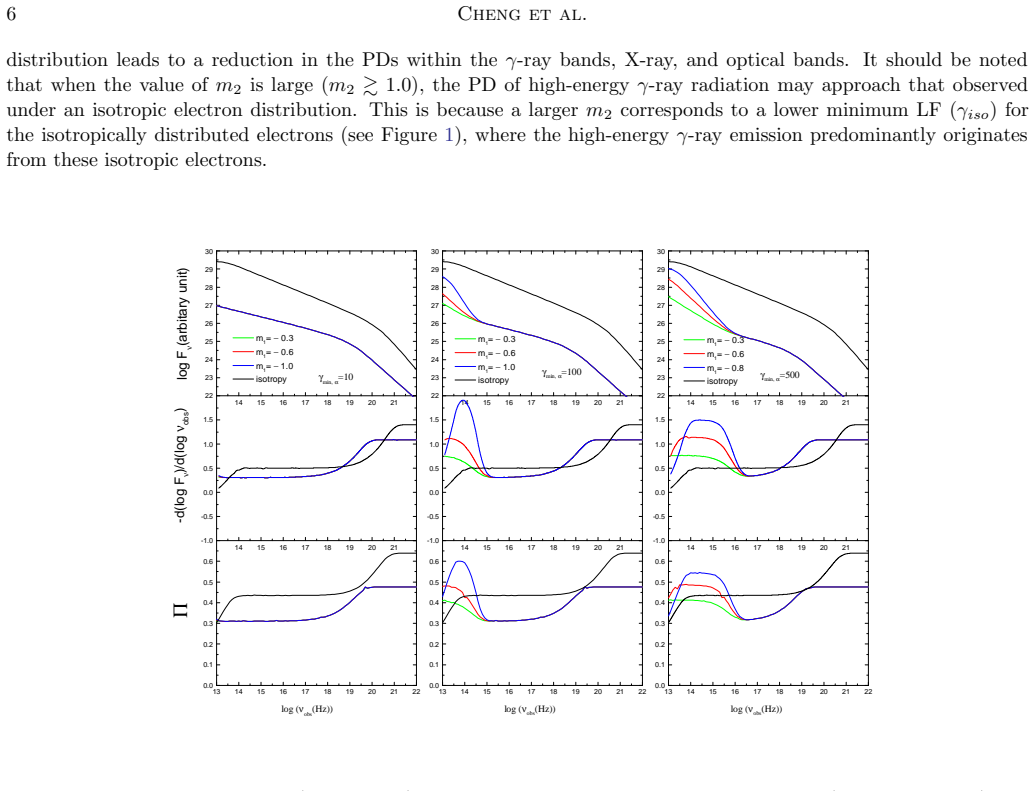
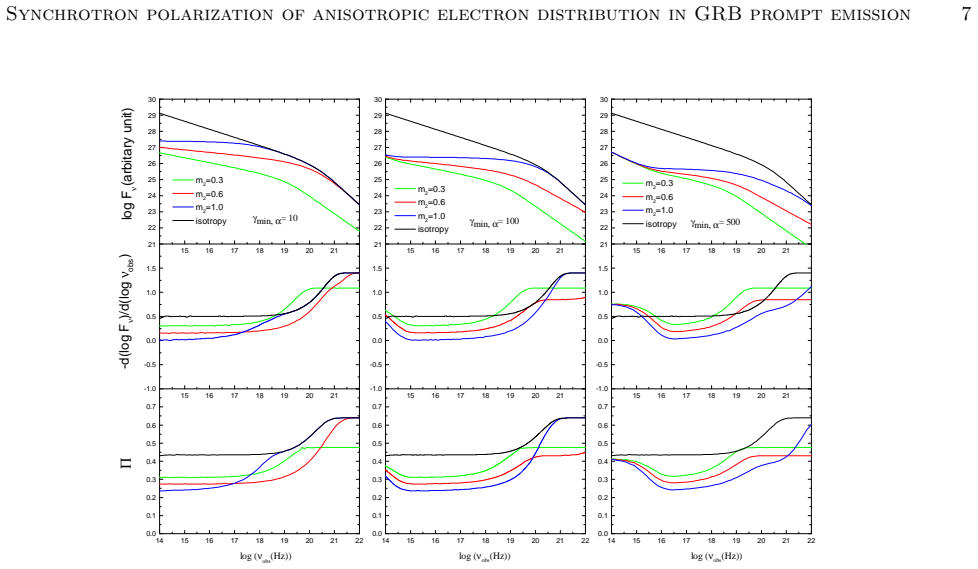
Within a globally toroidal magnetic field, the synchrotron polarization degrees produced by anisotropically distributed electrons are systematically lower in the gamma-ray and X-ray bands than those from isotropically distributed electrons. In the optical band the polarization degree can be either lower or higher depending on the value of the energy slope m. Numerical comparisons with data indicate that an anisotropic distribution may explain the polarization and spectral data of some gamma-ray bursts.
What carries the argument
The energy-dependent anisotropic electron pitch-angle distribution, where the mean value of sin squared alpha follows a power-law proportionality to gamma to the power m for Lorentz factors below gamma_iso while remaining isotropic above it, which modifies the synchrotron emissivity and Stokes parameters.
If this is right
- Polarization degrees in gamma-ray and X-ray bands are reduced compared to the isotropic electron case.
- Optical polarization can be either reduced or increased relative to isotropic, depending on the value of the slope m.
- The anisotropic model supplies a possible match to both polarization and spectral observations in some GRBs.
- Multi-band polarization measurements can be used to constrain the electron pitch-angle distribution in the emission region.
Where Pith is reading between the lines
- If the model holds, it would favor magnetic reconnection over shock acceleration as the dominant process setting the electron distribution in GRB jets.
- Simultaneous gamma-ray, X-ray, and optical polarimetry of future GRBs could provide a direct test of the predicted band-dependent polarization differences.
- The same anisotropic prescription might be applied to polarization calculations in other reconnection-powered sources such as pulsar wind nebulae or blazar jets.
Load-bearing premise
The specific anisotropic form for low-energy electrons, with mean sin squared alpha proportional to gamma to the m, that is taken from magnetic reconnection simulations applies directly to the GRB prompt emission region.
What would settle it
Observation of gamma-ray polarization degrees in GRBs that are not systematically lower than isotropic-model predictions, or optical polarization values that contradict the m-dependent range, would contradict the central results.
Figures



read the original abstract
In gamma-ray bursts (GRBs), the electron pitch angle ($\alpha$) is usually assumed to be isotropically distributed. However, recent numerical simulations indicate that only the high-energy electrons (with Lorentz factors $\gamma>\gamma_{iso}$) are distributed isotropically, whereas the low-energy electrons (with $\gamma<\gamma_{iso}$) follow an energy-dependent anisotropic distribution during magnetic reconnection. The mean value of $\sin^2 \alpha$ approximately follows the relation $\langle \sin^2 \alpha \rangle \propto \gamma^{m}$ for $\gamma<\gamma_{iso}$. In principle, polarization measurements may help us constrain the pitch-angle distribution of electrons in GRBs, since different pitch-angle distributions produce distinct synchrotron polarization signatures. The polarization of GRBs produced by isotropically distributed electrons has been extensively studied. In this paper, we investigate synchrotron polarization produced by anisotropically distributed electrons within a globally toroidal magnetic field in GRB prompt emission. Our results show that the synchrotron PDs in the $\gamma$-ray and X-ray bands produced by anisotropically distributed electrons are systematically lower than those produced by isotropically distributed electrons, while the PD in the optical band could be either lower or higher than that of isotropically distributed electrons, depending primarily on the value of the energy slope $m$. In addition, we compared our numerical results with observational data, and the comparison suggests that an anisotropic distribution of electrons may offer a potential explanation for the PD and spectral data of some GRBs.
Editorial analysis
A structured set of objections, weighed in public.
Referee Report
Summary. The paper claims that synchrotron polarization degrees (PDs) in GRB prompt emission, computed via numerical integration of the emissivity over an energy-dependent anisotropic electron pitch-angle distribution (⟨sin²α⟩ ∝ γ^m for γ < γ_iso) taken from magnetic reconnection simulations and embedded in a globally toroidal magnetic field, are systematically lower than the isotropic case in the γ-ray and X-ray bands; the optical PD can be lower or higher depending on m. A direct comparison of these numerical PDs with selected GRB observations is presented as suggesting that the anisotropy may help explain both PD and spectral data for some bursts.
Significance. If the imported pitch-angle distribution applies, the work supplies a concrete mechanism for the lower-than-expected PDs often seen in GRB prompt emission and generates an m-dependent prediction for the optical band that is in principle falsifiable with multi-wavelength polarimetry. The direct numerical integration over the assumed distribution is reproducible and avoids analytic approximations that might hide the anisotropy effects.
major comments (3)
- [Introduction / model setup] The functional form ⟨sin²α⟩ ∝ γ^m (for γ < γ_iso) is imported directly from reconnection simulations and inserted into the GRB prompt-emission calculation without derivation from GRB-relevant processes (shock acceleration, Weibel instability, or prompt-region turbulence) or robustness tests against other plausible anisotropies; this assumption is load-bearing for every reported PD offset relative to the isotropic case.
- [Results / data comparison] The comparison with observational PD and spectral data is described only as 'suggestive' and lacks quantitative fit statistics, error budgets, or explicit parameter choices for the GRB sample; without these it is impossible to judge whether the anisotropic model provides a statistically meaningful improvement over the isotropic baseline.
- [Numerical method / field geometry] All calculations assume a globally toroidal magnetic field geometry; the systematic PD reduction in the γ-ray/X-ray bands is not shown to survive under other plausible field configurations (e.g., tangled or radially dominated) that are also discussed in the GRB literature.
minor comments (2)
- The notation for the anisotropic distribution and the precise definition of γ_iso could be stated more explicitly in the equations to facilitate reproduction.
- A brief statement of the numerical integration method (quadrature scheme, energy and angle grids) would improve clarity.
Simulated Author's Rebuttal
We thank the referee for the constructive and detailed comments, which have helped us improve the clarity and scope of the manuscript. We address each major comment point by point below, indicating revisions where made.
read point-by-point responses
-
Referee: [Introduction / model setup] The functional form ⟨sin²α⟩ ∝ γ^m (for γ < γ_iso) is imported directly from reconnection simulations and inserted into the GRB prompt-emission calculation without derivation from GRB-relevant processes (shock acceleration, Weibel instability, or prompt-region turbulence) or robustness tests against other plausible anisotropies; this assumption is load-bearing for every reported PD offset relative to the isotropic case.
Authors: We acknowledge that the adopted functional form for the pitch-angle anisotropy is taken directly from magnetic reconnection simulations without a first-principles derivation tailored to GRB prompt-emission regions. Our study focuses on the observational implications of this distribution as reported in the simulation literature. We have added a dedicated paragraph in the Introduction discussing the potential applicability to GRB shocks (including references to related acceleration mechanisms) and explicitly noting the assumption's limitations. Robustness tests against alternative anisotropy prescriptions are beyond the scope of the present work but are highlighted as an important avenue for future investigation. revision: partial
-
Referee: [Results / data comparison] The comparison with observational PD and spectral data is described only as 'suggestive' and lacks quantitative fit statistics, error budgets, or explicit parameter choices for the GRB sample; without these it is impossible to judge whether the anisotropic model provides a statistically meaningful improvement over the isotropic baseline.
Authors: We agree that the data comparison remains qualitative and is appropriately labeled 'suggestive'. The model depends on multiple parameters (including m, γ_iso, and the bulk Lorentz factor), which precludes a straightforward statistical fit without additional priors. We have revised the relevant section to provide more explicit documentation of the parameter values adopted for each burst in the sample and to include a brief discussion of associated uncertainties. A full quantitative analysis (e.g., χ² minimization or Bayesian model comparison) would require an extensive parameter survey that we consider outside the scope of this initial exploration. revision: partial
-
Referee: [Numerical method / field geometry] All calculations assume a globally toroidal magnetic field geometry; the systematic PD reduction in the γ-ray/X-ray bands is not shown to survive under other plausible field configurations (e.g., tangled or radially dominated) that are also discussed in the GRB literature.
Authors: The globally toroidal field is chosen because it permits high polarization degrees in the isotropic-electron case, thereby isolating the effect of the pitch-angle anisotropy. We recognize that other geometries (tangled or radial) are also discussed in the GRB literature and would generally suppress overall PDs. We have added a short paragraph in the Conclusions noting that the reported anisotropy-induced reduction is most relevant for ordered-field configurations and that the interplay with disordered fields remains to be quantified in future work. revision: partial
Circularity Check
No significant circularity; results follow from numerical integration over imported distribution
full rationale
The central results are obtained by direct numerical integration of the synchrotron emissivity and polarization over the assumed anisotropic pitch-angle distribution ⟨sin²α⟩ ∝ γ^m (γ < γ_iso) taken from external reconnection simulations, inserted into a toroidal B-field geometry. This produces PD values in γ-ray, X-ray, and optical bands that are outputs of the integration, not equivalent by construction to the input distribution or to any fitted GRB data. The comparison with observational data is a post-hoc suggestion of possible explanation and does not involve parameter fitting that would render the predictions tautological. No self-citation load-bearing steps, self-definitional relations, or ansatzes smuggled via citation are present in the derivation chain.
Axiom & Free-Parameter Ledger
free parameters (1)
- m
axioms (2)
- domain assumption Low-energy electrons follow an energy-dependent anisotropic pitch-angle distribution with ⟨sin²α⟩ ∝ γ^m for γ < γ_iso.
- domain assumption The magnetic field in the GRB prompt emission region is globally toroidal.
Reference graph
Works this paper leans on
-
[1]
1993, ApJ, 413, 281, doi: 10.1086/172995
Band, D., Matteson, J., Ford, L., et al. 1993, ApJ, 413, 281, doi: 10.1086/172995
-
[2]
Hard X-Ray Polarization Catalog for a Five-year Sample of Gamma-Ray Bursts Using AstroSat CZT Imager
Chattopadhyay, T., Gupta, S., Iyyani, S., et al. 2022, ApJ, 936, 12, doi: 10.3847/1538-4357/ac82ef 12Cheng et al
-
[3]
2025, ApJ, 985, 112, doi: 10.3847/1538-4357/add1d7 —
Cheng, K., Mao, J., Zhao, X., et al. 2025, ApJ, 985, 112, doi: 10.3847/1538-4357/add1d7 —. 2024a, ApJ, 975, 277, doi: 10.3847/1538-4357/ad8234
-
[4]
2024b, A&A, 687, A128, doi: 10.1051/0004-6361/202348050
Cheng, K., Zhao, X., Mao, J., & Chen, Z. 2024b, A&A, 687, A128, doi: 10.1051/0004-6361/202348050
-
[5]
Cheng, K. F., Zhao, X. H., & Bai, J. M. 2020, MNRAS, 498, 3492, doi: 10.1093/mnras/staa2595
-
[6]
2024, ApJ, 972, 9, doi: 10.3847/1538-4357/ad51fe
Comisso, L. 2024, ApJ, 972, 9, doi: 10.3847/1538-4357/ad51fe
-
[7]
2023, ApJ, 959, 137, doi: 10.3847/1538-4357/ad1241
Comisso, L., & Jiang, B. 2023, ApJ, 959, 137, doi: 10.3847/1538-4357/ad1241
-
[8]
2019, ApJ, 886, 122, doi: 10.3847/1538-4357/ab4c33 —
Comisso, L., & Sironi, L. 2019, ApJ, 886, 122, doi: 10.3847/1538-4357/ab4c33 —. 2021, PhRvL, 127, 255102, doi: 10.1103/PhysRevLett.127.255102 —. 2022, ApJL, 936, L27, doi: 10.3847/2041-8213/ac8422
-
[9]
Comisso, L., Sobacchi, E., & Sironi, L. 2020, ApJL, 895, L40, doi: 10.3847/2041-8213/ab93dc Di Gesu, L., Donnarumma, I., Tavecchio, F., et al. 2022, ApJL, 938, L7, doi: 10.3847/2041-8213/ac913a
-
[10]
Eichler, D., Livio, M., Piran, T., & Schramm, D. N. 1989, Nature, 340, 126, doi: 10.1038/340126a0
-
[11]
Errando, M., Liodakis, I., Marscher, A. P., et al. 2024, ApJ, 963, 5, doi: 10.3847/1538-4357/ad1ce4
-
[12]
The Astrophysical Journal960(1), 87 (2024) https://doi.org/10.3847/1538-4357/acfc43
Feng, Z.-K., Liu, H.-B., Xie, F., et al. 2024, ApJ, 960, 87, doi: 10.3847/1538-4357/acfc43
-
[13]
Ghisellini, G., Celotti, A., & Lazzati, D. 2000, MNRAS, 313, L1, doi: 10.1046/j.1365-8711.2000.03354.x
-
[14]
2021, MNRAS, 504, 1939, doi: 10.1093/mnras/stab1013
Gill, R., & Granot, J. 2021, MNRAS, 504, 1939, doi: 10.1093/mnras/stab1013 —. 2024a, MNRAS, 527, 12178, doi: 10.1093/mnras/stad3991 —. 2024b, MNRAS, 527, 12178, doi: 10.1093/mnras/stad3991
-
[15]
Gill, R., Granot, J., & Kumar, P. 2020, MNRAS, 491, 3343, doi: 10.1093/mnras/stz2976
-
[16]
2026, MNRAS, doi: 10.1093/mnras/stag452
Gill, R., He, J., Granot, J., et al. 2026, MNRAS, doi: 10.1093/mnras/stag452
-
[17]
2022, ApJ, 933, 18, doi: 10.3847/1538-4357/ac67d5
Goto, R., & Asano, K. 2022, ApJ, 933, 18, doi: 10.3847/1538-4357/ac67d5
- [18]
-
[19]
Granot, J., & K¨ onigl, A. 2003, ApJL, 594, L83, doi: 10.1086/378733
-
[20]
Granot, J., & Taylor, G. B. 2005, ApJ, 625, 263, doi: 10.1086/429536
-
[21]
Kaneko, Y., Preece, R. D., Briggs, M. S., et al. 2006, ApJS, 166, 298, doi: 10.1086/505911
-
[22]
2024, arXiv e-prints, arXiv:2406.05783, doi: 10.48550/arXiv.2406.05783
Kole, M., de Angelis, N., Bacelj, A., et al. 2024, arXiv e-prints, arXiv:2406.05783, doi: 10.48550/arXiv.2406.05783
-
[23]
M., Liodakis , I., Middei , R., et al
Kouch, P. M., Liodakis, I., Middei, R., et al. 2024, A&A, 689, A119, doi: 10.1051/0004-6361/202449166
-
[24]
The Physics of Gamma-Ray Bursts and Relativistic Jets
Kumar, P., & Zhang, B. 2015, PhR, 561, 1, doi: 10.1016/j.physrep.2014.09.008
work page Pith review doi:10.1016/j.physrep.2014.09.008 2015
-
[25]
2019, ApJ, 870, 96, doi: 10.3847/1538-4357/aaf41d
Lan, M.-X., Geng, J.-J., Wu, X.-F., & Dai, Z.-G. 2019, ApJ, 870, 96, doi: 10.3847/1538-4357/aaf41d
-
[26]
2021, ApJ, 909, 184, doi: 10.3847/1538-4357/abe3fb
Lan, M.-X., Wang, H.-B., Xu, S., Liu, S., & Wu, X.-F. 2021, ApJ, 909, 184, doi: 10.3847/1538-4357/abe3fb
-
[27]
2025, ApJ, 988, 202, doi: 10.3847/1538-4357/ade4c4 M´ esz´ aros, P
Mai, Q., Liu, H., Tuo, J., et al. 2025, ApJ, 988, 202, doi: 10.3847/1538-4357/ade4c4 M´ esz´ aros, P. 2006, Reports on Progress in Physics, 69, 2259, doi: 10.1088/0034-4885/69/8/R01
-
[28]
2003, JCAP, 2003, 005, doi: 10.1088/1475-7516/2003/10/005
Nakar, E., Piran, T., & Waxman, E. 2003, JCAP, 2003, 005, doi: 10.1088/1475-7516/2003/10/005
-
[29]
2004, Reviews of Modern Physics, 76, 1143, doi: 10.1103/RevModPhys.76.1143
Piran, T. 2004, Reviews of Modern Physics, 76, 1143, doi: 10.1103/RevModPhys.76.1143
-
[30]
Preece, R. D., Briggs, M. S., Mallozzi, R. S., et al. 2000, ApJS, 126, 19, doi: 10.1086/313289
-
[31]
Rossi, E. M., Lazzati, D., Salmonson, J. D., & Ghisellini, G. 2004, MNRAS, 354, 86, doi: 10.1111/j.1365-2966.2004.08165.x
-
[32]
B., & Lightman, A
Rybicki, G. B., & Lightman, A. P. 1979, Radiative processes in astrophysics
1979
-
[33]
1998, ApJL, 497, L17, doi: 10.1086/311269
Sari, R., Piran, T., & Narayan, R. 1998, ApJL, 497, L17, doi: 10.1086/311269
-
[34]
Sazonov, V. N. 1969, Soviet Ast., 13, 396
1969
-
[35]
2009, ApJ, 698, 1042, doi: 10.1088/0004-637X/698/2/1042
Toma, K., Sakamoto, T., Zhang, B., et al. 2009, ApJ, 698, 1042, doi: 10.1088/0004-637X/698/2/1042
-
[36]
Uhm, Z. L., & Zhang, B. 2014, Nature Physics, 10, 351, doi: 10.1038/nphys2932
-
[37]
2025, ApJ, 994, 194, doi: 10.3847/1538-4357/ae12ee
Wang, X.-Y., Li, J.-S., & Lan, M.-X. 2025, ApJ, 994, 194, doi: 10.3847/1538-4357/ae12ee
-
[38]
Woosley, S. E. 1993, ApJ, 405, 273, doi: 10.1086/172359
-
[39]
2018, ApJL, 864, L16, doi: 10.3847/2041-8213/aada4f
Yang, Y.-P., & Zhang, B. 2018, ApJL, 864, L16, doi: 10.3847/2041-8213/aada4f
-
[40]
2011, ApJL, 743, L30, doi: 10.1088/2041-8205/743/2/L30
Yonetoku, D., Murakami, T., Gunji, S., et al. 2011, ApJL, 743, L30, doi: 10.1088/2041-8205/743/2/L30
-
[41]
2002, ApJ, 571, 876, doi: 10.1086/339981
Zhang, B., & M´ esz´ aros, P. 2002, ApJ, 571, 876, doi: 10.1086/339981
-
[42]
2019, Science China Physics, Mechanics, and Astronomy, 62, 29502, doi: 10.1007/s11433-018-9309-2
Zhang, S., Santangelo, A., Feroci, M., et al. 2019, Science China Physics, Mechanics, and Astronomy, 62, 29502, doi: 10.1007/s11433-018-9309-2
-
[43]
2025, Science China Physics, Mechanics, and Astronomy, 68, 119502, doi: 10.1007/s11433-025-2786-6
Zhang, S.-N., Santangelo, A., Xu, Y., et al. 2025, Science China Physics, Mechanics, and Astronomy, 68, 119502, doi: 10.1007/s11433-025-2786-6
-
[44]
2014, ApJ, 780, 12, doi: 10.1088/0004-637X/780/1/12
Zhao, X., Li, Z., Liu, X., et al. 2014, ApJ, 780, 12, doi: 10.1088/0004-637X/780/1/12
-
[45]
2025, ApJ, 986, 32, doi: 10.3847/1538-4357/add0ac
Zhong, Q., Liu, H.-B., Cheng, K., et al. 2025, ApJ, 986, 32, doi: 10.3847/1538-4357/add0ac
discussion (0)
Sign in with ORCID, Apple, or X to comment. Anyone can read and Pith papers without signing in.