Recognition: unknown
Measuring Epistemic Unfairness for Algorithmic Decision-Making
Pith reviewed 2026-05-08 09:06 UTC · model grok-4.3
The pith
A deficit-based framework quantifies epistemic injustice in algorithms as gaps in credibility, uptake, and agency that persist even when predictive fairness holds.
A machine-rendered reading of the paper's core claim, the machinery that carries it, and where it could break.
Core claim
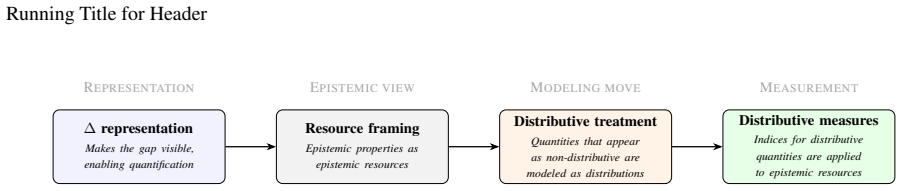
We propose a quantitative framework for evaluating forms of epistemic injustice in algorithmic environments. First, we introduce a deficit-based template that models epistemic injustices as gaps between ideal and realized conditions across features such as credibility, uptake, and epistemic agency. We map these deficits to concrete stages of algorithmic mediation, showing how epistemic injustice can persist even when standard fairness constraints are satisfied. Drawing on distributive fairness indices, we distinguish two evaluation stances: resource inequality, where indices are applied to distributions of epistemic goods directly, and capability/rights inequity, where indices are applied to
What carries the argument
A deficit-based template that treats epistemic injustices as measurable gaps in credibility, uptake, and epistemic agency, mapped onto algorithmic mediation stages, then evaluated with translated distributive fairness indices in either resource or capability stances.
If this is right
- Epistemic unfairness can be detected and tracked separately from standard predictive fairness metrics.
- The indices identify distinct patterns such as exclusionary tails and hierarchical concentration in access to epistemic goods.
- Audits can be performed longitudinally as algorithms are updated iteratively.
- In recommender-mediated settings the indices register changes in epistemic unfairness driven by repeated platform interventions.
Where Pith is reading between the lines
- The same deficit template could be tested on non-recommender systems such as search or content moderation to check whether epistemic gaps appear in those mediation stages as well.
- If the indices are deployed in live systems, one could measure whether changes in the indices precede observable shifts in user belief diversity or participation rates.
- Regulators might require these epistemic measures alongside accuracy audits when approving high-impact algorithmic tools.
Load-bearing premise
Epistemic ideas like credibility and agency can be turned into precise numerical deficits that fit algorithmic steps without losing their original meaning or creating unresolvable measurement conflicts.
What would settle it
Run the recommender opinion-dynamics simulation with balanced predictive fairness constraints; if the epistemic indices stay near zero while users show reduced access to diverse information or lowered willingness to share beliefs, the framework fails to capture the intended harms.
Figures



read the original abstract
Algorithmic systems increasingly function as epistemic infrastructures that govern the conditions of interpretative access and social belief. Yet, mainstream auditing strategies operationalize fairness primarily in predictive terms - error rates, calibration, or group-level parity - leaving epistemic harms under-theorized and under-measured. We propose a quantitative framework for evaluating forms of epistemic injustice in algorithmic environments. First, we introduce a deficit-based template that models epistemic injustices as gaps between ideal and realized conditions across features such as credibility, uptake, and epistemic agency. We map these deficits to concrete stages of algorithmic mediation, showing how epistemic injustice can persist even when standard fairness constraints are satisfied. Drawing on distributive fairness indices, we distinguish two evaluation stances: resource inequality, where indices are applied to distributions of epistemic goods directly, and capability/rights inequity, where indices are applied to output-induced epistemic opportunity. We provide an epistemic translation of canonical indices, illustrating how they diagnose complementary signatures of unfairness - such as exclusionary tails and hierarchical concentration - and support longitudinal auditing under iterative deployment. We also provide a simulation study of a recommender-mediated opinion dynamics setting, showing how the proposed indices capture the evolution of epistemic unfairness under repeated platform interventions. The result is a measurement framework that makes the epistemic dimension of algorithmic harms explicit for system design and evaluation.
Editorial analysis
A structured set of objections, weighed in public.
Referee Report
Summary. The manuscript proposes a quantitative framework for evaluating epistemic injustice in algorithmic systems. It introduces a deficit-based template modeling gaps in credibility, uptake, and epistemic agency mapped to stages of algorithmic mediation, adapts distributive fairness indices under resource-inequality and capability-inequity stances, and presents a simulation of recommender-mediated opinion dynamics to illustrate that epistemic unfairness can persist even when standard predictive fairness constraints are satisfied.
Significance. If the indices are shown to be independent of standard fairness metrics, the work would provide a valuable extension of auditing tools to epistemic harms such as exclusionary tails and hierarchical concentration in belief formation. The simulation study offers a concrete demonstration in an iterative setting, and the use of established indices supports longitudinal evaluation. These elements position the framework as a practical addition for system design beyond predictive parity.
major comments (2)
- The central claim that epistemic deficits persist independently of standard fairness metrics lacks an explicit orthogonality check. The recommender opinion-dynamics simulation does not report results for interventions that satisfy demographic parity or equalized odds and whether those drive the proposed epistemic indices to zero; without this, the persistence result risks reducing to a restatement of existing fairness violations rather than identifying a new dimension.
- The deficit-based template and its epistemic translation of canonical indices are presented conceptually without formal equations or derivation steps showing how credibility/uptake/agency gaps are quantified from algorithmic outputs. This leaves the mapping open to post-hoc fitting concerns and makes it difficult to verify that the indices capture variation not already present in the data distributions used by standard metrics.
minor comments (2)
- The abstract states that the framework supports longitudinal auditing under iterative deployment, yet the simulation results section does not include time-series plots or analysis of index evolution across repeated platform interventions.
- Notation for the translated indices (e.g., how resource vs. capability versions differ mathematically) would benefit from explicit definitions or pseudocode rather than purely descriptive text.
Simulated Author's Rebuttal
We thank the referee for the constructive feedback, which helps clarify the independence of the epistemic framework and strengthens its formal presentation. We address each major comment below and commit to revisions that directly incorporate the suggested checks and formalizations.
read point-by-point responses
-
Referee: The central claim that epistemic deficits persist independently of standard fairness metrics lacks an explicit orthogonality check. The recommender opinion-dynamics simulation does not report results for interventions that satisfy demographic parity or equalized odds and whether those drive the proposed epistemic indices to zero; without this, the persistence result risks reducing to a restatement of existing fairness violations rather than identifying a new dimension.
Authors: We agree that an explicit orthogonality demonstration is necessary to establish the framework as capturing a distinct dimension. In the revised manuscript, we will extend the simulation section with new experiments that enforce demographic parity and equalized odds constraints on the recommender interventions. We will report the corresponding epistemic index trajectories (under both resource-inequality and capability-inequity stances) and show that they remain strictly positive, with quantitative tables and plots comparing them to the unconstrained case. This will directly address the concern that the persistence result might collapse to standard fairness violations. revision: yes
-
Referee: The deficit-based template and its epistemic translation of canonical indices are presented conceptually without formal equations or derivation steps showing how credibility/uptake/agency gaps are quantified from algorithmic outputs. This leaves the mapping open to post-hoc fitting concerns and makes it difficult to verify that the indices capture variation not already present in the data distributions used by standard metrics.
Authors: We acknowledge that the current conceptual presentation would benefit from explicit formalization to enable verification and reduce ambiguity. The revised manuscript will add a new subsection (Section 3.1) containing: (i) formal definitions of the deficit template, e.g., credibility deficit as the expected difference between an agent's ground-truth expertise-based credibility score and the algorithmically assigned score derived from output logits or rankings; (ii) step-by-step derivations translating the Gini coefficient and Theil index to epistemic goods under both evaluation stances, with explicit formulas showing how gaps in uptake and agency are extracted from algorithmic outputs; and (iii) a brief variance decomposition argument demonstrating that the epistemic indices are not linear functions of the input feature distributions used by standard metrics. These additions will allow readers to replicate the mapping and confirm the captured variation. revision: yes
Circularity Check
No circularity: framework extends canonical indices via explicit translation and simulation
full rationale
The derivation introduces a deficit template mapping epistemic concepts to algorithmic stages and translates existing distributive fairness indices into resource-inequality and capability-inequity stances. These steps rely on external canonical indices rather than self-defining the target quantities or fitting parameters to the outputs being audited. The simulation demonstrates evolution under interventions without reducing the epistemic signatures to the same predictive fairness metrics by construction. No self-citation chains, uniqueness theorems, or ansatzes imported from prior author work appear as load-bearing elements. The central claim of complementary signatures is therefore independent of the inputs.
Axiom & Free-Parameter Ledger
axioms (1)
- domain assumption Epistemic injustices can be modeled as gaps between ideal and realized conditions in credibility, uptake, and epistemic agency.
Reference graph
Works this paper leans on
-
[1]
Epistemic injustices and curriculum: Strategizing for justice.Social Sciences & Humanities Open11 (2025), 101220. [Baker and Hawn(2022)] Ryan S Baker and Aaron Hawn. 2022. Algorithmic bias in education.International journal of artificial intelligence in education32, 4 (2022), 1052–1092. [Barocas et al.(2020)] Solon Barocas, Moritz Hardt, and Arvind Naraya...
-
[2]
On the information unfairness of social networks. InProceedings of the 2020 SIAM International Conference on Data Mining. SIAM, 613–521. [Keyes(2018)] Os Keyes. 2018. The misgendering machines: Trans/HCI implications of automatic gender recognition. Proceedings of the ACM on human-computer interaction2, CSCW (2018), 1–22. [Kim(2022)] Junyeol Kim. 2022. De...
-
[3]
In2nd European Workshop on Algorithmic Fairness, EWAF 2023
Qualification and quantification of fairness for sustainable mobility policies. In2nd European Workshop on Algorithmic Fairness, EWAF 2023. CEUR-WS. org, 29. [Quaresmini et al.(2025)] Camilla Quaresmini, Eugenia Villa, Samira Maghool, Valentina Breschi, Viola Schaffonati, and Mara Tanelli. 2025. The Role of Epistemic Fairness in Dynamics Models to Support...
discussion (0)
Sign in with ORCID, Apple, or X to comment. Anyone can read and Pith papers without signing in.