Recognition: 2 theorem links
· Lean TheoremBiTA: Bidirectional Gated Recurrent Unit-Transformer Aggregator in a Temporal Graph Network Framework for Alert Prediction in Computer Networks
Pith reviewed 2026-05-13 19:57 UTC · model grok-4.3
The pith
BiTA redesigns the temporal aggregation step inside TGNs by combining bidirectional GRU sequential encoding with Transformer long-range context over each node's history.
A machine-rendered reading of the paper's core claim, the machinery that carries it, and where it could break.
Core claim
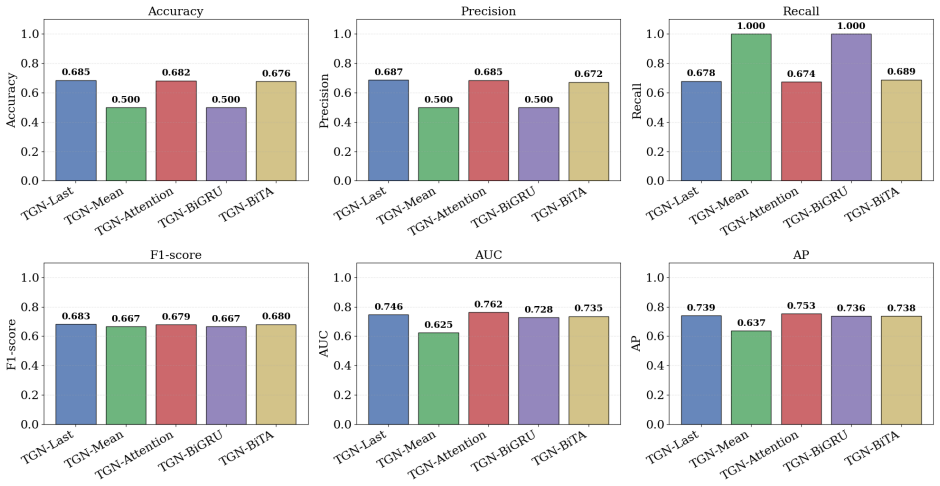
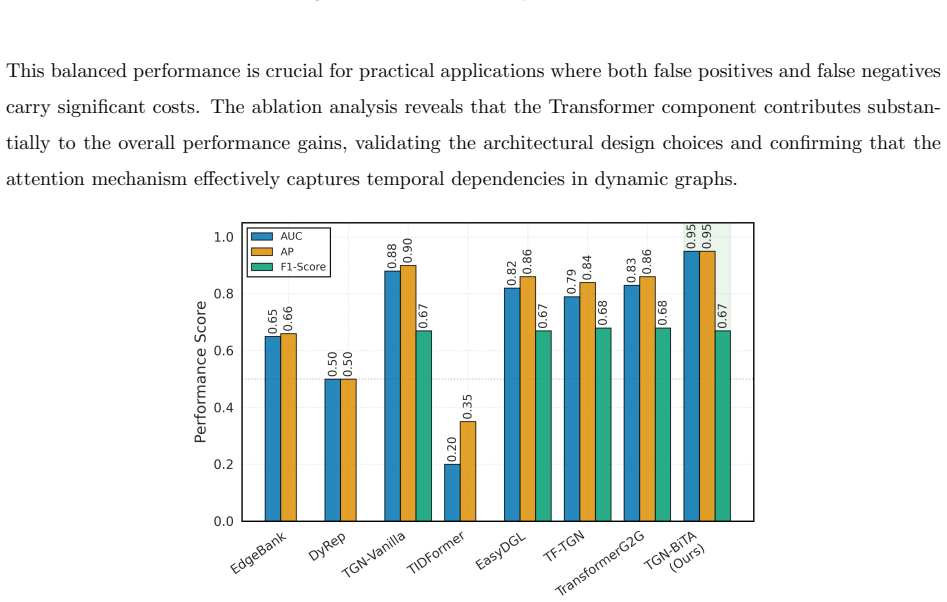
BiTA redesigns the temporal aggregation function within the TGN framework by jointly encoding bidirectional sequential dependencies and long-range contextual relations over each node's temporal neighborhood, enabling complementary temporal reasoning at different scales while preserving the original TGN memory and message-passing structure. On real-world alert datasets the method yields measurable gains in AUC, average precision, mean reciprocal rank, and per-category accuracy versus prior TGN variants under both transductive and inductive evaluation.
What carries the argument
Bidirectional Gated Recurrent Unit-Transformer Aggregator (BiTA), which processes each node's temporal neighborhood by running a bidirectional GRU for sequential order and a Transformer for distant relations in one step.
If this is right
- The same TGN memory and message-passing backbone can support richer temporal reasoning without architectural overhaul.
- Attack prediction improves on both seen and previously unseen nodes and edges.
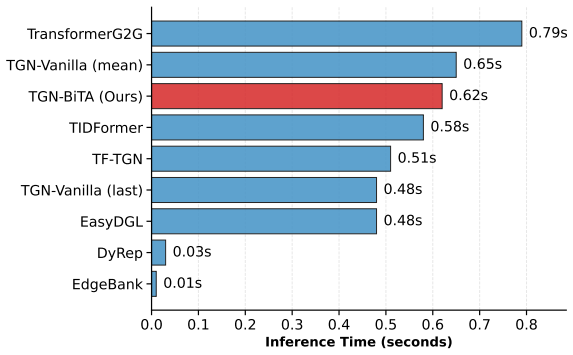
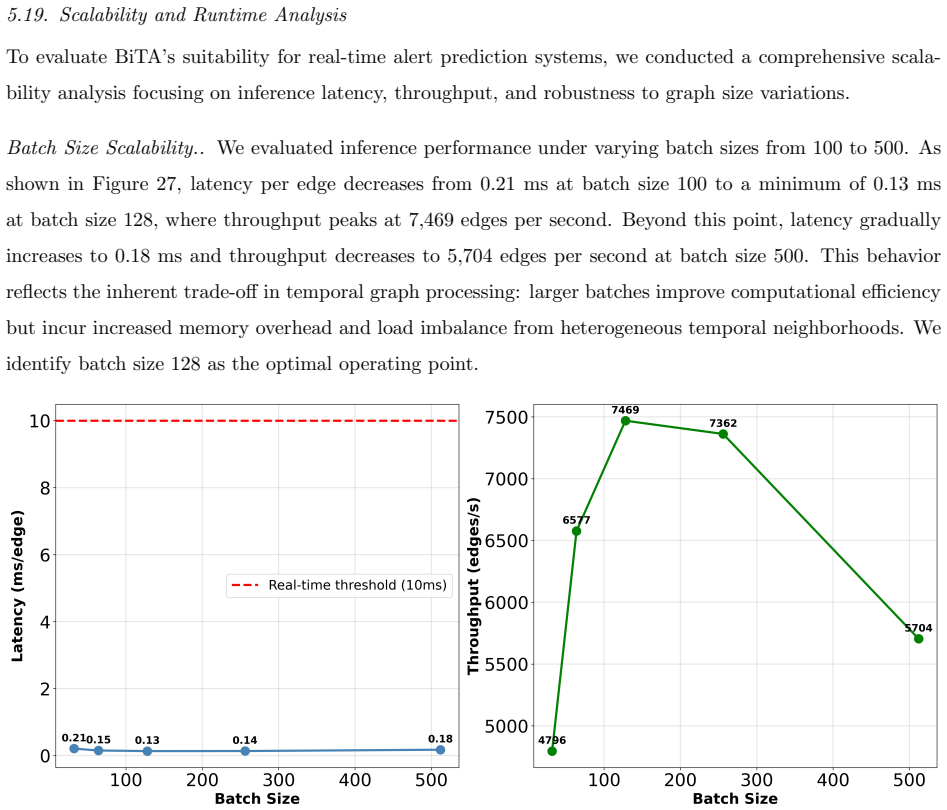
- The approach remains computationally scalable for real-time use because it reuses the original TGN structure.
- Per-category accuracy rises, allowing more precise identification of distinct threat types.
Where Pith is reading between the lines
- Similar bidirectional-plus-context aggregators could be swapped into other temporal graph tasks such as user behavior modeling or traffic forecasting.
- The design suggests a general pattern for upgrading any memory-based temporal model by adding a parallel long-range attention path.
- If the performance lift holds on larger, noisier logs it could reduce the need for deeper or wider networks in intrusion detection pipelines.
Load-bearing premise
Jointly encoding bidirectional sequences and long-range relations through GRU plus Transformer will capture the multi-scale recursive timing of attacks more reliably than unidirectional or single-mechanism aggregators.
What would settle it
An ablation study on the same alert datasets in which the bidirectional GRU or the Transformer component is removed and the resulting model shows no drop in AUC or average precision relative to the full BiTA.
Figures










read the original abstract
Proactive alert prediction in computer networks is critical for mitigating evolving cyber threats and enabling timely defensive actions. Temporal Graph Neural Networks (TGNs) provide a principled framework for modeling time-evolving interactions; however, existing TGN-based methods predominantly rely on unidirectional or single-mechanism temporal aggregation, which limits their ability to capture recursive, multi-scale temporal patterns commonly observed in real-world attack behaviors. In this paper, we propose BiTA, a Bidirectional Gated Recurrent Unit-Transformer Aggregator for temporal graph learning. Rather than introducing a deeper or higher-capacity model, BiTA redesigns the temporal aggregation function within the TGN framework by jointly encoding bidirectional sequential dependencies and long-range contextual relations over each node's temporal neighborhood. This aggregation strategy enables complementary temporal reasoning at different scales while preserving the original TGN memory and message-passing structure. We evaluate BiTA on real-world alert datasets, demonstrating significant improvements in key performance metrics such as area under the curve, average precision, mean reciprocal rank, and per-category prediction accuracy when compared to state-of-the-art temporal graph models. BiTA outperforms baseline methods under both transductive and inductive settings, highlighting its robustness and generalization capabilities in dynamic network environments. BiTA is a scalable and interpretable framework for real-time cyber threat anticipation, paving the way toward more intelligent and adaptive intrusion detection systems.
Editorial analysis
A structured set of objections, weighed in public.
Referee Report
Summary. The manuscript proposes BiTA, a Bidirectional Gated Recurrent Unit-Transformer Aggregator integrated into the Temporal Graph Network (TGN) framework for proactive alert prediction in computer networks. It redesigns the temporal aggregation function to jointly encode bidirectional sequential dependencies and long-range contextual relations over each node's temporal neighborhood, enabling complementary multi-scale temporal reasoning while preserving the original TGN memory and message-passing structure. The approach is evaluated on real-world alert datasets and claims significant improvements in AUC, average precision, mean reciprocal rank, and per-category accuracy over state-of-the-art temporal graph models under both transductive and inductive settings.
Significance. If the performance gains are genuine and the aggregator maintains strict temporal causality, BiTA offers a practical architectural refinement for modeling recursive, multi-scale temporal patterns in dynamic network graphs. This could strengthen proactive cyber threat anticipation in intrusion detection systems by improving upon unidirectional or single-mechanism aggregators without requiring changes to core TGN components, potentially aiding adoption in real-time security applications.
major comments (1)
- BiTA Aggregator (description of the joint bidirectional GRU-Transformer encoding): The bidirectional GRU risks violating temporal causality, as the reverse pass can incorporate events with timestamps > t unless explicitly masked. The abstract states that BiTA 'preserves the original TGN memory and message-passing structure,' but provides no details on time-aware masking or causal enforcement in the aggregator. This is load-bearing for the central claim, because any reported gains in AUC/AP/MRR could stem from non-causal leakage rather than improved capture of attack dynamics. Please supply the exact forward/reverse pass equations, masking implementation, or pseudocode to confirm that no future information influences the state at time t.
minor comments (2)
- Abstract: The claim of 'significant improvements' in key metrics is stated without any numerical values, dataset sizes, or baseline comparisons; adding the top-line results (e.g., AUC deltas) would make the summary self-contained.
- Evaluation: Confirm that all reported metric improvements include error bars or statistical tests across multiple runs to substantiate outperformance claims.
Simulated Author's Rebuttal
We thank the referee for the detailed and constructive review. The concern about temporal causality in the BiTA aggregator is important, and we address it directly below with a commitment to strengthen the manuscript.
read point-by-point responses
-
Referee: BiTA Aggregator (description of the joint bidirectional GRU-Transformer encoding): The bidirectional GRU risks violating temporal causality, as the reverse pass can incorporate events with timestamps > t unless explicitly masked. The abstract states that BiTA 'preserves the original TGN memory and message-passing structure,' but provides no details on time-aware masking or causal enforcement in the aggregator. This is load-bearing for the central claim, because any reported gains in AUC/AP/MRR could stem from non-causal leakage rather than improved capture of attack dynamics. Please supply the exact forward/reverse pass equations, masking implementation, or pseudocode to confirm that no future information influences the state at time t.
Authors: We agree that explicit causal enforcement must be demonstrated. In BiTA, the temporal neighborhood for each node at time t consists solely of events with timestamps ≤ t. The bidirectional GRU processes this sequence as follows: the forward GRU pass iterates from the oldest to the newest event before t; the reverse GRU pass iterates from the newest event before t backwards to the oldest, with no access to any future events. The Transformer self-attention is likewise restricted to this same causal sequence via a lower-triangular mask. We will add the exact forward/reverse GRU update equations, the masking procedure, and pseudocode in the revised Section 3.2 to make this explicit and rule out leakage. revision: yes
Circularity Check
No circularity: architectural redesign with independent evaluation
full rationale
The paper proposes BiTA as a redesign of the temporal aggregation function inside the existing TGN framework, combining bidirectional GRU and Transformer components to capture multi-scale patterns while preserving the original memory and message-passing structure. No equations, derivations, or parameter-fitting steps are described that reduce the claimed performance gains (AUC, AP, MRR) to fitted inputs or self-referential quantities by construction. The contribution is evaluated empirically on real-world alert datasets against external baselines under transductive and inductive settings, with no load-bearing self-citations or uniqueness theorems invoked to justify the architecture. The derivation chain is therefore self-contained and does not collapse to its own inputs.
Axiom & Free-Parameter Ledger
Lean theorems connected to this paper
-
IndisputableMonolith/Foundation/ArrowOfTime.leanarrow_from_z unclearBiTA redesigns the temporal aggregation function within the TGN framework by jointly encoding bidirectional sequential dependencies and long-range contextual relations over each node's temporal neighborhood... preserves the original TGN memory and message-passing structure.
-
IndisputableMonolith/Foundation/AbsoluteFloorClosure.leanreality_from_one_distinction unclearStrict causality is a fundamental requirement... BiTA modifies only the message aggregation stage and does not alter the memory update protocol of TGN... input to the BiTA aggregator consists exclusively of historical messages with timestamps ti ≤ t.
Reference graph
Works this paper leans on
-
[1]
Ansari, M. S., Bartos, V., & Lee, B. (2020). Shallow and deep learning approaches for network intrusion alert prediction.Procedia Computer Science,171, 644–653
work page 2020
-
[2]
Ansari, M. S., Bartoˇ s, V., & Lee, B. (2022). GRU-based deep learning approach for network intrusion alert prediction.Future Generation Computer Systems,128, 235–247. URL:https://www.researchgate. net/publication/355133237
-
[3]
An Empirical Evaluation of Generic Convolutional and Recurrent Networks for Sequence Modeling
Bai, S., Kolter, J. Z., & Koltun, V. (2018). An empirical evaluation of generic convolutional and recurrent networks for sequence modeling.arXiv preprint arXiv:1803.01271,
work page internal anchor Pith review Pith/arXiv arXiv 2018
-
[4]
Chen, C., Geng, H., Yang, N., Yang, X., & Yan, J. (2024). Easydgl: Encode, train and interpret for continuous-time dynamic graph learning.IEEE Transactions on Pattern Analysis and Machine Intelli- gence,
work page 2024
-
[5]
Fu, C., Pei, W., Cao, Q., Zhang, C., Zhao, Y., Shen, X., & Tai, Y.-W. (2019). Non-local recurrent neural memory for supervised sequence modeling. InProceedings of the IEEE/CVF International Conference on Computer Vision(pp. 6311–6320)
work page 2019
-
[6]
X., Han, Z., Fu, F., Zhang, W., & Jiang, J
Huang, Q., Yan, X., Wang, X., Rao, S. X., Han, Z., Fu, F., Zhang, W., & Jiang, J. (2024). Retrofitting temporal graph neural networks with transformer.arXiv preprint arXiv:2409.05477, . Hus´ ak, M., Bajtoˇ s, T., Kaˇ spar, J., Bou-Harb, E., &ˇCeleda, P. (2020). Predictive cyber situational awareness and personalized blacklisting: a sequential rule mining ...
-
[7]
Kacha, P., Kostenec, M., & Kropacova, A. (2015). Warden 3: Security event exchange redesign. InProceed- ings of the 19th International Conference on Computers: Recent Advances in Computer Science
work page 2015
-
[8]
Kearney, P., Abdelsamea, M., Schmoor, X., Shah, F., & Vickers, I. (2023). Combating alert fatigue in the security operations centre.Available at SSRN 4633965, . 49
work page 2023
-
[9]
Nayeri, Z. M., & Rezvani, M. (2024). Alert prediction in computer networks using deep graph learning. In 2024 10th International Conference on Signal Processing and Intelligent Systems (ICSPIS)(pp. 1–5). IEEE
work page 2024
-
[10]
Nayeri, Z. M., & Rezvani, M. (2026). Alert prediction in computer networks using transformer-based temporal graph neural networks: Identifying the next victim.Journal of Network and Computer Applications, (p. 104455)
work page 2026
-
[11]
Oguntoyinbo, M. (2025). Mitigating the risk as soc alert analyst and incident responder,
work page 2025
-
[12]
Peng, J., Wei, Z., & Ye, Y. (2025). Tidformer: Exploiting temporal and interactive dynamics makes a great dynamic graph transformer. InProceedings of the 31st ACM SIGKDD Conference on Knowledge Discovery and Data Mining V. 2(pp. 2245–2256)
work page 2025
-
[13]
Poursafaei, F., Huang, S., Pelrine, K., & Rabbany, R. (2022). Towards better evaluation for dynamic link prediction.Advances in Neural Information Processing Systems,35, 32928–32941
work page 2022
-
[14]
Riebe, T., Wirth, T., Bayer, M., K¨ uhn, P., Kaufhold, M.-A., Knauthe, V., Guthe, S., & Reuter, C. (2021). Cysecalert: An alert generation system for cyber security events using open source intelligence data. In International Conference on Information and Communications Security(pp. 429–446). Springer
work page 2021
- [15]
-
[16]
Siyan, A., & Sans, M. (2024). Machine learning in cyber security: Enhancing soc operations with predictive analytics,
work page 2024
-
[17]
Trivedi, R., Farajtabar, M., Biswal, P., & Zha, H. (2019). Dyrep: Learning representations over dynamic graphs. InInternational conference on learning representations
work page 2019
-
[18]
J., Bora, A., Xu, M., & Karniadakis, G
Varghese, A. J., Bora, A., Xu, M., & Karniadakis, G. E. (2024). Transformerg2g: Adaptive time-stepping for learning temporal graph embeddings using transformers.Neural Networks,172, 106086
work page 2024
- [19]
-
[20]
Xu, D., Ruan, C., Korpeoglu, E., Kumar, S., & Achan, K. (2020). Inductive representation learning on temporal graphs.arXiv preprint arXiv:2002.07962, . 50 Zahra Makki Nayeriis a Ph.D. candidate at Shahrood University of Technology and currently a visiting researcher at the University of Stuttgart, Germany, where she conducts research on knowledge graph fo...
discussion (0)
Sign in with ORCID, Apple, or X to comment. Anyone can read and Pith papers without signing in.