Predicting Wind Loads on Container Ships in Harbor Environments through Multi-Fidelity Modeling
Pith reviewed 2026-05-08 12:21 UTC · model grok-4.3
The pith
Multi-fidelity surrogate models using recursive co-kriging predict wind loads on modern container ships in harbors more accurately and with less computation than single-fidelity or empirical methods.
A machine-rendered reading of the paper's core claim, the machinery that carries it, and where it could break.
Core claim
The authors establish that their recursive co-kriging multi-fidelity surrogate, built from empirical correlations plus simplified and detailed flow simulations for open-sea and harbor settings, produces accurate wind-load coefficient predictions that depend correctly on key geometric parameters and require far fewer high-fidelity runs than direct simulation.
What carries the argument
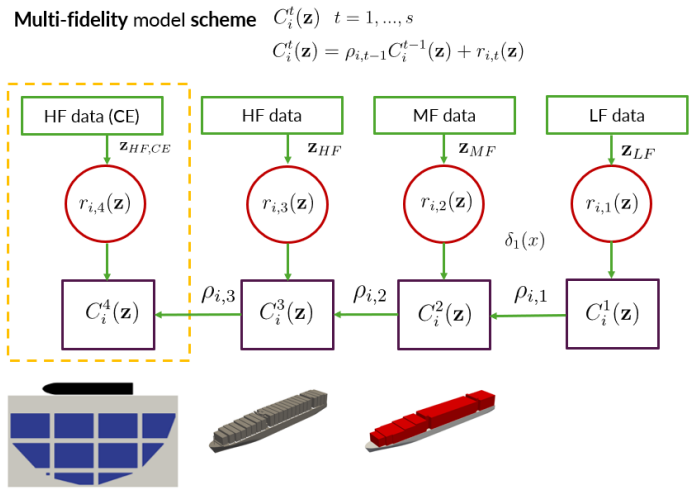
recursive co-kriging, which systematically merges data from three levels of model fidelity to create a single surrogate that respects the relationships between cheap approximations and expensive accurate ones.
If this is right
- The surrogate models accurately predict wind loads for various loading configurations in two harbor environments.
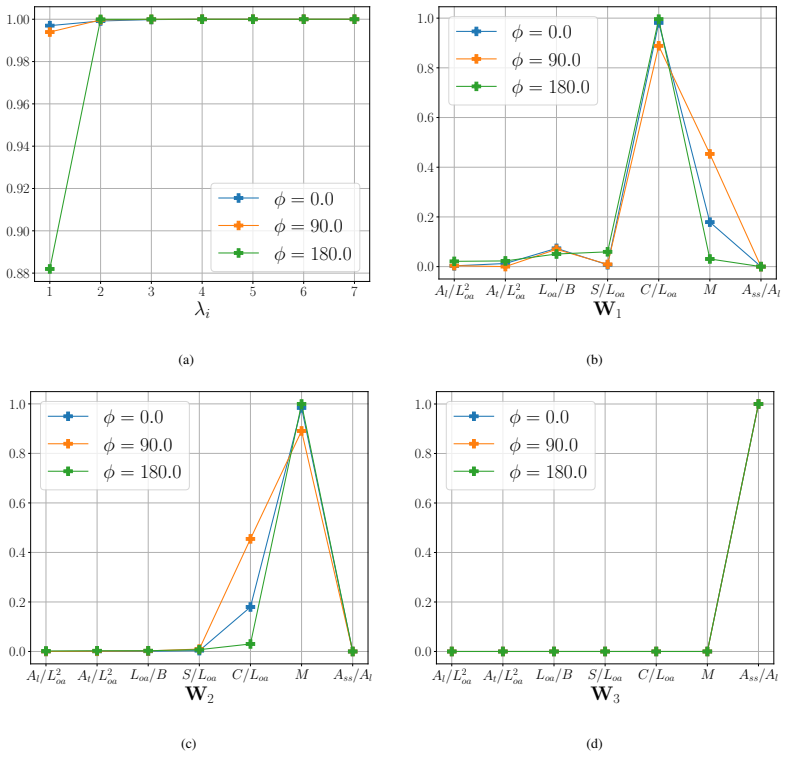
- The framework captures dependence on geometric parameters identified by sensitivity analysis.
- It consistently outperforms traditional empirical correlations.
Where Pith is reading between the lines
- Engineers could apply the same framework to explore many ship designs quickly during early stages.
- The approach may extend to other problems involving wind or fluid forces where models of varying accuracy exist.
- Adjusting the low-fidelity models for specific harbor features could make predictions even more reliable for complex port layouts.
Load-bearing premise
The method assumes that the low-fidelity models, originally developed for open-sea conditions, transfer reliably to harbor geometries when fused through recursive co-kriging.
What would settle it
Running the multi-fidelity predictor on a container ship geometry and harbor configuration never seen during training and then comparing its output directly to a new set of high-fidelity flow simulation results or physical measurements; large discrepancies would indicate the fusion step fails.
Figures









read the original abstract
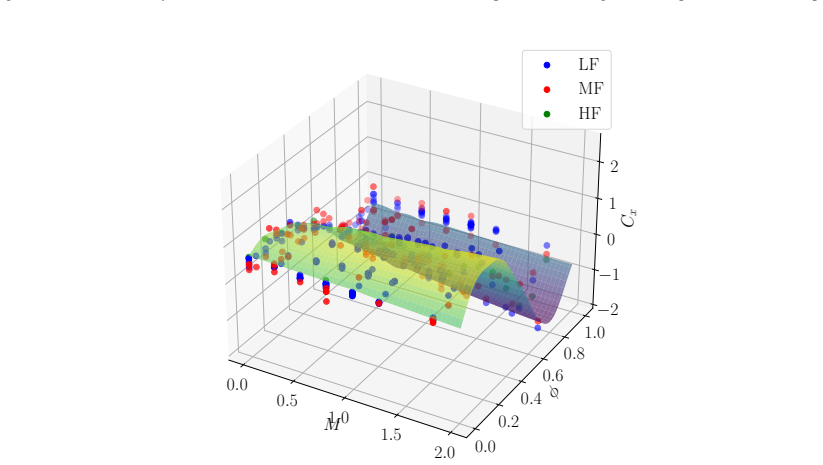
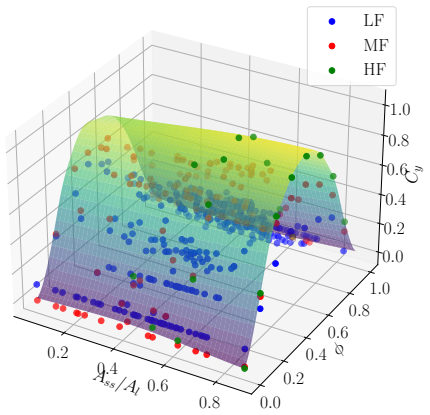
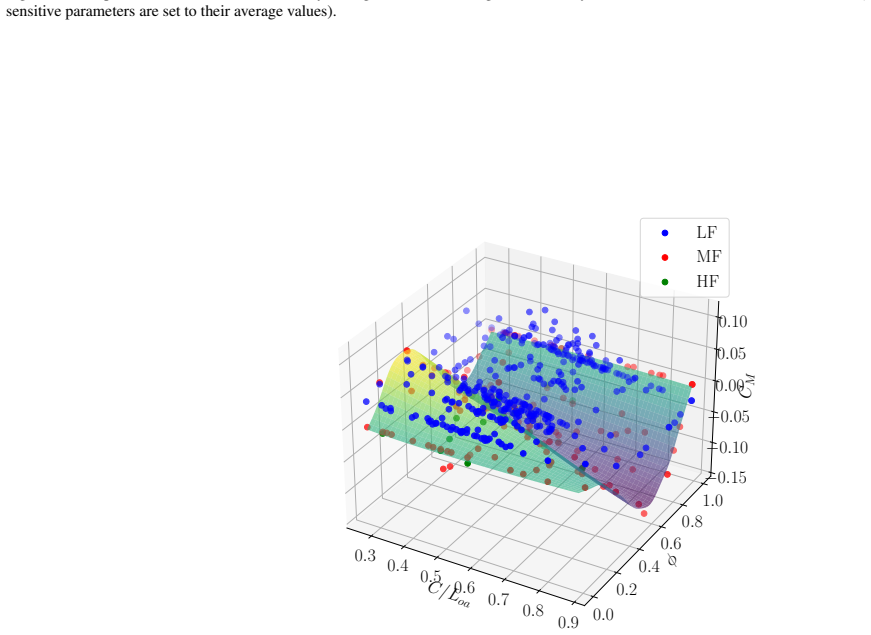
Modern container ships face higher wind loads due to increased windage areas, making accurate predictions of wind loads essential for mooring design. Existing empirical models, largely developed for container ships with smaller windage areas and simpler geometrical configurations than those of modern large-scale vessels, often lack accuracy and do not account for the influence of nearby structures. This study proposes a multi-fidelity surrogate modelling framework for the prediction of wind-load coefficients, combining empirical correlations with simplified and detailed CFD models for ships in open-sea and harbor environments. The approach relies on recursive co-kriging to consistently fuse information across fidelity levels, enabling accurate predictions at a reduced computational cost. A sensitivity analysis is used to identify the most influential geometric parameters, and the resulting reduced parameter space is explored through sequential sampling to efficiently construct the training database. The surrogate models are validated over a wide range of loading configurations and for two distinct harbor environments. The results demonstrate that the multi-fidelity approach significantly improves prediction accuracy compared to single-fidelity models, while substantially reducing the reliance on high-fidelity simulations. In particular, the proposed framework captures the dependence of wind loads on key geometric parameters and consistently outperforms traditional empirical correlations, providing a robust and efficient tool for engineering applications.
Editorial analysis
A structured set of objections, weighed in public.
Referee Report
Summary. The manuscript presents a multi-fidelity surrogate modeling framework for predicting wind-load coefficients on modern container ships in harbor settings. It integrates empirical correlations, simplified CFD, and high-fidelity CFD using recursive co-kriging, incorporates sensitivity analysis for parameter reduction, and uses sequential sampling. The models are validated across loading configurations and two harbor environments, with claims of superior accuracy to single-fidelity approaches and empirical models, alongside reduced computational demands.
Significance. Should the quantitative validations confirm the reported accuracy improvements and computational savings, this framework would offer a practical advancement for naval architecture and mooring system design. By efficiently capturing geometric parameter dependencies and harbor effects, it could lower the barrier to accurate wind load predictions for large vessels where traditional empirical models fall short.
major comments (3)
- [Abstract] Abstract: The central claim that the multi-fidelity approach 'significantly improves prediction accuracy' and 'consistently outperforms traditional empirical correlations' is stated without any supporting quantitative metrics, such as specific error reductions, R² values, or references to validation tables/figures. This absence prevents assessment of whether the improvements are substantial enough to justify the framework's adoption.
- [Methodology] Methodology (recursive co-kriging description): The recursive co-kriging fusion of low-fidelity open-sea models with harbor high-fidelity data assumes the hierarchical discrepancy function adequately models additional physics like shielding and reflections from nearby structures. However, the manuscript provides no explicit check or validation that the correlation structure holds under this domain shift, raising the possibility of systematic bias in predictions for certain wind directions or ship positions, which directly impacts the claimed reduction in high-fidelity simulations.
- [Validation] Validation: The validation over a wide range of loading configurations and two harbor environments is described, but without details on how the post-hoc parameter reduction from sensitivity analysis interacts with the outperformance claims or the cross-validation strategy, it remains unclear whether the results robustly support reduced reliance on high-fidelity data.
minor comments (1)
- [Introduction] Introduction: The discussion of increased windage areas in modern ships could benefit from a brief quantitative comparison to older vessels to better contextualize the problem scale.
Simulated Author's Rebuttal
We thank the referee for the constructive comments, which help clarify key aspects of the work. We address each major point below and will revise the manuscript accordingly to strengthen the presentation of results and methodology.
read point-by-point responses
-
Referee: [Abstract] Abstract: The central claim that the multi-fidelity approach 'significantly improves prediction accuracy' and 'consistently outperforms traditional empirical correlations' is stated without any supporting quantitative metrics, such as specific error reductions, R² values, or references to validation tables/figures. This absence prevents assessment of whether the improvements are substantial enough to justify the framework's adoption.
Authors: We agree that the abstract's brevity omits specific metrics. The full manuscript reports these in Section 4 (e.g., R² > 0.92 and 15-25% error reduction vs. empirical models in Tables 3-5 and Figures 6-8). We will revise the abstract to include representative quantitative values and cross-references to the validation results. revision: yes
-
Referee: [Methodology] Methodology (recursive co-kriging description): The recursive co-kriging fusion of low-fidelity open-sea models with harbor high-fidelity data assumes the hierarchical discrepancy function adequately models additional physics like shielding and reflections from nearby structures. However, the manuscript provides no explicit check or validation that the correlation structure holds under this domain shift, raising the possibility of systematic bias in predictions for certain wind directions or ship positions, which directly impacts the claimed reduction in high-fidelity simulations.
Authors: The recursive co-kriging is intended to capture domain-shift effects via the discrepancy term, and overall validation across wind directions and positions supports its effectiveness. However, we acknowledge the lack of an explicit correlation-structure diagnostic for the discrepancy function. We will add this analysis in the revised methodology section, including plots of predicted vs. observed discrepancies for representative wind angles and positions. revision: yes
-
Referee: [Validation] Validation: The validation over a wide range of loading configurations and two harbor environments is described, but without details on how the post-hoc parameter reduction from sensitivity analysis interacts with the outperformance claims or the cross-validation strategy, it remains unclear whether the results robustly support reduced reliance on high-fidelity data.
Authors: The sensitivity analysis (Section 3.2) reduces the parameter space before sequential sampling, and cross-validation is performed on the resulting design. To clarify the interaction, we will expand Section 4 with additional discussion and metrics showing accuracy retention after reduction and details of the k-fold cross-validation procedure used to quantify the savings in high-fidelity evaluations. revision: yes
Circularity Check
No circularity: multi-fidelity fusion and validation are independent of target outputs
full rationale
The paper applies standard recursive co-kriging to fuse three fidelity levels (empirical correlations, simplified CFD, detailed CFD) for wind-load coefficients on container ships. Training data are generated via sequential sampling in a reduced parameter space identified by sensitivity analysis, and models are validated on held-out configurations across two harbor environments. No equation or claim equates the final prediction to a parameter fitted from the same target data; the outperformance versus single-fidelity baselines is shown empirically. The derivation chain therefore remains self-contained and does not reduce by construction to its inputs.
Axiom & Free-Parameter Ledger
axioms (1)
- domain assumption Recursive co-kriging can consistently fuse multi-fidelity information without systematic bias across open-sea and harbor geometries.
Reference graph
Works this paper leans on
-
[1]
N. K. Park, S. C. Suh, Tendency toward mega container- ships and the constraints of container terminals, Journal of Marine Science and Engineering 7 (5) (2019) 131
work page 2019
-
[2]
M. A. Gomez Paz, A. Camarero Orive, N. Gonzalez Can- celas, Use of the delphi method to determine the con- straints that affect the future size of large container ships, Maritime Policy & Management 42 (3) (2015) 263–277
work page 2015
- [3]
-
[4]
S. Torre, M. Burlando, D. Ruscelli, M. Repetto, G. Ca- mauli, Wind tunnel experimental investigation of the aero- dynamic coefficients reduction due to sheltering surround- ings on a cruise ship moored in port, Journal of Wind Engineering and Industrial Aerodynamics 218 (2021) 104731
work page 2021
-
[5]
K. Yan, J. Oh, D.-W. Seo, Computational analysis for es- timation of mooring force acting on various ships in bu- san new port, Journal of Marine Science and Engineering 11 (9) (2023) 1649
work page 2023
-
[6]
I. M. V . Andersen, Wind loads on post-panamax container ship, Ocean engineering 58 (2013) 115–134
work page 2013
-
[7]
Aage, Wind coefficients for nine ship models, Hydro and Aerodynamics Laboratory Report (1971)
C. Aage, Wind coefficients for nine ship models, Hydro and Aerodynamics Laboratory Report (1971)
work page 1971
-
[8]
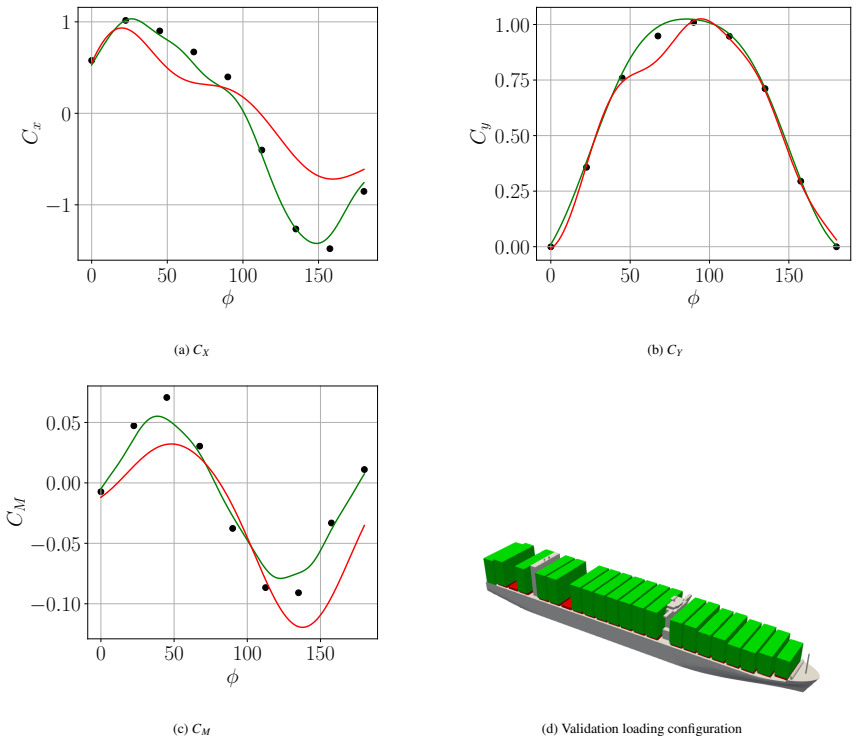
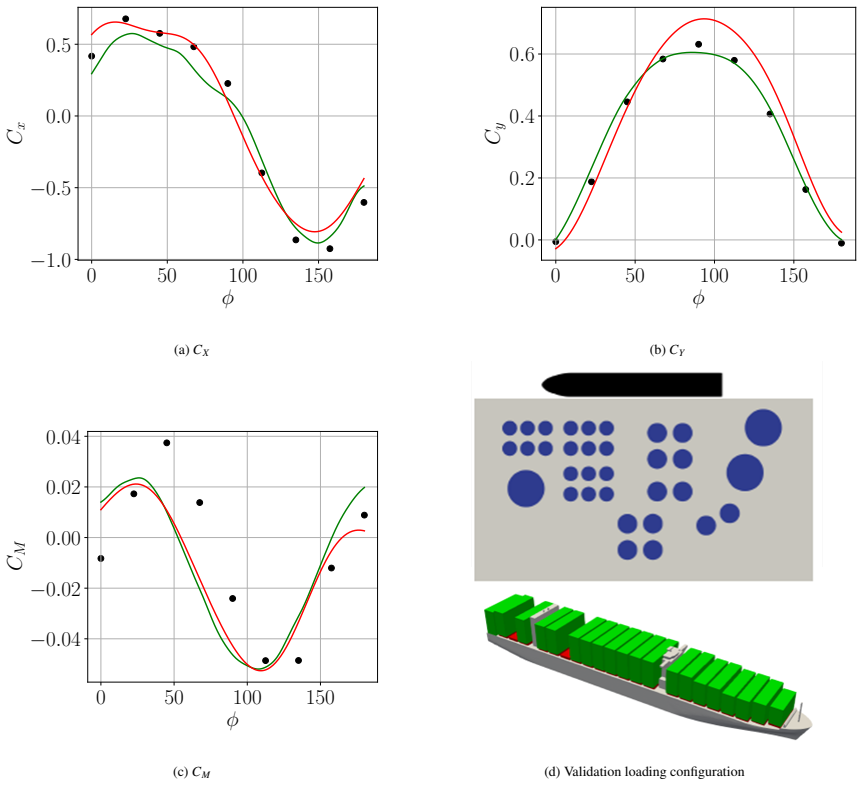
W. Blendermann, K. Hellwig, E. Schuckert, Wind loads on a passenger/car ferry by cfd computations and wind tunnel tests, Ship Technology Research 58 (2) (2011) 82– 88. 25 0 50 100 150 φ □1.0 □0.5 0.0 0.5 Cx (a)C X 0 50 100 150 φ 0.0 0.2 0.4 0.6 Cy (b)C Y 0 50 100 150 φ □0.04 □0.02 0.00 0.02 0.04 CM (c)C M (d) Validation loading configuration Figure 29: Co...
work page 2011
-
[9]
W. Blendermann, Parameter identification of wind loads on ships, Journal of Wind Engineering and Industrial Aerodynamics 51 (3) (1994) 339–351
work page 1994
-
[10]
Isherwood, Wind resistance of merchant ships, Trans
R. Isherwood, Wind resistance of merchant ships, Trans. RINA 115 (1973) 327–338
work page 1973
-
[11]
T. Fujiwara, Y . Tsukada, F. Kitamura, H. Sawada, Exper- imental investigation and estimation on wind forces for a container ship, in: ISOPE International Ocean and Polar Engineering Conference, ISOPE, 2009, pp. ISOPE–I
work page 2009
-
[12]
A. Z. Saydam, M. Taylan, Evaluation of wind loads on ships by cfd analysis, Ocean engineering 158 (2018) 54– 63
work page 2018
- [13]
-
[14]
W. Janssen, B. Blocken, H. van Wijhe, Cfd simulations of wind loads on a container ship: Validation and impact of geometrical simplifications, Journal of wind engineering and industrial aerodynamics 166 (2017) 106–116
work page 2017
-
[15]
C. G. Grlj, N. Degiuli, Ž. Tukovi ´c, A. Farkas, I. Marti ´c, The effect of loading conditions and ship speed on the wind and air resistance of a containership, Ocean engi- neering 273 (2023) 113991
work page 2023
- [16]
-
[17]
A. Koop, Using cfd to determine scale effects on cur- rent loads of offshore vessels in side-by-side configura- tion, Ocean Engineering 195 (2020) 106707
work page 2020
-
[18]
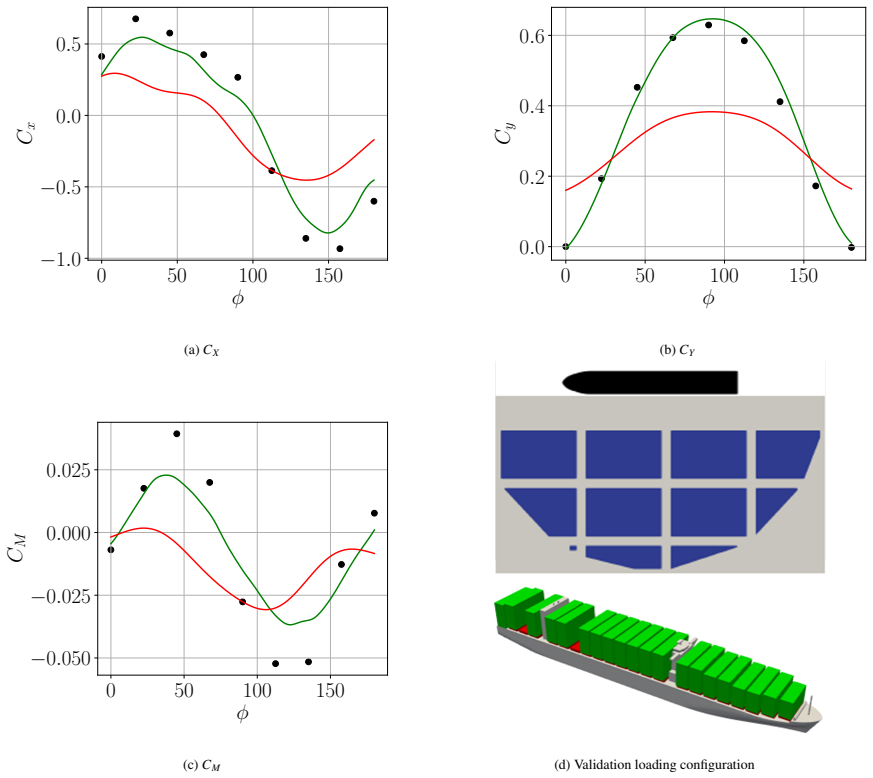
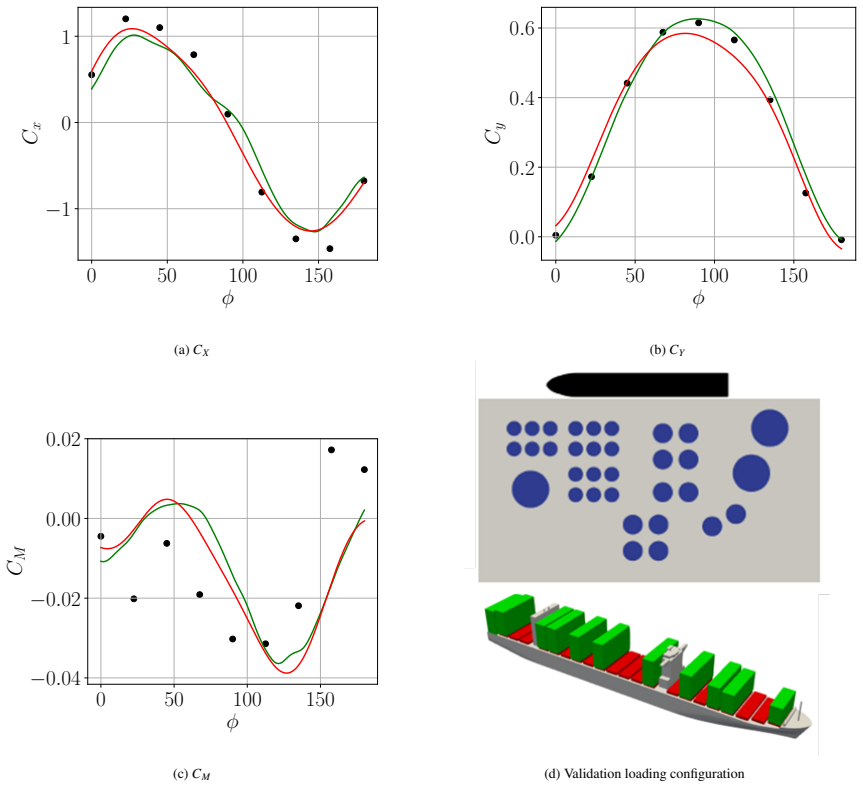
N. Degiuli, C. G. Grlj, I. Marti ´c, S. B. Šegota, N. An¯deli´c, D. Majnari´c, Machine learning models for the prediction of wind loads on containerships, Journal of marine science and engineering 13 (3) (2025) 417. 26 0 50 100 150 φ □1 0 1 Cx (a)C X 0 50 100 150 φ 0.0 0.2 0.4 0.6 Cy (b)C Y 0 50 100 150 φ □0.04 □0.02 0.00 0.02 CM (c)C M (d) Validation loa...
work page 2025
- [19]
-
[20]
J. Prpi ´c-Orši´c, M. Val ˇci´c, Z. ˇCarija, A hybrid wind load estimation method for container ship based on computa- tional fluid dynamics and neural networks, Journal of ma- rine science and engineering 8 (7) (2020) 539
work page 2020
-
[21]
M. Loft, H. Schwarz, T. Rung, Data-driven pressure field prediction for ships in regular sea states, Engineering Applications of Computational Fluid Mechanics 19 (1) (2025) 2553337
work page 2025
-
[22]
G. Wang, Y . Feng, Y . Dai, Z. Chen, Y . Wu, An efficient prediction method for wind loads on container ships based on numerical simulation and gaussian process regression, Ocean Engineering 343 (2026) 123384
work page 2026
-
[23]
Le Gratiet, Multi-fidelity gaussian process regression for computer experiments, Ph.D
L. Le Gratiet, Multi-fidelity gaussian process regression for computer experiments, Ph.D. thesis, Université Paris- Diderot-Paris VII (2013)
work page 2013
-
[24]
C. K. Williams, C. E. Rasmussen, Gaussian processes for machine learning, V ol. 2, MIT press Cambridge, MA, 2006
work page 2006
-
[25]
M. C. Kennedy, A. O’Hagan, Predicting the output from a complex computer code when fast approximations are available, Biometrika 87 (1) (2000) 1–13
work page 2000
-
[26]
L. Le Gratiet, J. Garnier, Recursive co-kriging model for design of computer experiments with multiple levels of fidelity, International Journal for Uncertainty Quantifica- tion 4 (5) (2014)
work page 2014
-
[27]
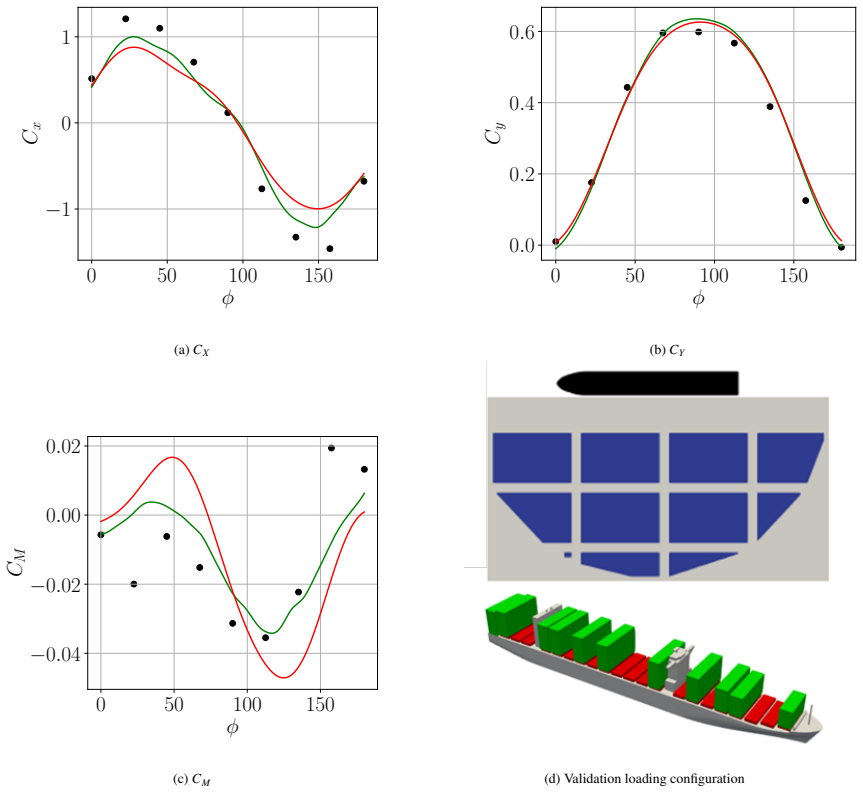
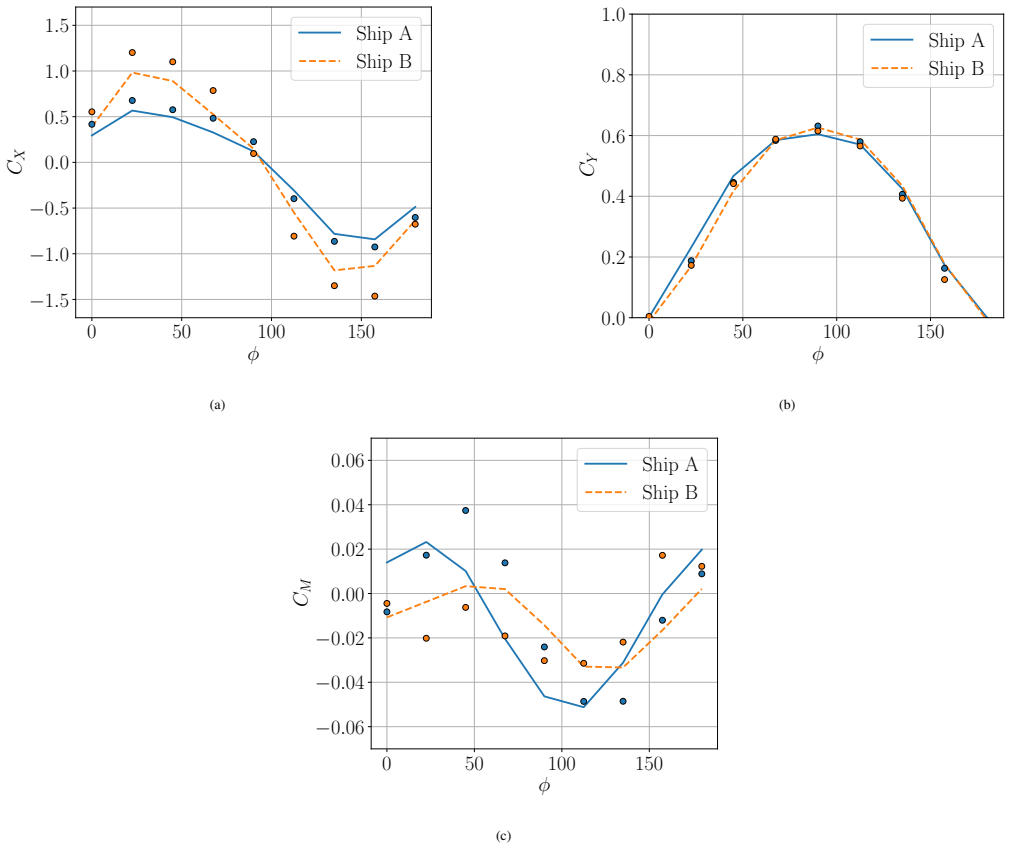
P. G. Constantine, E. Dow, Q. Wang, Active subspace methods in theory and practice: applications to kriging surfaces, SIAM Journal on Scientific Computing 36 (4) (2014) A1500–A1524. 27 0 50 100 150 φ □1.5 □1.0 □0.5 0.0 0.5 1.0 1.5 CX Ship A Ship B (a)C X 0 50 100 150 φ 0.0 0.2 0.4 0.6 0.8 1.0 CY Ship A Ship B (b)C Y 0 50 100 150 φ □0.06 □0.04 □0.02 0.00 0...
work page 2014
-
[28]
A. Saltelli, S. Tarantola, F. Campolongo, M. Ratto, et al., Sensitivity analysis in practice: a guide to assessing sci- entific models, V ol. 1, Wiley Online Library, 2004
work page 2004
-
[29]
T. Arnoult, G. Glabeke, L. Donatini, J. van Beeck, Experi- mental analysis of wind effects on moored container ships in harbour environments, in: Submitted to EACWE, 2025, 2025
work page 2025
-
[30]
A. P. C. Bresciani, M. Fiore, T. Arnoult, J. Christophe, G. Glabeke, J. van Beeck, Numerical investigation of aerodynamic forces on container ships in harbor environ- ment: from synoptic winds to microburst events, submit- ted to Journal of Wind Engineering & Industrial Aerody- namics (2026). 32
work page 2026
discussion (0)
Sign in with ORCID, Apple, or X to comment. Anyone can read and Pith papers without signing in.