Recognition: unknown
Fixed-phase Resonance Tracking for Fast Nonlinear Resonant Ultrasound Spectroscopy
Pith reviewed 2026-05-08 09:14 UTC · model grok-4.3
The pith
A discrete-time method tracks instantaneous resonance in nonlinear ultrasound tests by updating frequency from phase alone.
A machine-rendered reading of the paper's core claim, the machinery that carries it, and where it could break.
Core claim
The central claim is that a model-assisted discrete-time controller, driven by a linearized frequency-phase relation, can maintain a resonant system at its instantaneous resonance condition and thereby extract resonance frequency and damping estimates without acquiring complete frequency sweeps at each measurement point.
What carries the argument
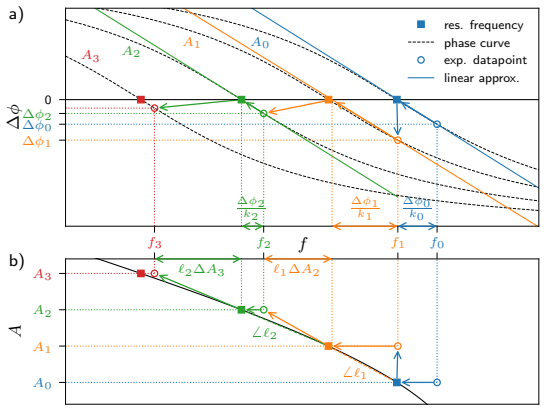
The linearized frequency-phase model that converts observed phase error into an excitation-frequency update to enforce a prescribed phase relation between drive and response.
If this is right
- Measurement duration drops because full sweeps are replaced by single-frequency steps.
- Transient wave buildup can be actively suppressed by optional feedforward correction tied to an external control parameter.
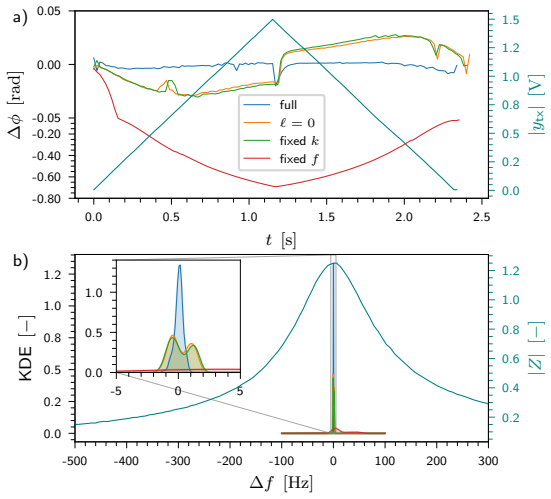
- Inferred nonlinear indicators become sensitive to the chosen measurement speed and mode stability.
- The same tracking logic applies to any resonant system whose parameters evolve slowly.
Where Pith is reading between the lines
- The approach could support continuous monitoring of damage or conditioning in materials under repeated loading.
- It may extend naturally to other resonant measurement domains such as mechanical vibration testing or acoustic levitation.
- Combining the tracker with adaptive model updates could handle faster parameter drifts than the current fixed linearization assumes.
Load-bearing premise
The linearized frequency-phase model must accurately predict the required frequency update and material parameters must change slowly enough that the discrete steps keep the system near resonance without accumulating lag.
What would settle it
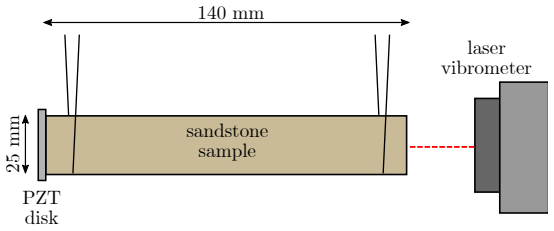
Running the tracker in parallel with occasional full frequency sweeps on the same sandstone sample and finding that the tracked frequency consistently misses the actual peak location by more than the expected discretization error would falsify the method.
Figures




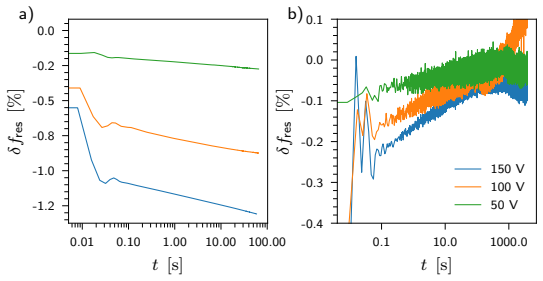
read the original abstract
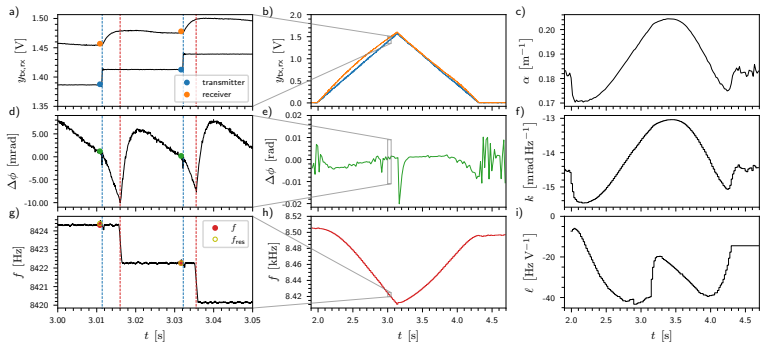
Nonlinear Resonant Ultrasound Spectroscopy (NRUS) experiments that rely on repeated sampling of resonance curves are inherently sensitive to measurement protocol due to evolution of material parameters caused by fast and slow dynamic effects. We introduce a model-assisted discrete-time resonance tracking method that maintains a system at its instantaneous resonance condition without the need to acquire full frequency sweeps. Resonance is defined through a prescribed phase relation between excitation and response, and the excitation frequency is iteratively updated using a linearized frequency--phase model. The procedure allows controlled suppression of transient wave buildup using optional feedforward correction with respect to an external control parameter. The method is demonstrated on NRUS and on conditioning--relaxation protocol conducted on a sandstone bar, providing estimates of resonance frequency and damping. Comparison with conventional approaches shows that measurement speed and mode stability significantly influence the inferred nonlinear indicators. The proposed framework is not limited to nonlinear acoustics and can be applied to arbitrary resonant systems with slowly evolving parameters.
Editorial analysis
A structured set of objections, weighed in public.
Referee Report
Summary. The paper introduces a model-assisted discrete-time resonance tracking method for nonlinear resonant ultrasound spectroscopy (NRUS) that maintains a system at its instantaneous resonance condition by defining resonance via a fixed phase relation between excitation and response and iteratively updating the drive frequency using a linearized frequency-phase model. The approach optionally incorporates feedforward correction to suppress transients with respect to an external control parameter. It is demonstrated on NRUS and conditioning-relaxation protocols on a sandstone bar, providing estimates of resonance frequency and damping, with comparisons to conventional full-sweep methods indicating that measurement speed and mode stability affect inferred nonlinear indicators. The framework is presented as applicable to arbitrary resonant systems with slowly evolving parameters.
Significance. If the tracking accuracy and assumptions hold under validation, the method could enable substantially faster NRUS measurements with reduced sensitivity to material evolution during acquisition, improving the consistency of nonlinear parameter estimates. The discrete-time fixed-phase approach and optional feedforward control represent a practical advance over repeated full sweeps, with potential extension to other resonant systems in acoustics or related fields.
major comments (3)
- [Methods] The central claim that the method maintains the instantaneous resonance condition relies on the linearized frequency-phase model for discrete updates and the assumption of sufficiently slow parameter evolution. However, no quantitative bounds on tracking error, lag, or overshoot are provided, nor is there sensitivity analysis to step size or evolution rate (see skeptic note on validity of the linearization).
- [Results/Demonstrations] The demonstrations on sandstone NRUS and conditioning-relaxation protocols compare to conventional sweeps and note influences on nonlinear indicators, but lack reported error bars, explicit tracking accuracy metrics, or tests of when the linear approximation breaks, preventing assessment of whether results support the claims of improved stability and speed.
- [Method description] The abstract and description state that the procedure allows controlled suppression of transient wave buildup, but no equations, implementation details, or validation of the optional feedforward correction are given to show how it interacts with the discrete updates without introducing additional error.
minor comments (2)
- [Abstract] The abstract claims 'estimates of resonance frequency and damping' but provides no specific values, figures, or tables in the summary, making it hard to gauge the quantitative output of the method.
- [Methods] Notation for the prescribed phase relation and the linearized model coefficients could be introduced with explicit equations early in the methods to improve clarity for readers implementing the approach.
Simulated Author's Rebuttal
We thank the referee for their constructive and detailed review. The comments highlight important aspects of rigor and clarity that we will address in the revision. Below we respond point-by-point to the major comments.
read point-by-point responses
-
Referee: [Methods] The central claim that the method maintains the instantaneous resonance condition relies on the linearized frequency-phase model for discrete updates and the assumption of sufficiently slow parameter evolution. However, no quantitative bounds on tracking error, lag, or overshoot are provided, nor is there sensitivity analysis to step size or evolution rate (see skeptic note on validity of the linearization).
Authors: We agree that explicit quantitative bounds would strengthen the central claim. The linearization follows directly from the first-order Taylor expansion of the phase-frequency relation at resonance and is valid when the frequency step is small compared with the resonance bandwidth. In the revised manuscript we will add a dedicated subsection containing (i) an analytic expression for the steady-state tracking lag under constant parameter drift and (ii) numerical sensitivity results obtained by simulating the discrete-time controller with controlled rates of resonance-frequency evolution. These additions will also address the validity of the linear approximation. revision: yes
-
Referee: [Results/Demonstrations] The demonstrations on sandstone NRUS and conditioning-relaxation protocols compare to conventional sweeps and note influences on nonlinear indicators, but lack reported error bars, explicit tracking accuracy metrics, or tests of when the linear approximation breaks, preventing assessment of whether results support the claims of improved stability and speed.
Authors: The experimental section emphasizes comparative differences in inferred nonlinear parameters rather than absolute accuracy. We will augment the results with (a) standard-error bars derived from repeated tracking runs on the same specimen, (b) a quantitative metric of tracking fidelity (rms phase deviation from the target value), and (c) a short discussion, supported by the new simulation analysis mentioned above, of the regime in which the linear update remains accurate. These additions will allow readers to evaluate the claimed improvements in stability and speed. revision: yes
-
Referee: [Method description] The abstract and description state that the procedure allows controlled suppression of transient wave buildup, but no equations, implementation details, or validation of the optional feedforward correction are given to show how it interacts with the discrete updates without introducing additional error.
Authors: The feedforward term is presented only conceptually in the current text. In the revised methods section we will supply the explicit discrete-time feedforward equation, describe its coupling to the phase-based frequency update, and include both simulated and experimental validation demonstrating that the combined controller does not degrade steady-state phase tracking when the external parameter changes at the rates typical of NRUS conditioning protocols. revision: yes
Circularity Check
No significant circularity in resonance tracking method derivation
full rationale
The paper presents a model-assisted discrete-time resonance tracking method defining resonance via a prescribed phase relation between excitation and response, with frequency updated iteratively using a linearized frequency-phase model. No equations, derivations, or self-citations are shown in the abstract or description that reduce by construction to fitted inputs renamed as predictions, self-definitional loops, or load-bearing self-citations. Demonstrations on sandstone NRUS and conditioning-relaxation protocols include comparisons to conventional full-sweep approaches, indicating the central claim retains independent content and is self-contained against external benchmarks rather than forced by internal definitions.
Axiom & Free-Parameter Ledger
free parameters (1)
- linearized frequency-phase model coefficients
axioms (2)
- domain assumption Resonance condition is defined by a prescribed phase relation between excitation and response.
- domain assumption Material parameters evolve slowly compared to discrete tracking updates.
Reference graph
Works this paper leans on
-
[1]
P. A. Johnson, P. N. J. Rasolofosaon, Nonlinear elasticity and stress- induced anisotropy in rock, Journal of Geophysical Research: Solid Earth 101 (1996) 3113–3124. URL:https://agupubs.onlinelibrary. wiley.com/doi/10.1029/95JB02880. doi:10.1029/95JB02880
-
[2]
Rivière, L
J. Rivière, L. Pimienta, M. Scuderi, T. Candela, P. Shokouhi, J. Fortin, A. Schubnel, C. Marone, P. A. Johnson, Fre- quency, pressure, and strain dependence of nonlinear elasticity in Berea Sandstone, Geophysical Research Letters 43 (2016) 3226–
2016
-
[3]
URL:https://agupubs.onlinelibrary.wiley.com/doi/10. 1002/2016GL068061. doi:10.1002/2016GL068061
-
[4]
M. C. Remillieux, R. A. Guyer, C. Payan, T. Ulrich, Decoupling Nonclassical Nonlinear Behavior of Elastic Wave Types, Physical Re- view Letters 116 (2016) 115501. URL:https://link.aps.org/doi/ 10.1103/PhysRevLett.116.115501. doi:10.1103/PhysRevLett.116. 115501
-
[5]
X. Li, C. Sens-Schönfelder, R. Snieder, Nonlinear elasticity in resonance experiments, PhysicalReviewB97(2018)144301.URL:https://link. aps.org/doi/10.1103/PhysRevB.97.144301. doi:10.1103/PhysRevB. 97.144301
-
[6]
M. Bentahar, H. El Aqra, R. El Guerjouma, M. Griffa, M. Scalerandi, Hysteretic elasticity in damaged concrete: Quantitative analysis of slow and fast dynamics, Physical Review B 73 (2006) 014116. URL: https://link.aps.org/doi/10.1103/PhysRevB.73.014116. doi:10. 1103/PhysRevB.73.014116
-
[7]
C. Payan, T. J. Ulrich, P. Y. Le Bas, T. Saleh, M. Guimaraes, Quantitative linear and nonlinear resonance inspection techniques and analysis for material characterization: Application to concrete thermal damage, The Journal of the Acoustical Society of America 136 31 (2014) 537–546. URL:https://pubs.aip.org/jasa/article/136/ 2/537/842582/Quantitative-line...
-
[8]
M. Dominguez-Bureos, C. Sens-Schönfelder, E. Niederleithinger, C. Hadziioannou, Stress- and Time-dependent Variations of Elas- tic Properties for Integrity Assessment in a Reinforced Concrete Test Bridge, Journal of Nondestructive Evaluation 44 (2025) 115. URL: https://link.springer.com/10.1007/s10921-025-01257-y.doi:10. 1007/s10921-025-01257-y
-
[9]
J. Kober, A. Kruisova, M. Scalerandi, Elastic Slow Dynamics in Poly- crystalline Metal Alloys, Applied Sciences 11 (2021) 8631. URL:https: //www.mdpi.com/2076-3417/11/18/8631. doi:10.3390/app11188631
-
[10]
N. Kamali, N. Tehrani, A. Mostavi, S.-W. Chi, D. Ozevin, J. E. Inda- cochea, Influence of Mesoscale and Macroscale Heterogeneities in Metals on Higher Harmonics Under Plastic Deformation, Journal of Nonde- structive Evaluation 38 (2019) 53. URL:http://link.springer.com/ 10.1007/s10921-019-0593-6. doi:10.1007/s10921-019-0593-6
-
[11]
J. Y. Yoritomo, R. L. Weaver, Slow dynamic nonlinearity in unconsol- idated glass bead packs, Physical Review E 101 (2020) 012901. URL: https://link.aps.org/doi/10.1103/PhysRevE.101.012901. doi:10. 1103/PhysRevE.101.012901
-
[12]
L. D. Landau, L. P. Pitaevskij, A. M. Kosevich, E. M. Lifšic, Theory of Elasticity: Volume 7, 3rd ed ed., 1986
1986
-
[13]
R. A. Guyer, P. A. Johnson, Nonlinear mesoscopic elasticity: the com- plex behaviour of granular media including rocks and soil, Wiley-VCH, Weinheim, 2009
2009
-
[14]
P. A. Johnson, B. Zinszner, P. N. J. Rasolofosaon, Resonance and elastic nonlinear phenomena in rock, Journal of Geophysi- cal Research: Solid Earth 101 (1996) 11553–11564. URL:https: //agupubs.onlinelibrary.wiley.com/doi/10.1029/96JB00647. doi:10.1029/96JB00647. 32
-
[15]
R. A. Guyer, J. TenCate, P. Johnson, Hysteresis and the Dynamic Elasticity of Consolidated Granular Materials, Physical Review Let- ters 82 (1999) 3280–3283. URL:https://link.aps.org/doi/10.1103/ PhysRevLett.82.3280. doi:10.1103/PhysRevLett.82.3280
-
[16]
L. A. Ostrovsky, P. A. Johnson, Dynamic nonlinear elasticity in geoma- terials, La Rivista del Nuovo Cimento 24 (2001) 1–46. URL:http:// link.springer.com/10.1007/BF03548898. doi:10.1007/BF03548898
-
[17]
J. A. TenCate, T. J. Shankland, Slow dynamics in the nonlinear elastic response of Berea sandstone, Geophysical Research Letters 23 (1996) 3019–3022. URL:http://doi.wiley.com/10.1029/96GL02884. doi:10.1029/96GL02884
-
[18]
J. A. TenCate, Slow Dynamics of Earth Materials: An Experimental Overview, Pure and Applied Geophysics 168 (2011) 2211–2219. URL:http://link.springer.com/10.1007/s00024-011-0268-4. doi:10.1007/s00024-011-0268-4
-
[19]
M. Scalerandi, M. Bentahar, C. Mechri, Conditioning and elas- tic nonlinearity in concrete: Separation of damping and phase contributions, Construction and Building Materials 161 (2018) 208–220. URL:https://linkinghub.elsevier.com/retrieve/pii/ S0950061817322481. doi:10.1016/j.conbuildmat.2017.11.035
-
[20]
M. Scalerandi, C. Mechri, M. Bentahar, A. Di Bella, A. Gliozzi, M. Tortello, Experimental Evidence of Correlations Between Con- ditioning and Relaxation in Hysteretic Elastic Media, Physical Re- view Applied 12 (2019) 044002. URL:https://link.aps.org/doi/10. 1103/PhysRevApplied.12.044002. doi:10.1103/PhysRevApplied.12. 044002
-
[21]
R. L. Weaver, S. Lee, Slow dynamics in a single bead with mechani- cal conditioning and transient heating, Physical Review E 107 (2023) 044902. URL:https://link.aps.org/doi/10.1103/PhysRevE.107. 044902. doi:10.1103/PhysRevE.107.044902
-
[22]
J. Kober, M. Scalerandi, M. Tortello, T. J. Ulrich, R. Zeman, The role of fast and slow dynamics in nonlinear resonant ul- trasound spectroscopy of consolidated granular materials, Scien- 33 tific Reports 15 (2025). URL:https://www.nature.com/articles/ s41598-025-11854-6. doi:10.1038/s41598-025-11854-6
-
[23]
C. Sens-Schönfelder, R. Snieder, X. Li, A Model for Non- linear Elasticity in Rocks Based on Friction of Internal Inter- faces and Contact Aging, Geophysical Journal International (2018). URL:https://academic.oup.com/gji/advance-article/ doi/10.1093/gji/ggy414/5116168. doi:10.1093/gji/ggy414
-
[24]
R. Zeman, J. Kober, M. Scalerandi, Distribution of Time Scales In- duces Slow Dynamics and Elastic Hysteresis in Sandstones: A Model of Non-equilibrium Strain, Rock Mechanics and Rock Engineering (2025). URL:https://doi.org/10.1007/s00603-025-04668-5.doi:10.1007/ s00603-025-04668-5
-
[25]
J. Y. Yoritomo, R. L. Weaver, Slow dynamic nonlinear elastic- ity during and after conditioning, a unified theory and a lock- in probe, Journal of the Mechanics and Physics of Solids 200 (2025) 106149. URL:https://linkinghub.elsevier.com/retrieve/ pii/S0022509625001255. doi:10.1016/j.jmps.2025.106149
-
[26]
J. Bittner, J. Popovics, Mechanistic diffusion model for slow dynamic behaviorinmaterials, JournaloftheMechanicsandPhysicsofSolids150 (2021) 104355. URL:https://linkinghub.elsevier.com/retrieve/ pii/S0022509621000521. doi:10.1016/j.jmps.2021.104355
-
[27]
J. Jin, P. Johnson, P. Shokouhi, An integrated analytical and exper- imental study of contact acoustic nonlinearity at rough interfaces of fatigue cracks, Journal of the Mechanics and Physics of Solids 135 (2020) 103769. URL:https://linkinghub.elsevier.com/retrieve/ pii/S0022509619305629. doi:10.1016/j.jmps.2019.103769
-
[28]
A. V. Lebedev, Slow Time Phenomena in Heterogeneous Materials: from Microscopic Fluctuations to Macroscopic Relaxation, Acousti- cal Physics 69 (2023) 58–73. URL:https://link.springer.com/10. 1134/S1063771022700543. doi:10.1134/S1063771022700543
-
[29]
J.-Y. Kim, L. J. Jacobs, J. Qu, J. W. Littles, Experimen- tal characterization of fatigue damage in a nickel-base super- alloy using nonlinear ultrasonic waves, The Journal of the 34 Acoustical Society of America 120 (2006) 1266–1273. URL: https://pubs.aip.org/jasa/article/120/3/1266/899881/ Experimental-characterization-of-fatigue-damage-in. doi:10.1121/...
-
[30]
M. Kersemans, I. De Baere, J. Degrieck, K. Van Den Abeele, L. Pyl, F. Zastavnik, H. Sol, W. Van Paepegem, Nondestructive damage assessment in fiber reinforced composites with the pulsed ultra- sonic polar scan, Polymer Testing 34 (2014) 85–96. URL:https: //linkinghub.elsevier.com/retrieve/pii/S0142941814000233. doi:10.1016/j.polymertesting.2014.01.001
-
[31]
M. C. Remillieux, T. J. Ulrich, C. Payan, J. Rivière, C. R. Lake, P. Le Bas, Resonant ultrasound spectroscopy for ma- terials with high damping and samples of arbitrary geometry, Journal of Geophysical Research: Solid Earth 120 (2015) 4898–
2015
-
[32]
URL:https://agupubs.onlinelibrary.wiley.com/doi/10. 1002/2015JB011932. doi:10.1002/2015JB011932
-
[33]
Guéguen, P
P. Guéguen, P. Johnson, P. Roux, Nonlinear dynamics in- duced in a structure by seismic and environmental loading, The Journal of the Acoustical Society of America 140 (2016) 582–590. URL:https://pubs.aip.org/jasa/article/140/1/582/ 604352/Nonlinear-dynamics-induced-in-a-structure-by. doi:10. 1121/1.4958990
2016
-
[34]
J. Jin, J. Rivière, Y. Ohara, P. Shokouhi, Dynamic acousto-elastic re- sponse of single fatigue cracks with different microstructural features: An experimental investigation, Journal of Applied Physics 124 (2018) 075303. URL:http://aip.scitation.org/doi/10.1063/1.5036531. doi:10.1063/1.5036531
-
[35]
M. Scalerandi, M. Griffa, P. Antonaci, M. Wyrzykowski, P. Lura, Nonlinear elastic response of thermally damaged consolidated granular media, Journal of Applied Physics 113 (2013) 154902. URL:https://pubs.aip.org/jap/article/113/15/154902/ 374188/Nonlinear-elastic-response-of-thermally-damaged. doi:10.1063/1.4801801. 35
-
[36]
G. Kim, E. Giannini, N. Klenke, J.-Y. Kim, K. E. Kurtis, L. J. Jacobs, Measuring Alkali-Silica Reaction (ASR) Microscale Dam- age in Large-Scale Concrete Slabs Using Nonlinear Rayleigh Sur- face Waves, Journal of Nondestructive Evaluation 36 (2017)
2017
-
[37]
URL:http://link.springer.com/10.1007/s10921-017-0410-z. doi:10.1007/s10921-017-0410-z
-
[38]
L. Gao, P. Shokouhi, J. Rivière, Effect of Grain Shape and Rel- ative Humidity on the Nonlinear Elastic Properties of Granular Media, Geophysical Research Letters 50 (2023). URL:https: //agupubs.onlinelibrary.wiley.com/doi/10.1029/2023GL103245. doi:10.1029/2023GL103245
-
[39]
M.-L. Chavazas, P. Bromblet, J. Berthonneau, J. Hénin, C. Payan, Impact of relative humidity variations on Carrara marble me- chanical properties investigated by nonlinear resonant ultrasound spectroscopy, Construction and Building Materials 431 (2024) 136529. URL:https://linkinghub.elsevier.com/retrieve/pii/ S0950061824016702. doi:10.1016/j.conbuildmat.2...
-
[40]
X. Feng, M. Fehler, D. Burns, S. Brown, T. L. Szabo, Effects of humidity and temperature on the non-linear elasticity of rocks, Geophysical Jour- nal International 231 (2022) 1823–1832. URL:https://academic.oup. com/gji/article/231/3/1823/6652498. doi:10.1093/gji/ggac292
-
[41]
S. Choi, J. Ryu, J.-S. Kim, K.-Y. Jhang, Comparison of Linear and Nonlinear Ultrasonic Parameters in Characterizing Grain Size and Mechanical Properties of 304L Stainless Steel, Metals 9 (2019)
2019
-
[42]
URL:https://www.mdpi.com/2075-4701/9/12/1279. doi:10. 3390/met9121279
2075
-
[43]
J. Kober, A. Gliozzi, M. Scalerandi, M. Tortello, Material Grain Size Determines Relaxation-Time Distributions in Slow-Dynamics Ex- periments, Physical Review Applied 17 (2022) 014002. URL:https: //link.aps.org/doi/10.1103/PhysRevApplied.17.014002. doi:10. 1103/PhysRevApplied.17.014002
-
[44]
G. Renaud, J. Rivière, S. Haupert, P. Laugier, Anisotropy of dynamic acoustoelasticity in limestone, influence of conditioning, and comparison 36 withnonlinearresonancespectroscopy, TheJournaloftheAcousticalSo- ciety of America 133 (2013) 3706–3718. URL:http://asa.scitation. org/doi/10.1121/1.4802909. doi:10.1121/1.4802909
-
[45]
R. Zeman, J. Kober, F. Nistri, M. Scalerandi, Relaxation of Viscoelastic Properties of Sandstones: Hysteresis and Anisotropy, Rock Mechan- ics and Rock Engineering (2024). URL:https://doi.org/10.1007/ s00603-024-03914-6. doi:10.1007/s00603-024-03914-6
-
[46]
K. E.-A. Van Den Abeele, P. A. Johnson, A. Sutin, Non- linear Elastic Wave Spectroscopy (NEWS) Techniques to Dis- cern Material Damage, Part I: Nonlinear Wave Modulation Spectroscopy (NWMS), Research in Nondestructive Evaluation 12 (2000) 17–30. URL:http://www.tandfonline.com/doi/abs/10. 1080/09349840009409646. doi:10.1080/09349840009409646
-
[47]
Hadziioannou, E
C. Hadziioannou, E. Larose, O. Coutant, P. Roux, M. Campillo, Stability of monitoring weak changes in multiply scattering me- dia with ambient noise correlation: Laboratory experiments, The Journal of the Acoustical Society of America 125 (2009) 3688–
2009
-
[48]
URL:https://pubs.aip.org/jasa/article/125/6/3688/ 787909/Stability-of-monitoring-weak-changes-in-multiply. doi:10.1121/1.3125345
-
[49]
C. L. E. Bruno, A. S. Gliozzi, M. Scalerandi, P. Antonaci, Analysis of elastic nonlinearity using the scaling subtraction method, Physical Re- view B 79 (2009) 064108. URL:https://link.aps.org/doi/10.1103/ PhysRevB.79.064108. doi:10.1103/PhysRevB.79.064108
-
[50]
Y. Ohara, Y. Shintaku, S. Horinouchi, M. Ikeuchi, K. Yamanaka, En- hancement of Selectivity in Nonlinear Ultrasonic Imaging of Closed Cracks Using Amplitude Difference Phased Array, Japanese Journal of Applied Physics 51 (2012) 07GB18. URL:https://iopscience. iop.org/article/10.1143/JJAP.51.07GB18. doi:10.1143/JJAP.51. 07GB18
-
[51]
Kober, Assessing Porosity in Selective Electron Beam Melt- ing Manufactured Ti–6Al–4V by Nonlinear Impact Modulation Spec- troscopy, Journal of Nondestructive Evaluation (2020) 8
J. Kober, Assessing Porosity in Selective Electron Beam Melt- ing Manufactured Ti–6Al–4V by Nonlinear Impact Modulation Spec- troscopy, Journal of Nondestructive Evaluation (2020) 8. doi:10.1007/ s10921-020-00731-z. 37
2020
-
[52]
A. J. Croxford, P. D. Wilcox, B. W. Drinkwater, P. B. Nagy, The use of non-collinear mixing for nonlinear ultrasonic detection of plas- ticity and fatigue, The Journal of the Acoustical Society of America 126 (2009) EL117–EL122. URL:http://asa.scitation.org/doi/10. 1121/1.3231451. doi:10.1121/1.3231451
-
[53]
K. E.-A. Van Den Abeele, J. Carmeliet, J. A. Ten Cate, P. A. Johnson, Nonlinear Elastic Wave Spectroscopy (NEWS) Techniques to Discern Material Damage, Part II: Single-Mode Nonlinear Reso- nance Acoustic Spectroscopy, Research in Nondestructive Evaluation 12 (2000) 31–42. URL:http://www.tandfonline.com/doi/abs/10. 1080/09349840009409647. doi:10.1080/09349...
-
[54]
M. Lott, M. C. Remillieux, P.-Y. Le Bas, T. J. Ulrich, V. Gar- nier, C. Payan, From local to global measurements of non- classical nonlinear elastic effects in geomaterials, The Jour- nal of the Acoustical Society of America 140 (2016) EL231– EL235. URL:https://pubs.aip.org/jasa/article/140/3/EL231/ 649628/From-local-to-global-measurements-of-nonclassical...
-
[55]
P. R. Geimer, L. Beardslee, T. J. Ulrich, Nonlinear resonant ul- trasound spectroscopy using white-noise excitation, The Journal of the Acoustical Society of America 154 (2023) A67–A67. URL: https://pubs.aip.org/jasa/article/154/4_supplement/A67/ 2923779/Nonlinear-resonant-ultrasound-spectroscopy-using. doi:10.1121/10.0022818
-
[56]
J. F. Gregg, B. E. Anderson, M. C. Remillieux, Electromag- netic excitation technique for nonlinear resonant ultrasound spec- troscopy, NDT & E International 109 (2020) 102181. URL:https: //linkinghub.elsevier.com/retrieve/pii/S0963869519304116. doi:10.1016/j.ndteint.2019.102181
-
[57]
J. Kober, R. Zeman, J. Krofta, A. S. Gliozzi, M. Scalerandi, Mon- itoring gallium-induced damage in aluminum alloys using nonlin- ear resonant ultrasound spectroscopy, NDT & E International 161 (2026) 103714. URL:https://linkinghub.elsevier.com/retrieve/ pii/S096386952600085X. doi:10.1016/j.ndteint.2026.103714. 38
-
[58]
X. Liu, Z. Dao, J. Zhu, W. Qu, X. Gong, K. Van Den Abeele, L. Ma, Localization of material defects using nonlinear resonant ultrasound spectroscopy under asymmetric boundary conditions, Physics Procedia 3 (2010) 55–61. URL:https://linkinghub.elsevier.com/retrieve/ pii/S187538921000009X. doi:10.1016/j.phpro.2010.01.008
-
[59]
M. Bentahar, C. Mechri, M. Scalerandi, Nonlinear elastic imaging with amplitude and frequency modulated low fre- quency sources, Applied Physics Letters 117 (2020) 084101. URL:https://pubs.aip.org/apl/article/117/8/084101/ 39697/Nonlinear-elastic-imaging-with-amplitude-and. doi:10.1063/5.0016357
-
[60]
C. Mechri, M. Scalerandi, M. Bentahar, Separation of Damping and Velocity Strain Dependencies using an Ultrasonic Monochromatic Ex- citation, Physical Review Applied 11 (2019) 054050. URL:https: //link.aps.org/doi/10.1103/PhysRevApplied.11.054050. doi:10. 1103/PhysRevApplied.11.054050
-
[61]
A. F. Vakakis (Ed.), Normal Modes and Localization in Non- linear Systems, Springer Netherlands, Dordrecht, 2001. URL: http://link.springer.com/10.1007/978-94-017-2452-4. doi:10.1007/978-94-017-2452-4
-
[62]
S. Peter, R. Riethmüller, R. I. Leine, Tracking of Backbone Curves of Nonlinear Systems Using Phase-Locked-Loops, in: G. Kerschen (Ed.), Nonlinear Dynamics, Volume 1, Springer International Pub- lishing, Cham, 2016, pp. 107–120. URL:http://link.springer.com/ 10.1007/978-3-319-29739-2_11. doi:10.1007/978-3-319-29739-2_ 11, series Title: Conference Proceedi...
-
[63]
A. H. Nayfeh, D. T. Mook, Nonlinear oscillations, Wiley, New York,
-
[64]
doi:10.1002/9783527617586
-
[65]
J. F. Rhoads, S. W. Shaw, K. L. Turner, Nonlinear Dynamics and Its Applications in Micro- and Nanoresonators, in: ASME 2008 Dynamic Systems and Control Conference, Parts A and B, ASMEDC, Ann Arbor, Michigan, USA, 2008, pp. 1509–1538. URL: 39 https://asmedigitalcollection.asme.org/DSCC/proceedings/ DSCC2008/43352/1509/334042. doi:10.1115/DSCC2008-2406
-
[66]
Antonio, D
D. Antonio, D. H. Zanette, D. López, Frequency stabilization in nonlin- ear micromechanical oscillators, Nature Communications 3 (2012) 806. URL:https://www.nature.com/articles/ncomms1813. doi:10.1038/ ncomms1813
2012
-
[67]
S. Peter, R. I. Leine, Excitation power quantities in phase resonance testing of nonlinear systems with phase-locked-loop ex- citation, Mechanical Systems and Signal Processing 96 (2017) 139–158. URL:https://linkinghub.elsevier.com/retrieve/pii/ S0888327017302005. doi:10.1016/j.ymssp.2017.04.011
-
[68]
V. Denis, M. Jossic, C. Giraud-Audine, B. Chomette, A. Renault, O. Thomas, Identification of nonlinear modes using phase-locked- loop experimental continuation and normal form, Mechanical Systems and Signal Processing 106 (2018) 430–452. URL:https: //linkinghub.elsevier.com/retrieve/pii/S0888327018300220. doi:10.1016/j.ymssp.2018.01.014
-
[69]
S. Maier, J.-Y. Kim, M. Forstenhäusler, J. J. Wall, L. J. Ja- cobs, Noncontact nonlinear resonance ultrasound spectroscopy (NRUS) for small metallic specimens, NDT & E International 98 (2018) 37–44. URL:https://linkinghub.elsevier.com/retrieve/ pii/S0963869517305911. doi:10.1016/j.ndteint.2018.04.003
-
[70]
A. Di Bella, A. S. Gliozzi, M. Scalerandi, M. Tortello, Analysis of Elastic Nonlinearity Using Continuous Waves: Validation and Applica- tions, Applied Sciences 9 (2019) 5332. URL:https://www.mdpi.com/ 2076-3417/9/24/5332. doi:10.3390/app9245332
-
[71]
M. Scalerandi, C. Mechri, M. Bentahar, A. Di Bella, A. Gliozzi, M. Tortello, Role of slow dynamics in fast dynamics ultrasonic measurements, Communications in Nonlinear Science and Numerical Simulation 91 (2020) 105452. URL:https://linkinghub.elsevier. com/retrieve/pii/S1007570420302823. doi:10.1016/j.cnsns.2020. 105452. 40
-
[72]
Fixed-phase Resonance Tracking for Fast Nonlinear Resonant Ultrasound Spectroscopy
R. Zeman, J. Kober, M. Scalerandi, Data for "Fixed-phase Resonance Tracking for Fast Nonlinear Resonant Ultrasound Spectroscopy", 2026. doi:10.5281/zenodo.19604874. 41
discussion (0)
Sign in with ORCID, Apple, or X to comment. Anyone can read and Pith papers without signing in.