Recognition: unknown
Price Cap vs. Per-Unit Subsidies: Selection, Pricing, and Cross Subsidization
Pith reviewed 2026-05-08 08:57 UTC · model grok-4.3
The pith
Ad valorem subsidies reduce spending in the FCC Rural Health Care program compared to price caps, while consortiums increase it via cross-subsidization.
A machine-rendered reading of the paper's core claim, the machinery that carries it, and where it could break.
Core claim
The ad valorem mechanism substantially reduces program spending relative to the price cap by restoring cost-containment incentives for providers, whereas the consortium option significantly inflates spending through cross-subsidization, as shown by both theoretical predictions and causal estimates from the full population of program participants.
What carries the argument
Theoretical models of provider incentives under price-cap and ad valorem subsidies combined with an extension of the two-way fixed effects framework allowing for continuous treatments to estimate policy effects.
If this is right
- The ad valorem design aligns provider incentives with cost control, leading to lower total outlays.
- Consortium applications enable ineligible entities to benefit indirectly, increasing program costs.
- Targeted enforcement can reduce the distortions from cross-subsidization.
- Similar trade-offs between incentive alignment and selection effects arise in other subsidy programs.
Where Pith is reading between the lines
- The findings suggest that subsidy programs should carefully balance cost-sharing rules with eligibility restrictions to minimize unintended transfers.
- Policy designers could test variations in the provider cost-share percentage to optimize spending reductions.
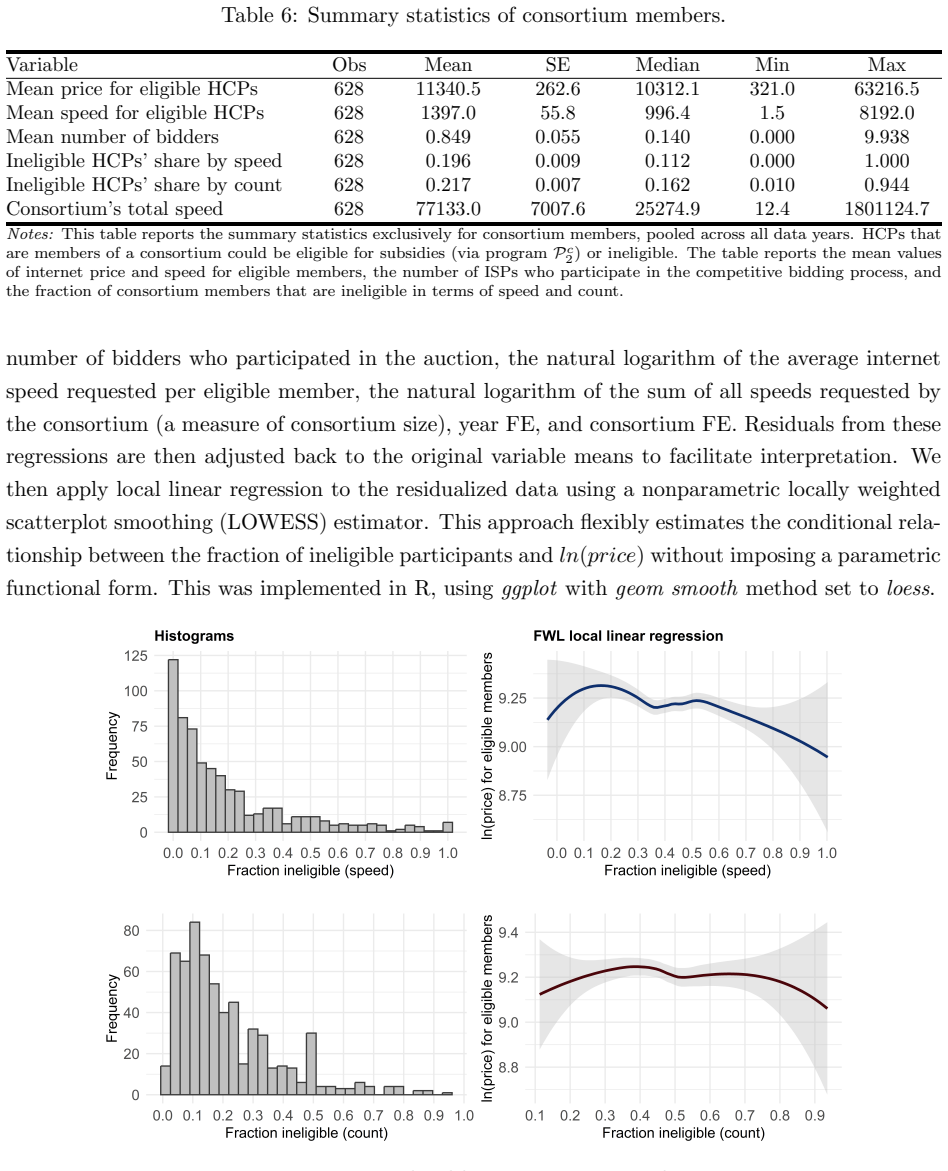
- The inverted U-shaped relationship implies that moderate shares of ineligible members maximize cross-subsidization effects.
- These mechanisms may generalize to other government programs involving matching or reimbursement subsidies.
Load-bearing premise
The causal identification from the extended two-way fixed effects model holds without significant biases from selection, unobserved factors, or failures in parallel trends assumptions.
What would settle it
If spending did not decrease after the 2014 ad valorem change or did not increase with consortium adoption, or if the relationship between ineligible member share and cross-subsidization deviated from the inverted U shape in the data.
Figures



read the original abstract
We evaluate subsidy mechanisms in the FCC's Rural Health Care program using administrative data covering the full population of participants. The original price-cap mechanism removes cost-containment incentives for health care providers. An ad valorem mechanism introduced in 2014 addresses this flaw by making providers bear 35% of costs. However, allowing consortium applications creates a new distortion: cross-subsidization from eligible to ineligible members. We develop theoretical models predicting these effects and estimate treatment effects using an extension of the two-way fixed effects framework with continuous treatments. We find that the ad valorem mechanism substantially reduces program spending relative to the price cap, while the consortium option significantly inflates it. Enforcement records and an inverted U-shaped relationship between cross-subsidization intensity and ineligible member share corroborate the findings.
Editorial analysis
A structured set of objections, weighed in public.
Referee Report
Summary. The manuscript evaluates subsidy mechanisms in the FCC's Rural Health Care program using full-population administrative data. It develops theoretical models showing that the original price-cap mechanism removes providers' cost-containment incentives, while the 2014 ad valorem mechanism (providers bear 35% of costs) restores them and reduces spending; however, consortium applications create cross-subsidization from eligible to ineligible members that inflates spending. Treatment effects are estimated via an extension of two-way fixed effects to continuous treatments, yielding the headline result that the ad valorem mechanism substantially reduces program spending relative to the price cap while the consortium option significantly inflates it. Corroboration is provided via enforcement records and an inverted-U relationship between cross-subsidization intensity and ineligible-member share.
Significance. If the causal estimates are valid, the paper contributes to the design of public subsidy programs by quantifying incentive and selection trade-offs in a high-stakes setting. Strengths include the use of comprehensive administrative data covering the full population of participants and the integration of theoretical predictions with empirical tests. The findings on spending reductions and cross-subsidization effects would be of interest to researchers in public finance and industrial organization.
major comments (2)
- [Econometric strategy section] The causal interpretation of the treatment effects rests on the generalized parallel-trends assumption for the continuous-treatment TWFE extension (described in the econometric strategy section). No direct pre-trend tests or placebo checks for varying treatment intensities are reported, leaving open the possibility that time-varying unobservables correlated with selection into consortia or cost-sharing intensity drive the spending changes.
- [Results and robustness section] The headline claims—that the ad valorem mechanism reduces spending while consortia inflate it via cross-subsidization—depend on the validity of the continuous-treatment estimator. The corroborating evidence (enforcement records and inverted-U pattern in ineligible-member share) does not directly test for selection on unobservables or violations of the identifying assumption, which is load-bearing for the policy conclusions.
minor comments (2)
- [Econometric strategy section] The description of the continuous-treatment TWFE extension would benefit from an explicit equation showing how treatment intensity enters the model and how the generalized parallel-trends condition is stated.
- [Results section] Table or figure presenting the main treatment-effect estimates should include standard errors clustered at the appropriate level and a clear definition of the continuous treatment variable.
Simulated Author's Rebuttal
We thank the referee for the constructive comments on our manuscript. We address each major point below, clarifying our econometric approach and committing to additional robustness analyses that directly respond to the concerns raised.
read point-by-point responses
-
Referee: [Econometric strategy section] The causal interpretation of the treatment effects rests on the generalized parallel-trends assumption for the continuous-treatment TWFE extension (described in the econometric strategy section). No direct pre-trend tests or placebo checks for varying treatment intensities are reported, leaving open the possibility that time-varying unobservables correlated with selection into consortia or cost-sharing intensity drive the spending changes.
Authors: We agree that explicit placebo and pre-trend diagnostics for the continuous-treatment specification would strengthen the analysis. The 2014 policy shift was a uniform, nationwide change in subsidy rules, and consortium participation is governed by observable eligibility criteria and application costs. In the revision we will add placebo exercises that apply post-2014 treatment intensities to pre-2014 data only, as well as leads of the continuous treatment to test for anticipation or pre-existing differential trends. These checks will be reported alongside the main estimates. revision: yes
-
Referee: [Results and robustness section] The headline claims—that the ad valorem mechanism reduces spending while consortia inflate it via cross-subsidization—depend on the validity of the continuous-treatment estimator. The corroborating evidence (enforcement records and inverted-U pattern in ineligible-member share) does not directly test for selection on unobservables or violations of the identifying assumption, which is load-bearing for the policy conclusions.
Authors: We acknowledge that the enforcement records and inverted-U pattern test the proposed mechanism rather than the identifying assumption itself. Nevertheless, the institutional environment limits the scope for selection on unobservables: consortium formation requires costly coordination and is recorded in the administrative data, while the ad valorem rule was imposed exogenously. In the revision we will add specifications that include provider-specific linear trends and an alternative estimator that matches on observables to balance treatment intensities. We will also expand the discussion of the generalized parallel-trends assumption and its plausibility given the policy setting. revision: partial
Circularity Check
No significant circularity in derivation chain
full rationale
The paper develops independent theoretical models predicting effects of price-cap versus ad valorem mechanisms and consortium cross-subsidization, then estimates treatment effects via an extension of two-way fixed effects with continuous treatments applied to full-population administrative data from the FCC program. No quoted steps reduce predictions or results by construction to fitted inputs, self-definitions, or load-bearing self-citations. The central claims rest on external policy variation and data rather than renaming known results or smuggling ansatzes. The derivation is self-contained against external benchmarks.
Axiom & Free-Parameter Ledger
free parameters (1)
- 35 percent provider cost share
axioms (1)
- domain assumption Assumptions of the two-way fixed effects estimator extended to continuous treatments hold without major violations in this setting
Reference graph
Works this paper leans on
-
[1]
competitive bidding
HCPs can switch programs at the time of subsidy renewal. Besides eligible rural and eligible urban, HCPs could be ineligible rural or ineligible urban. Ineligible HCPs do not count in the calculation that determines the majority-rural status of a consortium. When a consortium submits a subsidy request, it enters a competitive bidding process, in which ISP...
2013
-
[2]
GB”, “Gbps
UnderP 1, a subsidy request must mention the rural and urban price. We set the price equal to the rural price, and we set the subsidy equal to the difference between the rural and urban prices. UnderP 2/P c 2, the request specifies the subsidy amount. In this case, we take the subsidy amount as given, and we set the price equal to the subsidy divided by 0...
2013
-
[3]
Standard errors in parentheses;p-values in brackets
The rowτ 02 −τ 01 reports the estimated difference. Standard errors in parentheses;p-values in brackets. Significance: ∗∗∗ p <0.01, ∗∗ p <0.05, ∗ p <0.1. 19 Table A6: Goodness of fit: price–speed functional forms, 2014. P1 P2 P c 2 Rank ModelkAdj.R 2 RMSE Adj.R 2 RMSE Adj.R 2 RMSE Panel A: HCP level(N:P 1=643,P 2=419,P c 2=43) 1P=a+bS+cS 2 3 0.273$22,930 ...
2014
-
[4]
Log” column reports the coefficient from the log-linear model (Table 5 in the appendix), which equals the semi-elasticity∂lny/∂xdirectly. The “Level/¯y
The rowτ 02 −τ 01 reports the estimated difference. A log-linear specification of this table (with ln(price), ln(subsidy), and ln(HCP net cost) as dependent variables) is reported in Table 5 in the main text. Significance: ∗∗∗ p <0.01, ∗∗ p <0.05, ∗ p <0.1. 21 Table A9: Semi-elasticity comparison: log-linear vs. linear models (Panel A, 2014). Price Subsid...
2014
-
[5]
Restricted
We identify the range of pre-treatment (2013) download speeds among HCPs that participate inP c 2: [1.5, 139.6] Mbps. We then drop all HCPs whose 2013 speed falls outside this range, regardless of their program assignment. This removes 21 of 970 baseline HCPs (2.2%), all fromP 1 andP 2, leaving a sample of 949 HCPs observed on common support. Table A11 co...
2013
discussion (0)
Sign in with ORCID, Apple, or X to comment. Anyone can read and Pith papers without signing in.