Recognition: 2 theorem links
· Lean TheoremIXPE Polarizations of the Lighthouse Pulsar, Trail, and Filament
Pith reviewed 2026-05-13 07:41 UTC · model grok-4.3
The pith
X-ray polarization shows the Lighthouse pulsar's filament has a magnetic field aligned with its axis and weaker turbulence than models predict.
A machine-rendered reading of the paper's core claim, the machinery that carries it, and where it could break.
Core claim
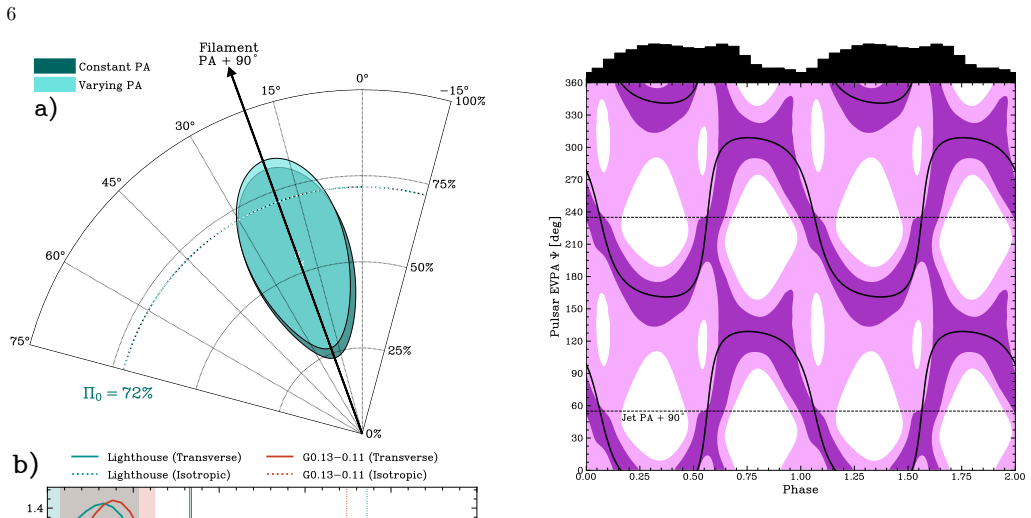
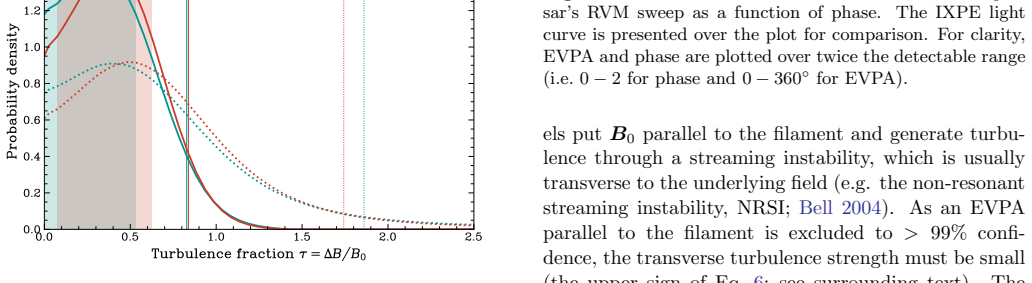
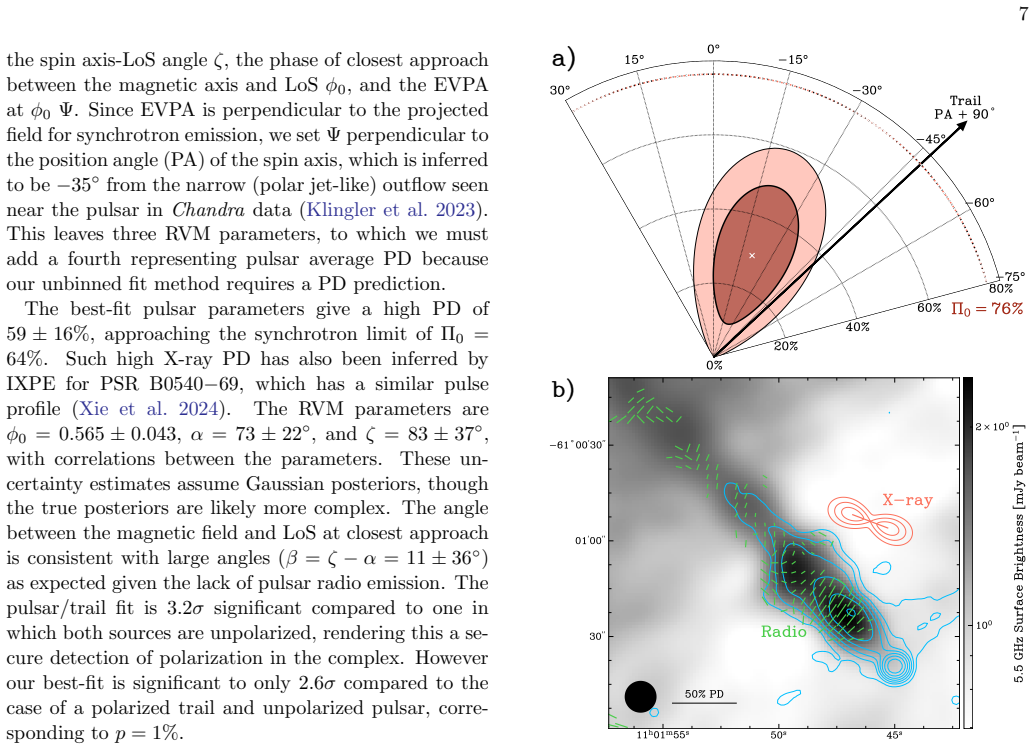
A one-megasecond IXPE observation detects filament polarization with PD 55 ± 18 percent at 99 percent and EVPA indicating a magnetic field parallel to the filament axis. The large PD implies a turbulent magnetic field weaker than the background field, in conflict with some existing models. Polarization is also detected from the pulsar, which is well-fit by the rotating vector model, and from the trail, where the X-ray polarization is nearly orthogonal to the radio polarization, suggesting spatial separation between the X-ray- and radio-emitting leptons.
What carries the argument
Synchrotron polarization degree and electric vector position angle from IXPE data, which directly constrain magnetic field direction and the ratio of turbulent to ordered field strength in the filament.
If this is right
- The filament magnetic field is largely ordered and aligned with the structure rather than randomized by strong turbulence.
- Existing models of magnetic amplification and turbulence in pulsar trails must be revised to allow regions where the ordered field dominates.
- X-ray and radio emission in the trail arise from leptons accelerated and radiating in spatially distinct zones.
- The pulsar's X-ray polarization geometry follows the same rotating-vector description that works at radio wavelengths.
Where Pith is reading between the lines
- Targeted IXPE observations of other pulsar trails could test whether high-polarization filaments are common or unique to this geometry.
- Joint radio-to-X-ray polarization modeling would map the radial separation of emitting lepton populations along the trail.
- If the low-turbulence conclusion holds, similar ordered fields may appear in other synchrotron structures where background fields are strong.
Load-bearing premise
The measured polarization comes purely from synchrotron emission in a uniform or simply structured magnetic field without significant beam depolarization, foreground effects, or contamination from the nearby trail or pulsar.
What would settle it
A deeper exposure or multi-epoch measurement returning a filament polarization degree below 30 percent or an electric-vector position angle inconsistent with a field parallel to the filament axis would falsify the low-turbulence interpretation.
Figures

read the original abstract
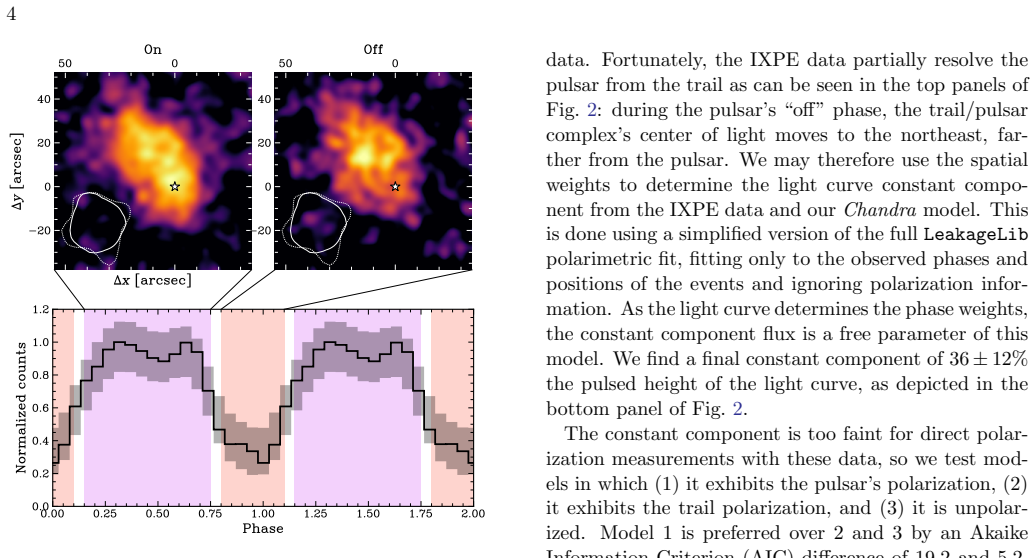
The Lighthouse pulsar (PSR J1101$-$6101) sports a bright X-ray trail and filament. The synchrotron emission from both structures is expected to be polarized, with electric vector position angle (EVPA) perpendicular to the magnetic field direction and polarization degree (PD) indicating the local degree of magnetic turbulence. We present a 1 megasecond Imaging X-ray Polarimetry Explorer (IXPE) observation of the Lighthouse complex. At the 99% confidence level, we detect the filament polarization with PD $55 \pm 18\%$ and EVPA indicating a magnetic field parallel to the filament axis. The large PD implies a turbulent magnetic field weaker than the background field, in conflict with some existing models. We also detect polarization from the pulsar and trail. The trail's X-ray polarization is nearly orthogonal to the radio polarization, suggesting spatial separation between the X-ray- and radio-emitting leptons. The pulsar polarization is well-fit by the rotating vector model.
Editorial analysis
A structured set of objections, weighed in public.
Referee Report
Summary. The manuscript reports results from a 1 Ms IXPE observation of the Lighthouse pulsar PSR J1101-6101 and its associated X-ray trail and filament. The central claims are a 99% confidence detection of filament polarization with PD = 55 ± 18% and EVPA indicating a magnetic field parallel to the filament axis (implying reduced turbulence relative to the background field), polarization from the trail that is nearly orthogonal to the radio polarization (suggesting spatial separation of X-ray and radio emitting leptons), and pulsar polarization that is well-fit by the rotating vector model.
Significance. If the measurements hold, the work delivers direct X-ray polarimetric constraints on magnetic field geometry and turbulence in a pulsar trail/filament system. The high filament PD provides a falsifiable test of turbulence models, while the orthogonal trail polarization offers evidence for distinct lepton populations. The use of standard IXPE Stokes analysis on defined regions with explicit error bars and model fits strengthens the result.
minor comments (2)
- [Abstract and §3 (data analysis)] The abstract states the filament detection at 99% CL with PD 55 ± 18%; the main text should explicitly reference the section or appendix detailing the Stokes parameter extraction, background subtraction, and significance calculation (e.g., via Monte Carlo or likelihood ratio) for the chosen extraction region.
- [Figure 1 and §3] Figure 1 or the region definition table should include the precise sky coordinates or radii used for the filament, trail, and pulsar apertures to allow independent verification of the reported PD and EVPA values.
Simulated Author's Rebuttal
We thank the referee for their positive summary, recognition of the significance of the IXPE results on the Lighthouse pulsar system, and recommendation to accept the manuscript. No major comments were provided for response.
Circularity Check
Direct observational measurements from IXPE data; no derivation reduces to inputs by construction
full rationale
The paper reports polarization detections (filament PD 55 ± 18% at 99% CL, EVPA orientation, trail and pulsar results) obtained via standard Stokes analysis on defined extraction regions from photon event data. The rotating vector model fit to the pulsar is a conventional application of an established external model. No equations or steps equate a claimed prediction to a fitted input by construction, no self-citation chain bears the central claim, and no ansatz or uniqueness theorem is smuggled in. Implications for magnetic turbulence follow directly from the measured PD under standard synchrotron assumptions without circular reduction. This is a self-contained observational result.
Axiom & Free-Parameter Ledger
free parameters (1)
- Filament polarization degree
axioms (1)
- domain assumption Synchrotron radiation from relativistic electrons produces linear polarization with EVPA perpendicular to the local magnetic field.
Lean theorems connected to this paper
-
IndisputableMonolith/Cost/FunctionalEquation.leanwashburn_uniqueness_aczel unclear?
unclearRelation between the paper passage and the cited Recognition theorem.
PD Π0 = Γ/(Γ + 2/3) ... turbulence fraction τ = ΔB/B0 ... isotropic/transverse formulas (Eqs. 5–6)
-
IndisputableMonolith/Foundation/AlexanderDuality.leanalexander_duality_circle_linking unclear?
unclearRelation between the paper passage and the cited Recognition theorem.
EVPA perpendicular to projected B; RVM fit for pulsar
What do these tags mean?
- matches
- The paper's claim is directly supported by a theorem in the formal canon.
- supports
- The theorem supports part of the paper's argument, but the paper may add assumptions or extra steps.
- extends
- The paper goes beyond the formal theorem; the theorem is a base layer rather than the whole result.
- uses
- The paper appears to rely on the theorem as machinery.
- contradicts
- The paper's claim conflicts with a theorem or certificate in the canon.
- unclear
- Pith found a possible connection, but the passage is too broad, indirect, or ambiguous to say the theorem truly supports the claim.
Reference graph
Works this paper leans on
-
[1]
Algeri, S., Aalbers, J., Mor˚ a, K. D., & Conrad, J. 2020, Nature Reviews Physics, 2, 245, doi: 10.1038/s42254-020-0169-5
-
[2]
Baldini, L., Bucciantini, N., Lalla, N. D., et al. 2022, SoftwareX, 19, 101194, doi: 10.1016/j.softx.2022.101194
-
[3]
2008, A&A, 490, L3, doi: 10.1051/0004-6361:200810666
Bandiera, R. 2008, A&A, 490, L3, doi: 10.1051/0004-6361:200810666
-
[4]
2016, MNRAS, 459, 178, doi: 10.1093/mnras/stw551
Bandiera, R., & Petruk, O. 2016, MNRAS, 459, 178, doi: 10.1093/mnras/stw551
-
[5]
Bell, A. R. 2004, MNRAS, 353, 550, doi: 10.1111/j.1365-2966.2004.08097.x
-
[6]
Briggs, D. S. 1995, in American Astronomical Society Meeting Abstracts, Vol. 187, American Astronomical Society Meeting Abstracts, 112.02
work page 1995
-
[7]
Bucciantini, N., Wong, J., Romani, R. W., et al. 2025, A&A, 699, A33, doi: 10.1051/0004-6361/202554216
-
[8]
Burn, B. J. 1966, MNRAS, 133, 67, doi: 10.1093/mnras/133.1.67 10
-
[9]
Bykov, A. M., Amato, E., Petrov, A. E., Krassilchtchikov, A. M., & Levenfish, K. P. 2017, SSRv, 207, 235, doi: 10.1007/s11214-017-0371-7
-
[10]
2024, A&A, 686, A14, doi: 10.1051/0004-6361/202349080
Churazov, E., Khabibullin, I., Barnouin, T., et al. 2024, A&A, 686, A14, doi: 10.1051/0004-6361/202349080
-
[11]
2025, ApJ, 984, 171, doi: 10.3847/1538-4357/adc92c Del Zanna, L., Bucciantini, N., & Landi, S
Cibrario, N., Negro, M., Bonino, R., et al. 2025, ApJ, 984, 171, doi: 10.3847/1538-4357/adc92c Del Zanna, L., Bucciantini, N., & Landi, S. 2025, A&A, 702, A171, doi: 10.1051/0004-6361/202556255 Di Marco, A., Soffitta, P., Costa, E., et al. 2023, AJ, 165, 143, doi: 10.3847/1538-3881/acba0f
-
[12]
Dinsmore, J. T., & Romani, R. W. 2024, ApJ, 976, 4, doi: 10.3847/1538-4357/ad8344
-
[13]
Dinsmore, J. T., & Romani, R. W. 2024, jtdinsmore/leakagelib: Publication, v1.0.0, Zenodo, doi: 10.5281/zenodo.10483298
-
[14]
Dinsmore, J. T., & Romani, R. W. 2024, ApJ, 962, 183, doi: 10.3847/1538-4357/ad2065 —. 2025, ApJ, 993, 173, doi: 10.3847/1538-4357/ae0f95 —. 2026, ApJ, in press
-
[15]
Dinsmore, J. T., & Romani, R. W. 2026, arXiv preprint arXiv:2603.20532
-
[16]
Dinsmore, J. T., Romani, R. W., Mandarakas, N., Blinov, D., & Liodakis, I. 2025, ApJ, 980, 229, doi: 10.3847/1538-4357/adafa8 Gonz´ alez-Caniulef, D., Caiazzo, I., & Heyl, J. 2023, MNRAS, 519, 5902, doi: 10.1093/mnras/stad033
-
[17]
Halpern, J. P., Tomsick, J. A., Gotthelf, E. V., et al. 2014, ApJL, 795, L27, doi: 10.1088/2041-8205/795/2/L27
-
[18]
Ho, W. C. G., Kuiper, L., Espinoza, C. M., et al. 2022, ApJ, 939, 7, doi: 10.3847/1538-4357/ac8743
-
[19]
Hughes, A., Staveley-Smith, L., Kim, S., Wolleben, M., & Filipovi´ c, M. 2007, MNRAS, 382, 543, doi: 10.1111/j.1365-2966.2007.12466.x
-
[20]
Journal of Plasma Physics , archivePrefix = "arXiv", eprint =
Kargaltsev, O., Pavlov, G. G., Klingler, N., & Rangelov, B. 2017, Journal of Plasma Physics, 83, 635830501, doi: 10.1017/S0022377817000630
-
[21]
2023, The Astrophysical Journal, 950, 177
Tomsick, J. 2023, The Astrophysical Journal, 950, 177
work page 2023
-
[22]
Lai, P. C. W., Ng, C.-Y., & Zhang, S. 2026, arXiv e-prints, arXiv:2602.20230, doi: 10.48550/arXiv.2602.20230
-
[23]
Luo, J., Ransom, S., Demorest, P., et al. 2021, ApJ, 911, 45, doi: 10.3847/1538-4357/abe62f
-
[24]
Marshall, H. L. 2021, ApJ, 907, 82, doi: 10.3847/1538-4357/abcfc3
-
[25]
Martin, P., Coriat, M., Olmi, B., et al. 2026, arXiv preprint arXiv:2601.18596 Nasa High Energy Astrophysics Science Archive Research Center (Heasarc). 2014, HEAsoft: Unified Release of FTOOLS and XANADU, Astrophysics Source Code Library, record ascl:1408.004. http://ascl.net/1408.004
-
[26]
Ng, C. Y., Gaensler, B. M., Chatterjee, S., & Johnston, S. 2010, ApJ, 712, 596, doi: 10.1088/0004-637X/712/1/596
-
[27]
Olmi, B., Amato, E., Bandiera, R., & Blasi, P. 2024, A&A, 684, L1, doi: 10.1051/0004-6361/202449382
-
[28]
2019, MNRAS, 484, 5755, doi: 10.1093/mnras/stz382
Olmi, B., & Bucciantini, N. 2019, MNRAS, 484, 5755, doi: 10.1093/mnras/stz382
-
[29]
2011, A&A, 533, A74, doi: 10.1051/0004-6361/201117379
Pavan, L., Bozzo, E., P¨ uhlhofer, G., et al. 2011, A&A, 533, A74, doi: 10.1051/0004-6361/201117379
-
[30]
2014, Astronomy & Astrophysics, 562, A122
Pavan, L., Bordas, P., P¨ uhlhofer, G., et al. 2014, Astronomy & Astrophysics, 562, A122
work page 2014
-
[31]
Baldini, L. 2021, Nuclear Instruments and Methods in Physics Research Section A: Accelerators, Spectrometers, Detectors and Associated Equipment, 986, 164740, doi: https://doi.org/10.1016/j.nima.2020.164740
-
[32]
Radhakrishnan, V., & Cooke, D. J. 1969, Astrophys. Lett., 3, 225
work page 1969
-
[33]
Ravi, S., Ng, M., Marshall, H. L., & Gnarini, A. 2026, ApJ, 997, 60, doi: 10.3847/1538-4357/ae21bd
-
[34]
Sault, R. J., Teuben, P. J., & Wright, M. C. H. 1995, in Astronomical Society of the Pacific Conference Series, Vol. 77, Astronomical Data Analysis Software and Systems IV, ed. R. A. Shaw, H. E. Payne, & J. J. E. Hayes, 433, doi: 10.48550/arXiv.astro-ph/0612759
- [35]
-
[36]
Susobhanan, A., Kaplan, D. L., Archibald, A. M., et al. 2024, ApJ, 971, 150, doi: 10.3847/1538-4357/ad59f7
-
[37]
A., Bodaghee, A., Rodriguez, J., et al
Tomsick, J. A., Bodaghee, A., Rodriguez, J., et al. 2012, ApJL, 750, L39, doi: 10.1088/2041-8205/750/2/L39
-
[38]
2015, in International Cosmic Ray Conference, Vol
Vianello, G., Lauer, R., Younk, P., et al. 2015, in International Cosmic Ray Conference, Vol. 34, 34th International Cosmic Ray Conference (ICRC2015), 1042, doi: 10.22323/1.236.1042
-
[39]
Wong, J., Romani, R. W., & Dinsmore, J. T. 2023, ApJ, 953, 28, doi: 10.3847/1538-4357/acdc1d
-
[40]
2024, ApJ, 962, 92, doi: 10.3847/1538-4357/ad17ba
Xie, F., Wong, J., La Monaca, F., et al. 2024, ApJ, 962, 92, doi: 10.3847/1538-4357/ad17ba
-
[41]
Yusef-Zadeh, F., & Gaensler, B. M. 2005, Advances in Space Research, 35, 1129, doi: 10.1016/j.asr.2005.03.003
discussion (0)
Sign in with ORCID, Apple, or X to comment. Anyone can read and Pith papers without signing in.