Recognition: unknown
Supermassive stars with embedded stellar black hole cores: dense assembling star clusters as faint multiple Little Red Dot systems
Pith reviewed 2026-05-08 10:41 UTC · model grok-4.3
The pith
Dense star clusters embed stellar black holes in supermassive stars to form long-lived quasi-star systems matching faint Little Red Dots.
A machine-rendered reading of the paper's core claim, the machinery that carries it, and where it could break.
Core claim
In star clusters with surface densities exceeding 10^6 solar masses per square parsec, stellar black holes of up to 60 solar masses undergo rapid mass segregation within the sphere of influence of extremely massive or supermassive stars and embed in their gaseous layers. This quasi-star phase is a natural outcome of runaway stellar collisions in the densest clusters. The embedded black hole configuration persists for a duration orders of magnitude longer than the supermassive star lifetime, enabling extended growth by stellar collisions and the formation of embedded gravitational wave sources when more than one stellar black hole is captured. The cluster sizes of roughly 100 parsecs and the
What carries the argument
The quasi-star phase formed when stellar black holes embed in the gaseous envelopes of extremely massive or supermassive stars through mass segregation and relaxation inside high surface-density clusters.
If this is right
- The quasi-star phase lasts orders of magnitude longer than the supermassive star lifetime and thereby permits extended growth by stellar collisions.
- Capture of more than one stellar black hole creates embedded gravitational wave sources inside the quasi-star.
- The assembly regions of size approximately 100 parsecs and quasi-star masses of at least 10,000 solar masses reproduce the observed properties of faint Little Red Dots.
- The proximity of the quasi-stars to young massive blue star-forming clumps matches the spatial arrangement of multiple Little Red Dot systems.
Where Pith is reading between the lines
- If stable, the configuration offers an efficient channel for building intermediate-mass black hole seeds inside the densest high-redshift clusters.
- The requirement for surface densities above 10^6 solar masses per square parsec predicts that only a subset of star-forming regions at high redshift should host such objects.
- Detection of X-ray emission or gravitational-wave signatures from faint Little Red Dots would provide a direct test for the embedded black hole.
- The mechanism implies that runaway stellar collisions operate more frequently in early dense clusters than models without black-hole embedding assume.
Load-bearing premise
The simulated cluster densities together with post-Newtonian and stellar-evolution physics produce a stable embedded quasi-star configuration that survives long enough without rapid disruption or ejection.
What would settle it
A simulation in which the stellar black hole is ejected from the supermassive star envelope before significant additional growth occurs, or JWST observations showing that faint multiple Little Red Dots lack associated dense cluster environments.
Figures



read the original abstract
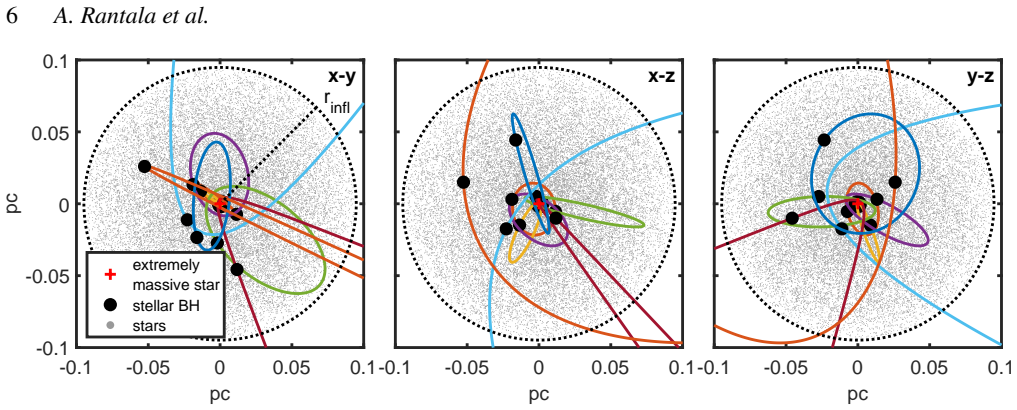
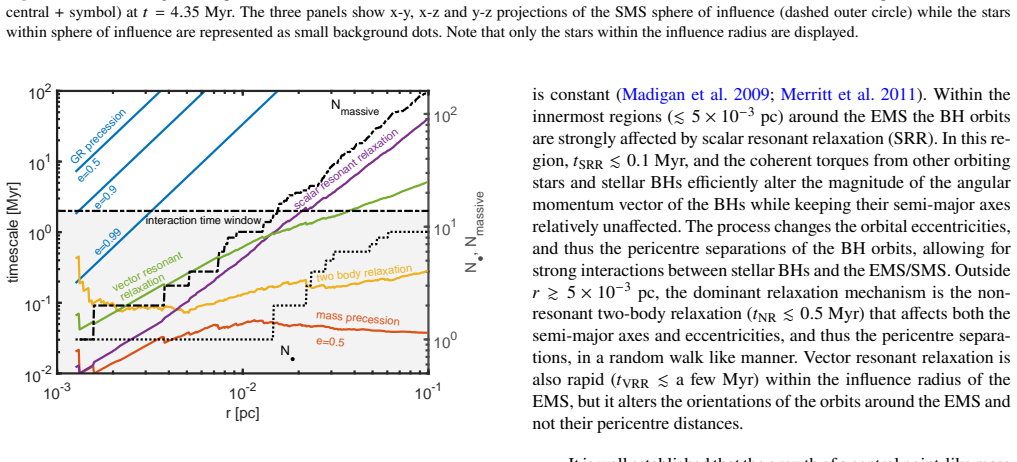
Numerical simulations have established that star clusters with densities comparable to the high redshift ($z>6$-$10$) James Webb Space Telescope (JWST) proto globular clusters may build up extremely massive (EMSs; $m_\mathrm{\star}>1000 M_\odot$) or even supermassive stars (SMSs; $m_\mathrm{\star}>10000 M_\odot$) and potentially intermediate mass black holes (IMBHs) through runaway stellar collisions. Using direct simulations of assembling star clusters including post-Newtonian black hole dynamics and stellar evolution, we demonstrate that in such dense environments ($\Sigma_\mathrm{h} \gtrsim 10^6 M_\odot$pc$^\mathrm{-2}$) stellar BHs ($m_\bullet \lesssim 60 M_\odot$), driven by rapid mass segregation and relaxation effects within the sphere of influence of the EMSs/SMSs, may strongly interact with the extremely massive stars and become embedded within their gaseous layers. We suggest that this quasi-star (QS) like embedded BH phase is a natural outcome of the runaway formation of EMSs/SMSs in the densest star clusters. The QS phase is orders of magnitude longer in duration than the lifetime of the SMS, enabling an extended growth period by stellar collisions, and allows the formation of embedded gravitational wave sources if the QS captures more than a single stellar BH. The star cluster assembly region sizes ($\sim100$ pc), QS masses ($\gtrsim 10^4 M_\odot$) and their proximity to young, massive blue star forming clumps are consistent with the faint population of multiple little red dots (LRDs) recently discovered by the JWST.
Editorial analysis
A structured set of objections, weighed in public.
Referee Report
Summary. The paper presents direct N-body simulations of dense assembling star clusters (with post-Newtonian black-hole dynamics and stellar evolution) to argue that stellar black holes (m_• ≲ 60 M_⊙) undergo rapid mass segregation and embed within the gaseous envelopes of extremely massive or supermassive stars (EMSs/SMSs) formed by runaway collisions in environments with Σ_h ≳ 10^6 M_⊙ pc^{-2}. This produces a quasi-star (QS)-like phase claimed to persist orders of magnitude longer than the SMS lifetime, enabling extended growth by collisions, possible multi-BH capture for gravitational-wave sources, and consistency with the observed properties (sizes ~100 pc, masses ≳10^4 M_⊙, proximity to blue clumps) of faint multiple Little Red Dots at z>6-10.
Significance. If the embedding mechanism and long-term QS stability are confirmed, the work supplies a concrete dynamical channel linking high-redshift proto-globular-cluster assembly to JWST LRDs, with additional implications for IMBH seeding and embedded GW sources. The use of direct simulations incorporating PN terms and stellar evolution is a methodological strength that grounds the mass-segregation and close-encounter results.
major comments (2)
- [Abstract / simulation results] Abstract and simulation description: the central claim that the QS phase 'is orders of magnitude longer in duration than the lifetime of the SMS' and 'enables an extended growth period' is load-bearing for the LRD interpretation, yet the reported N-body runs (with PN and stellar evolution) only evolve the pre-embedding mass segregation and close encounters on dynamical/relaxation timescales; no direct integration or modeling of the embedded BH-envelope configuration, gaseous response, continued accretion, or orbital stability is shown over the required ~10^7 yr window.
- [Abstract] Abstract: the statement that cluster assembly region sizes, QS masses, and proximity to young clumps 'are consistent with' the faint multiple LRD population is presented without quantitative comparison to observed LRD number densities, luminosity functions, or spatial clustering statistics, leaving the match at a qualitative level.
minor comments (2)
- [Methods] Notation for surface density threshold (Σ_h) and the precise definition of the sphere of influence should be clarified with an explicit equation or reference to the simulation setup.
- [Methods] The manuscript would benefit from a brief table or paragraph summarizing the range of simulated cluster densities, number of runs, and any convergence tests performed.
Simulated Author's Rebuttal
We thank the referee for the thorough review and constructive feedback. We address each major comment below, clarifying the scope of our simulations while strengthening the manuscript where possible. Revisions will be incorporated in the next version.
read point-by-point responses
-
Referee: [Abstract / simulation results] Abstract and simulation description: the central claim that the QS phase 'is orders of magnitude longer in duration than the lifetime of the SMS' and 'enables an extended growth period' is load-bearing for the LRD interpretation, yet the reported N-body runs (with PN and stellar evolution) only evolve the pre-embedding mass segregation and close encounters on dynamical/relaxation timescales; no direct integration or modeling of the embedded BH-envelope configuration, gaseous response, continued accretion, or orbital stability is shown over the required ~10^7 yr window.
Authors: We agree that the N-body simulations (including PN terms and stellar evolution) demonstrate the dynamical processes of mass segregation and BH embedding within EMS/SMS on short dynamical and relaxation timescales, but do not directly evolve the subsequent gaseous quasi-star configuration over ~10^7 yr. The extended QS duration claim is an inference drawn from the expected stability of embedded BH-envelope systems once formed, consistent with analytic and prior hydrodynamical models of quasi-stars in the literature. We do not claim to have performed long-term hydrodynamical integration of the embedded phase, which lies outside the scope of direct N-body methods. In revision, we will update the abstract and add a new subsection in the discussion explicitly distinguishing the simulated pre-embedding phase from the theoretically expected QS lifetime, including caveats on the assumptions and references to supporting QS stability studies. revision: yes
-
Referee: [Abstract] Abstract: the statement that cluster assembly region sizes, QS masses, and proximity to young clumps 'are consistent with' the faint multiple LRD population is presented without quantitative comparison to observed LRD number densities, luminosity functions, or spatial clustering statistics, leaving the match at a qualitative level.
Authors: The abstract statement is intentionally qualitative, as the paper's focus is the dynamical formation mechanism rather than a statistical population model. We acknowledge that a more quantitative link would strengthen the interpretation. In the revised manuscript, we will add a short paragraph in the discussion section providing order-of-magnitude estimates: using published high-redshift cluster formation rates and the fraction of dense clusters expected to produce such QS systems, compared against current observational constraints on faint LRD number densities at z>6. This will remain at the level of plausibility rather than a full luminosity-function fit, but will move beyond purely qualitative language. revision: partial
Circularity Check
No circularity: forward N-body simulations with PN terms generate BH-embedding results independently of LRD data
full rationale
The paper's derivation proceeds from initial conditions of dense star clusters (Σ_h ≳ 10^6 M_⊙ pc^{-2}) through direct numerical integration of stellar dynamics, post-Newtonian BH interactions, and stellar evolution. Mass segregation and close encounters are evolved on dynamical timescales to produce the embedding of stellar BHs (m_• ≲ 60 M_⊙) within EMS/SMS gaseous layers. The QS phase duration, extended growth by collisions, and consistency with faint multiple LRDs are presented as post-simulation interpretive outcomes and comparisons, not as fitted parameters or self-defined quantities. No equations reduce the central claims to their inputs by construction, no load-bearing self-citations close the loop, and no ansatz or uniqueness theorem is smuggled in. The chain remains self-contained as a forward simulation whose outputs are not statistically forced by the target observations.
Axiom & Free-Parameter Ledger
free parameters (1)
- cluster surface density threshold
axioms (2)
- domain assumption Runaway stellar collisions in dense clusters produce EMSs and SMSs
- domain assumption Post-Newtonian dynamics and stellar evolution are adequately modeled for the embedded phase
invented entities (1)
-
Quasi-star-like embedded BH phase (QS)
no independent evidence
Reference graph
Works this paper leans on
-
[1]
The Origin and Evolution of Multiple Star Systems
Abdurro’uf et al., 2025, arXiv e-prints, p. arXiv:2512.08054 Adamo A., et al., 2020, Space Sci. Rev., 216, 69 Adamo A., et al., 2024, Nature, 632, 513 AgarwalB.,KhochfarS.,JohnsonJ.L.,NeisteinE.,DallaVecchiaC.,Livio M., 2012, MNRAS, 425, 2854 Akins H. B., et al., 2025, ApJ, 991, 37 Arca Sedda M., et al., 2024, MNRAS, 528, 5119 BaggenJ.F.W.,vanDokkumP.,Lab...
work page internal anchor Pith review doi:10.48550/arxiv.2203.10066 2025
-
[2]
is 𝑡M = 𝑚EMS𝑃• 𝑀★(< 𝑎 • ) 𝑓(𝑒 • )= 𝑚EMS𝑃• 𝑀★(< 𝑎 • ) 1+ √︁ 1−𝑒 2•√︁ 1−𝑒 2• .(A2) For a spherical power-law cusp𝜌(𝑟) ∝𝑟 −𝛾 the mass precession timescale becomes 𝑡M ∝𝑎 𝛾−3/2 • 𝑓(𝑒 • ).(A3) Thus, for inner cusps with𝛾=3/2the mass precession timescale does not depend on the semi-major axis of the orbit. A2 Relaxation Non-resonant two-body relaxation changes b...
2008
-
[3]
2009; Kocsis & Tremaine 2015; Fouvry et al
𝑡SRR ∼ 𝑚EMS ˜𝑚 𝑃• .(A5) Similarly, the VRR timescale can be estimated (Eilon et al. 2009; Kocsis & Tremaine 2015; Fouvry et al
2009
-
[4]
This paper has been typeset from a TEX/LATEX file prepared by the author
as 𝑡VRR ∼𝑓 VRR 𝑚EMS [𝑀★(𝑎 • )˜𝑚]1/2 𝑃• (A6) inwhichtheparameter𝑓 VRRdependsontheeccentricitydistribution oftheorbitsandtypicallygetsvaluesintherangeof0.5≲𝑓 VRR ≲5 (Kocsis & Tremaine 2015). This paper has been typeset from a TEX/LATEX file prepared by the author. MNRAS000, 1–11 (2026)
2015
discussion (0)
Sign in with ORCID, Apple, or X to comment. Anyone can read and Pith papers without signing in.