Recognition: 2 theorem links
· Lean TheoremMycoponically Integrated Network Device for Multimodal Sensing with Living Mycelial Networks
Pith reviewed 2026-05-12 02:26 UTC · model grok-4.3
The pith
MIND turns living mycelium into universal self-repairing biosensors that distinguish 14 stimulus classes for over 11 months.
A machine-rendered reading of the paper's core claim, the machinery that carries it, and where it could break.
Core claim
MIND is an engineered biophysical interface that combines antimicrobial nutrient delivery via ceramic size exclusion with non-invasive electrophysiology in cylindrical (MINDTube) and planar (MINDPixel) forms. It sustains colonized Pleurotus ostreatus mycelium beyond 11 months, distinguishes 14 stimulus classes from a single device, follows Hill-type calibration across five phylogenetically diverse fungi, recovers full function within 72 hours after mechanical excision through continuous nutrition, and converts living mycelium networks into universal self-repairing biosensors.
What carries the argument
MIND platform integrating mycoponic ceramic size-exclusion nutrient delivery with standardized non-invasive electrode geometry to maintain living mycelial electrophysiological responsiveness.
If this is right
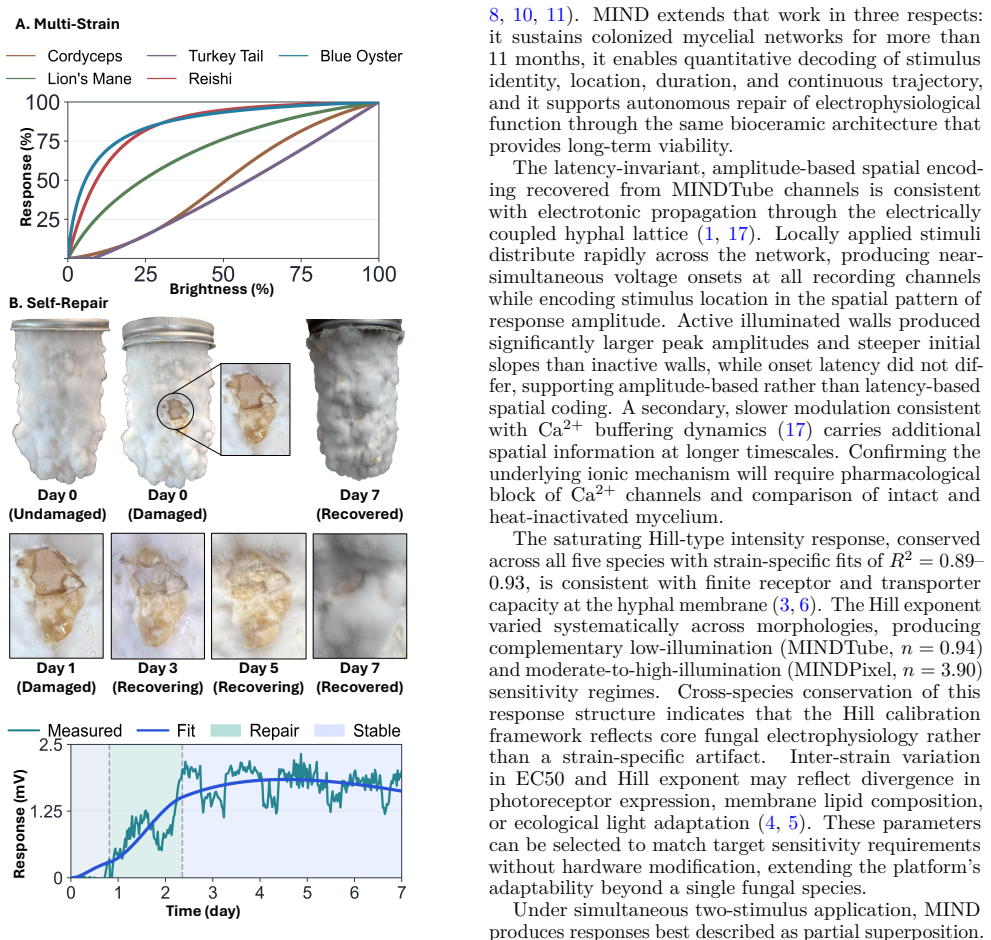
- Steady-state intensity responses follow Hill-type functions, allowing any of five tested fungal strains to be selected as a tunable design parameter for the same interface.
- Multichannel recordings from the fixed electrode layout recover stimulus duration, spatial location, and trajectory information.
- Continuous mycoponic nutrition enables complete recovery of electrophysiological responses within 72 hours after physical excision of part of the network.
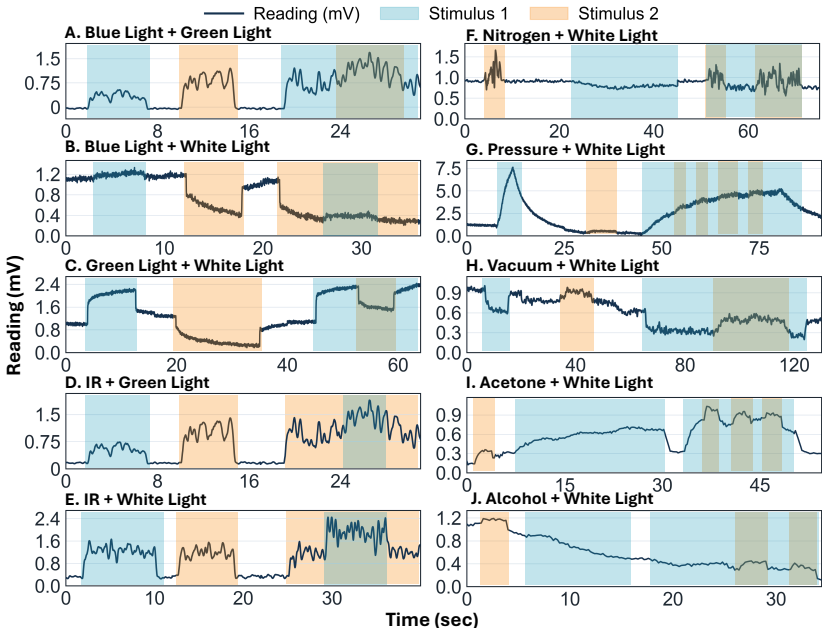
- One unmodified device handles 14 distinct stimulus classes spanning chemical, mechanical, thermal, optical, and biological modalities.
- The platform extends operational lifetime from days or weeks in earlier work to beyond 11 months while supporting multimodal sensing.
Where Pith is reading between the lines
- Such sustained living interfaces could support long-term environmental monitoring arrays where sensors must adapt to changing conditions without replacement.
- The self-repair property after damage suggests applications in wearable or structural monitoring where physical stress is routine.
- Because response calibration is consistent across strains, genetic variants of the same fungus could be swapped to emphasize sensitivity to particular target molecules.
Load-bearing premise
The ceramic size-exclusion nutrient delivery keeps mycelial metabolism and electrical signals stable over months without adding new signals or changes that would prevent accurate classification of external stimuli.
What would settle it
A controlled long-term test in which stimulus classification accuracy falls below reliable levels after several months while nutrient delivery continues, or new uncorrelated signal artifacts appear that match the nutrient solution composition.
Figures


read the original abstract
Living mycelial filaments integrate chemical, optical, mechanical, thermal, and biological information via electrophysiological cellular trans-membrane potential. The challenge is to create a mycology interface that sustains metabolism, standardizes electrode geometry, and tolerates mechanical damage. Using mycoponics we overcome these factors that limited prior demonstrations to single modalities, and operational windows of days to weeks. We present MIND, an engineered biophysical interface integrating antimicrobial nutrient delivery (ceramic size exclusion) with non-invasive electrophysiology, in cylindrical (MINDTube) and planar (MINDPixel) form-factors. The platform sustains colonized \textit{Pleurotus ostreatus} mycelium beyond 11 months and distinguishes 14 stimulus classes from a single unmodified device. Steady-state intensity responses follow Hill-type calibration functions across five phylogenetically diverse fungi grown on the identical interface, making strain selection a tunable design parameter. Multichannel decoding from the standardized electrode geometry recovers stimulus duration, location, and trajectory. Continuous nutrition provided by mycoponics recovered complete electrophysiological function within 72 h after mechanical excision. MIND converts living mycelium networks into universal, self-repairing, biosensors.
Editorial analysis
A structured set of objections, weighed in public.
Referee Report
Summary. The manuscript introduces MIND, a mycoponically integrated biophysical interface (in cylindrical MINDTube and planar MINDPixel forms) that uses living mycelial networks of Pleurotus ostreatus and other fungi for multimodal electrophysiological sensing of chemical, optical, mechanical, thermal, and biological stimuli. It claims sustained operation beyond 11 months, reliable distinction of 14 stimulus classes from a single device, Hill-type intensity-response calibration across five phylogenetically diverse strains, multichannel decoding of stimulus duration/location/trajectory, and full electrophysiological recovery within 72 hours after mechanical excision via continuous mycoponic nutrient delivery.
Significance. If the reported long-term stability, multi-class decoding, and strain-independent Hill-type responses are substantiated with full methods and controls, the work would constitute a meaningful advance in bio-hybrid sensing and living materials by providing a standardized, self-repairing platform that extends prior mycelium-electrophysiology demonstrations from days/weeks and single modalities to months and multimodal operation. The use of mycoponics as a tunable design parameter for strain selection is a potentially useful engineering insight.
major comments (2)
- [Abstract] Abstract: the manuscript states quantitative outcomes (11 months operation, 14 stimulus classes, 72 h recovery, Hill-type fits across strains) but supplies no methods section, raw data, error bars, exclusion criteria, or statistical details, so the central claims cannot be evaluated against evidence.
- [Abstract] Abstract and mycoponic interface description: the claim that ceramic size-exclusion nutrient delivery sustains true mycelial trans-membrane potential responsiveness without confounding signals is load-bearing for the 14-class decoding and self-repair assertions, yet no controls (no-nutrient baselines, blinded artifact injection, or pH/ion-gradient monitoring) are reported to isolate the ceramic's contribution from external stimuli.
Simulated Author's Rebuttal
We thank the referee for their constructive review and for recognizing the potential significance of MIND as a standardized, self-repairing platform for bio-hybrid sensing. We address each major comment below and have revised the manuscript to provide additional methodological transparency and controls.
read point-by-point responses
-
Referee: [Abstract] Abstract: the manuscript states quantitative outcomes (11 months operation, 14 stimulus classes, 72 h recovery, Hill-type fits across strains) but supplies no methods section, raw data, error bars, exclusion criteria, or statistical details, so the central claims cannot be evaluated against evidence.
Authors: The full manuscript contains a dedicated Methods section detailing electrode fabrication, mycoponic nutrient delivery protocols, electrophysiological recording parameters, stimulus application procedures, data preprocessing, Hill-equation fitting, and multi-class decoding algorithms. Sample sizes, exclusion criteria (e.g., devices with <80% colonization), and statistical tests (ANOVA with post-hoc corrections) are specified there, with raw traces and error bars provided in the supplementary figures. We have revised the abstract to include a concise methods clause and added explicit statistical reporting to all quantitative claims in the main text to improve evaluability. revision: yes
-
Referee: [Abstract] Abstract and mycoponic interface description: the claim that ceramic size-exclusion nutrient delivery sustains true mycelial trans-membrane potential responsiveness without confounding signals is load-bearing for the 14-class decoding and self-repair assertions, yet no controls (no-nutrient baselines, blinded artifact injection, or pH/ion-gradient monitoring) are reported to isolate the ceramic's contribution from external stimuli.
Authors: We agree that explicit isolation of the ceramic's contribution is essential. In the revised manuscript we have added a dedicated control subsection in Results together with expanded Methods describing (i) no-nutrient baseline recordings over 30 days showing loss of responsiveness, (ii) continuous pH and ion-gradient monitoring via embedded sensors confirming stable conditions, and (iii) blinded artifact-injection trials demonstrating that external signals do not produce the observed multi-class patterns. These controls substantiate that the reported 14-class decoding and 72-hour recovery arise from mycelial electrophysiology sustained by mycoponic delivery. revision: yes
Circularity Check
No significant circularity: experimental device report with data-driven claims
full rationale
The manuscript is an experimental description of a mycoponic interface for mycelial electrophysiology, reporting measured responses, stimulus classification accuracy, and recovery times from direct observations rather than any derivation chain. No equations, first-principles predictions, or fitted parameters are presented as deriving new results that reduce to the inputs by construction. Hill-type calibration functions are described as empirical fits to observed intensity responses, not as predictive outputs. No self-citations, uniqueness theorems, or ansatzes are invoked to justify core claims such as 14-class decoding or self-repair within 72 h. The work is self-contained against external benchmarks via reported measurements and controls, yielding no load-bearing circular steps.
Axiom & Free-Parameter Ledger
Lean theorems connected to this paper
-
IndisputableMonolith/Cost/FunctionalEquation.leanwashburn_uniqueness_aczel unclearsteady-state intensity responses follow Hill-type calibration functions across five phylogenetically diverse fungi
Reference graph
Works this paper leans on
-
[1]
M Buffi, et al., Electrical signaling in fungi: past and present challenges.FEMS Microbiol. Rev. 49, fuaf009 (2025)
work page 2025
-
[2]
A Adamatzky, , et al., Fungal electronics.Biosystems212, 104588 (2022)
work page 2022
-
[3]
Y Qi, et al., Identification of two Pleurotus ostreatus blue light receptor genes (PoWC-1 and PoWC-2) and in vivo confirmation of complex PoWC-12 formation through yeast two hybrid system.Fungal Biol.124, 8–14 (2020)
work page 2020
-
[4]
LM Corrochano, Light in the fungal world: From photoreception to gene transcription and beyond.Annu. Rev. Genet.53, 149–170 (2019)
work page 2019
-
[5]
K Vu, JM Bautos, A Gelli, The Cch1-Mid1 high-affinity calcium channel contributes to the virulence of Cryptococcus neoformans by mitigating oxidative stress.Eukaryot. Cell14, 1135–1143 (2015)
work page 2015
-
[6]
CR Zhao, ZL Y ou, L Bai, Fungal plasma membrane h+-atpase: Structure, mechanism, and drug discovery.J. Fungi10, 273 (2024)
work page 2024
-
[7]
AK Mishra, et al., Mycelium-based biohybrid robots controlled by fungal electrical signals.Sci. Robotics9, eadk8019 (2024)
work page 2024
-
[8]
A Gandia, A Adamatzky, Fungal skin for robots.Biosystems235, 105106 (2024)
work page 2024
-
[9]
N Phillips, A Gandia, A Adamatzky, Electrical response of fungi to changing moisture content. Fungal Biol. Biotechnol.10, 8 (2023)
work page 2023
-
[10]
M Buffi, , et al., Detection of electrical signals in fungal mycelia in response to external stimuli. iScience28, 113484 (2025)
work page 2025
-
[11]
D Danninger, R Pruckner, L Holzinger, R Koeppe, M Kaltenbrunner, Myceliotronics: Fungal mycelium skin for sustainable electronics.Sci. Adv.8, eadd7118 (2022)
work page 2022
-
[12]
M Haneef, et al., Advanced materials from fungal mycelium: Fabrication and tuning of physical properties.Sci. Reports7, 41292 (2017)
work page 2017
-
[13]
M Jones, A Mautner, S Luenco, A Bismarck, S John, Engineered mycelium composite construction materials from fungal biorefineries: a critical review.Mater. & Des.187, 108397 (2020)
work page 2020
-
[14]
MR Blatt, et al., Does electrical activity in fungi function as a language?Fungal Ecol.68, 101326 (2024)
work page 2024
-
[15]
Y Cai, et al., Mycoelectronics: Bioprinted living fungal bioelectronics for artificial sensation. bioRxiv(2025) Preprint
work page 2025
-
[16]
DM Porterfield, et al., Mycoponics: Controlled bioproduction utilizing biophysical, solid-state, liquid nutrient delivery.Biotechnol. J.21, e70184 (2026)
work page 2026
-
[17]
A Itani, et al., Local calcium signal transmission in mycelial network exhibits decentralized stress responses.PNAS Nexus2, pgad012 (2023)
work page 2023
-
[18]
CH Chen, BS DeMay, AS Gladfelter, JC Dunlap, JJ Loros, Physical interaction between VIVID and white collar complex regulates photoadaptation in Neurospora.Proc. Natl. Acad. Sci. United States Am.107, 16715–16720 (2010)
work page 2010
-
[19]
A Dasgupta, et al., Biological significance of photoreceptor photocycle length: VIVID photocycle governs the dynamic VIVID-White Collar Complex pool mediating photo-adaptation and response to changes in light intensity.PLoS Genet.11, e1005215 (2015)
work page 2015
-
[20]
Y Xu, et al., Blue light receptor WC-2 regulates ganoderic acid biosynthesis in Ganoderma lingzhi.J. Fungi11, 646 (2025)
work page 2025
- [21]
-
[22]
Y Zhao, Y Liu, X Chen, J Xiao, Genome resequencing and transcriptome analysis reveal the molecular mechanism of albinism in Cordyceps militaris.Front. Microbiol.14, 1153153 (2023)
work page 2023
-
[23]
P Chutimanukul, S Sukdee, P Phetkaew, O Thepsilvisut, O Prajuabjinda, LED light spectra influence the stimulation of mycelial growth and anticancer activity in Hericium erinaceus mycelium.Front. Fungal Biol.6, 1684852 (2025)
work page 2025
-
[24]
Y Y ang, X Hu, A chromosome-scale genome of Trametes versicolor and transcriptome-based screening for light-induced genes that promote triterpene biosynthesis.J. Fungi11, 81 (2025)
work page 2025
-
[25]
Y Fukasawa, D Akai, T Takehi, Y Osada, Electrical integrity and week-long oscillation in fungal mycelia.Sci. Reports14, 15601 (2024)
work page 2024
-
[26]
J Garc´ıa-Mart´ınez, M Brunk, J Avalos, U Terpitz, The CarO rhodopsin of the fungus Fusarium fujikuroi is a light-driven proton pump that retards spore germination.Sci. Reports5, 7798 (2015)
work page 2015
-
[27]
M La Greca, et al., The photoreaction of the proton-pumping rhodopsin 1 from the maize pathogenic basidiomycete Ustilago maydis.Front. Mol. Biosci.9, 826990 (2022)
work page 2022
-
[28]
E Navarro-Tapia, A Querol, R P ´erez-Torrado, Membrane fluidification by ethanol stress activates unfolded protein response in yeasts.Microb. Biotechnol.11, 465–475 (2018)
work page 2018
- [29]
discussion (0)
Sign in with ORCID, Apple, or X to comment. Anyone can read and Pith papers without signing in.