Recognition: unknown
Realizing multi-orbital Emery models with ultracold atoms
Pith reviewed 2026-05-08 08:58 UTC · model grok-4.3
The pith
An optical superlattice with interfering lasers can realize the three-band Emery model in ultracold fermions with independent control over orbital interactions and charge-transfer energy.
A machine-rendered reading of the paper's core claim, the machinery that carries it, and where it could break.
Core claim
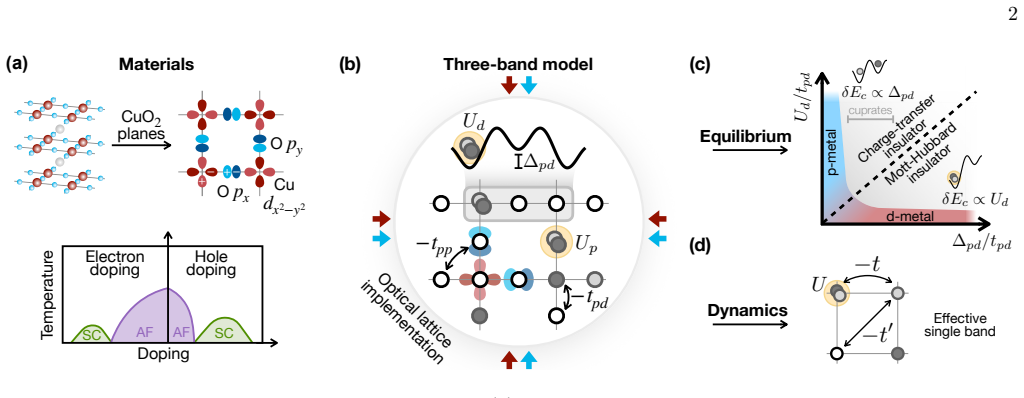
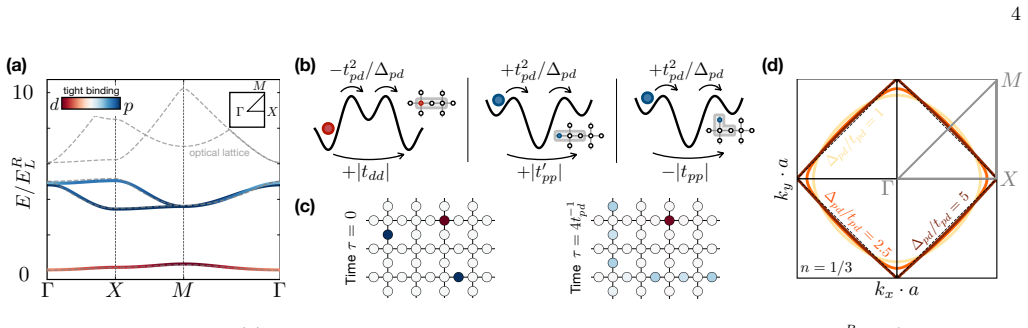
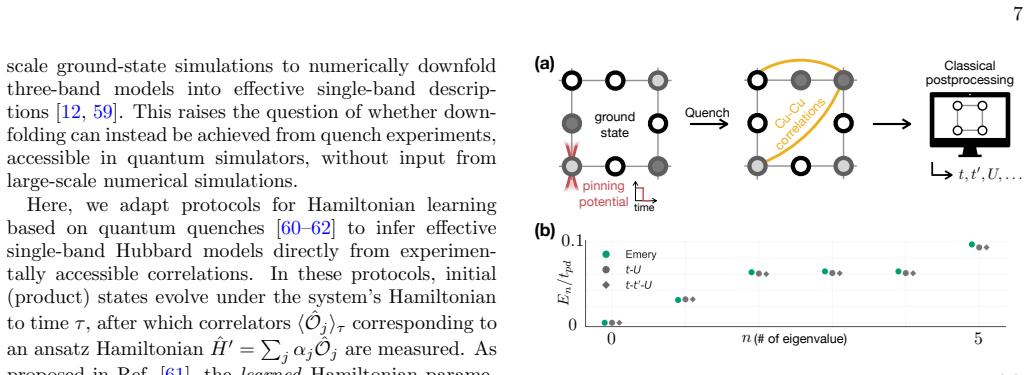
We propose an optical superlattice architecture that implements the three-band Emery model with ultracold fermions. By combining lattice beams with controllable interference, we engineer orbital degrees of freedom that reproduce key features of the cuprate band structure, while enabling independent control of orbital-dependent interactions and charge-transfer energy. Single-particle quantum walks benchmark the resulting tight-binding model. Determinant quantum Monte Carlo calculations of the undoped regime reveal a finite-temperature metal-insulator crossover accompanied by the onset of antiferromagnetic correlations. A Hamiltonian learning protocol then extracts effective single-band models
What carries the argument
The optical superlattice formed by interfering lattice beams, which creates tunable three-orbital sites and allows separate adjustment of intra- and inter-orbital interactions plus charge-transfer energy.
If this is right
- Single-particle quantum walks serve as an immediate experimental benchmark of the engineered tight-binding parameters.
- In the undoped regime the system exhibits a metal-insulator crossover together with growing antiferromagnetic correlations at temperatures reachable in current quantum gas microscopes.
- Hamiltonian learning applied to measured data can map the multi-orbital realization onto an effective single-band Hubbard model.
- The same lattice platform supplies a practical route to study multi-orbital Hubbard physics under quantum gas microscope observation.
Where Pith is reading between the lines
- Successful implementation would open the possibility of doping the system in situ to search for superconducting phases.
- Independent tuning of the charge-transfer energy could isolate its contribution to pairing mechanisms that are difficult to vary in solid-state samples.
- The interference-based engineering approach might generalize to other multi-orbital geometries beyond the Emery model.
Load-bearing premise
Laser beam interference patterns can be engineered precisely enough to produce the desired orbital geometry and independent parameter control without introducing uncontrolled mixing or heating.
What would settle it
Measure the single-particle band structure or quantum walk dynamics in the proposed lattice and check whether the extracted hopping amplitudes and orbital energies match the target Emery-model values within experimental resolution; a clear mismatch would show the architecture fails to realize the claimed model.
Figures




read the original abstract
Strongly-correlated electrons in transition-metal oxides give rise to intriguing emergent phenomena, including high-temperature superconductivity in cuprates. While simplified one-band Hubbard models capture some aspects, explicitly describing the interplay of copper and oxygen orbitals -- as in the three-band Emery model -- is essential to capture the full phenomenology of cuprates. Quantum simulators based on ultracold atoms offer a promising route to study such systems in a controlled setting, but realizing realistic multi-orbital Hubbard models remains challenging. Here we propose an optical superlattice architecture that implements the three-band Emery model with ultracold fermions. By combining lattice beams with controllable interference, we engineer orbital degrees of freedom that reproduce key features of the cuprate band structure, while enabling independent control of orbital-dependent interactions and charge-transfer energy. We show that single-particle quantum walks can benchmark the resulting tight-binding model. Using determinant quantum Monte Carlo, we further investigate thermodynamic properties in the undoped regime and find a finite-temperature metal-insulator crossover accompanied by the onset of antiferromagnetic correlations accessible in current experiments. Finally, we apply a Hamiltonian learning protocol enabling to infer effective single-band Hubbard models from experimental realizations of Emery models. Our results provide a practical pathway to simulate multi-orbital Hubbard physics with quantum gas microscopes.
Editorial analysis
A structured set of objections, weighed in public.
Referee Report
Summary. The manuscript proposes an optical superlattice architecture to realize the three-band Emery model with ultracold fermions. By combining lattice beams with controllable interference, it engineers orbital degrees of freedom to reproduce key cuprate band-structure features while allowing independent tuning of orbital-dependent interactions and charge-transfer energy. The work derives the resulting tight-binding parameters, benchmarks them via single-particle quantum-walk simulations, computes finite-temperature thermodynamics in the undoped regime using determinant quantum Monte Carlo (showing a metal-insulator crossover and onset of antiferromagnetic correlations), and applies a Hamiltonian learning protocol to infer effective single-band Hubbard models from the Emery realization.
Significance. If experimentally realizable, the proposal would enable controlled quantum simulation of multi-orbital Hubbard physics central to cuprate phenomenology, going beyond one-band models. Strengths include the explicit beam configuration, quantum-walk benchmarking, DQMC thermodynamics accessible to current experiments, and the Hamiltonian learning protocol that connects multi-orbital realizations to simpler models. These elements provide concrete, falsifiable pathways for experimental implementation.
major comments (2)
- [§3.2, Eq. (7)] §3.2, Eq. (7): The mapping from lattice-beam interference to independent control of orbital-dependent interactions and charge-transfer energy assumes ideal phase stability and intensity ratios; no quantitative robustness analysis against realistic beam misalignment or intensity fluctuations is provided, which is load-bearing for the central engineering claim.
- [§5.1] §5.1: The DQMC results demonstrate a finite-temperature metal-insulator crossover and antiferromagnetic correlations, but the manuscript does not quantify how the simulated temperatures map onto experimentally accessible regimes for the proposed lattice depths and interaction strengths.
minor comments (2)
- [Figure 3] Figure 3: The color scale and axis labels for the quantum-walk probability distributions are difficult to read at the printed size; enlarging or adding a supplementary high-resolution version would improve clarity.
- The reference list omits several recent works on optical-lattice realizations of multi-orbital models (e.g., those using Raman-assisted tunneling); adding these would better situate the novelty of the superlattice approach.
Simulated Author's Rebuttal
We thank the referee for their positive assessment of our work and for the constructive major comments. We agree that additional quantitative analyses will strengthen the manuscript's claims regarding experimental feasibility and will incorporate them in the revision.
read point-by-point responses
-
Referee: [§3.2, Eq. (7)] The mapping from lattice-beam interference to independent control of orbital-dependent interactions and charge-transfer energy assumes ideal phase stability and intensity ratios; no quantitative robustness analysis against realistic beam misalignment or intensity fluctuations is provided, which is load-bearing for the central engineering claim.
Authors: We agree that a quantitative robustness analysis is essential to support the central engineering claim. In the revised manuscript, we will add a dedicated subsection (or appendix) that numerically evaluates the sensitivity of the derived tight-binding parameters (hopping amplitudes, charge-transfer energy, and interaction strengths) to realistic experimental imperfections. This will include simulations of the optical potential under 1-5% intensity fluctuations and phase drifts up to 0.2 rad, demonstrating that the key orbital-selective features remain stable within the tolerances achievable in current quantum gas experiments. revision: yes
-
Referee: [§5.1] The DQMC results demonstrate a finite-temperature metal-insulator crossover and antiferromagnetic correlations, but the manuscript does not quantify how the simulated temperatures map onto experimentally accessible regimes for the proposed lattice depths and interaction strengths.
Authors: We thank the referee for highlighting this point. Although the manuscript states that the temperatures are accessible, we will revise §5.1 to include explicit mappings. Using the lattice depths, hopping scales, and interaction strengths from our proposal, we will convert the simulated temperatures (in units of t) to physical temperatures in nK and compare them directly to the cooling limits reported for quantum gas microscopes (typically T/t ≲ 0.1-0.2 in similar fermionic setups). This will provide concrete benchmarks for experimental realization. revision: yes
Circularity Check
No significant circularity in the optical superlattice proposal
full rationale
The manuscript is a forward proposal for an optical-superlattice realization of the three-band Emery model. It supplies an explicit lattice-beam configuration, derives the resulting tight-binding parameters from the engineered optical potential, benchmarks them with independent single-particle quantum-walk simulations, and computes finite-temperature thermodynamics via DQMC. No claimed prediction or first-principles result reduces by construction to a fitted parameter, self-citation, or ansatz; the derivation chain remains self-contained against external benchmarks.
Axiom & Free-Parameter Ledger
axioms (2)
- domain assumption The three-band Emery model Hamiltonian accurately captures the essential low-energy physics of cuprates.
- standard math Determinant quantum Monte Carlo provides reliable thermodynamic properties for the undoped Emery model at accessible temperatures.
Reference graph
Works this paper leans on
-
[1]
Gross and I
C. Gross and I. Bloch, Science357, 995 (2017)
2017
-
[2]
Pseudo- gap in a Fermi-Hubbard quantum simulator,
L. H. Kendrick, A. Kale, Y. Gang, A. D. Deters, M. Lebrat, A. W. Young, and M. Greiner, “Pseudo- gap in a Fermi-Hubbard quantum simulator,” (2025), arXiv:2509.180751
-
[3]
Bourgund, T
D. Bourgund, T. Chalopin, P. Bojovi´ c, H. Schl¨ omer, S. Wang, T. Franz, S. Hirthe, A. Bohrdt, F. Grusdt, I. Bloch, and T. A. Hilker, Nature637, 57 (2025)
2025
-
[4]
Chalopin, P
T. Chalopin, P. Bojovi´ c, S. Wang, T. Franz, A. Sinha, Z. Wang, D. Bourgund, J. Obermeyer, F. Grusdt, A. Bohrdt, L. Pollet, A. Wietek, A. Georges, T. Hilker, and I. Bloch, Proceedings of the National Academy of Sciences123(2026)
2026
-
[5]
M. Xu, L. H. Kendrick, A. Kale, Y. Gang, C. Feng, S. Zhang, A. W. Young, M. Lebrat, and M. Greiner, Nature (2025)
2025
-
[6]
Gross and W
C. Gross and W. S. Bakr, Nature Physics17, 1316 (2021)
2021
-
[7]
Bohrdt, L
A. Bohrdt, L. Homeier, C. Reinmoser, E. Demler, and F. Grusdt, Annals of Physics435, 168651 (2021)
2021
-
[8]
Dagotto, Reviews of Modern Physics66, 763 (1994)
E. Dagotto, Reviews of Modern Physics66, 763 (1994)
1994
-
[9]
L.-M. Duan, E. Demler, and M. D. Lukin, Physical Re- view Letters91, 090402 (2003)
2003
-
[10]
Qin, C.-M
M. Qin, C.-M. Chung, H. Shi, E. Vitali, C. Hubig, U. Schollw¨ ock, S. R. White, and S. Zhang (Simons Col- laboration on the Many-Electron Problem), Physical Re- view X10(2020)
2020
-
[11]
Hirayama, Y
M. Hirayama, Y. Yamaji, T. Misawa, and M. Imada, Physical Review B98, 134501 (2018)
2018
-
[12]
Jiang, D
S. Jiang, D. J. Scalapino, and S. R. White, Physical Review B108, l161111 (2023)
2023
-
[13]
Xu, C.-M
H. Xu, C.-M. Chung, M. Qin, U. Schollw¨ ock, S. R. White, and S. Zhang, Science384(2024)
2024
-
[14]
Keimer, S
B. Keimer, S. A. Kivelson, M. R. Norman, S. Uchida, and J. Zaanen, Nature518, 179 (2015)
2015
-
[15]
V. J. Emery, Physical Review Letters58, 2794 (1987)
1987
-
[16]
R. T. Scalettar, D. J. Scalapino, R. L. Sugar, and S. R. White, Physical Review B44, 770 (1991)
1991
-
[17]
de’ Medici, X
L. de’ Medici, X. Wang, M. Capone, and A. J. Millis, Physical Review B80, 054501 (2009)
2009
-
[18]
Ponsioen, S
B. Ponsioen, S. S. Chung, and P. Corboz, Physical Re- view B108, 205154 (2023)
2023
-
[19]
Zaanen, G
J. Zaanen, G. A. Sawatzky, and J. W. Allen, Physical Review Letters55, 418 (1985)
1985
-
[20]
Imada, A
M. Imada, A. Fujimori, and Y. Tokura, Reviews of Mod- ern Physics70, 1039 (1998)
1998
-
[21]
P. R. C. Kent, T. Saha-Dasgupta, O. Jepsen, O. K. An- dersen, A. Macridin, T. A. Maier, M. Jarrell, and T. C. Schulthess, Physical Review B78, 035132 (2008)
2008
-
[22]
Karolak, G
M. Karolak, G. Ulm, T. Wehling, V. Mazurenko, A. Poteryaev, and A. Lichtenstein, Journal of Electron Spectroscopy and Related Phenomena181, 11 (2010)
2010
-
[23]
X. Wang, M. J. Han, L. de’ Medici, H. Park, C. A. Mar- ianetti, and A. J. Millis, Physical Review B86, 195136 (2012)
2012
-
[24]
Weber, C
C. Weber, C. Yee, K. Haule, and G. Kotliar, EPL (Eu- rophysics Letters)100, 37001 (2012)
2012
-
[25]
Rybicki, M
D. Rybicki, M. Jurkutat, S. Reichardt, C. Kapusta, and J. Haase, Nature Communications7(2016)
2016
-
[26]
Kowalski, S
N. Kowalski, S. S. Dash, P. S´ emon, D. S´ en´ echal, and A.-M. Tremblay, Proceedings of the National Academy of Sciences118(2021)
2021
-
[27]
Z. Wang, C. Zou, C. Lin, X. Luo, H. Yan, C. Yin, Y. Xu, X. Zhou, Y. Wang, and J. Zhu, Science381, 227 (2023)
2023
-
[28]
Tarruell, D
L. Tarruell, D. Greif, T. Uehlinger, G. Jotzu, and T. Esslinger, Nature483, 302 (2012)
2012
-
[29]
Greif, Daniel G¨ unther, ETH Zurich, PhD Thesis (2013), Quantum magnetism with ultracold fermions in an opti- cal lattice
2013
-
[30]
M. Xu, L. H. Kendrick, A. Kale, Y. Gang, G. Ji, R. T. Scalettar, M. Lebrat, and M. Greiner, Nature620, 971 (2023)
2023
-
[31]
Mongkolkiattichai, L
J. Mongkolkiattichai, L. Liu, D. Garwood, J. Yang, and P. Schauss, Physical Review A108, l061301 (2023)
2023
-
[32]
M. L. Prichard, B. M. Spar, I. Morera, E. Demler, Z. Z. Yan, and W. S. Bakr, Nature629, 323 (2024)
2024
-
[33]
Lebrat, M
M. Lebrat, M. Xu, L. H. Kendrick, A. Kale, Y. Gang, P. Seetharaman, I. Morera, E. Khatami, E. Demler, and M. Greiner, Nature629, 317 (2024)
2024
-
[34]
Ferrimagnetism of ultracold fermions in a multi-band Hubbard system
M. Lebrat, A. Kale, L. H. Kendrick, M. Xu, Y. Gang, A. Nikolaenko, P. M. Bonetti, S. Sachdev, and M. Greiner, “Ferrimagnetism of ultracold fermions in a multi-band Hubbard system,” (2024), arXiv:2404.17555
work page internal anchor Pith review arXiv 2024
-
[35]
S. Taie, H. Ozawa, T. Ichinose, T. Nishio, S. Nakajima, and Y. Takahashi, Science Advances1(2015)
2015
-
[36]
Hirthe, T
S. Hirthe, T. Chalopin, D. Bourgund, P. Bojovi´ c, A. Bohrdt, E. Demler, F. Grusdt, I. Bloch, and T. A. Hilker, Nature613, 463 (2023)
2023
-
[37]
Vitali, H
E. Vitali, H. Shi, A. Chiciak, and S. Zhang, Physical Review B99, 165116 (2019)
2019
-
[38]
Di Liberto, A
M. Di Liberto, A. Hemmerich, and C. Morais Smith, Physical Review Letters117, 163001 (2016)
2016
-
[39]
Flannigan, L
S. Flannigan, L. Madail, R. G. Dias, and A. J. Daley, New Journal of Physics23, 083014 (2021)
2021
-
[40]
Walters, G
R. Walters, G. Cotugno, T. H. Johnson, S. R. Clark, and D. Jaksch, Physical Review A87, 043613 (2013)
2013
-
[41]
Marzari and D
N. Marzari and D. Vanderbilt, Physical Review B56, 12847 (1997)
1997
-
[42]
Weitenberg, M
C. Weitenberg, M. Endres, J. F. Sherson, M. Cheneau, P. Schauß, T. Fukuhara, I. Bloch, and S. Kuhr, Nature 471, 319 (2011)
2011
-
[43]
P. M. Preiss, R. Ma, M. E. Tai, A. Lukin, M. Rispoli, P. Zupancic, Y. Lahini, R. Islam, and M. Greiner, Sci- ence347, 1229 (2015)
2015
-
[44]
A. W. Young, W. J. Eckner, N. Schine, A. M. Childs, and A. M. Kaufman, Science377, 885 (2022)
2022
-
[45]
D. Wei, D. Adler, K. Srakaew, S. Agrawal, P. Weckesser, I. Bloch, and J. Zeiher, Physical Review X13, 021042 (2023)
2023
-
[46]
Fradkin, Field Theories of Condensed Matter Physics (Cambridge University Press, 2013)
E. Fradkin, Field Theories of Condensed Matter Physics (Cambridge University Press, 2013)
2013
-
[47]
Eskes and J
H. Eskes and J. H. Jefferson, Physical Review B48, 9788 (1993)
1993
-
[48]
F. C. Zhang and T. M. Rice, Physical Review B37, 3759 (1988)
1988
-
[49]
L. H. Tjeng, B. Sinkovic, N. B. Brookes, J. B. Goedkoop, R. Hesper, E. Pellegrin, F. M. F. de Groot, S. Altieri, S. L. Hulbert, E. Shekel, and G. A. Sawatzky, Physical Review Letters78, 1126 (1997)
1997
-
[50]
N¨ ucker, J
N. N¨ ucker, J. Fink, J. C. Fuggle, P. J. Durham, and W. M. Temmerman, Physical Review B37, 5158 (1988)
1988
-
[51]
C. T. Chen, F. Sette, Y. Ma, M. S. Hybertsen, E. B. Stechel, W. M. C. Foulkes, M. Schulter, S.-W. Cheong, 13 A. S. Cooper, L. W. Rupp, B. Batlogg, Y. L. Soo, Z. H. Ming, A. Krol, and Y. H. Kao, Physical Review Letters 66, 104 (1991)
1991
-
[52]
Pellegrin, N
E. Pellegrin, N. N¨ ucker, J. Fink, S. L. Molodtsov, A. Guti´ errez, E. Navas, O. Strebel, Z. Hu, M. Domke, G. Kaindl, S. Uchida, Y. Nakamura, J. Markl, M. Klauda, G. Saemann-Ischenko, A. Krol, J. L. Peng, Z. Y. Li, and R. L. Greene, Physical Review B47, 3354 (1993)
1993
-
[53]
G. L. Reaney, N. Kowalski, A.-M. S. Tremblay, and G. Sordi, Physical Review B112(2025)
2025
-
[54]
S. M. O’Mahony, W. Ren, W. Chen, Y. X. Chong, X. Liu, H. Eisaki, S. Uchida, M. H. Hamidian, and J. C. S. Davis, Proceedings of the National Academy of Sciences 119(2022)
2022
-
[56]
Cohen-Stead, S
B. Cohen-Stead, S. M. Costa, J. Neuhaus, A. T. Ly, Y. Zhang, R. Scalettar, K. Barros, and S. Johnston, SciPost Phys. Codebases , 29 (2024)
2024
-
[57]
P. M. Duarte, R. A. Hart, T.-L. Yang, X. Liu, T. Paiva, E. Khatami, R. T. Scalettar, N. Trivedi, and R. G. Hulet, Physical Review Letters114, 070403 (2015)
2015
-
[58]
Greif, M
D. Greif, M. F. Parsons, A. Mazurenko, C. S. Chiu, S. Blatt, F. Huber, G. Ji, and M. Greiner, Science351, 953 (2016)
2016
-
[59]
H. Lange, T. Blatz, U. Schollw¨ ock, S. Paeckel, and A. Bohrdt, “Towards effective models for low- dimensional cuprates: From ground state Hamilto- nian reconstruction to spectral functions,” (2025), arXiv:2509.06947
-
[60]
Bairey, I
E. Bairey, I. Arad, and N. H. Lindner, Physical Review Letters122, 020504 (2019)
2019
-
[61]
Z. Li, L. Zou, and T. H. Hsieh, Physical Review Letters 124, 160502 (2020)
2020
-
[62]
R. Ott, T. V. Zache, M. Pr¨ ufer, S. Erne, M. Tajik, H. Pichler, J. Schmiedmayer, and P. Zoller, Physical Review Research6, 043284 (2024)
2024
-
[63]
Impertro, S
A. Impertro, S. Karch, J. F. Wienand, S. Huh, C. Schweizer, I. Bloch, and M. Aidelsburger, Physical Review Letters133, 063401 (2024)
2024
-
[64]
Chalopin, P
T. Chalopin, P. Bojovi´ c, D. Bourgund, S. Wang, T. Franz, I. Bloch, and T. Hilker, Physical Review Let- ters134, 053402 (2025)
2025
-
[65]
Hansmann, N
P. Hansmann, N. Parragh, A. Toschi, G. Sangiovanni, and K. Held, New Journal of Physics16, 033009 (2014)
2014
-
[66]
A. N. Carroll, H. Hirzler, C. Miller, D. Wellnitz, S. R. Muleady, J. Lin, K. P. Zamarski, R. R. W. Wang, J. L. Bohn, A. M. Rey, and J. Ye, Science388, 381 (2025)
2025
- [67]
-
[68]
Marzari, A
N. Marzari, A. A. Mostofi, J. R. Yates, I. Souza, and D. Vanderbilt, Rev. Mod. Phys.84, 1419 (2012)
2012
-
[69]
Kremer, R
M. Kremer, R. Sachdeva, A. Benseny, and T. Busch, Phys. Rev. A96, 063611 (2017)
2017
-
[70]
Miles, B
C. Miles, B. Cohen-Stead, O. Bradley, S. Johnston, R. Scalettar, and K. Barros, Phys. Rev. E105, 045311 (2022)
2022
-
[71]
Y. F. Kung, C.-C. Chen, Y. Wang, E. W. Huang, E. A. Nowadnick, B. Moritz, R. T. Scalettar, S. Johnston, and T. P. Devereaux, Phys. Rev. B93, 155166 (2016)
2016
discussion (0)
Sign in with ORCID, Apple, or X to comment. Anyone can read and Pith papers without signing in.