Recognition: unknown
AI Hastens Limits to Exponential Growth
Pith reviewed 2026-05-08 09:10 UTC · model grok-4.3
The pith
Exponential growth in electricity demand will exhaust all terrestrial energy resources within decades if accelerated to fifteen percent per year by AI.
A machine-rendered reading of the paper's core claim, the machinery that carries it, and where it could break.
Core claim
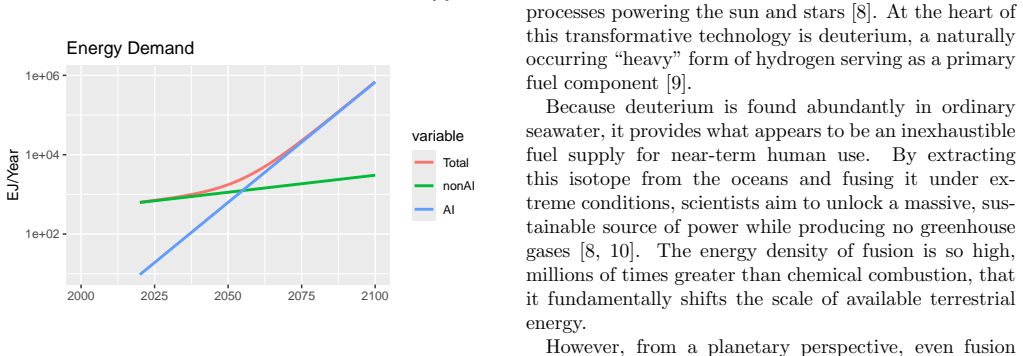
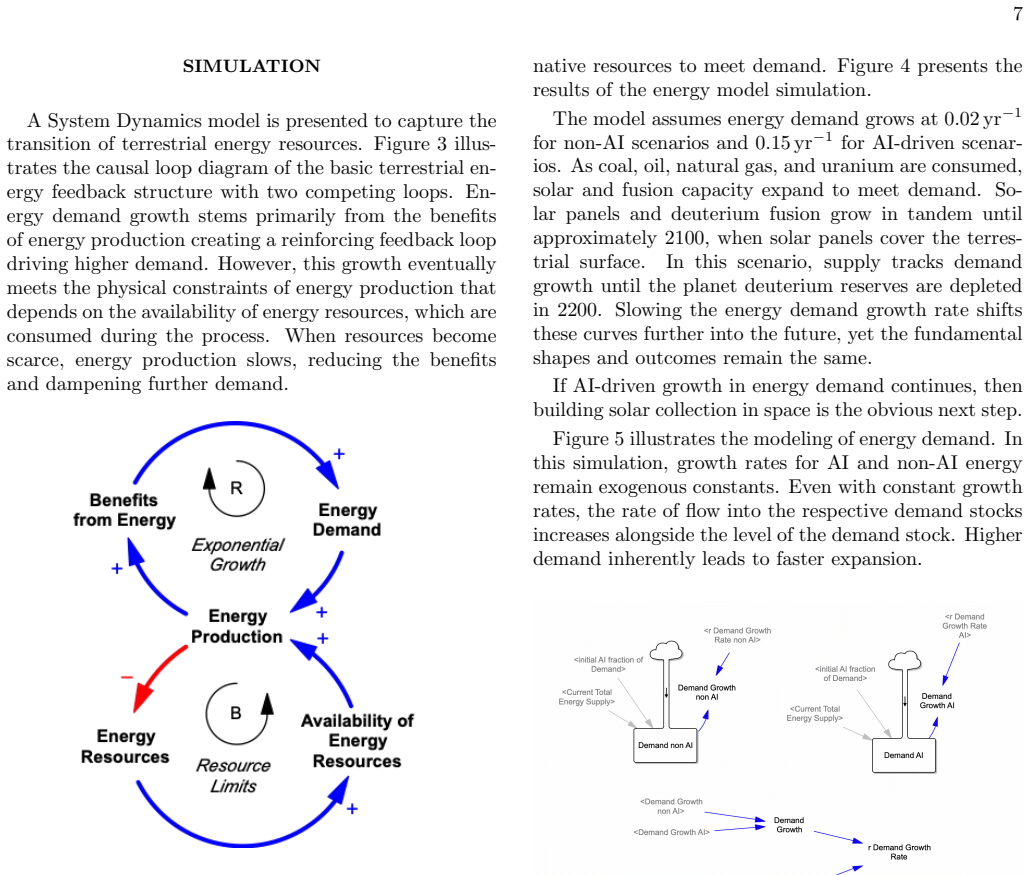
At any sustained positive growth rate of energy demand, depletion of all terrestrial energy resources occurs within a remarkably compressed period inversely proportional to the growth rate. AI has the potential to increase the growth rate of electricity from three percent per year to fifteen percent per year, collapsing multi-millennial expansion timelines into decades and requiring progression to Kardashev Type II civilization and beyond.
What carries the argument
The inverse proportionality of depletion time to demand growth rate, revealed through simple algebraic models and supported by system dynamics simulation.
Load-bearing premise
Electricity demand will sustain a constant positive exponential growth rate over decades without major efficiency gains, saturation effects, or policy interventions that alter the trajectory.
What would settle it
Observation of electricity demand growth rates remaining near or below three percent per year for the next ten to twenty years, or the appearance of strong saturation effects in energy consumption despite AI deployment.
Figures



read the original abstract
At any sustained positive growth rate of energy demand, depletion of all terrestrial energy resources, including non-renewable deuterium fusion and renewable solar, occurs within a remarkably compressed period. The time to depletion is inversely proportional to the demand growth rate. Artificial Intelligence (AI) has the potential to increase the growth rate of electricity from three percent per year to fifteen percent per year, effectively collapsing multi-millennial expansion timelines into decades. To grow after terrestrial depletion will require capturing more of the sun's output than the earth's cross-sectional area, eventually capturing the entire sun's output (Kardashev Type~II civilization). Expansion beyond that threshold requires colonizing other star systems. Simple algebraic models yield the main conclusions of the paper, supported by a system dynamics simulation. This analysis reveals that even unthinkably vast resources, such as total oceanic deuterium or the full luminosity of the Sun, are decidedly finite when viewed through a logarithmic lens. Uncertainties in the exact remaining resources of coal, oil, natural gas, and uranium do not affect the conclusions of this paper, as the fundamental physical limit is dictated by the geometry of expansion and the universal speed of light.
Editorial analysis
A structured set of objections, weighed in public.
Referee Report
Summary. The manuscript argues that any sustained positive exponential growth rate in energy demand leads to depletion of all terrestrial resources—including renewables and deuterium fusion—on timescales inversely proportional to the growth rate. It claims AI could accelerate electricity demand growth from 3% to 15% per year, collapsing multi-millennial timelines into decades. Beyond terrestrial limits, further expansion requires capturing increasing fractions of the Sun's luminosity (approaching Kardashev Type II), with interstellar colonization needed thereafter. These results follow from simple algebraic models of exponential growth against fixed resources and are supported by an unspecified system dynamics simulation; uncertainties in resource estimates are stated not to affect the core conclusions due to the geometry of expansion and the speed of light.
Significance. If the modeling assumptions hold, the paper offers a transparent algebraic illustration of how exponential growth renders even vast resources (e.g., total solar output or oceanic deuterium) finite on human timescales, with direct implications for long-term energy strategy and the necessity of space expansion. The explicit linkage to AI as a potential accelerator of demand growth provides a timely perspective on technological drivers of physical limits. The algebraic simplicity is a strength, allowing the inverse scaling of depletion time with growth rate to be derived directly without complex numerics.
major comments (3)
- [Abstract and system dynamics simulation description] The central result that depletion time scales as 1/r follows tautologically from the exponential functional form with fixed resources and constant r (as stated in the abstract); the manuscript provides no endogenous feedbacks in the described system dynamics simulation that would allow r to respond to scarcity, price, or policy, which is load-bearing for the claim that AI 'hastens limits' rather than merely illustrating an upper-bound scenario.
- [Algebraic models and simulation support] No sensitivity analysis, error propagation, or validation against historical electricity demand data is presented for the 3% baseline or the posited 15% AI-driven rate (abstract); this leaves the specific quantitative timelines (decades vs. millennia) dependent on the free parameter 'electricity demand growth rate' without robustness checks.
- [Abstract] The assertion that 'uncertainties in the exact remaining resources of coal, oil, natural gas, and uranium do not affect the conclusions' (abstract) holds only because the model treats resources as fixed and growth as exogenous; without exploring saturation, efficiency gains, or demand elasticity, the extrapolation to solar capture and Kardashev Type II remains conditional on the absence of countervailing dynamics observed in real energy systems.
minor comments (2)
- [Abstract] The abstract would benefit from an explicit numerical example of depletion time under the 15% scenario to make the 'decades' claim concrete.
- Notation for growth rate r and resource quantities could be defined more clearly at first use to aid readers unfamiliar with the exponential depletion formula.
Simulated Author's Rebuttal
We thank the referee for their insightful comments on our manuscript. We address each of the major comments point by point below. We agree with the need to clarify modeling assumptions and will make revisions accordingly to better contextualize our results as scenario analyses.
read point-by-point responses
-
Referee: The central result that depletion time scales as 1/r follows tautologically from the exponential functional form with fixed resources and constant r (as stated in the abstract); the manuscript provides no endogenous feedbacks in the described system dynamics simulation that would allow r to respond to scarcity, price, or policy, which is load-bearing for the claim that AI 'hastens limits' rather than merely illustrating an upper-bound scenario.
Authors: We concur that the inverse scaling of depletion time with growth rate r is a direct mathematical consequence of the exponential growth model with fixed resources and constant r. The system dynamics simulation described in the manuscript serves primarily to illustrate the trajectories under these assumptions rather than to model adaptive behaviors. Our intent is to demonstrate the physical limits that would arise if exponential growth in energy demand is sustained, with AI posited as a potential driver increasing r. We will revise the manuscript to explicitly frame this as an upper-bound scenario without endogenous feedbacks, and add discussion on how real-world responses (e.g., price signals or policy) might alter r. This addresses the load-bearing aspect for the 'hastens limits' claim. revision: yes
-
Referee: No sensitivity analysis, error propagation, or validation against historical electricity demand data is presented for the 3% baseline or the posited 15% AI-driven rate (abstract); this leaves the specific quantitative timelines (decades vs. millennia) dependent on the free parameter 'electricity demand growth rate' without robustness checks.
Authors: We acknowledge that the current manuscript lacks explicit sensitivity analysis, error propagation, and direct validation against historical data for the growth rates. The 3% figure draws from observed long-term electricity demand growth trends, while 15% is an illustrative projection for AI-driven acceleration. To strengthen the quantitative claims, we will incorporate a sensitivity analysis varying the growth rate between 1% and 20%, include comparisons to historical data from international energy agencies, and discuss uncertainties in the timelines. This will provide the requested robustness checks. revision: yes
-
Referee: The assertion that 'uncertainties in the exact remaining resources of coal, oil, natural gas, and uranium do not affect the conclusions' (abstract) holds only because the model treats resources as fixed and growth as exogenous; without exploring saturation, efficiency gains, or demand elasticity, the extrapolation to solar capture and Kardashev Type II remains conditional on the absence of countervailing dynamics observed in real energy systems.
Authors: The statement in the abstract is accurate within the model's framework, where resources are treated as fixed stocks and growth as exogenous, because depletion time scales with (1/r) * ln(resource size), making it insensitive to order-of-magnitude variations in resource estimates at higher r values. However, we agree that this does not account for potential endogenous changes such as efficiency improvements or demand saturation. We will revise the abstract to qualify the statement more clearly and add a dedicated limitations section discussing the absence of these dynamics, noting that the results apply under sustained growth conditions without countervailing effects. revision: partial
Circularity Check
Depletion timelines scale as 1/r by algebraic identity under fixed exponential growth
specific steps
-
self definitional
[Abstract]
"The time to depletion is inversely proportional to the demand growth rate. Artificial Intelligence (AI) has the potential to increase the growth rate of electricity from three percent per year to fifteen percent per year, effectively collapsing multi-millennial expansion timelines into decades. ... Simple algebraic models yield the main conclusions of the paper, supported by a system dynamics simulation."
The inverse proportionality is the closed-form solution of the exponential growth ODE with fixed total resource; inserting a higher constant r therefore reduces t by construction. The paper presents the resulting timeline collapse as a derived conclusion, yet it is identical to the algebraic input once the 15% rate is assumed to persist without feedback.
full rationale
The paper's headline result—that AI raises electricity demand growth from 3% to 15% yr⁻¹ and thereby collapses depletion timelines from millennia to decades—follows directly from the stated inverse proportionality between depletion time and growth rate. This scaling is the exact integral of dE/dt = rE against a fixed resource stock and is therefore tautological once the constant-r assumption and the 15% value are inserted. The abstract explicitly attributes the main conclusions to 'simple algebraic models,' with the system-dynamics simulation described only as support; no endogenous feedback on r is shown. This constitutes partial circularity (score 6) because the central 'hastening' claim reduces to the model's own definitional mathematics rather than independent evidence.
Axiom & Free-Parameter Ledger
free parameters (1)
- electricity demand growth rate
axioms (2)
- domain assumption Energy demand grows exponentially at a constant rate over long periods
- domain assumption Terrestrial energy resources are finite and can be treated as a fixed stock
Reference graph
Works this paper leans on
-
[1]
Instantaneous DemandD(t): D(t) =D(0) exp(r t) (4) This expression models the temporal trajectory of energy needs. It establishes that demand functions as a compounding variable where the rate of in- crease is proportional to the current magnitude, resulting in a non-linear acceleration of power re- quirements over time
-
[2]
Cumulative ConsumptionQ(t): Q(t) = D(0) r exp(r t)−1 (5) This integral defines the total volume of energy ex- tracted from the environment over a given period. In a systems dynamics context,Q(t) represents the total drain on finite resource stocks; it illustrates how the area under an exponential curve can ex- haust even vast reserves within a limited num...
-
[3]
fuel tank
Expansion VelocitydD/dt: dD dt =r D(0) exp(r t) (6) The first derivative of demand with respect to time quantifies the speed of expansion. This metric iden- tifies the rate at which new energy capacity must be brought online to satisfy growth, highlighting that the challenge is not only the absolute magnitude of demand but the exponential acceleration of ...
1960
-
[4]
Transmission of Information by Ex- traterrestrial Civilizations,
N. S. Kardashev, “Transmission of Information by Ex- traterrestrial Civilizations,”Soviet Astronomy8, 217 (1964)
1964
-
[5]
Energy Institute – Statistical Review of World Energy (2025),
U.S. Energy Information Administration, “Energy Institute – Statistical Review of World Energy (2025),” https://ourworldindata.org/explorers/energy (2025)
2025
-
[6]
Electricity generation,
The Energy Institute, “Electricity generation,” Ember (2026); Energy Institute – Statistical Review of World Energy (2025),https://ourworldindata.org/grapher/ electricity-generation
2026
-
[7]
7 Key Factors Driving the AI Mar- ket,
Sabey Data Centers, “7 Key Factors Driving the AI Mar- ket,”https://sabeydatacenters.com(n.d.)
-
[8]
GPU Shortages: How the AI Compute Crunch Is Reshaping Infrastructure,
Clarifai, “GPU Shortages: How the AI Compute Crunch Is Reshaping Infrastructure,” Clarifai (January 29, 2026)
2026
-
[9]
IEA Energy and AI Observatory,https: //www.iea.org/data-and-statistics/data-tools/ energy-and-ai-observatory
-
[10]
Turliuk and Sterman, manuscript in review (2026)
2026
-
[11]
Energy Density of Water via Deuterium Fusion Reactions,
R. Przybocki, “Energy Density of Water via Deuterium Fusion Reactions,” Stanford University (December 15, 2023)
2023
-
[12]
Fuelling,
ITER Organization, “Fuelling,”https://www.iter.org (n.d.)
-
[13]
Deuterium Und Tritium: Unlocking Fusion’s Future Energy Potential,
Smolsys, “Deuterium Und Tritium: Unlocking Fusion’s Future Energy Potential,”https://www.smolsys.com (n.d.)
-
[14]
Detailed balance limit of efficiency of p-n junction solar cells,
W. Shockley and H. J. Queisser, “Detailed balance limit of efficiency of p-n junction solar cells,”Journal of Ap- plied Physics32(3), 510–519 (1961)
1961
-
[15]
IPCC,Climate Change 2021: The Physical Science Ba- sis, Contribution of Working Group I to the Sixth As- sessment Report, Cambridge University Press (2021)
2021
-
[16]
R. T. Pierrehumbert,Principles of Planetary Climate, Cambridge University Press (2010)
2010
-
[17]
earthdata.nasa.gov/topics/land-surface/albedo
NASA, “Albedo,” NASA Earthdata,https://www. earthdata.nasa.gov/topics/land-surface/albedo
-
[18]
Search for artificial stellar sources of infra- red radiation,
F. J. Dyson, “Search for artificial stellar sources of infra- red radiation,”Science131(3414), 1667–1668 (1960)
1960
-
[19]
Astroengineering: The Potential of Dyson Spheres and Other Megastructures for Energy Harvest- ing,
L. Bars, “Astroengineering: The Potential of Dyson Spheres and Other Megastructures for Energy Harvest- ing,”Journal of Astrophysics & Aerospace Technology 12(5), 317 (2024)
2024
-
[20]
B. W. Carroll and D. A. Ostlie,An Introduction to Mod- ern Astrophysics, 2nd ed., Cambridge University Press (2017)
2017
-
[21]
The Last Question,
I. Asimov, “The Last Question,”Science Fiction Quar- terly(1956)
1956
-
[22]
The Case for SETI,
J. T. Wright, “The Case for SETI,”The Astrophysical Journal(2020)
2020
-
[23]
AI inference vs. training: What is AI infer- ence?
Cloudflare, “AI inference vs. training: What is AI infer- ence?”https://www.cloudflare.com(n.d.)
-
[24]
The next big shifts in AI workloads and hyperscaler strategies,
C. Aroraet al., “The next big shifts in AI workloads and hyperscaler strategies,” McKinsey & Company (Decem- ber 17, 2025)
2025
-
[25]
The LLM Scaling Wall is Here. What’s Next for AI?
D. B´ evort, “The LLM Scaling Wall is Here. What’s Next for AI?” Adeaca (January 20, 2026)
2026
-
[26]
Will we run out of data? limits of llm scaling based on human-generated data
P. Villaloboset al., “Will we run out of data? Lim- its of LLM scaling based on human-generated data,” arXiv:2211.04325 (2024)
-
[27]
SpaceX seeks FCC approval for mega AI data center constellation,
M. Donegan, “SpaceX seeks FCC approval for mega AI data center constellation,”Light Reading(February 2, 2026)
2026
-
[28]
Data centers in outer space emerge as solu- tion to AI’s massive energy requirements,
E. Revell, “Data centers in outer space emerge as solu- tion to AI’s massive energy requirements,”Fox Business (January 14, 2026). 10
2026
-
[29]
Tether-Based Architecture for Solar- Powered Orbital AI Data Centers,
I. Bargatinet al., “Tether-Based Architecture for Solar- Powered Orbital AI Data Centers,” arXiv (n.d.)
-
[30]
Deloitte,Tech Trends 2026, Deloitte Insights (2025)
2026
-
[31]
DOE National Laboratory makes history by achieving fusion ignition,
U.S. Department of Energy, “DOE National Laboratory makes history by achieving fusion ignition,”https://www.energy.gov/articles/ doe-national-laboratory-makes-history- achieving-fusion-ignition(December 13, 2022)
2022
-
[32]
Eni and Commonwealth Fusion Systems sign$1 bil- lion cooperation agreement to accelerate com- mercial fusion energy,
Commonwealth Fusion Systems, “Eni and Commonwealth Fusion Systems sign$1 bil- lion cooperation agreement to accelerate com- mercial fusion energy,”https://cfs.energy/ news-and-media/eni-and-commonwealth-fusion- systems-sign-1-billion(February 24, 2025)
2025
-
[33]
Blue Origin,https://www.blueorigin.com
-
[34]
SpaceX, “Mars,”https://www.spacex.com/ humanspaceflight/mars(n.d.)
-
[35]
Federal Communications Commission, SpaceX AI data center constellation application (2026)
2026
-
[36]
Dark matter,
National Aeronautics and Space Administration, “Dark matter,” NASA Science,https://science.nasa.gov/ dark-matter/(August 29, 2025)
2025
-
[37]
G. R. Sullivan and M. V. Harper,Hope is Not a Strat- egy: The 6 Keys to Winning the Way Forward, Times Business (1997)
1997
-
[38]
What is deu- terium,
International Atomic Energy Agency, “What is deu- terium,”https://www.iaea.org/newscenter/news/ what-is-deuterium(May 16, 2023)
2023
-
[39]
How much water is in the ocean?
National Ocean Service, “How much water is in the ocean?” NOAA,https://oceanservice.noaa.gov/ facts/oceanwater.html(June 16, 2024). [37]NRL Plasma Formulary, p. 44. Deuterium Resources Since non-renewable resources are dominated by deu- terium, and estimates of deuterium resources are not as widely available as fossil fuels and uranium, we document the de...
2024
discussion (0)
Sign in with ORCID, Apple, or X to comment. Anyone can read and Pith papers without signing in.