Recognition: unknown
The Decay of Impact with Network Distance in Linear Diffusion Processes
Pith reviewed 2026-05-08 08:55 UTC · model grok-4.3
The pith
Total impact between nodes in linear diffusion decays exponentially with network distance, approximated by eigenvector centrality product and spectral terms.
A machine-rendered reading of the paper's core claim, the machinery that carries it, and where it could break.
Core claim
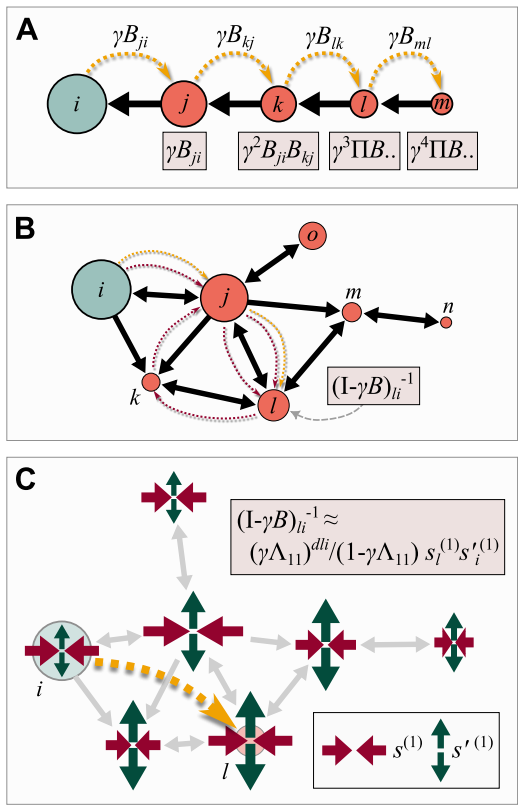
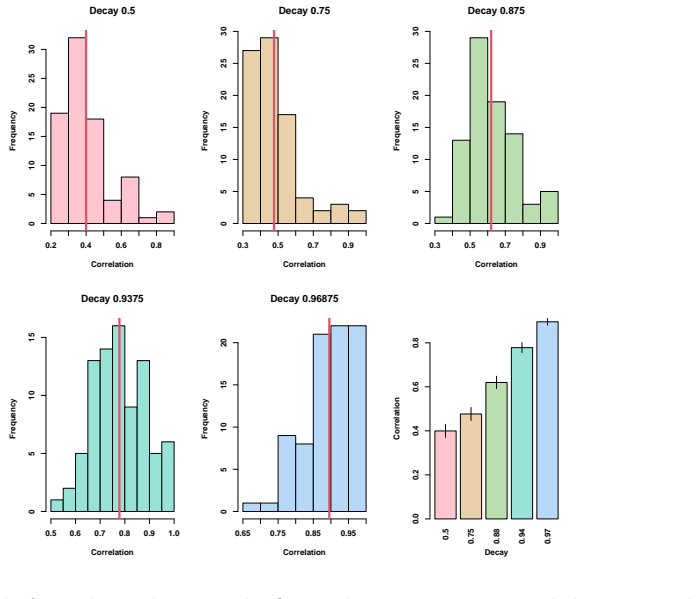
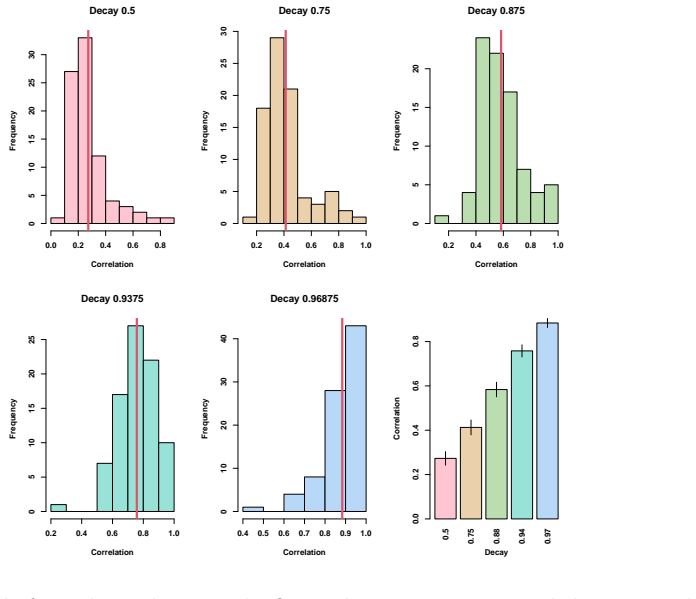
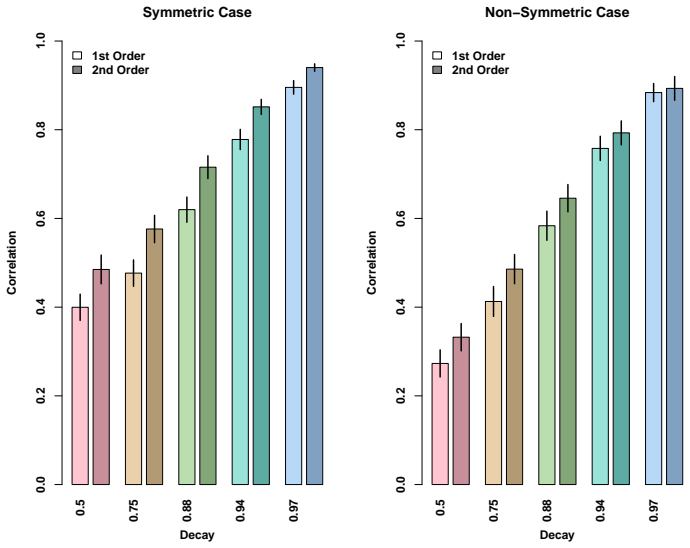
Here, we provide an approximate solution for the total impact of one node on another as a function of network distance, showing that the total impact is given to first order by a product of eigenvector centrality scores together with an expression in terms of the graph spectrum (eigenvalues of the adjacency matrix) that falls exponentially with distance. We also show how this solution can be refined using higher-order eigenvectors of the adjacency matrix. A numerical study on interpersonal networks drawn from educational settings verifies an average exponential decline in impact strength under the linear diffusion model, and shows that the first-order eigenvector approximation can often be a
What carries the argument
The first-order term from the leading eigenvector of the adjacency matrix paired with the dominant eigenvalue, which together produce the exponential decay in summed path contributions.
If this is right
- Total impact falls exponentially with distance on average in linear diffusion processes.
- The product of eigenvector centrality scores serves as a practical proxy for pairwise total impact.
- Higher-order eigenvectors of the adjacency matrix can be used to refine the first-order approximation.
- This yields a simple model for estimating influence or status effects in social networks without full path summation.
Where Pith is reading between the lines
- The approximation may enable faster influence calculations on large networks by avoiding repeated full solutions of the diffusion equation.
- Local interaction models could be justified when distant impacts become negligible due to the exponential term.
- Similar spectral approximations might extend to directed networks or those with weighted edges if the adjacency structure permits.
Load-bearing premise
That the first-order term involving only the leading eigenvector and dominant spectral contribution provides a good proxy for total impact across graphs and diffusion parameters in social networks.
What would settle it
A network where exact total impacts computed from the diffusion model show no exponential decay with distance or deviate strongly from the predicted product of eigenvector centralities.
Figures

read the original abstract
Many processes related to status, power, and influence within social networks have been modeled using forced linear diffusion models; examples include the highly successful Friedkin-Johnsen model of social influence, the status/power scores of Katz and Bonacich, and the widely used network autocorrelation model. While a basic assumption of such models is that the impact of one individual on another through any given path falls exponentially with path length, the total impact of the first individual on the second involves contributions from walks of all lengths; thus, while total impact is expected to decline with network distance, the relationship is not trivial. Here, we provide an approximate solution for the total impact of one node on another as a function of network distance, showing that the total impact is given to first order by a product of eigenvector centrality scores together with an expression in terms of the graph spectrum (eigenvalues of the adjacency matrix) that falls exponentially with distance. We also show how this solution can be refined using higher-order eigenvectors of the adjacency matrix. A numerical study on interpersonal networks drawn from educational settings verifies an average exponential decline in impact strength under the linear diffusion model, and shows that the first-order eigenvector approximation can often be a good proxy for total impact as obtained from the exact solution. This suggests a simple model that can be used to approximate total impact for social influence or status processes in a range of settings.
Editorial analysis
A structured set of objections, weighed in public.
Referee Report
Summary. The manuscript derives an approximate closed-form expression for the total impact of one node on another under linear diffusion processes on graphs. To first order, this impact is proportional to the product of the nodes' components in the leading eigenvector of the adjacency matrix (i.e., eigenvector centralities) multiplied by a spectral factor involving the dominant eigenvalue that decays exponentially with shortest-path distance. Higher-order corrections using additional eigenvectors are outlined, and numerical experiments on educational interpersonal networks are presented to show that impact declines exponentially with distance on average and that the first-order approximation often serves as a reasonable proxy for the exact impact obtained from matrix inversion.
Significance. If the approximation is accurate with controllable error, the work supplies a simple, interpretable link between pairwise impact, eigenvector centrality, and the graph spectrum, enabling efficient estimation of influence decay without full linear-system solves. This is relevant for models such as Friedkin-Johnsen, Katz-Bonacich status, and network autocorrelation. The numerical verification on real social networks adds practical value, though the result's scope is tied to the tested network class.
major comments (1)
- [§3] §3 (Derivation of the first-order approximation): The truncation of the spectral expansion of the resolvent (I − αA)^−1 after the leading term is presented without an explicit remainder bound in terms of |λ2/λ1| and the diffusion parameter α. This is load-bearing for the central claim that the leading term provides a good proxy, because the error can become non-negligible when the spectral gap is small, as noted in the stress-test concern; the manuscript supplies no quantitative condition under which the truncation error remains small uniformly in distance d.
minor comments (2)
- [Abstract] The abstract states that the total impact 'is given to first order by a product of eigenvector centrality scores together with an expression in terms of the graph spectrum' but does not display the explicit leading-order formula; inserting the concrete expression would improve immediate clarity.
- [§2] Notation for the impact function and the precise definition of network distance (shortest-path versus walk-based) should be introduced consistently in §2 before the derivation begins.
Simulated Author's Rebuttal
We thank the referee for their thorough review and for identifying a key point that can strengthen the rigor of our first-order approximation. We address the major comment below and will revise the manuscript to incorporate an explicit error bound.
read point-by-point responses
-
Referee: [§3] §3 (Derivation of the first-order approximation): The truncation of the spectral expansion of the resolvent (I − αA)^−1 after the leading term is presented without an explicit remainder bound in terms of |λ2/λ1| and the diffusion parameter α. This is load-bearing for the central claim that the leading term provides a good proxy, because the error can become non-negligible when the spectral gap is small, as noted in the stress-test concern; the manuscript supplies no quantitative condition under which the truncation error remains small uniformly in distance d.
Authors: We agree that an explicit remainder bound is desirable to make the conditions for the approximation fully quantitative. In the revision we will add to §3 a derivation of the truncation error for the resolvent expansion, expressed in terms of the spectral gap ratio |λ2/λ1| and α (under the standing assumption that the graph is connected and α is below the reciprocal of the largest eigenvalue). The bound will be shown to be independent of distance d when the leading eigenvector components are bounded away from zero, and we will discuss the regime in which the error remains small uniformly in d. This addition will also clarify the stress-test scenarios. revision: yes
Circularity Check
Spectral truncation approximation derived directly from adjacency matrix eigenvalues without circular reduction
full rationale
The paper's core claim is an approximate closed-form expression for total impact obtained by truncating the spectral expansion of the resolvent (I - αA)^{-1} after the dominant eigenvector term. This is a direct application of standard linear algebra to the forced linear diffusion model and does not reduce to a fitted parameter, self-definition, or self-citation chain. The numerical study on educational networks is described as independent verification of the exponential decay pattern rather than the source of the formula. No load-bearing steps invoke prior author work as an unverified uniqueness theorem or rename an empirical pattern as a derivation.
Axiom & Free-Parameter Ledger
axioms (1)
- domain assumption Impact of one individual on another through any given path falls exponentially with path length
Reference graph
Works this paper leans on
-
[1]
Anselin, L. (1988). Spatial Econometrics: Methods and Models . Kluwer, Norwell, MA
1988
-
[2]
Ayala, G. X. and Team, S. D. P. R. C. (2011). Effects of a promotor-based intervention to promote physical activity: Familias sanas y activas. American Journal of Public Health , 101(12):2261--2268
2011
-
[3]
Bonacich, P. (1972). Factoring and weighting approaches to clique identification. Journal of Mathematical Sociology , 2:113--120
1972
-
[4]
Bonacich, P. (1987). Power and centrality: A family of measures. American Journal of Sociology , 92:1170--1182
1987
-
[5]
and Page, L
Brin, S. and Page, L. (1998). The anatomy of a large-scale hypertextual web search engine. Computer Networks and ISDN Systems , 30(1-7):107--117
1998
-
[6]
Butts, C. T. (2008a). network: a package for managing relational data in R . Journal of Statistical Software , 24(2)
-
[7]
Butts, C. T. (2008b). Social network analysis with sna. Journal of Statistical Software , 24(6)
-
[8]
Butts, C. T. (2025). A perturbative solution to the linear influence/network autocorrelation model under network dynamics. Journal of Mathematical Sociology , 49(3):192--210
2025
-
[9]
Cliff, A. D. and Ord, J. K. (1973). Spatial Autocorrelation . Pion, London
1973
-
[10]
Doreian, P. (1989). Two regimes of network autocorrelation. In Kochen, M., editor, The Small World , pages 280--295. Ablex, Norwood
1989
-
[11]
Eng, E. (1993). The save our sisters project. a social network strategy for reaching rural black women. Cancer , 72(S3):1071--1077
1993
-
[12]
Freeman, L. C. (1979). Centrality in social networks: Conceptual clarification. Social Networks , 1(3):223--258
1979
-
[13]
Freidkin, N. (1998). A Structural Theory of Social Influence . Cambridge University Press, Cambridge
1998
-
[14]
Friedkin, N. (1991). Theoretical foundations for centrality measures. American Journal of Sociology , 96(6):1478--1504
1991
-
[15]
and Cook, K
Friedkin, N. and Cook, K. S. (1991). Peer group influence. Sociological Methods and Research , 19:122--143
1991
-
[16]
and Johnsen, E
Friedkin, N. and Johnsen, E. C. (1990). Social influence and opinions. Journal of Mathematical Sociology , 15:193--206
1990
-
[17]
Friedkin, N. E. and Bullo, F. (2017). How truth wins in opinion dynamics along issue sequences. Proceedings of the National Academy of Sciences , 114(43):11380--11385
2017
-
[18]
E., Proskurnikov, A
Friedkin, N. E., Proskurnikov, A. V., Tempo, R., and Parsegov, S. E. (2016). Network science on belief system dynamics under logic constraints. Science , 354(6310):321--326
2016
-
[19]
S., Hunter, D
Handcock, M. S., Hunter, D. R., Butts, C. T., Goodreau, S. M., and Morris, M. (2008). statnet : Software tools for the representation, visualization, analysis and simulation of network data. Journal of Statistical Software , 24(1):1--11
2008
-
[20]
Katz, L. (1953). A new status index derived from sociometric analysis. Psychometrika , 18(1):39--43
1953
-
[21]
A., Peeters, L., Richter, S., Tenfelde-Podehl, D., and Zlotowski, O
Kosch \" u tzki, D., Lehmann, K. A., Peeters, L., Richter, S., Tenfelde-Podehl, D., and Zlotowski, O. (2005). Centrality indices. In Brandes, U. and Erlebach, T., editors, Network Analysis: Methodological Foundations , chapter 3, pages 16--61. Springer-Verlag, Berlin
2005
-
[22]
M., Pechmann, C., Wang, C., Pan, L., Delucchi, K., and Prochaska, J
Lakon, C. M., Pechmann, C., Wang, C., Pan, L., Delucchi, K., and Prochaska, J. J. (2016). Mapping engagement in twitter-based support networks for adult smoking cessation. American journal of public health , 106(8):1374--1380
2016
-
[23]
M., Wang, C., Hipp, J
Lakon, C. M., Wang, C., Hipp, J. R., and Butts, C. T. (2025). Simulating social network-based interventions for adolescent cigarette smoking. Social Science & Medicine , 380:118196
2025
-
[24]
Latan \' e , B. (1981). The psychology of social impact. American Psychologist , 36(4):343--356
1981
-
[25]
Lee, N. H. (1969). The Search for an Abortionist . University of Chicago Press, Chicago, IL
1969
-
[26]
buddy systems
May, S. and West, R. (2000). Do social support interventions (“buddy systems”) aid smoking cessation? a review. Tobacco control , 9(4):415--422
2000
-
[27]
Minkler, M. (1986). Building support networks from social isolation. Generations: Journal of the American Society on Aging , 10(4):46--49
1986
-
[28]
Moody, J. (2001). Peer influence groups: Identifying dense clusters in large networks. Social Networks , 23:261--283
2001
-
[29]
L., Williams, C
Perry, C. L., Williams, C. L., Komro, K. A., Veblen-Mortenson, S., Stigler, M. H., Munson, K. A., Farbakhsh, K., Jones, R. M., and Forster, J. L. (2002). Project northland: Long-term outcomes of community action to reduce adolescent alcohol use. Health education research , 17(1):117--132
2002
-
[30]
R: A Language and Environment for Statistical Computing
R Core Team (2026). R: A Language and Environment for Statistical Computing . R Foundation for Statistical Computing, Vienna, Austria
2026
-
[31]
Salancik, G. R. (1986). An index of subgroup influence in dependency networks. Administrative Science Quarterly , 31(2):194--211
1986
-
[32]
Valente, T. W. (2012). Network interventions. science , 337(6090):49--53
2012
-
[33]
T., Hipp, J
Wang, C., Butts, C. T., Hipp, J. R., and Lakon, C. M. (2026). Peer influence decay and behavioral diffusion in adolescent networks: a simulation approach. Science , forthcoming
2026
-
[34]
R., Butts, C
Wang, C., Hipp, J. R., Butts, C. T., and Lakon, C. M. (2022). Insight into selecting adolescents for drinking intervention programs: a simulation based on stochastic actor--oriented models. Prevention Science , 23(1):48--58
2022
-
[35]
and Faust, K
Wasserman, S. and Faust, K. (1994). Social Network Analysis: Methods and Applications . Cambridge University Press, Cambridge
1994
discussion (0)
Sign in with ORCID, Apple, or X to comment. Anyone can read and Pith papers without signing in.