Recognition: unknown
ML-Guided Primal Heuristics for Mixed Binary Quadratic Programs
Pith reviewed 2026-05-08 12:04 UTC · model grok-4.3
The pith
Machine learning can train neural networks to predict good solutions and guide primal heuristics for mixed binary quadratic programs.
A machine-rendered reading of the paper's core claim, the machinery that carries it, and where it could break.
Core claim
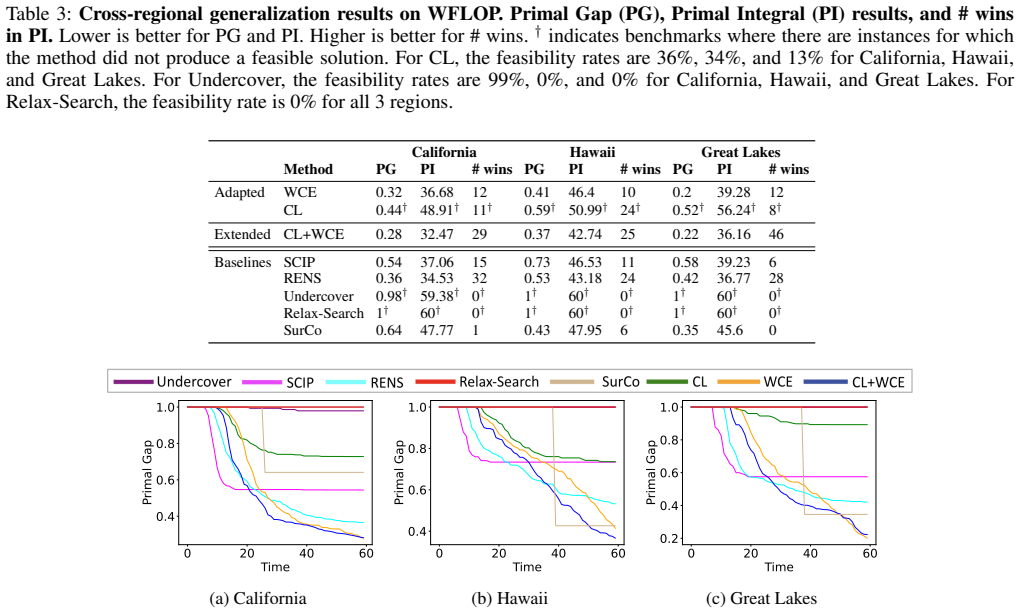
The paper claims that ML-guided primal heuristics for MBQPs, using a new neural network architecture for solution prediction and trained with a novel combination of contrastive and weighted cross-entropy losses on collected instances, significantly outperform existing primal heuristics and state-of-the-art solvers on standard and real-world benchmarks, with particular gains in solution quality, speed, and cross-regional generalization on a wind farm layout optimization problem.
What carries the argument
A neural network for predicting high-quality variable assignments in mixed binary quadratic programs, integrated into primal heuristics and trained via new data collection and a combined contrastive plus weighted cross-entropy loss.
If this is right
- Primal heuristics inside branch-and-bound solvers reach feasible high-quality solutions in shorter runtimes for large MBQPs.
- The methods deliver measurable gains on real-world nonlinear combinatorial problems such as wind farm layout optimization.
- Training with the combined loss improves prediction accuracy and generalization compared to single-loss adaptations from linear programs.
- Better cross-regional performance arises because the models learn transferable structural patterns rather than overfitting to specific training instances.
Where Pith is reading between the lines
- The same prediction-plus-heuristic pattern could transfer to other mixed-integer nonlinear programs if the accuracy of variable assignment forecasts remains high.
- Automating the training data collection procedure might allow rapid creation of similar ML-guided heuristics for entirely new problem families.
- If the generalization holds across domains, hybrid ML-optimization pipelines could reduce reliance on hand-crafted heuristics in industrial solvers.
Load-bearing premise
Neural networks trained on the collected MBQP instances will produce predictions that generalize reliably to new problem instances and distributions, such as wind-farm cases from unseen regions.
What would settle it
Running the ML-guided heuristics on a fresh set of MBQP instances drawn from a different distribution than the training data and finding that they fail to match or exceed the solution quality and speed of standard primal heuristics or commercial solvers.
Figures



read the original abstract
Mixed Binary Quadratic Programs (MBQPs) are an important and complex set of problems in combinatorial optimization. As solving large-scale combinatorial optimization problems is challenging, primal heuristics have been developed to quickly identify high-quality solutions within a short amount of time. Recently, a growing body of research has also used machine learning to accelerate solution methods for challenging combinatorial optimization problems. Despite the increasing popularity of these ML-guided methods, a large body of work has focused on Mixed-Integer Linear Programs (MILPs). MBQPs are challenging to solve due to the combinatorial complexity coupled with nonlinearities. This work proposes ML-guided primal heuristics for Mixed Binary Quadratic Programs (MBQPs) by adapting and extending existing work on ML-guided MILP solution prediction to MBQPs. We introduce a new neural network architecture for MBQP solution prediction and a new training data collection procedure. Moreover, we extend existing loss functions in solution prediction and propose to combine contrastive and weighted cross-entropy losses. We evaluate the methods on standard and real-world MBQP benchmarks and show that the developed ML-guided methods significantly outperform existing primal heuristics and state-of-the-art solvers. Furthermore, models trained with our proposed extension with combined losses outperform other ML-based methods adapted from MILPs and improve generalization in cross-regional inference on a real-world wind farm layout optimization problem.
Editorial analysis
A structured set of objections, weighed in public.
Referee Report
Summary. The paper claims to develop ML-guided primal heuristics for Mixed Binary Quadratic Programs (MBQPs) by adapting and extending ML methods from MILPs. It introduces a new neural network architecture for solution prediction, a new training data collection procedure, and a combined contrastive and weighted cross-entropy loss. The methods are evaluated on standard MBQP benchmarks and a real-world wind farm layout optimization problem, claiming significant outperformance over existing primal heuristics and state-of-the-art solvers, along with improved generalization in cross-regional inference.
Significance. If the empirical results hold, this would be a useful extension of ML-guided optimization techniques to the nonlinear MBQP setting, which is relevant for applications such as wind farm layout design. The combined loss and data collection approach could provide practical value if they reliably improve solution quality and transfer.
major comments (1)
- [Section 5 (experimental evaluation on wind farm instances)] The headline claim that combined-loss models improve generalization in cross-regional inference on the wind-farm problem (abstract) is load-bearing for the overall outperformance result. The manuscript provides no analysis of distribution match between the collected training instances and the held-out regional test instances, such as statistics on variable counts, quadratic coefficient distributions, or constraint densities. Without this, the reported gains over MILP-adapted baselines could reflect in-distribution performance rather than the claimed transfer.
minor comments (2)
- Clarify how the new neural network architecture differs in detail from prior MILP predictors (e.g., input feature encoding for quadratic terms).
- Add explicit description of the statistical testing or variance reporting used to support 'significantly outperform' statements across benchmark instances.
Simulated Author's Rebuttal
We thank the referee for their constructive feedback. We address the single major comment below and will incorporate the suggested analysis into the revised manuscript.
read point-by-point responses
-
Referee: [Section 5 (experimental evaluation on wind farm instances)] The headline claim that combined-loss models improve generalization in cross-regional inference on the wind-farm problem (abstract) is load-bearing for the overall outperformance result. The manuscript provides no analysis of distribution match between the collected training instances and the held-out regional test instances, such as statistics on variable counts, quadratic coefficient distributions, or constraint densities. Without this, the reported gains over MILP-adapted baselines could reflect in-distribution performance rather than the claimed transfer.
Authors: We agree that providing explicit statistics on the distributional match between training and held-out regional test instances would strengthen the generalization claims. The cross-regional inference experiments were constructed by partitioning wind-farm instances according to geographic regions to simulate transfer, and the combined-loss models showed improved performance on the held-out regions. However, the original manuscript did not include comparative statistics. In the revised version, we will add a new paragraph and table in Section 5 reporting summary statistics for both sets, including number of variables, distributions of quadratic coefficients (mean, variance, and range), and constraint densities. This addition will clarify the extent of distributional shift while leaving the reported empirical results unchanged. revision: yes
Circularity Check
No circularity: empirical ML performance claims rest on held-out evaluation
full rationale
The paper's core contribution is an empirical comparison: new NN architectures and combined losses are trained on a collected set of MBQP instances, then evaluated for solution quality and runtime on standard benchmarks plus held-out real-world wind-farm instances. No equation or procedure defines a 'prediction' as a direct function of its own fitted parameters; training and test splits are distinct, and outperformance is reported via external metrics against baselines. Self-citations, if present, are not load-bearing for the central claim, which remains falsifiable by the observed performance deltas rather than reducing to definitional equivalence.
Axiom & Free-Parameter Ledger
free parameters (1)
- neural network weights
Reference graph
Works this paper leans on
-
[1]
Ding, J.-Y .; Zhang, C.; Shen, L.; Li, S.; Wang, B.; Xu, Y .; and Song, L
Expressive Power of Graph Neural Networks for (Mixed-Integer) Quadratic Programs.arXiv preprint arXiv:2406.05938. Ding, J.-Y .; Zhang, C.; Shen, L.; Li, S.; Wang, B.; Xu, Y .; and Song, L. 2020. Accelerating primal solution findings for mixed integer programs based on solution prediction. InAAAI conference on Artificial Intelligence, volume 34, 1452–1459....
-
[2]
InThe Thirty-eighth An- nual Conference on Neural Information Processing Systems
IPM-LSTM: A Learning-Based Interior Point Method for Solving Nonlinear Programs. InThe Thirty-eighth An- nual Conference on Neural Information Processing Systems. Ghaddar, B.; G ´omez-Casares, I.; Gonz ´alez-D´ıaz, J.; Gonz´alez-Rodr´ıguez, B.; Pateiro-L´opez, B.; and Rodr´ıguez- Ballesteros, S. 2023. Learning for spatial branching: An al- gorithm selecti...
-
[3]
Flow Straight and Fast: Learning to Generate and Transfer Data with Rectified Flow
An unconstrained quadratic binary programming ap- proach to the vertex coloring problem.Annals of Operations Research, 139: 229–241. L´etocart, L.; Plateau, M.-C.; and Plateau, G. 2014. An efficient hybrid heuristic method for the 0-1 exact k-item quadratic knapsack problem.Pesquisa Operacional, 34. Liang, E.; and Chen, M. 2024. Generative Learning for So...
work page internal anchor Pith review arXiv 2014
-
[4]
Machine learning augmented branch and bound for mixed integer linear programming.Mathematical Program- ming, 1–44. Tang, B.; Khalil, E. B.; and Drgo ˇna, J. 2025. Learning to Optimize for Mixed-Integer Non-linear Programming with Feasibility Guarantees. arXiv:2410.11061. Turner, S.; Romero, D.; Zhang, P.; Amon, C.; and Chan, T
-
[5]
Zheng, X.; Sun, X.; Li, D.; and Sun, J
A new mathematical programming approach to opti- mize wind farm layouts.Renewable Energy, 63: 674–680. Zheng, X.; Sun, X.; Li, D.; and Sun, J. 2012. Successive convex approximations to cardinality-constrained quadratic programs: a DC approach. Technical report, Tech. rep., School of Management, Fudan University
2012
discussion (0)
Sign in with ORCID, Apple, or X to comment. Anyone can read and Pith papers without signing in.