Recognition: unknown
On the Cancellation of Nuclear Effects in the Valence Region
Pith reviewed 2026-05-08 07:09 UTC · model grok-4.3
The pith
Deep-inelastic scattering data show nuclear effects on nucleon structure functions nearly cancel in the valence region.
A machine-rendered reading of the paper's core claim, the machinery that carries it, and where it could break.
Core claim
Deep-inelastic e/μ scattering data off targets ranging from deuterium to lead indicate that the nuclear modifications to the structure functions of bound nucleons are minimal in the kinematic region around the peak of the valence quark distributions. An analysis of world measurements of the isoscalar cross-section ratios σ^A/σ^{2H} in the region of 0.25 ≤ x ≤ 0.35 shows a remarkable cancellation across all nuclei, with an average value of 0.9985 ± 0.0022. We discuss these results and possible interpretations in the context of a microscopic model of nuclear modifications of the structure functions.
What carries the argument
The isoscalar cross-section ratio σ^A/σ^{2H} measured in the valence peak region, which serves as a direct probe of the cancellation of nuclear effects on parton distributions.
Load-bearing premise
The systematic uncertainties and any normalization offsets between different experiments' data sets are negligible compared to the reported precision of the average ratio.
What would settle it
A high-precision measurement of σ^A/σ^{2H} at x around 0.3 for a nucleus such as lead or gold that deviates significantly from unity would falsify the cancellation claim.
Figures


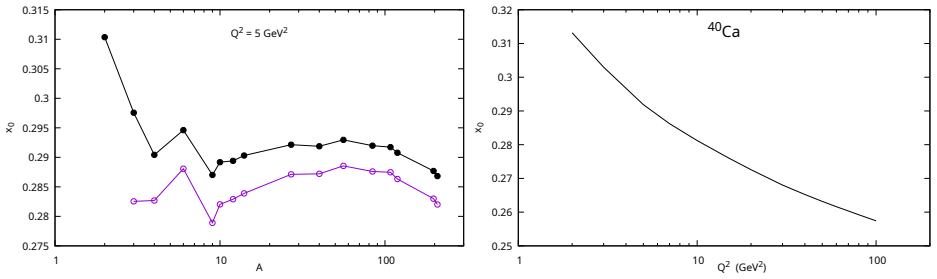
read the original abstract
Deep-inelastic $e/\mu$ scattering data off targets ranging from deuterium to lead indicate that the nuclear modifications to the structure functions of bound nucleons are minimal in the kinematic region around the peak of the valence quark distributions. An analysis of world measurements of the isoscalar cross-section ratios $\sigma^A/\sigma^{{}^2\text{H}}$ in the region of $0.25 \leq x \leq 0.35$ shows a remarkable cancellation across all nuclei, with an average value of $0.9985 \pm 0.0022$. We discuss these results and possible interpretations in the context of a microscopic model of nuclear modifications of the structure functions.
Editorial analysis
A structured set of objections, weighed in public.
Referee Report
Summary. The manuscript analyzes world deep-inelastic scattering data on isoscalar cross-section ratios σ^A/σ^{2H} for nuclei from A=3 to Pb. It reports that nuclear modifications to valence quark distributions are minimal in the region 0.25 ≤ x ≤ 0.35, with the ratios averaging to 0.9985 ± 0.0022 across all measured nuclei. The result is interpreted using a microscopic model of nuclear structure-function modifications.
Significance. If the reported near-unity average is robust against inter-experiment normalization and systematic covariances, the finding would constrain models of nuclear parton distributions by demonstrating a striking cancellation of nuclear effects precisely where valence quarks dominate. The compilation of heterogeneous world data and the downstream microscopic model discussion are strengths, but the central empirical claim requires explicit validation of the averaging procedure.
major comments (2)
- [data compilation and averaging procedure] The central numerical result (average 0.9985 ± 0.0022) is obtained by combining measurements from SLAC, EMC, NMC, BCDMS and other experiments that differ in beam energy, acceptance, radiative corrections and absolute normalization. The quoted uncertainty (0.22 %) is smaller than typical quoted normalization uncertainties (0.5–2 %). The manuscript must specify, in the data-analysis section, whether global normalization floats were introduced, how systematic covariances between experiments were constructed, and whether any post-hoc cuts were applied after the initial selection.
- [results and error analysis] The error propagation and weighting scheme used to obtain the quoted average and its uncertainty are not described in sufficient detail to allow independent verification. If only statistical errors plus individual quoted systematics were added in quadrature without accounting for possible common normalization offsets, the apparent cancellation could be an artifact of inconsistent normalizations rather than a physical effect.
minor comments (2)
- [figures] Figure captions should explicitly state the x-range and kinematic cuts used for each data set shown.
- [results] A table listing the individual experiments, their quoted normalizations, and the weights assigned in the average would improve transparency.
Simulated Author's Rebuttal
We thank the referee for the careful reading of our manuscript and the constructive comments on the data compilation and error analysis. We address each major comment below and will revise the manuscript to provide the requested clarifications.
read point-by-point responses
-
Referee: [data compilation and averaging procedure] The central numerical result (average 0.9985 ± 0.0022) is obtained by combining measurements from SLAC, EMC, NMC, BCDMS and other experiments that differ in beam energy, acceptance, radiative corrections and absolute normalization. The quoted uncertainty (0.22 %) is smaller than typical quoted normalization uncertainties (0.5–2 %). The manuscript must specify, in the data-analysis section, whether global normalization floats were introduced, how systematic covariances between experiments were constructed, and whether any post-hoc cuts were applied after the initial selection.
Authors: We agree that the averaging procedure must be documented in greater detail to permit independent verification. No global normalization floats were applied; each experiment was incorporated using its published absolute normalization. Systematic covariances were not constructed across experiments because the datasets originate from independent collaborations with distinct beam energies, acceptances, and correction procedures. No post-hoc cuts were imposed after the initial selection of the 0.25 ≤ x ≤ 0.35 interval. In the revised manuscript we will expand the data-analysis section with an explicit description of these choices, a table of all included data points with their individual uncertainties, and a statement confirming the absence of additional cuts. revision: yes
-
Referee: [results and error analysis] The error propagation and weighting scheme used to obtain the quoted average and its uncertainty are not described in sufficient detail to allow independent verification. If only statistical errors plus individual quoted systematics were added in quadrature without accounting for possible common normalization offsets, the apparent cancellation could be an artifact of inconsistent normalizations rather than a physical effect.
Authors: The average was obtained via inverse-variance weighting of the total uncertainties (statistical plus the quoted systematic uncertainties) for each data point; the uncertainty on the mean is the standard error of the weighted mean. We acknowledge that the original text did not supply the explicit weighting formula or a full list of points, and we will add both in the revision. While common normalization offsets between experiments cannot be excluded a priori, the near-unity result is reproduced across many independent datasets and nuclei, which would be unlikely if the cancellation were merely an artifact of inconsistent normalizations. To address the concern directly, the revised manuscript will include a short robustness discussion in which normalizations are varied within their published uncertainties and the stability of the average is quantified. revision: yes
Circularity Check
No circularity: central result is direct average of experimental data
full rationale
The paper's strongest claim is an empirical average of 0.9985 ± 0.0022 for the isoscalar cross-section ratio σ^A/σ^{2H} in 0.25 ≤ x ≤ 0.35, obtained by analyzing world measurements from multiple experiments. This is not derived from any model or ansatz but computed from the data itself. The microscopic model is invoked only for subsequent interpretation and does not enter the calculation of the average. No self-definitional steps, fitted inputs presented as predictions, or load-bearing self-citations are present in the derivation of the main result. The analysis is self-contained against external benchmarks (the published data).
Axiom & Free-Parameter Ledger
axioms (1)
- domain assumption Standard assumptions of the parton model and nuclear DIS kinematics hold in the valence region.
Reference graph
Works this paper leans on
-
[1]
Arneodo, Nuclear effects in structure functions, Phys
M. Arneodo, Nuclear effects in structure functions, Phys. Rept.240, 301 (1994)
1994
-
[2]
P. R. Norton, The EMC effect, Rept. Prog. Phys.66, 1253 (2003)
2003
-
[3]
Physics Opportunities with the 12 GeV Upgrade at Jefferson Lab
J. Dudeket al., Physics Opportunities with the 12 GeV Upgrade at Jefferson Lab, Eur. Phys. J. A48, 187 (2012), arXiv:1208.1244 [hep-ex]
work page Pith review arXiv 2012
- [4]
-
[5]
Science Requirements and Detector Concepts for the Electron-Ion Collider: EIC Yellow Report
R. Abdul Khaleket al., Science Requirements and Detector Concepts for the Electron-Ion Col- lider: EIC Yellow Report, Nucl. Phys. A1026, 122447 (2022), arXiv:2103.05419 [physics.ins- det]
work page internal anchor Pith review arXiv 2022
-
[6]
Abiet al.(DUNE), (2020), 10.2172/1599307, arXiv:2002.03005 [hep-ex]
B. Abiet al.(DUNE), Deep Underground Neutrino Experiment (DUNE), Far Detector Tech- nical Design Report, Volume II: DUNE Physics 10.2172/1599307 (2020), arXiv:2002.03005 [hep-ex]
-
[7]
Ashmanet al.(European Muon), A Measurement of the ratio of the nucleon structure function in copper and deuterium, Z
J. Ashmanet al.(European Muon), A Measurement of the ratio of the nucleon structure function in copper and deuterium, Z. Phys. C57, 211 (1993)
1993
-
[8]
Bariet al.(BCDMS), A Measurement of Nuclear Effects in Deep Inelastic Muon Scattering on Deuterium, Nitrogen and Iron Targets, Phys
G. Bariet al.(BCDMS), A Measurement of Nuclear Effects in Deep Inelastic Muon Scattering on Deuterium, Nitrogen and Iron Targets, Phys. Lett. B163, 282 (1985)
1985
-
[9]
A. C. Benvenutiet al.(BCDMS), Nuclear Effects in Deep Inelastic Muon Scattering on Deuterium and Iron Targets, Phys. Lett. B189, 483 (1987)
1987
-
[10]
Gomezet al., Measurement of the A-dependence of deep inelastic electron scattering, Phys
J. Gomezet al., Measurement of the A-dependence of deep inelastic electron scattering, Phys. Rev. D49, 4348 (1994)
1994
-
[11]
P. Amaudruzet al.(New Muon), A Reevaluation of the nuclear structure function ratios for D, He, Li-6, C and Ca, Nucl. Phys. B441, 3 (1995), arXiv:hep-ph/9503291
-
[12]
Amaudruzet al.(New Muon), The ratio 𝐹 𝑛 2 /𝐹 𝑝 2 in deep inelastic muon scattering, Nucl
P. Amaudruzet al.(New Muon), The ratio 𝐹 𝑛 2 /𝐹 𝑝 2 in deep inelastic muon scattering, Nucl. Phys. B371, 3 (1992)
1992
-
[13]
Arneodoet al.(New Muon), The A dependence of the nuclear structure function ratios, Nucl
M. Arneodoet al.(New Muon), The A dependence of the nuclear structure function ratios, Nucl. Phys. B481, 3 (1996)
1996
-
[14]
Ackerstaffet al.(HERMES), Nuclear effects on 𝑅 = 𝜎𝐿/𝜎𝑇 in deep inelastic scattering, Phys
K. Ackerstaffet al.(HERMES), Nuclear effects on 𝑅 = 𝜎𝐿/𝜎𝑇 in deep inelastic scattering, Phys. Lett. B475, 386 (2000), [Erratum: Phys.Lett.B 567, 339–346 (2003)], arXiv:hep-ex/9910071. 11
-
[15]
A. Airapetianet al.(HERMES), Measurement of 𝑅 = 𝜎𝐿/𝜎𝑇 in deep inelastic scattering on nuclei, (2002), arXiv:hep-ex/0210068
-
[16]
Seelyet al., New measurements of the EMC effect in very light nuclei, Phys
J. Seelyet al., New measurements of the EMC effect in very light nuclei, Phys. Rev. Lett. 103, 202301 (2009), arXiv:0904.4448 [nucl-ex]
-
[17]
Karkiet al.(Hall C), First Measurement of the EMC effect in B10 and B11, Phys
A. Karkiet al.(Hall C), First Measurement of the EMC effect in B10 and B11, Phys. Rev. C 108, 035201 (2023), arXiv:2207.03850 [nucl-ex]
-
[18]
B. Schmookleret al.(CLAS), Modified structure of protons and neutrons in correlated pairs, Nature566, 354 (2019), arXiv:2004.12065 [nucl-ex]
-
[19]
K. A. Griffioenet al., Measurement of the EMC Effect in the Deuteron, Phys. Rev. C92, 015211 (2015), arXiv:1506.00871 [hep-ph]
work page Pith review arXiv 2015
-
[20]
D. Abramset al.(Jefferson Lab Hall A Tritium), EMC Effect of Tritium and Helium-3 from the JLab MARATHON Experiment, Phys. Rev. Lett.135, 062502 (2025), arXiv:2410.12099 [nucl-ex]
- [21]
- [22]
- [23]
- [24]
-
[25]
Dasuet al., Measurement of kinematic and nuclear dependence of 𝑅 = 𝜎𝐿/𝜎𝑇 in deep inelastic electron scattering, Phys
S. Dasuet al., Measurement of kinematic and nuclear dependence of 𝑅 = 𝜎𝐿/𝜎𝑇 in deep inelastic electron scattering, Phys. Rev. D49, 5641 (1994)
1994
-
[26]
Garutti,Nuclear effects in semi-inclusieve deep-inelastic scattering off 84Kr and other nuclei, Ph.D
E. Garutti,Nuclear effects in semi-inclusieve deep-inelastic scattering off 84Kr and other nuclei, Ph.D. thesis, University of Amsterdam (2003)
2003
- [27]
-
[28]
S. A. Kulagin, Deep Inelastic Scattering on Nuclei: Impulse Approximation and Mesonic Corrections, Nucl. Phys. A500, 653 (1989)
1989
- [29]
-
[30]
S. I. Alekhin, S. A. Kulagin, and R. Petti, Nuclear effects in the deuteron and constraints on the𝑑/𝑢ratio, Phys. Rev.D96, 054005 (2017), arXiv:1704.00204 [nucl-th]
work page Pith review arXiv 2017
- [31]
- [32]
- [33]
-
[34]
D. S. Koltun, Total Binding Energies of Nuclei, and Particle-Removal Experiments, Phys. Rev. Lett.28, 182 (1972)
1972
- [35]
-
[36]
S. Veerasamy and W. N. Polyzou, A momentum-space Argonne V18 interaction, Phys. Rev. C84, 034003 (2011), arXiv:1106.1934 [nucl-th]
- [37]
discussion (0)
Sign in with ORCID, Apple, or X to comment. Anyone can read and Pith papers without signing in.