System-Level Impacts of Flexible Data Center Load Scheduling on Cost, Emissions, and Transmission Congestion
Pith reviewed 2026-05-08 07:42 UTC · model grok-4.3
The pith
Flexible scheduling of best-effort data center jobs shifts loads to high-renewable periods, cutting system costs, emissions, and congestion.
A machine-rendered reading of the paper's core claim, the machinery that carries it, and where it could break.
Core claim
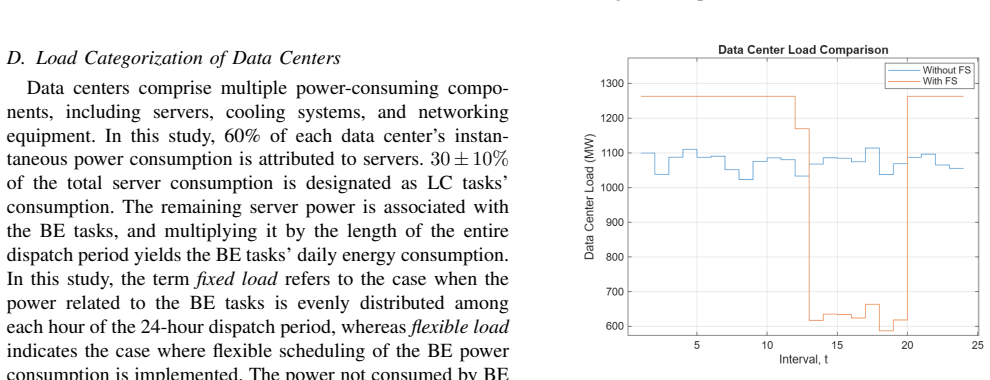
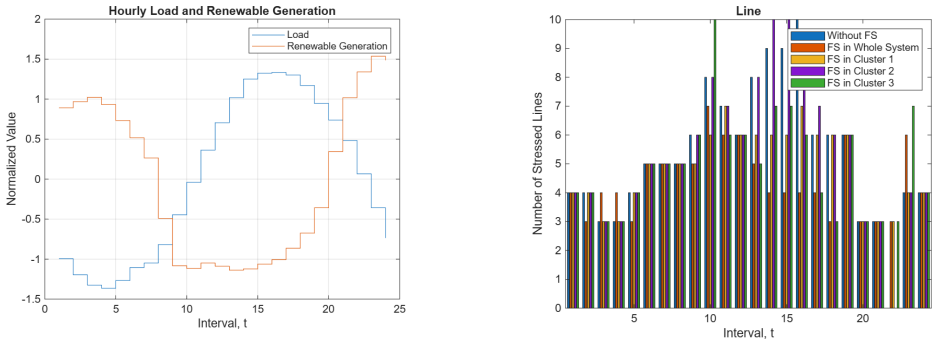
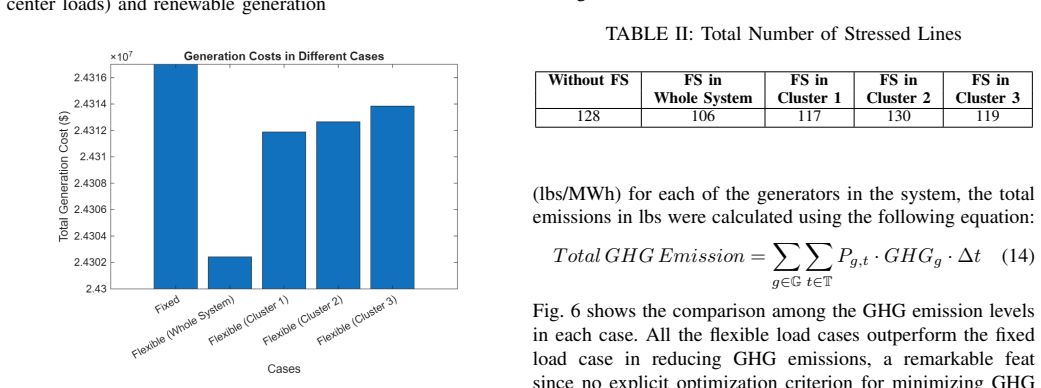
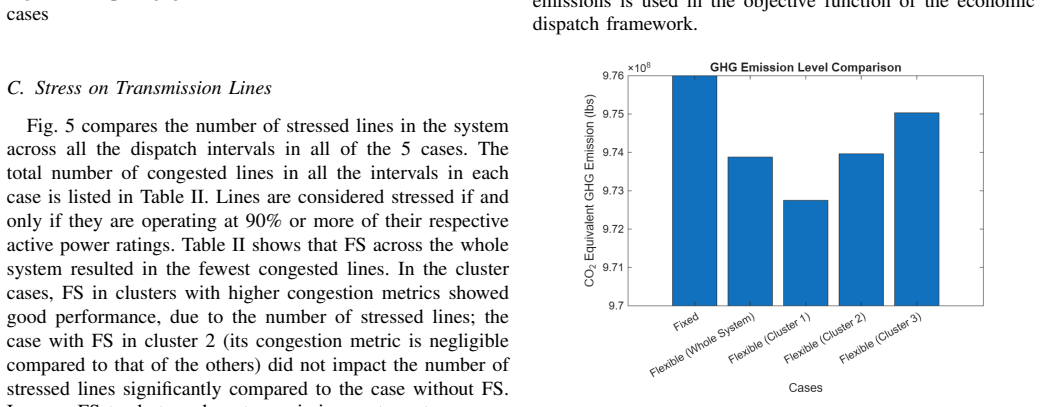
When best-effort data center loads are allowed to respond to locational marginal prices on the ACTIVSg2000 system, they migrate toward intervals of high renewable generation. This movement lowers overall production costs, reduces greenhouse-gas and toxic emissions, and decreases transmission congestion relative to inflexible operation, while latency-critical workloads continue to receive uninterrupted service.
What carries the argument
Flexible scheduling of best-effort data center workloads that responds to locational marginal prices while holding latency-critical jobs fixed.
If this is right
- Total power system operating costs fall as flexible loads track lower-price, higher-renewable hours.
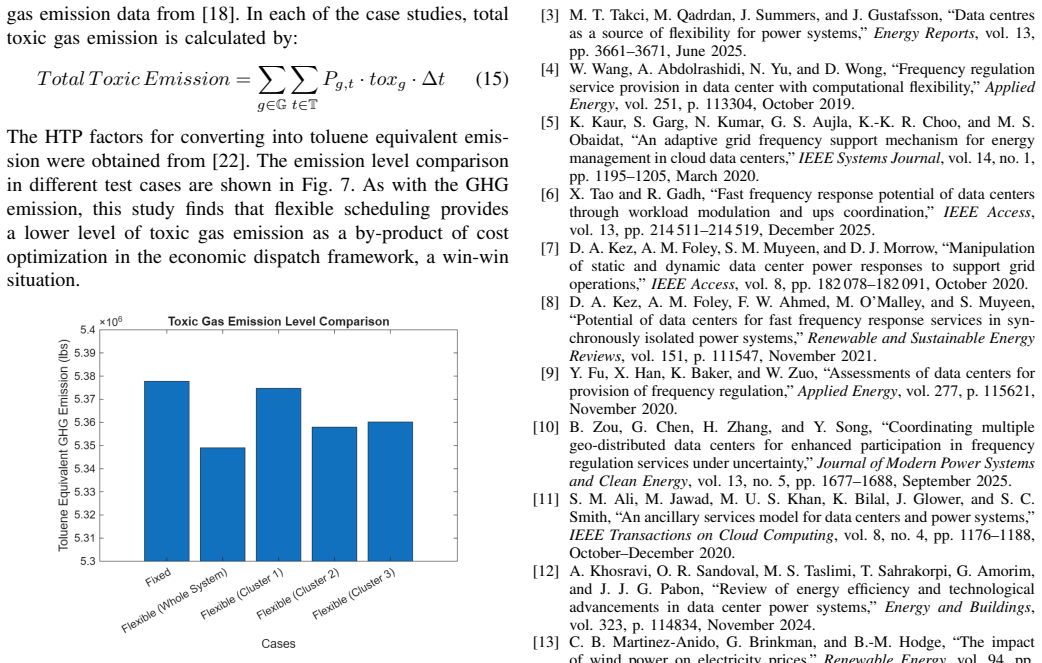
- Greenhouse-gas and toxic emissions decline compared with fixed scheduling.
- Transmission congestion metrics improve because load is redistributed away from constrained lines.
- Quality of service for latency-critical workloads stays unchanged.
- Grid operation becomes more efficient and sustainable without added generation or lines.
Where Pith is reading between the lines
- Data centers could act as a distributed storage-like resource that helps absorb renewable variability if similar price signals are extended to other flexible loads.
- Coordination protocols between data-center operators and grid operators would be needed to capture the modeled benefits at scale.
- The approach might interact with existing capacity markets or carbon pricing, altering the economic case for flexible versus rigid operation.
Load-bearing premise
The modeled test system and data-center load profiles match real-world conditions closely enough that shifting best-effort jobs creates no operational or service-quality problems.
What would settle it
If real-world measurements after flexible scheduling show higher total emissions or increased congestion on the same transmission paths, the claimed system-level benefits would not hold.
Figures

read the original abstract
Large data centers are being deployed in the U.S. at an unprecedented rate, introducing significant flexible load potential. A portion of data center workloads - best-effort (BE) jobs - can be scheduled flexibly to reduce power system operating costs and emissions. However, the system-level impacts of such scheduling remain underexplored. This paper investigates the effects of flexible data center load scheduling on operating cost, system stress, and emissions using the ACTIVSg2000 2000-bus test system. Results show that BE loads shift toward periods of lower locational marginal prices (LMPs), typically aligned with high renewable generation. Importantly, latency-critical (LC) workloads remain unaffected, preserving quality of service (QoS). Flexible scheduling also leads to reductions in both greenhouse gas and toxic emissions, as well as transmission congestion, compared to inflexible operation, demonstrating its potential to support more efficient and sustainable grid operation.
Editorial analysis
A structured set of objections, weighed in public.
Referee Report
Summary. The manuscript uses the ACTIVSg2000 2000-bus test system to simulate the system-level effects of flexibly scheduling best-effort (BE) data center workloads while keeping latency-critical (LC) workloads fixed. It reports that BE loads shift toward low-LMP periods that coincide with high renewable output, producing lower operating costs, reduced greenhouse-gas and toxic emissions, and lower transmission congestion relative to an inflexible baseline.
Significance. If the modeled correlations and shifting constraints prove representative, the work would demonstrate a concrete mechanism by which growing data-center loads can be leveraged to improve grid efficiency and environmental performance without QoS penalties.
major comments (2)
- [Results and Case Study] The headline reductions in GHG/toxic emissions and transmission congestion rest entirely on outputs from the ACTIVSg2000 system with synthetic BE load profiles; no calibration of the test-system generation mix, transmission topology, LMP-renewable correlation, or BE job arrival/size/delay-tolerance distributions against real ISO or data-center telemetry is provided. This is load-bearing for the central claim (see Results and Case Study sections).
- [Results] No quantitative effect sizes, confidence intervals, or sensitivity analyses are reported for the claimed emission and congestion reductions, nor is there discussion of how rack-level power limits or energy deadlines would constrain the observed schedule shifts. These omissions prevent assessment of whether the directional benefits survive realistic operating constraints.
minor comments (1)
- [Abstract] The abstract states directional results but supplies no methods overview, data sources, or effect magnitudes; adding a single sentence summarizing the modeling approach and key quantitative outcomes would improve readability.
Simulated Author's Rebuttal
We thank the referee for their constructive comments. We address each major comment below and indicate the revisions we will make to strengthen the manuscript.
read point-by-point responses
-
Referee: [Results and Case Study] The headline reductions in GHG/toxic emissions and transmission congestion rest entirely on outputs from the ACTIVSg2000 system with synthetic BE load profiles; no calibration of the test-system generation mix, transmission topology, LMP-renewable correlation, or BE job arrival/size/delay-tolerance distributions against real ISO or data-center telemetry is provided. This is load-bearing for the central claim (see Results and Case Study sections).
Authors: We agree that the study relies on the ACTIVSg2000 benchmark test system and synthetic BE load profiles without direct calibration against real ISO or data-center telemetry. Benchmark test systems are standard in power-systems research for reproducible, controlled evaluation of mechanisms. The synthetic profiles follow workload statistics from the literature on data-center jobs. In revision we will add an explicit limitations subsection that states these modeling choices, describes how the profiles and correlations were constructed, and discusses implications for generalizability. This addresses transparency without claiming empirical calibration. revision: partial
-
Referee: [Results] No quantitative effect sizes, confidence intervals, or sensitivity analyses are reported for the claimed emission and congestion reductions, nor is there discussion of how rack-level power limits or energy deadlines would constrain the observed schedule shifts. These omissions prevent assessment of whether the directional benefits survive realistic operating constraints.
Authors: We accept that quantitative effect sizes, uncertainty measures, and sensitivity results are needed. The revised manuscript will report the specific percentage reductions in operating cost, GHG emissions, toxic emissions, and congestion metrics obtained from the simulations, include confidence intervals derived from the optimization runs, and add sensitivity analyses on BE workload fraction, delay tolerance, and renewable penetration. We will also expand the methods section to detail how rack-level power limits and energy deadlines are enforced as constraints in the scheduling model, confirming that all reported shifts respect these limits. revision: yes
Circularity Check
No circularity; results from direct simulation comparisons on standard test system
full rationale
The paper conducts a simulation study on the ACTIVSg2000 2000-bus test system, modeling best-effort and latency-critical data center workloads and comparing flexible scheduling (shifting BE jobs to low-LMP periods) against inflexible baselines. No equations, derivations, fitted parameters, or self-referential definitions appear in the provided text or abstract. Claims of cost, emission, and congestion reductions are outputs of the simulation runs rather than quantities defined in terms of themselves or forced by self-citation chains. The ACTIVSg2000 system is an external standard test case, not an author-derived construct. This is a standard empirical modeling paper with no load-bearing circular steps.
Axiom & Free-Parameter Ledger
Reference graph
Works this paper leans on
-
[1]
2024 united states data center energy usage report,
A. Shehabi, S. J. Smith, A. Hubbard, A. Newkirk, N. Lei, M. A. B. Siddik, B. Holecek, J. Koomey, E. Masanet, and D. Sartor, “2024 united states data center energy usage report,” Lawrence Berkeley National Laboratory, Berkeley, California, Tech. Rep. LBNL-2001637, December 2024. [Online]. Available: https: //escholarship.org/content/qt32d6m0d1/qt32d6m0d1.pdf
work page 2024
-
[2]
Powermorph: QoS-aware server power reshaping for data center regulation service,
A. Jahanshahi, N. Yu, and D. Wong, “Powermorph: QoS-aware server power reshaping for data center regulation service,”ACM Trans. Archit. Code Optim., vol. 19, no. 3, pp. 36:1–36:27, August 2022
work page 2022
-
[3]
Data centres as a source of flexibility for power systems,
M. T. Takci, M. Qadrdan, J. Summers, and J. Gustafsson, “Data centres as a source of flexibility for power systems,”Energy Reports, vol. 13, pp. 3661–3671, June 2025
work page 2025
-
[4]
Frequency regulation service provision in data center with computational flexibility,
W. Wang, A. Abdolrashidi, N. Yu, and D. Wong, “Frequency regulation service provision in data center with computational flexibility,”Applied Energy, vol. 251, p. 113304, October 2019
work page 2019
-
[5]
An adaptive grid frequency support mechanism for energy management in cloud data centers,
K. Kaur, S. Garg, N. Kumar, G. S. Aujla, K.-K. R. Choo, and M. S. Obaidat, “An adaptive grid frequency support mechanism for energy management in cloud data centers,”IEEE Systems Journal, vol. 14, no. 1, pp. 1195–1205, March 2020
work page 2020
-
[6]
Fast frequency response potential of data centers through workload modulation and ups coordination,
X. Tao and R. Gadh, “Fast frequency response potential of data centers through workload modulation and ups coordination,”IEEE Access, vol. 13, pp. 214 511–214 519, December 2025
work page 2025
-
[7]
Manipulation of static and dynamic data center power responses to support grid operations,
D. A. Kez, A. M. Foley, S. M. Muyeen, and D. J. Morrow, “Manipulation of static and dynamic data center power responses to support grid operations,”IEEE Access, vol. 8, pp. 182 078–182 091, October 2020
work page 2020
-
[8]
D. A. Kez, A. M. Foley, F. W. Ahmed, M. O’Malley, and S. Muyeen, “Potential of data centers for fast frequency response services in syn- chronously isolated power systems,”Renewable and Sustainable Energy Reviews, vol. 151, p. 111547, November 2021
work page 2021
-
[9]
Assessments of data centers for provision of frequency regulation,
Y . Fu, X. Han, K. Baker, and W. Zuo, “Assessments of data centers for provision of frequency regulation,”Applied Energy, vol. 277, p. 115621, November 2020
work page 2020
-
[10]
B. Zou, G. Chen, H. Zhang, and Y . Song, “Coordinating multiple geo-distributed data centers for enhanced participation in frequency regulation services under uncertainty,”Journal of Modern Power Systems and Clean Energy, vol. 13, no. 5, pp. 1677–1688, September 2025
work page 2025
-
[11]
An ancillary services model for data centers and power systems,
S. M. Ali, M. Jawad, M. U. S. Khan, K. Bilal, J. Glower, and S. C. Smith, “An ancillary services model for data centers and power systems,” IEEE Transactions on Cloud Computing, vol. 8, no. 4, pp. 1176–1188, October–December 2020
work page 2020
-
[12]
Review of energy efficiency and technological advancements in data center power systems,
A. Khosravi, O. R. Sandoval, M. S. Taslimi, T. Sahrakorpi, G. Amorim, and J. J. G. Pabon, “Review of energy efficiency and technological advancements in data center power systems,”Energy and Buildings, vol. 323, p. 114834, November 2024
work page 2024
-
[13]
The impact of wind power on electricity prices,
C. B. Martinez-Anido, G. Brinkman, and B.-M. Hodge, “The impact of wind power on electricity prices,”Renewable Energy, vol. 94, pp. 474–487, August 2016
work page 2016
-
[14]
Optimal data center load scheduling in power system operation,
I. Hasan, Y . Sang, D. Irwin, and G. Zakeri, “Optimal data center load scheduling in power system operation,” in57th North American Power Symposium (NAPS). Storrs, CT, USA: IEEE, October 2025
work page 2025
-
[15]
ACTIVSg2000system data with emission rates,
A. H. Mazumder, “ACTIVSg2000system data with emission rates,” https://github.com/Akibul1770-cmd/ ACTIVSg2000-with-Emission-Data/blob/main/ACTIVSg2000 SysData.xlsx
-
[16]
Grid structural characteristics as validation criteria for synthetic networks,
A. B. Birchfield, T. Xu, K. M. Gegner, K. S. Shetye, and T. J. Over- bye, “Grid structural characteristics as validation criteria for synthetic networks,”IEEE Transactions on Power Systems, vol. 32, no. 4, pp. 3258–3265, July 2017
work page 2017
-
[17]
Application of large-scale synthetic power system models for energy economic studies,
T. Xu, A. B. Birchfield, K. M. Gegner, K. S. Shetye, and T. J. Overbye, “Application of large-scale synthetic power system models for energy economic studies,” inProceedings of the 50th Hawaii International Conference on System Sciences, Honolulu, HI, January 2017
work page 2017
-
[18]
United States Environmental Protection Agency, “egrid with 2023 data,” https://www.epa.gov/system/files/documents/2025-06/egrid2023 data rev2.xlsx, [Online]. Accessed: January 16, 2026
work page 2023
-
[19]
Data viewer: Accelerating speed to power,
US Department of Energy, “Data viewer: Accelerating speed to power,” https://maps.nlr.gov/speed-to-power/data-viewer, [Online]. Ac- cessed: December 7, 2025
work page 2025
-
[20]
M. I. Alomoush, “Performance indices to measure and compare system utilization and congestion severity of different dispatch scenarios,” Electric Power Systems Research, vol. 74, no. 2, pp. 223–230, May 2005
work page 2005
-
[21]
M. Sarwar and A. S. Siddiqui, “An approach to locational marginal price based zonal congestion management in deregulated electricity market,” Frontiers in Energy, vol. 10, pp. 240–248, April 2016
work page 2016
-
[22]
An update of the human toxicity potential with special consideration of conventional air pollutants,
E. G. Hertwich, S. F. Mateles, W. S. Pease, and T. E. McKone, “An update of the human toxicity potential with special consideration of conventional air pollutants,” Norwegian University of Science and Technology (NTNU) and Industrial Ecology Programme (IndEcol), Trondheim, Norway, Tech. Rep. ISSN 1504-3681, January 2006
work page 2006
discussion (0)
Sign in with ORCID, Apple, or X to comment. Anyone can read and Pith papers without signing in.