Mesh-Intrinsic GFEM: Asymptotic Smoothness on C⁰ Unstructured Meshes
Pith reviewed 2026-05-08 07:45 UTC · model grok-4.3
The pith
Local polynomial reconstructions on overlapping patches blended by partition of unity cancel derivative jumps exactly for polynomials on standard C0 meshes.
A machine-rendered reading of the paper's core claim, the machinery that carries it, and where it could break.
Core claim
The core analysis establishes a partition-of-zero smoothness-transfer mechanism driven by interface coherence: derivative jumps cancel exactly for polynomial reproduction and decay as O(h^{p+1-|α|}) for smooth nonpolynomial fields. On this basis a PoZ-consistent intrinsic derivative is defined that is polynomial-exact and approximation-order consistent, enabling pointwise strong-form evaluation of high-order PDEs on C0 meshes. For derivative-type or free boundary conditions the method embeds constraints into local patch reconstruction via a boundary absorption constrained weighted least-squares strategy that keeps the global system square and sparse.
What carries the argument
The partition-of-zero (PoZ) smoothness-transfer mechanism, which uses interface coherence arising from overlapping nodal patch reconstructions blended by a partition of unity to cancel derivative jumps at element interfaces.
If this is right
- Machine-precision patch tests are obtained for all polynomials up to the reconstruction degree.
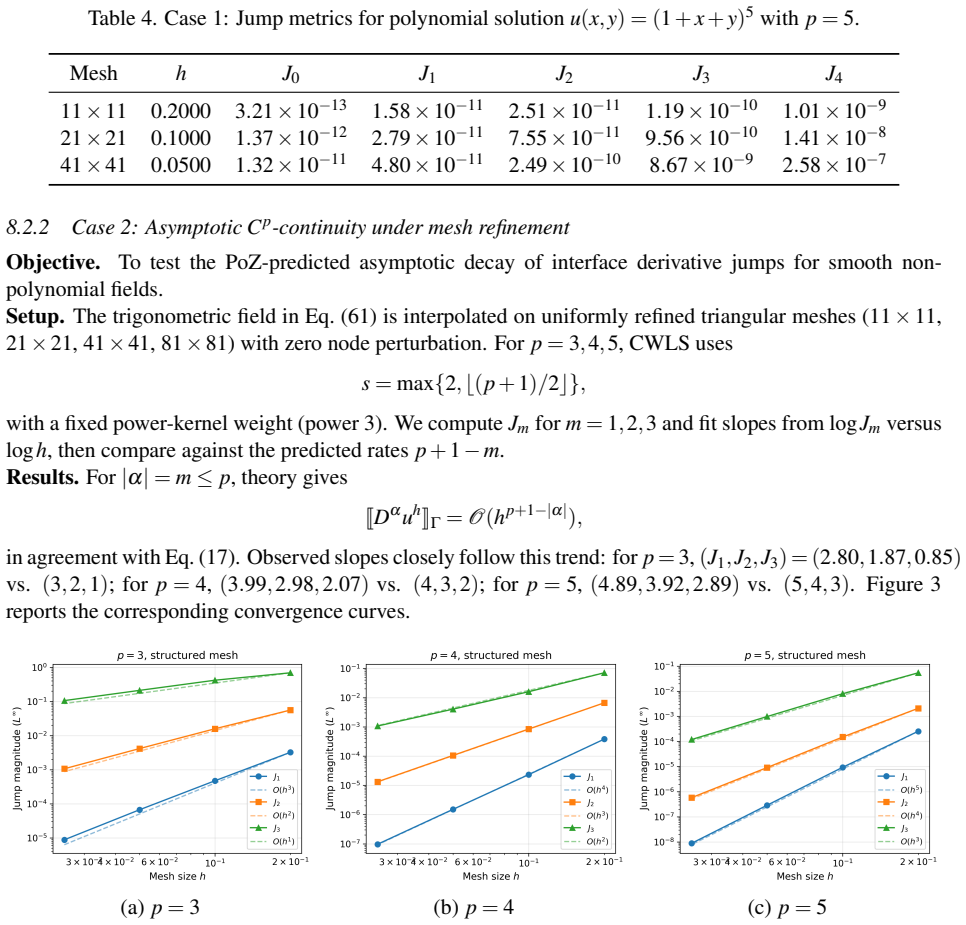
- Derivative jump magnitudes decay at the rate O(h^{p+1-|α|}) for smooth non-polynomial fields.
- The same trial space supports both weak-form Galerkin and strong-form collocation discretizations of high-order PDEs.
- Boundary constraints are embedded directly into local patch solves without global over-determination or penalty-parameter tuning.
- Robust accuracy is retained on highly distorted unstructured meshes.
Where Pith is reading between the lines
- High-order mesh generation may become unnecessary for many engineering problems governed by high-order PDEs.
- Convergence behavior could be benchmarked directly against classical high-order finite-element codes to quantify savings in mesh generation and storage.
- The smoothness-transfer idea may apply to other partition-of-unity frameworks such as meshfree or extended finite-element methods.
Load-bearing premise
Local polynomial reconstructions on overlapping nodal patches, when blended by a partition of unity, produce interface coherence sufficient for exact derivative-jump cancellation on polynomials and the stated decay rate on non-polynomials without additional global constraints or post-processing.
What would settle it
A sequence of refined meshes on which measured derivative jumps at element interfaces for a smooth non-polynomial field fail to decay at the predicted O(h^{p+1-|α|}) rate, or on which polynomial patch tests fail to reach machine precision.
Figures





read the original abstract
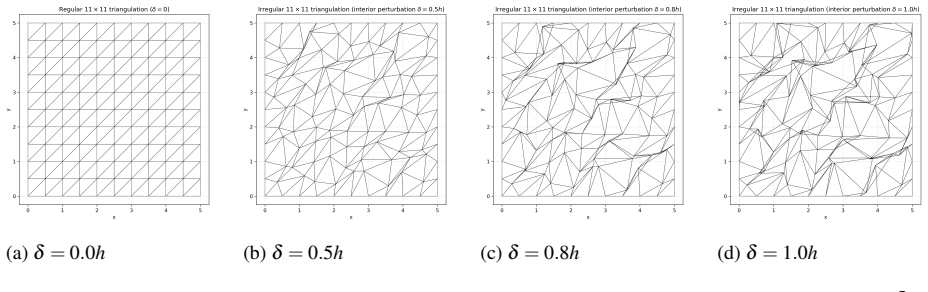
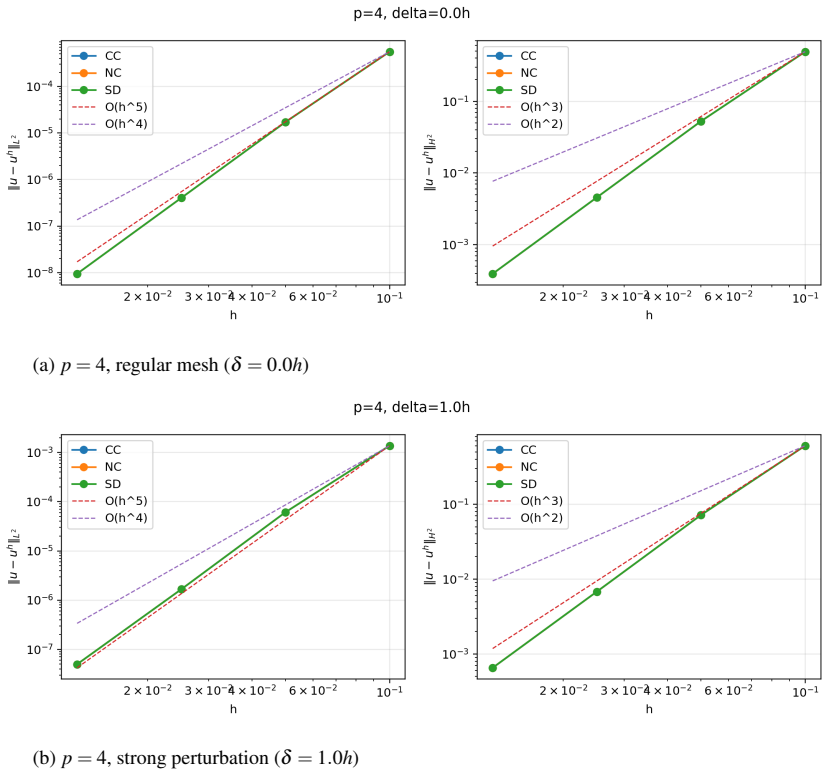
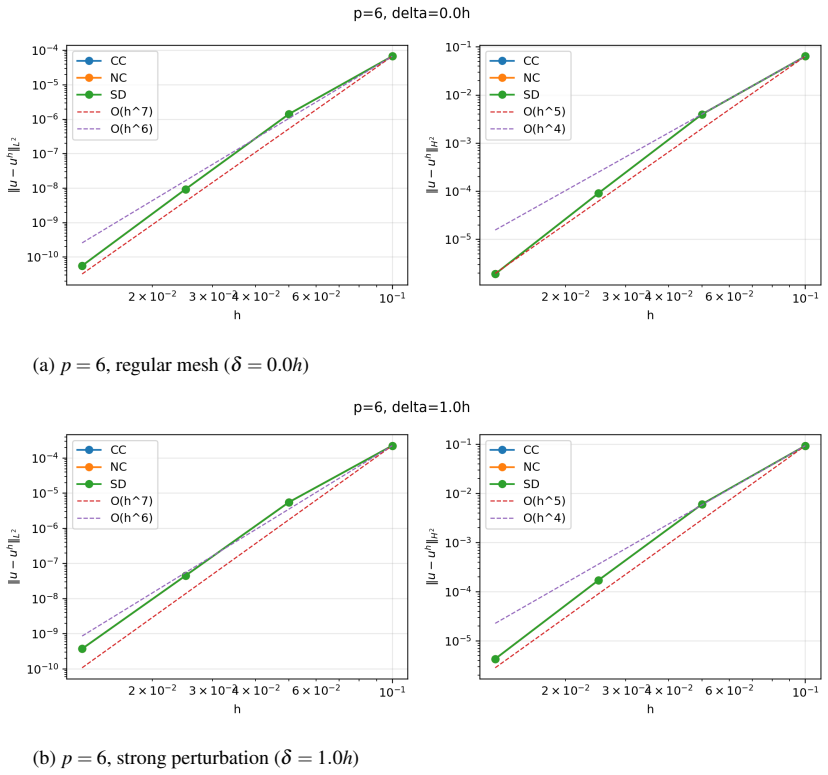
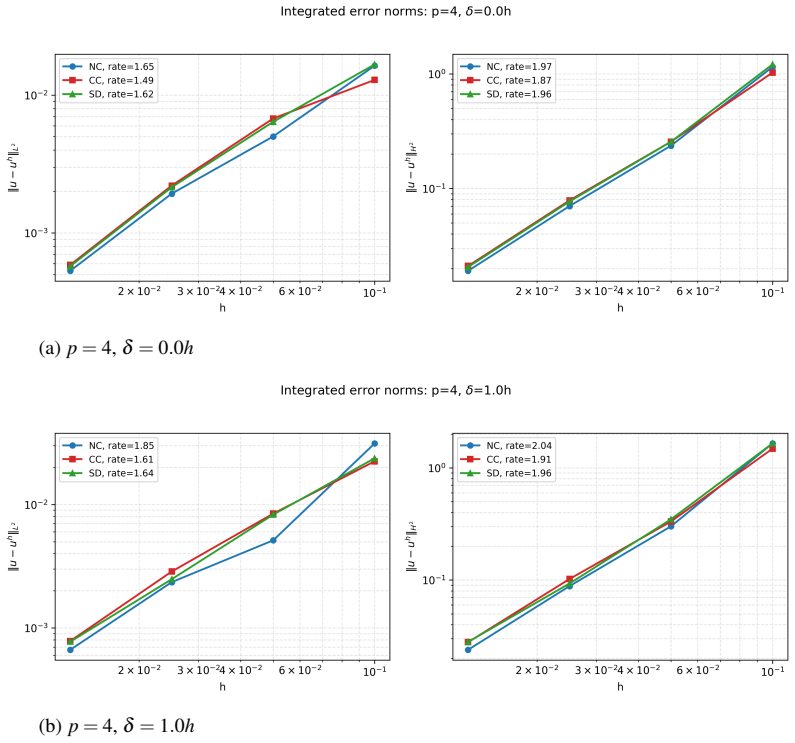
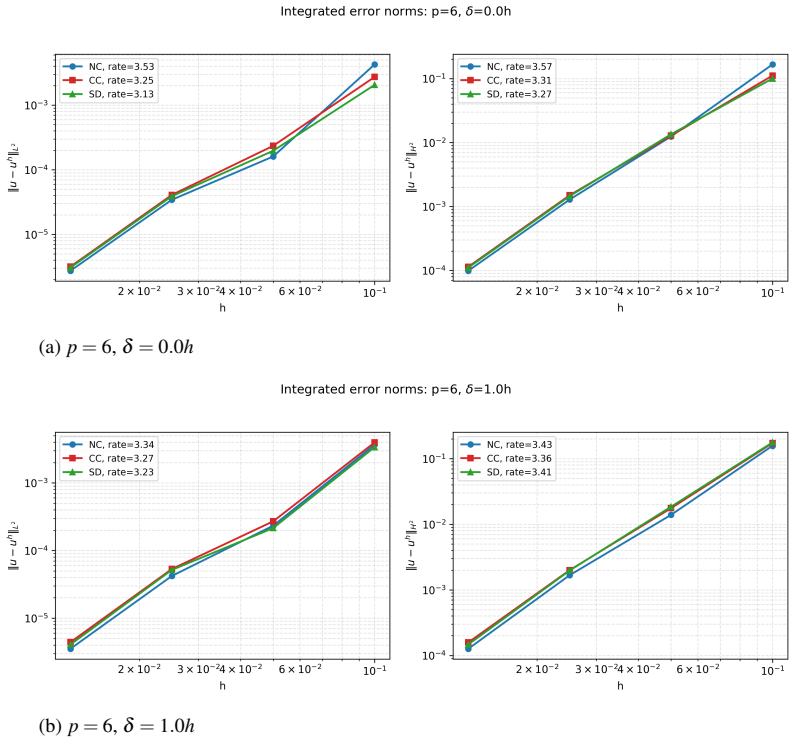
MiGFEM constructs enriched local approximations from the original nodal degrees of freedom of a finite element mesh, without extra enrichment unknowns, thereby avoiding the linear dependence, ill-conditioning, energy inconsistency, and mass-lumping difficulties of conventional enriched formulations. This paper establishes asymptotic smoothness of MiGFEM on standard C0 unstructured meshes. Although the global approximation uses C0 partition-of-unity functions, its inter-element derivative jumps of order up to p decay as O(h^{p+1-|alpha|}) for solutions in C^{p+1}, and vanish identically when the exact solution lies in the local reconstruction space on every patch. The mechanism relies on interface coherence of patchwise local approximations and a derivative-space partition-of-unity identity (Partition of Zero) that cancels coherent interfacial traces. Asymptotic smoothness motivates the leading Leibniz derivative, which retains only the principal term of the full Leibniz expansion. This operator is globally continuous by construction; the neglected remainder shares the same asymptotic order as the inter-element jumps. Consequently, the same C0 MiGFEM trial space supports both weak Galerkin discretization via the full Leibniz derivative and strong-form collocation via the leading Leibniz derivative, on identical nodal unknowns. Numerical experiments verify the predicted jump decay and confirm exact cancellation under patchwise reproduction. The unified weak-strong framework is demonstrated on elasticity and biharmonic problems using unstructured meshes. A singular-enrichment test further shows that strong-form collocation reproduces enriched basis functions exactly without quadrature constraints.
Editorial analysis
A structured set of objections, weighed in public.
Referee Report
Summary. The paper claims to introduce a mesh-intrinsic generalized finite element method (MiGFEM) for high-order smoothness on C^0 unstructured meshes. Local polynomial fields are reconstructed on overlapping nodal patches from shared nodal unknowns and blended using a partition of unity. A partition-of-zero (PoZ) smoothness-transfer mechanism is established, driven by interface coherence, leading to exact derivative jump cancellation for polynomials and O(h^{p+1-|α|}) decay for smooth nonpolynomial fields. A PoZ-consistent intrinsic derivative is defined for strong-form PDE evaluation, and a boundary absorption constrained weighted least-squares (BA-CWLS) strategy is proposed for boundary conditions. Numerical experiments demonstrate machine-precision patch tests, consistent jump-decay rates, and robustness on distorted meshes, supporting both Galerkin and collocation approaches.
Significance. If the PoZ mechanism and interface coherence hold as described, the work is significant for enabling high-order PDE discretizations on standard C^0 meshes without extra global degrees of freedom or special meshing. The unified trial space for weak-form Galerkin and strong-form collocation, combined with the reported machine-precision patch tests and matching theoretical decay rates, represents a practical strength. The mesh-intrinsic construction and BA-CWLS boundary handling avoid common pitfalls in generalized FEM extensions.
minor comments (2)
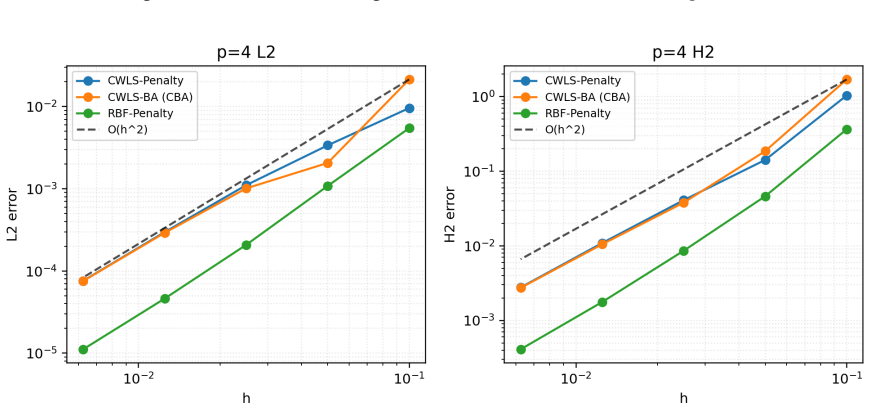
- The numerical results section mentions machine-precision patch tests and jump-decay rates consistent with theory but supplies no explicit error tables, figures, or quantitative data; including these would allow independent verification of the central claims.
- Notation for the PoZ-consistent intrinsic derivative and the precise definition of interface coherence would benefit from a dedicated equation or definition box in the analysis section for improved clarity.
Simulated Author's Rebuttal
We thank the referee for the positive summary of our work and for recommending minor revision. The referee's description accurately reflects the core elements of MiGFEM, including the partition-of-zero smoothness-transfer mechanism, interface coherence, polynomial-exact intrinsic derivatives, BA-CWLS boundary treatment, and the supporting numerical results. We appreciate the recognition of the method's significance for high-order discretizations on standard C^0 unstructured meshes without additional global degrees of freedom.
Circularity Check
No significant circularity detected
full rationale
The paper constructs local polynomial reconstructions on overlapping nodal patches from shared nodal unknowns, then blends via partition of unity. The core analysis derives the PoZ smoothness-transfer property (exact jump cancellation on polynomials, O(h^{p+1-|α|}) decay otherwise) directly from this construction and interface coherence induced by the shared unknowns. The PoZ-consistent intrinsic derivative is then defined on that basis. Numerical patch tests at machine precision and observed jump rates serve as independent external checks rather than tautological confirmation. No quoted step reduces a claimed prediction or uniqueness result to a self-definition, a fitted parameter, or a self-citation chain; the derivation remains self-contained against the stated assumptions and supporting experiments.
Axiom & Free-Parameter Ledger
axioms (2)
- standard math Partition of unity property holds for the blending functions on overlapping patches
- domain assumption Local reconstructions exactly reproduce polynomials up to degree p
invented entities (3)
-
partition-of-zero (PoZ) smoothness-transfer mechanism
no independent evidence
-
PoZ-consistent intrinsic derivative
no independent evidence
-
boundary absorption constrained weighted least-squares strategy (BA-CWLS)
no independent evidence
discussion (0)
Sign in with ORCID, Apple, or X to comment. Anyone can read and Pith papers without signing in.