Recognition: unknown
Persistent Fermi Pockets and Robust Electron Pairing in Lightly Doped CuO₂ Planes of Cuprate Superconductors
Pith reviewed 2026-05-08 06:59 UTC · model grok-4.3
The pith
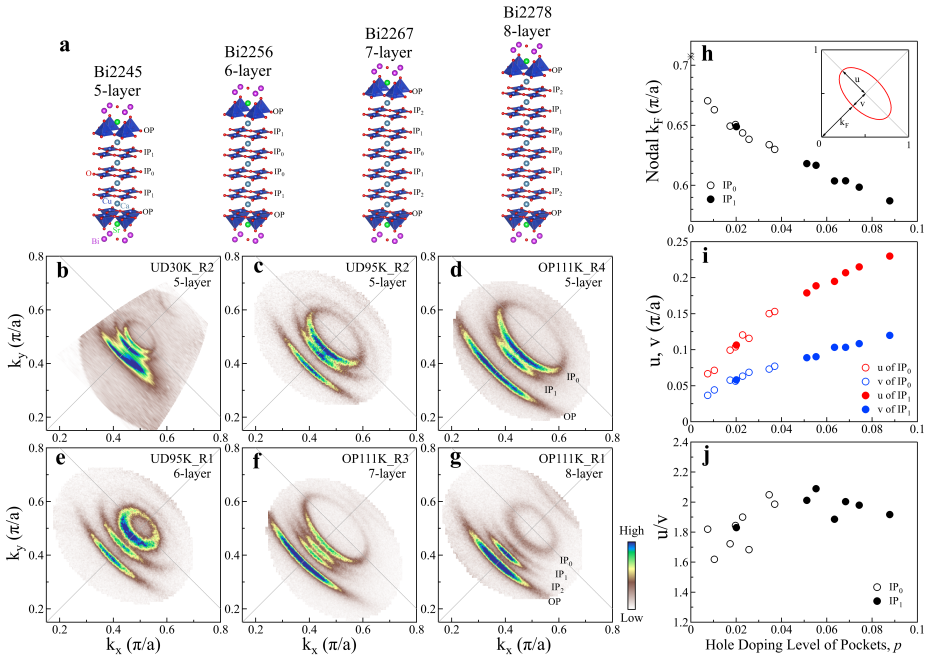
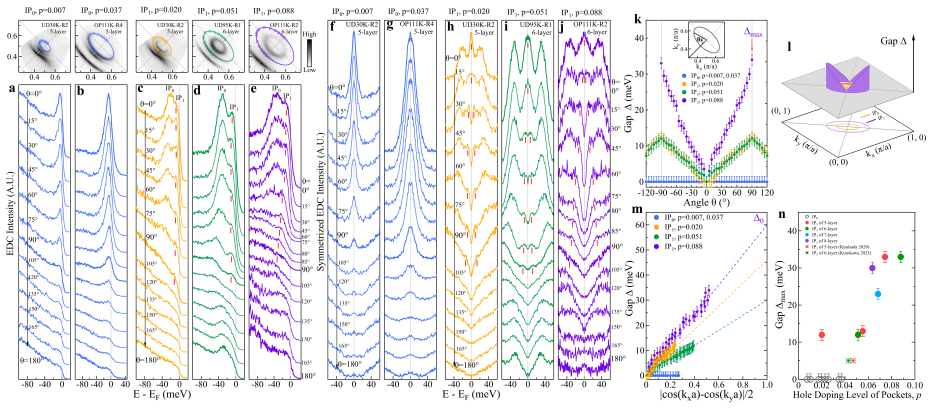
Lightly doped cuprate planes host well-defined Fermi pockets and anisotropic superconducting gaps up to 33 meV at doping levels of 0.007.
A machine-rendered reading of the paper's core claim, the machinery that carries it, and where it could break.
Core claim
Using spatially resolved laser angle-resolved photoemission spectroscopy on the inner CuO2 planes of Bi2Sr2Ca_{n-1}Cu_n O_{2n+4+δ} (n=5 to 8), which are shielded from disorder, we observe well-defined Fermi pockets at hole doping levels as low as 0.007. This demonstrates an abrupt transition from the parent Mott insulator to a metallic state upon introduction of an infinitesimal amount of doping. The innermost planes display gapless Fermi pockets while the second innermost planes show anisotropic superconducting gaps up to approximately 33 meV, indicating robust electron pairing that coexists with strong antiferromagnetic order.
What carries the argument
The inner CuO2 planes in multilayer cuprates, shielded from disorder and accessed by high-resolution laser ARPES, which serve as a clean platform for mapping intrinsic doping evolution and gap structures.
Load-bearing premise
The inner planes are effectively shielded from disorder and the observed gaps are superconducting rather than arising from competing orders.
What would settle it
Independent ARPES or tunneling measurements on samples with doping confirmed at 0.007 that show either no closed Fermi pockets or gaps that do not close at the known superconducting transition temperature would falsify the central observations.
Figures


read the original abstract
High temperature superconductivity in cuprate superconductors is generally considered to be generated from doping the Mott insulators. The fundamental nature of the doped parent compounds as well as the microscopic origin of electron pairing remain critical issues in understanding the emergence of superconductivity. Here, using high-resolution spatially-resolved laser angle-resolved photoemission spectroscopy, we investigate the intrinsic electronic structures of the CuO$_2$ planes in multilayer cuprates Bi$_2$Sr$_2$Ca$_{n-1}$Cu$_n$O$_{2n+4+\delta}$ (n=5$\sim$8). The inner CuO$_2$ planes are well shielded from the disorders and provide a rare and ideal platform to probe the intrinsic electronic phase diagram. We observe well-defined Fermi pockets with hole doping levels as low as 0.007, demonstrating an abrupt transition from the parent Mott insulator to a metallic state upon the introduction of an infinitesimal amount of doping. The innermost CuO$_2$ planes (IP$_0$) display gapless Fermi pockets, while the second innermost planes (IP$_1$) exhibit anisotropic superconducting gaps up to $\sim$33$\,$meV, indicative of robust electron pairing coexisting with strong antiferromagnetic order. Our findings provide a revised framework for understanding the doping-driven transitions and pairing mechanisms in cuprate superconductors.
Editorial analysis
A structured set of objections, weighed in public.
Referee Report
Summary. The manuscript reports high-resolution, spatially-resolved laser ARPES measurements on the inner CuO2 planes of multilayer cuprates Bi2Sr2Ca_{n-1}Cu_n O_{2n+4+δ} (n=5-8). Central claims include the observation of well-defined Fermi pockets at hole doping levels as low as 0.007 (abrupt Mott insulator-to-metal transition), gapless pockets in the innermost planes (IP0), and anisotropic gaps up to ~33 meV in the second-innermost planes (IP1) interpreted as superconducting gaps coexisting with strong antiferromagnetic order.
Significance. If the gap assignments and doping calibrations hold, the results would revise the low-doping cuprate phase diagram by demonstrating metallic Fermi surfaces and robust pairing in disorder-shielded planes. The inner-plane platform is a methodological strength for accessing intrinsic behavior, providing constraints on Mott transition and pairing mechanisms.
major comments (2)
- [Abstract and IP1 gap discussion] Abstract and IP1 gap analysis: The assignment of the anisotropic ~33 meV gap in IP1 to superconductivity (rather than AF zone folding, SDW reconstruction, or pseudogap) is load-bearing for the 'robust electron pairing coexisting with strong AF order' claim. No temperature dependence (gap closure at bulk Tc), coherence-peak evidence, or explicit exclusion of alternatives is provided, despite long AF correlation lengths expected at p~0.007.
- [Doping calibration and Fermi-pocket identification] Doping determination for inner planes: The hole doping level of 0.007 (and the 'infinitesimal doping' transition claim) relies on asserted calibration for shielded IP0/IP1. The manuscript does not detail the method (e.g., Luttinger count of Fermi-surface area accounting for possible reconstruction, or cross-checks with Hall coefficient or outer-plane data), which is required to support the central doping-driven transition narrative.
minor comments (2)
- [Figures and captions] Figure captions and data presentation: Include explicit resolution values, matrix-element considerations, and labeling of IP0 vs. IP1 in all relevant ARPES maps and momentum-distribution curves to aid reproducibility.
- [Notation and methods] Notation consistency: Define and relate the oxygen excess δ and hole doping p explicitly in the methods or results section; current usage risks ambiguity when comparing to literature values.
Simulated Author's Rebuttal
We thank the referee for the careful and constructive review of our manuscript. The comments highlight important points regarding the interpretation of the IP1 gap and the doping calibration, which we address below. We have revised the manuscript to strengthen these aspects where possible.
read point-by-point responses
-
Referee: [Abstract and IP1 gap discussion] Abstract and IP1 gap analysis: The assignment of the anisotropic ~33 meV gap in IP1 to superconductivity (rather than AF zone folding, SDW reconstruction, or pseudogap) is load-bearing for the 'robust electron pairing coexisting with strong AF order' claim. No temperature dependence (gap closure at bulk Tc), coherence-peak evidence, or explicit exclusion of alternatives is provided, despite long AF correlation lengths expected at p~0.007.
Authors: We agree that temperature-dependent measurements closing at Tc and coherence peaks would provide the most direct confirmation of superconductivity. The current assignment rests on the gap's large magnitude (~33 meV), its clear d-wave anisotropy, its presence only in the shielded IP1 planes (while IP0 remains gapless), and consistency with the overall Fermi-pocket topology. AF zone folding or SDW reconstruction would typically produce different pocket structures or shadow bands not observed here. In the revised manuscript we will add an expanded discussion section that explicitly compares the observed gap to expected signatures of AF reconstruction and pseudogap scenarios, using the doping dependence and plane-specific shielding as supporting arguments. We will also include any available temperature-dependent ARPES cuts if they were omitted from the original submission. revision: partial
-
Referee: [Doping calibration and Fermi-pocket identification] Doping determination for inner planes: The hole doping level of 0.007 (and the 'infinitesimal doping' transition claim) relies on asserted calibration for shielded IP0/IP1. The manuscript does not detail the method (e.g., Luttinger count of Fermi-surface area accounting for possible reconstruction, or cross-checks with Hall coefficient or outer-plane data), which is required to support the central doping-driven transition narrative.
Authors: The doping values were obtained from the Luttinger count of the enclosed Fermi-pocket area in the inner planes, cross-referenced against the known outer-plane doping levels in the same multilayer crystals and consistent with the charge-transfer balance in the Bi2212-family structure. In the revised version we will add a dedicated subsection in the Methods and a supplementary figure that details the Fermi-surface area integration, the precise Luttinger counting procedure (including any correction for possible weak reconstruction), and the cross-checks with outer-plane data and nominal oxygen content. revision: yes
Circularity Check
No significant circularity: purely experimental observations with no derivations or predictions
full rationale
This is an experimental ARPES paper reporting direct observations of Fermi pockets at doping levels as low as 0.007 and anisotropic gaps in inner CuO2 planes. No derivation chain, first-principles calculations, fitted parameters renamed as predictions, or self-referential equations exist in the presented claims. The abstract and structure rely on measurement data and doping calibration assertions rather than any reduction of outputs to inputs by construction. Self-citations, if present in the full text, are not load-bearing for any claimed prediction or uniqueness theorem. The result is self-contained against external benchmarks of photoemission data.
Axiom & Free-Parameter Ledger
axioms (2)
- standard math ARPES measures the single-particle spectral function of the electronic bands.
- domain assumption Inner CuO2 planes in multilayers are effectively decoupled from surface disorder.
Reference graph
Works this paper leans on
-
[1]
E. Dagotto. Correlated electrons in high-temperature superconductors. Reviews of Modern Physics 66, 763 (1994)
1994
-
[2]
Damascelli, Z
A. Damascelli, Z. Hussain, and Z. X. Shen. Angle-resolved photoemission studies of the cuprate superconductors. Reviews of Modern Physics 75, 473 (2003)
2003
-
[3]
P. A. Lee, N. Nagaosa, and X. G. Wen. Doping a Mott insulator: Physics of high-temperature superconductivity. Reviews of Modern Physics 78, 17 (2006)
2006
-
[4]
Keimer, S
B. Keimer, S. A. Kivelson, M. R. Norman, S. Uchida, and J. Zaanen. From quantum matter to high-temperature superconductivity in copper oxides. Nature 518, 179 (2015)
2015
-
[5]
J. A. Sobota, Y. He, and Z. X. Shen. Angle-resolved photoemission studies of quantum materials. Reviews of Modern Physics 93, 025006 (2021). 13
2021
-
[6]
Y. Ando, A. N. Lavrov, S. Komiya, K. Segawa, and X. F. Sun. Mobility of the doped holes and the antiferromagnetic correlations in underdoped high-T c cuprates. Physical Review Letters 87, 017001 (2001)
2001
-
[7]
Kohsaka, M
Y. Kohsaka, M. Azuma, I. Yamada, T. Sasagawa, T. Hanaguri, M. Takano, and H. Takagi. Growth of Na-doped Ca 2CuO2Cl2 single crystals under high pressures of several GPa. Journal of the American Chemical Society 124, 12275 (2002)
2002
-
[8]
Ono and Y
S. Ono and Y. Ando. Evolution of the resistivity anisotropy in Bi 2Sr2−xLaxCuO6+δ single crystals for a wide range of hole doping. Physical Review B 67, 104512 (2003)
2003
-
[9]
Y. Ando, S. Komiya, K. Segawa, S. Ono, and Y. Kurita. Electronic phase diagram of high-T c cuprate superconductors from a mapping of the in-plane resistivity curvature. Physical Review Letters 93, 267001 (2004)
2004
-
[10]
Y. J. Yu, L. G. Ma, P. Cai, R. D. Zhong, C. Ye, J. Shen, G. D. Gu, X. H. Chen, and Y. B. Zhang. High-temperature superconductivity in monolayer Bi 2Sr2CaCu2O8+δ. Nature 575, 156 (2019)
2019
-
[11]
K. M. Shen, T. Yoshida, D. H. Lu, F. Ronning, N. P. Armitage, W. S. Lee, X. J. Zhou, A. Damascelli, D. L. Feng, N. J. C. Ingle, H. Eisaki, Y. Kohsaka, H. Takagi, T. Kakeshita, S. Uchida, P. K. Mang, M. Greven, Y. Onose, Y. Taguchi, Y. Tokura, Seiki Komiya, Yoichi Ando, M. Azuma, M. Takano, A. Fujimori, and Z. X. Shen. Fully gapped single-particle excitati...
2004
-
[12]
I. M. Vishik, M. Hashimoto, R. H. He, W. S. Lee, F. Schmitt, D. H. Lu, R. G. Moore, C. Zhang, W. Meevasana, T. Sasagawa, S. Uchida, K. Fujita, S. Ishida, M. Ishikado, Y. Yoshida, H. Eisaki, Z. Hussain, T. P. Devereaux, and Z. X. Shen. Phase competition in trisected superconducting dome. Proceedings of the National Academy of Sciences 109, 18332 (2012)
2012
-
[13]
Y. Y. Peng, J. Q. Meng, D. X. Mou, J. F. He, L. Zhao, Y. Wu, G. D. Liu, X. L. Dong, S. L. He, J. Zhang, X. Y. Wang, Q. J. Peng, Z. M. Wang, S. J. Zhang, F. Yang, C. T. Chen, Z. Y. Xu, T. K. Lee, and X. J. Zhou. Disappearance of nodal gap across the insulator–superconductor transition in a copper-oxide superconductor. Nature Communications 4, 2459 (2013)
2013
-
[14]
Ronning, T
F. Ronning, T. Sasagawa, Y. Kohsaka, K. M. Shen, A. Damascelli, C. Kim, T. Yoshida, N. P. Armitage, D. H. Lu, D. L. Feng, L. L. Miller, H. Takagi, and Z. X. Shen. Evolution of a metal to insulator transition in Ca 2−xNaxCuO2Cl2 as seen by angle-resolved photoemission. Physical Review B 67, 165101 (2003). 14
2003
-
[15]
K. M. Shen, F. Ronning, D. H. Lu, W. S. Lee, N. J. C. Ingle, W. Meevasana, F. Baumberger, A. Damascelli, N. P. Armitage, L. L. Miller, Y. Kohsaka, M. Azuma, M. Takano, H. Takagi, and Z. X. Shen. Missing quasiparticles and the chemical potential puzzle in the doping evolution of the cuprate superconductors. Physical Review Letters 93, 267002 (2004)
2004
-
[16]
K. M. Shen, F. Ronning, D. H. Lu, F. Baumberger, N. J. C. Ingle, W. S. Lee, W. Meevasana, Y. Kohsaka, M. Azuma, M. Takano, H. Takagi, and Z. X. Shen. Nodal quasiparticles and antinodal charge ordering in Ca 2−xNaxCuO2Cl2. Science 307, 901 (2005)
2005
-
[17]
Yoshida, X
T. Yoshida, X. J. Zhou, K. Tanaka, W. L. Yang, Z. Hussain, Z. X. Shen, A. Fujimori, S. Sahrakorpi, M. Lindroos, R. S. Markiewicz, A. Bansil, S. Komiya, Y. Ando, H. Eisaki, T. Kakeshita, and S. Uchida. Systematic doping evolution of the underlying Fermi surface of La2−xSrxCuO4. Physical Review B 74, 224510 (2006)
2006
-
[18]
Hashimoto, T
M. Hashimoto, T. Yoshida, H. Yagi, M. Takizawa, A. Fujimori, M. Kubota, K. Ono, K. Tanaka, D. H. Lu, Z. X. Shen, S. Ono, and Y. Ando. Doping evolution of the electronic structure in the single-layer cuprate Bi 2Sr2−xLaxCuO6+δ: Comparison with other single-layer cuprates. Physical Review B 77, 094516 (2008)
2008
-
[19]
Tanaka, T
K. Tanaka, T. Yoshida, K. M. Shen, D. H. Lu, W. S. Lee, H. Yagi, A. Fujimori, Z.-X. Shen, Risdiana, T. Fujii, and I. Terasaki. Evolution of electronic structure from insulator to superconductor in Bi 2Sr2−xLax(Ca,Y)Cu2O8+δ. Physical Review B 81, 125115 (2010)
2010
-
[20]
Q. Gao, L. Zhao, C. Hu, H. T. Yan, H. Chen, Y. Q. Cai, C. Li, P. Ai, J. Liu, J. W. Huang, H. T. Rong, C. Y. Song, C. H. Yin, Q. Y. Wang, Y. Huang, G. D. Liu, Z. Y. Xu, and X. J. Zhou. Electronic evolution from the parent mott insulator to a superconductor in lightly hole-doped Bi 2Sr2CaCu2O8+δ. Chinese Physics Letters 37, 087402 (2020)
2020
-
[21]
Kunisada, S
S. Kunisada, S. Isono, Y. Kohama, S. Sakai, C. Bareille, S. Sakuragi, R. Noguchi, K. Kurokawa, K. Kuroda, Y. Ishida, S. Adachi, R. Sekine, T. K. Kim, C. Cacho, S. Shin, T. Tohyama, K. Tokiwa, and T. Kondo. Observation of small Fermi pockets protected by clean CuO 2 sheets of a high-T c superconductor. Science 369, 833 (2020)
2020
-
[22]
Kurokawa, S
K. Kurokawa, S. Isono, Y. Kohama, S. Kunisada, S. Sakai, R. Sekine, M. Okubo, M. D. Watson, T. K. Kim, C. Cacho, S. Shin, T. Tohyama, K. Tokiwa, and T. Kondo. Unveiling phase diagram of the lightly doped high-T c cuprate superconductors with disorder removed. Nature Communications 14, 4064 (2023)
2023
-
[23]
D. L. Feng, A. Damascelli, K. M. Shen, N. Motoyama, D. H. Lu, H. Eisaki, K. Shimizu, J.-i. 15 Shimoyama, K. Kishio, N. Kaneko, M. Greven, G. D. Gu, X. J. Zhou, C. Kim, F. Ronning, N. P. Armitage, and Z. X Shen. Electronic structure of the trilayer cuprate superconductor Bi2Sr2Ca2Cu3O10+δ. Physical Review Letters 88, 107001 (2002)
2002
-
[24]
Ideta, K
S. Ideta, K. Takashima, M. Hashimoto, T. Yoshida, A. Fujimori, H. Anzai, T. Fujita, Y. Nakashima, A. Ino, M. Arita, H. Namatame, M. Taniguchi, K. Ono, M. Kubota, D. H. Lu, Z.-X. Shen, K. M. Kojima, and S. Uchida. Enhanced superconducting gaps in the trilayer high-temperature Bi 2Sr2Ca2Cu3O10+δ cuprate superconductor. Physical Review Letters 104, 227001 (2010)
2010
-
[25]
X. Y. Luo, H. Chen, Y. H. Li, Q. Gao, C. H. Yin, H. T. Yan, T. M. Miao, H. L. Luo, Y. J. Shu, Y. W. Chen, C. T. Lin, S. J. Zhang, Z. M. Wang, F. F. Zhang, F. Yang, Q. J. Peng, G. D. Liu, L. Zhao, Z. Y. Xu, T. Xiang, and X. J. Zhou. Electronic origin of high superconducting critical temperature in trilayer cuprates. Nature Physics 19, 1841 (2023)
2023
-
[26]
Y. L. Chen, A. Iyo, W. L. Yang, X. J. Zhou, D. H. Lu, H. Eisaki, T. P. Devereaux, Z. Hus- sain, and Z. X. Shen. Anomalous Fermi-surface dependent pairing in a self-doped high-T c superconductor. Physical Review Letters 97, 236401 (2006)
2006
-
[27]
Z. C. Wang, C. W. Zou, C. T. Lin, X. Y. Luo, H. T. Yan, C. H. Yin, Y. Xu, X. J. Zhou, Y. Y. Wang, and J. Zhu. Correlating the charge-transfer gap to the maximum transition temperature in Bi 2Sr2Can−1CunO2n+4+δ. Science 381, 227 (2023)
2023
-
[28]
X. J. Zhou, S. L. He, G. D. Liu, L. Zhao, L. Yu, and W. T. Zhang. New developments in laser-based photoemission spectroscopy and its scientific applications: a key issues review. Reports on Progress in Physics 81, 062101 (2018)
2018
-
[29]
Mukuda, S
H. Mukuda, S. Shimizu, A. Iyo, and Y. Kitaoka. High-T c superconductivity and antiferro- magnetism in multilayered copper oxides –a new paradigm of superconducting mechanism–. Journal of the Physical Society of Japan 81, 011008 (2012)
2012
-
[30]
M. Mori, T. Tohyama, and S. Maekawa. Fermi surface splittings in multilayered high-T c cuprates. Physica C: Superconductivity and its Applications 445, 23 (2006)
2006
-
[31]
J. R. Schrieffer, X. G. Wen, and S. C. Zhang. Dynamic spin fluctuations and the bag mecha- nism of high-T c superconductivity. Physical Review B 39, 11663 (1989)
1989
-
[32]
A. V. Chubukov and D. M. Frenkel. Renormalized perturbation theory of magnetic instabilities in the two-dimensional Hubbard model at small doping. Physical Review B 46, 11884 (1992)
1992
-
[33]
Bulut, D
N. Bulut, D. J. Scalapino, and S. R. White. Electronic properties of the insulating half-filled 16 hubbard model. Physical Review Letters 73, 748 (1994)
1994
-
[34]
Xiang and J
T. Xiang and J. M. Wheatley. Quasiparticle energy dispersion in doped two-dimensional quantum antiferromagnets. Physical Review B 54, R12653 (1996)
1996
-
[35]
Kusko, R
C. Kusko, R. S. Markiewicz, M. Lindroos, and A. Bansil. Fermi surface evolution and collapse of the Mott pseudogap in Nd 2−xCexCuO4±δ. Physical Review B 66, 140513 (2002)
2002
-
[36]
McElroy, J
K. McElroy, J. Lee, J. A. Slezak, D. H. Lee, H. Eisaki, S. Uchida, and J. C. Davis. Atomic- scale sources and mechanism of nanoscale electronic disorder in Bi 2Sr2CaCu2O8+δ. Science 309, 1048 (2005)
2005
- [37]
-
[38]
Uchida, T
S. Uchida, T. Ido, H. Takagi, T. Arima, Y. Tokura, and S. Tajima. Optical spectra of La2−xSrxCuO4: Effect of carrier doping on the electronic structure of the CuO 2 plane. Physical Review B 43, 7942 (1991)
1991
-
[39]
C. Ye, P. Cai, R. Z. Yu, X. D. Zhou, W. Ruan, Q. Q. Liu, C. Q. Jin, and Y. Y. Wang. Visualizing the atomic-scale electronic structure of the Ca 2CuO2Cl2 Mott insulator. Nature Communications 4, 1365 (2013)
2013
-
[40]
D. J. Scalapino, E. Loh, and J. E. Hirsch. d-wave pairing near a spin-density-wave instability. Physical Review B 34, 8190 (1986)
1986
-
[41]
Monthoux, A
P. Monthoux, A. V. Balatsky, and D. Pines. Toward a theory of high-temperature supercon- ductivity in the antiferromagnetically correlated cuprate oxides. Physical Review Letters 67, 3448 (1991)
1991
-
[42]
D. J. Scalapino. The case for dx2−y2 pairing in the cuprate superconductors. Physics Reports 250, 329 (1995)
1995
-
[43]
Moriya and K
T. Moriya and K. Ueda. Spin fluctuations and high temperature superconductivity. Advances in Physics 49, 555 (2000)
2000
-
[44]
Abanov, A
Ar. Abanov, A. V. Chubukov, and M. R. Norman. Gap anisotropy and universal pairing scale in a spin-fluctuation model of cuprate superconductors. Physical Review B 78, 220507 (2008)
2008
-
[45]
T. Dahm, V. Hinkov, S. V. Borisenko, A. A. Kordyuk, V. B. Zabolotnyy, J. Fink, B. Büchner, D. J. Scalapino, W. Hanke, and B. Keimer. Strength of the spin-fluctuation-mediated pairing interaction in a high-temperature superconductor. Nature Physics 5, 217 (2009). 17
2009
-
[46]
P. W. Anderson. The resonating valence bond state in La 2CuO4 and superconductivity. Science 235, 1196 (1987)
1987
- [47]
-
[48]
C. T. Lin and B. Liang. Growth of a Hard-Grown Single Crystal — Bi 2Sr2Ca2Cu3O10+δ. In James F. Annett and Sergei Kruchinin, editors, New Trends in Superconductivity , pages 19–28. Springer Netherlands, Dordrecht (2002)
2002
-
[49]
Liang, C
B. Liang, C. T. Lin, P. Shang, and G. Yang. Single crystals of triple-layered cuprates Bi2Sr2Ca2Cu3O10+δ: growth, annealing and characterization. Physica C: Superconductivity 383, 75 (2002)
2002
-
[50]
G. D. Liu, G. L. Wang, Y. Zhu, H. B. Zhang, G. C. Zhang, X. Y. Wang, Y. Zhou, W. T. Zhang, H. Y. Liu, L. Zhao, J. Q. Meng, X. L. Dong, C. T. Chen, Z. Y. Xu, and X. J. Zhou. Development of a vacuum ultraviolet laser-based angle-resolved photoemission system with a superhigh energy resolution better than 1meV. Review of Scientific Instruments 79, 023105 (20...
2008
discussion (0)
Sign in with ORCID, Apple, or X to comment. Anyone can read and Pith papers without signing in.