Recognition: unknown
A Conceptual Technology-Dependent Framework of Ternary Quantum Gates
Pith reviewed 2026-05-08 08:17 UTC · model grok-4.3
The pith
A framework defines technology-dependent ternary quantum gates by direct analogy to binary gates for future qutrit systems.
A machine-rendered reading of the paper's core claim, the machinery that carries it, and where it could break.
Core claim
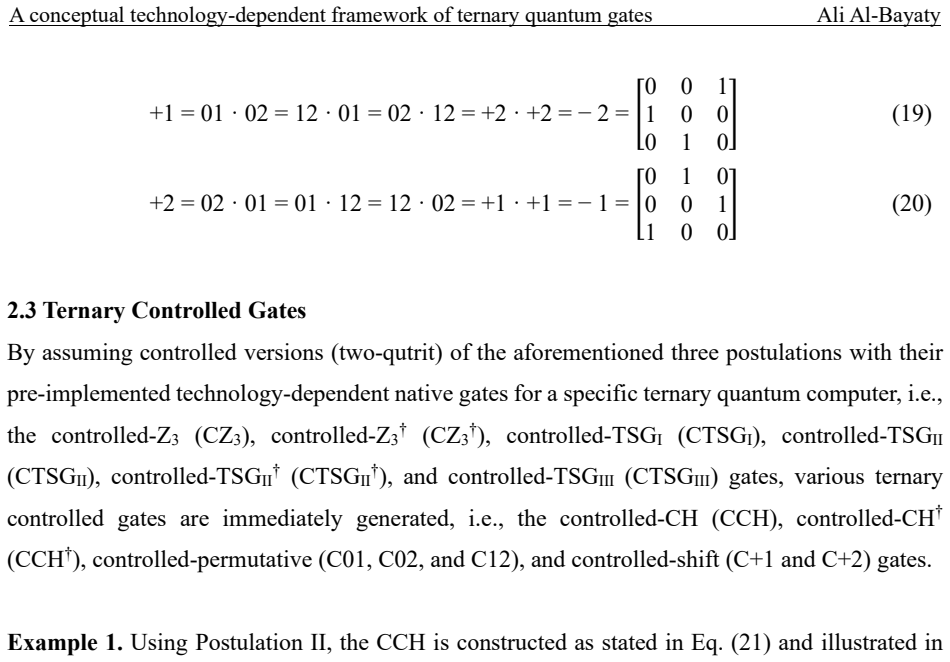
The paper establishes a technology-dependent framework that produces the following gates for ternary quantum systems: the Chrestenson gate, the Z3 gate, the 01, 02, and 12 gates, the +1 and +2 gates together with their inverses and controlled versions, a non-phase relative SWAP gate, and a cost-effective Toffoli gate that functions as a generic circuit for multiplication and addition in GF(3). These are presented as directly analogous to binary gates and suitable for implementation in superconducting and photonic technologies.
What carries the argument
The technology-dependent design approach that creates each ternary gate by explicit analogy to a corresponding binary quantum gate, thereby specifying the full listed set of one- to three-qutrit operations.
If this is right
- The gates supply complete control over one-, two-, and three-qutrit operations for building ternary quantum circuits.
- The Toffoli gate supplies a direct hardware realization of GF(3) multiplication and addition without decomposition.
- Inverse and controlled versions of the gates enable reversible and multi-qutrit computations at scale.
- The non-phase SWAP gate preserves quantum information without introducing extraneous phase shifts.
- The overall set allows construction of ternary quantum processors that avoid reliance on binary gate decompositions.
Where Pith is reading between the lines
- This design method could simplify the development of quantum algorithms that exploit three-state logic rather than binary logic.
- Classical simulation of the proposed gates on current hardware could expose fidelity or control issues prior to any physical build.
- Hybrid binary-ternary processors might emerge by integrating these gates with existing qubit libraries.
- The framework suggests a pathway for testing higher-radix quantum error correction using the same superconducting platforms already under development.
Load-bearing premise
The listed conceptual gates can be directly implemented and fabricated in future superconducting and photonic quantum systems without additional physical constraints or loss of fidelity.
What would settle it
Attempting to fabricate the proposed Chrestenson gate or Toffoli gate in an existing superconducting qutrit device and measuring whether the observed fidelity and functionality match the expected theoretical performance.
Figures




read the original abstract
This paper introduces a conceptual framework of technology-dependent ternary quantum gates that could be implemented and fabricated into future superconducting and photonic quantum systems for operating 3-valued quantum bits (qutrits). The "technology-dependent" means that such ternary quantum gates are on-purpose designed analogy to the contemporary binary quantum gates. Conceptually, the final built technology-dependent one-, two-, and three-qutrit gates are Chrestenson, Z3, 01, 02, 12, +1, +2 (including their corresponding inverse and controlled gates), a non-phase relative SWAP gate, and a cost-effective Toffoli gate, which is a generic ternary Galois Field (GF3) multiplication and addition circuit.
Editorial analysis
A structured set of objections, weighed in public.
Referee Report
Summary. The manuscript introduces a conceptual framework for technology-dependent ternary quantum gates intended for future implementation in superconducting and photonic quantum systems. It positions these gates as purposeful analogies to existing binary quantum gates and identifies a specific set of one-, two-, and three-qutrit gates: the Chrestenson gate, Z3 gate, 01, 02, 12, +1, +2 gates (with inverses and controlled versions), a non-phase relative SWAP gate, and a cost-effective Toffoli gate realized as a ternary Galois Field (GF(3)) multiplication and addition circuit.
Significance. If substantiated with physical implementations and fidelity analyses, the framework could offer a structured pathway for developing ternary quantum logic, potentially increasing computational density compared to binary systems. The emphasis on technology-dependence highlights the need for platform-specific designs, which is a valuable perspective in the field of multi-level quantum information processing.
major comments (3)
- [Abstract] Abstract: The assertion that the listed gates 'are the final built technology-dependent' set lacks supporting evidence such as unitary matrix representations, circuit decompositions, or mappings to physical control operations in superconducting or photonic platforms. This is central to the claim of a 'built' framework.
- [Main text] Main text: No derivations, simulations, or error analyses are supplied to confirm that the proposed gates (e.g., Chrestenson or the GF(3) Toffoli) satisfy unitarity or achieve acceptable gate fidelities on the target platforms, which is load-bearing for the practicality of the technology-dependent claim.
- [Toffoli gate discussion] Toffoli gate discussion: The claim that the Toffoli gate is 'cost-effective' as a generic GF(3) multiplication and addition circuit is not accompanied by any cost metrics, comparison to known ternary circuits, or resource analysis, undermining the 'cost-effective' assertion.
minor comments (2)
- [Abstract] Abstract: The phrasing 'on-purpose designed analogy' is awkward; rephrasing to 'purposefully designed as an analogy' would improve clarity.
- [Throughout] Throughout: Explicit matrix definitions or circuit diagrams for each gate would allow verification of the binary analogies and strengthen the presentation.
Simulated Author's Rebuttal
We thank the referee for the constructive comments on our manuscript introducing a conceptual framework for technology-dependent ternary quantum gates. We address each major comment below.
read point-by-point responses
-
Referee: The assertion that the listed gates 'are the final built technology-dependent' set lacks supporting evidence such as unitary matrix representations, circuit decompositions, or mappings to physical control operations in superconducting or photonic platforms. This is central to the claim of a 'built' framework.
Authors: We agree the term 'final built' is misleading as the work is conceptual. The gates are defined by their action on qutrit states as analogies to binary gates for potential implementation in the mentioned platforms. They are unitary by construction. We will revise the abstract to clarify the conceptual scope and include unitary matrix representations for the gates in the revised manuscript. revision: yes
-
Referee: No derivations, simulations, or error analyses are supplied to confirm that the proposed gates (e.g., Chrestenson or the GF(3) Toffoli) satisfy unitarity or achieve acceptable gate fidelities on the target platforms, which is load-bearing for the practicality of the technology-dependent claim.
Authors: The manuscript is a conceptual proposal, not a simulation or implementation study. Unitarity follows from the gate definitions as quantum operators. We will add explicit derivations and unitary matrices to the main text. However, we cannot provide fidelity analyses or error models without physical implementations, which are outside the current conceptual scope. We will revise to emphasize this limitation. revision: partial
-
Referee: The claim that the Toffoli gate is 'cost-effective' as a generic GF(3) multiplication and addition circuit is not accompanied by any cost metrics, comparison to known ternary circuits, or resource analysis, undermining the 'cost-effective' assertion.
Authors: The 'cost-effective' label is qualitative, referring to the direct GF(3) implementation avoiding complex decompositions. We acknowledge the absence of quantitative metrics. We will revise the text to qualify or remove this claim and note that detailed resource analysis is reserved for future work. revision: yes
Circularity Check
No circularity: purely conceptual proposal with no derivations or reductions
full rationale
The manuscript presents a forward-looking conceptual framework that enumerates named ternary gates (Chrestenson, Z3, 01/02/12, +1/+2, non-phase SWAP, GF(3) Toffoli) by explicit analogy to binary gates. No equations, matrix definitions, cost metrics, or parameter-fitting steps appear in the provided text. The central claim is definitional—the listed gates are declared to be the 'final built' set because the framework is introduced to contain exactly those gates. This is not a derivation that reduces to prior fitted inputs or self-citations; it is a naming and categorization exercise. The work is therefore self-contained as a proposal and receives the default non-circularity finding.
Axiom & Free-Parameter Ledger
axioms (1)
- domain assumption Ternary quantum gates can be designed by direct analogy to binary quantum gates for specific technologies
Reference graph
Works this paper leans on
-
[1]
Quantum computing,
A. Steane, “Quantum computing,” Reports on Progress in Physics, vol. 61, no. 2, pp. 117–173, 1998
1998
-
[2]
Quantum computing: An introduction,
T. Hey, “Quantum computing: An introduction,” Computing and Control Engineering, vol. 10, no. 3, pp. 105– 112, 1999
1999
-
[3]
Optical quantum computing,
J.L. O’brien, “Optical quantum computing,” Science, vol. 318, no. 5856, pp. 1567–1570, 2007
2007
-
[4]
Nielsen and I.L
M.A. Nielsen and I.L. Chuang, Quantum Computation and Quantum Information , 10th ed., Cambridge University Press, 2010
2010
-
[5]
LaPierre, Introduction to Quantum Computing, 1st ed
R. LaPierre, Introduction to Quantum Computing, 1st ed. Springer, 2021
2021
-
[6]
A fast quantum mechanical algorithm for database search,
L.K. Grover, “A fast quantum mechanical algorithm for database search,” In Proc. of the 28th Ann. ACM Symp. on Theory of Computing, 1996, pp. 1212–219
1996
-
[7]
Quantum counting
G. Brassard, P. Høyer, and A. Tapp, “Quantum counting.” In Automata, Languages and Programming, Springer, 1998
1998
-
[8]
Complete 3 -qubit Grover search on a programmable quantum computer,
C. Figgatt, D. Maslov, K.A. Landsman, N.M. Linke, S. Debnath, and C. Monroe, “Complete 3 -qubit Grover search on a programmable quantum computer,” Nature Communications, vol. 8, no. 1, p. 1918, 2017
1918
-
[9]
A concept of controlling Grover diffusion operator: A new approach to solve arbitrary Boolean-based problems,
A. Al-Bayaty and M. Perkowski, “A concept of controlling Grover diffusion operator: A new approach to solve arbitrary Boolean-based problems,” Scientific Reports, vol. 14, no. 1, p. 23570, 2024
2024
-
[10]
BHT-QAOA: The generalization of quantum approximate optimization algorithm to solve arbitrary Boolean problems as Hamiltonians,
A. Al -Bayaty and M . Perkowski, “BHT-QAOA: The generalization of quantum approximate optimization algorithm to solve arbitrary Boolean problems as Hamiltonians,” Entropy, vol. 26, no. 10, p. 843, 2024
2024
-
[11]
The impact of optimization approximation algorithms on the performance of the BHT-QAOA,
A. Al-Bayaty and M. Perkowski, “The impact of optimization approximation algorithms on the performance of the BHT-QAOA,” Academia Quantum, vol. 2, no. 4, 2025
2025
-
[12]
On some basic aspects of ternary reversible and quantum computing ,
C. Moraga, “On some basic aspects of ternary reversible and quantum computing ,”. In 2014 IEEE 44th International Symposium on Multiple-Valued Logic, May 2014, pp. 178–183
2014
-
[13]
Can ternary computing improve information assurance?,
B. Cambou, P.G. Flikkema, J. Palmer, D. Telesca, and C. Philabaum, “Can ternary computing improve information assurance?,” Cryptography, vol. 2, no. 1, p. 6, 2018
2018
-
[14]
Synthesis of ternary quantum logic circuits by decomposition ,
F.S. Khan and M. Perkowski, “Synthesis of ternary quantum logic circuits by decomposition ,” 2005, arXiv:quant-ph/0511041
-
[15]
Improved complexity of quantum oracles for ternary Grover algorithm for graph coloring,
Y . Wang and M. Perkowski, “Improved complexity of quantum oracles for ternary Grover algorithm for graph coloring,” In 2011 41st IEEE International Symposium on Multiple-Valued Logic, May 2011, pp. 294–301
2011
-
[16]
Realizing ternary quantum switching networks without ancilla bits,
G. Yang, X. Song, M. Perkowski, and J. Wu, “Realizing ternary quantum switching networks without ancilla bits,” Journal of Physics A: Mathematical and General, vol. 38, no. 44, pp. 9689–9697, 2005. A conceptual technology-dependent framework of ternary quantum gates Ali Al-Bayaty 13
2005
-
[17]
A class of generalized Walsh functions,
H.E. Chrestenson, “A class of generalized Walsh functions,” Pacific Journal of Mathematics, vol. 5, pp. 17–31, 1955
1955
-
[18]
Synthesis of ternary Grover ’s algorithm,
S.B. Mandal, A. Chakrabarti, and S. Sur-Kolay, “Synthesis of ternary Grover ’s algorithm,” In 2014 IEEE 44th International Symposium on Multiple-Valued Logic, May 2014, pp. 184–189
2014
-
[19]
Quantum robots. Now or never? ,
M. Perkowski, “Quantum robots. Now or never? ,” Invited Talk at the 5th National Conference on Informatics , Gdansk, Poland, May 2007
2007
-
[20]
Multi-valued quantum logic,
A. Al-Rabadi, L. Casperson, M. Perkowski, and X. Song, “Multi-valued quantum logic,” Quantum, vol. 10, no. 2, 2002
2002
-
[21]
Benchmarking Quantum Computers via Protocols, Comparing IBM's Heron vs IBM's Eagle
N. Mayo, T. Mor, and Y . Weinstein, “Benchmarking quantum computers via protocols, comparing IBM’s Heron vs IBM’s Eagle,” 2026, arXiv:2603.04377
work page internal anchor Pith review Pith/arXiv arXiv 2026
-
[22]
Characterizing and Benchmarking Dynamic Quantum Circuits
S. Shirgure, E. Kökcü, A. Mitra, W.A. de Jong, C. Iancu, and S. Niu, “Characterizing and benchmarking dynamic quantum circuits,” 2026, arXiv:2604.03360
work page internal anchor Pith review Pith/arXiv arXiv 2026
-
[23]
Generalised quantum gates for qudits and their application in quantum Fourier transform,
F. Pudda, M. Chizzini, and L. Crippa, “Generalised quantum gates for qudits and their application in quantum Fourier transform,” 2024, arXiv:2410.05122
-
[24]
High-fidelity qutrit entangling gates for superconducting circuits ,
N. Goss, A. Morvan, B. Marinelli, B.K. Mitchell, L.B. Nguyen, R.K. Naik, L. Chen, C. Jünger, J.M. Kreikebaum, D.I. Santiago, and J.J. Wallman, “High-fidelity qutrit entangling gates for superconducting circuits ,” Nature Communications, vol. 13, no. 1, p. 7481, 2022
2022
-
[25]
Improving the circuit realization of Grover ’s quantum search algorithm by replacing Hadamard with √X gates,
A. Al-Bayaty, A. Al-Shuwaili, A. AlZubaidi, and M . Perkowski, “Improving the circuit realization of Grover ’s quantum search algorithm by replacing Hadamard with √X gates,” In Proceedings of the 2026 2nd International Conference on Computing and Emerging Sciences (ICCES '26) , Association for Computing Machinery, New York, NY , USA, Feb. 2026, pp. 258–265
2026
-
[26]
A. Al-Bayaty and M. Perkowski, “p-SWAP: A generic cost-effective quantum Boolean-phase SWAP gate using two CNOT gates and the Bloch sphere approach,” 2024, arXiv:2410.16641
-
[27]
A cost-effective quantum Boolean-phase SWAP gate with only two CNOT gates,
A. Al-Bayaty, S. Chen, S.A. Bleiler, and M. Perkowski, “A cost-effective quantum Boolean-phase SWAP gate with only two CNOT gates,” 2025, arXiv:2507.17164
-
[28]
A. Al-Bayaty and M. Perkowski, “A geometrical design tool for building cost-effective layout-aware n -bit quantum gates using the Bloch sphere approach,” 2026, arXiv:2601.00484
-
[29]
BSA: The Bloch sphere approach as a geometrical design tool for building cost-Effective quantum gates,
A. Al-Bayaty and M. Perkowski, “BSA: The Bloch sphere approach as a geometrical design tool for building cost-Effective quantum gates,” 2024, Protocols.io
2024
-
[30]
A. Al-Bayaty and M. Perkowski, “Cost-effective realization of n-bit Toffoli gates for IBM quantum computers using the Bloch sphere approach and IBM native gates,” 2024, arXiv:2410.13104
-
[31]
A. Al-Bayaty and M. Perkowski, “GALA-n: Generic architecture of layout-aware n-bit quantum operators for cost-effective realization on IBM quantum computers,” 2023, arXiv:2311.06760
-
[32]
A. Al-Bayaty, X. Song, and M. Perkowski, “CALA-n: A quantum library for realizing cost-effective 2-, 3-, 4-, and 5-bit gates on IBM quantum computers using Bloch sphere approach, Clifford+T gates, and layouts,” 2024, arXiv:2408.01025
-
[33]
Layout -aware quantum circuitry and algorithmic extensions to Grover’s algorithm,
A. Al -Bayaty, “Layout -aware quantum circuitry and algorithmic extensions to Grover’s algorithm,” Ph.D. dissertation, Portland State University, Portland, OR, USA, 2025
2025
-
[34]
Visualizing the state space and transformations of higher order quantum logics via toric geometry
S. Bleiler, A. Al-Bayaty, S. Chen, and M. Perkowski, “Visualizing the state space of quantum trits, quadits, and pairs of qubits via toric geometry,” 2025, arXiv:2510.01455
work page internal anchor Pith review Pith/arXiv arXiv 2025
discussion (0)
Sign in with ORCID, Apple, or X to comment. Anyone can read and Pith papers without signing in.