Recognition: 2 theorem links
· Lean TheoremCharacterizing and Benchmarking Dynamic Quantum Circuits
Pith reviewed 2026-05-13 19:01 UTC · model grok-4.3
The pith
A new framework called dynamarq benchmarks dynamic quantum circuits and predicts their fidelity from structural features with models that transfer across hardware.
A machine-rendered reading of the paper's core claim, the machinery that carries it, and where it could break.
Core claim
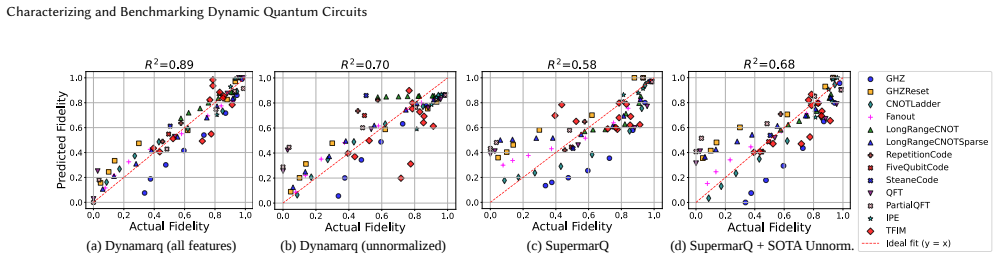
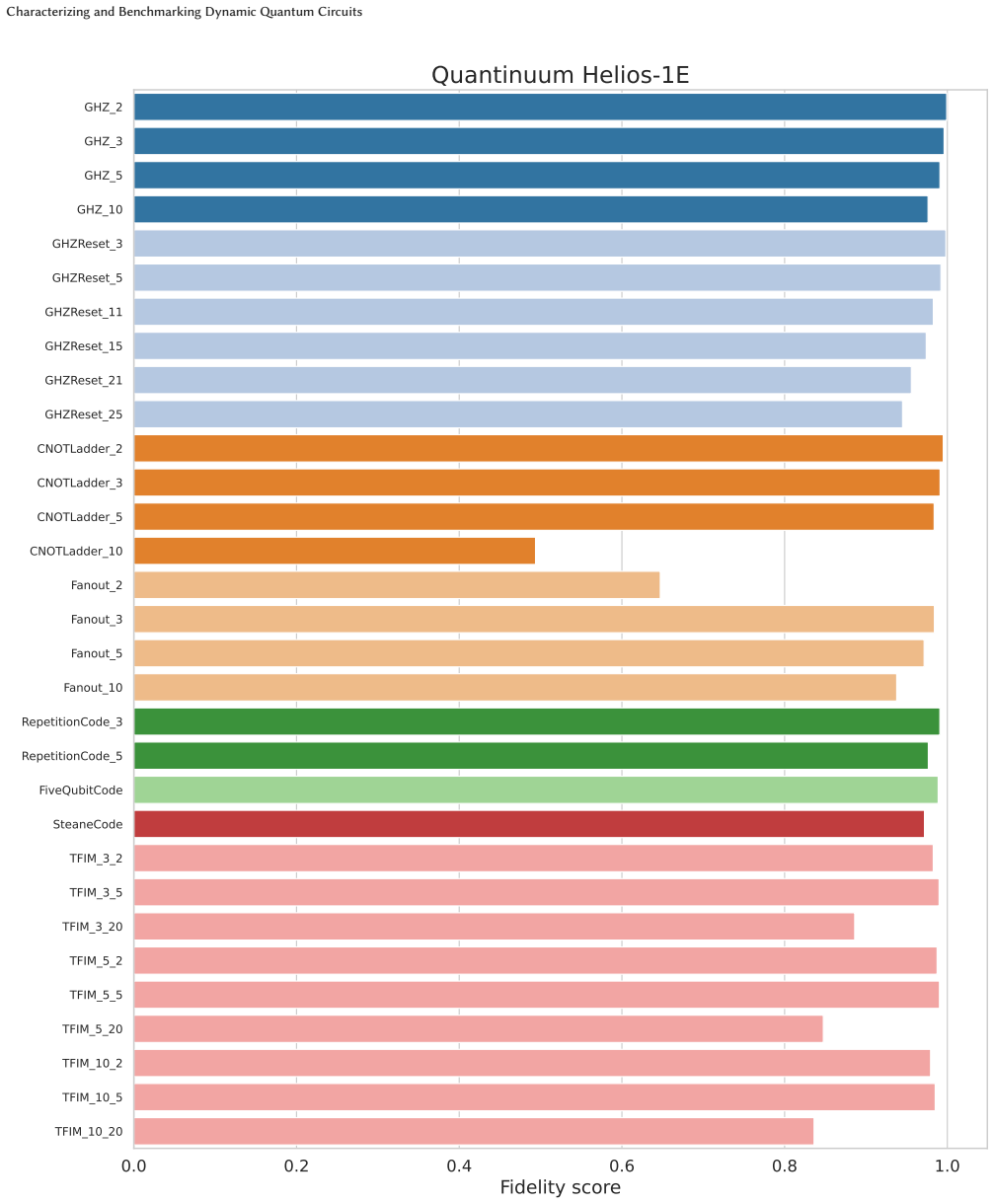
We propose dynamarq, a scalable and hardware-agnostic benchmarking framework for dynamic circuits. We collect a set of dynamic circuit benchmarks spanning various applications and propose a broad set of circuit features to characterize the structure of these dynamic circuits. We run them on two IBM quantum processors and the Quantinuum Helios-1E emulator, and propose scalable, application-dependent fidelity scores for each benchmark based on hardware execution results. We perform statistical modeling to identify correlations between circuit features and fidelity scores, and demonstrate highly accurate fidelity prediction using our model. Our model parameters are also transferable across hard
What carries the argument
The dynamarq framework, which uses a defined set of circuit features to characterize dynamic circuit structure and applies statistical modeling to predict fidelity scores from those features.
If this is right
- Circuit designers can adjust structural features identified as fidelity correlates to improve execution success rates.
- Fidelity predictions allow selection or ranking of candidate dynamic circuits before committing to hardware runs.
- The same models support performance comparisons across different quantum hardware platforms and over time as calibrations change.
- Insights from the feature-fidelity correlations guide the design of feed-forward loops in applications such as quantum error correction.
Where Pith is reading between the lines
- The feature set could be expanded to include interaction terms between measurements and feed-forward operations for larger circuits.
- The predictive approach might apply to other non-unitary elements in quantum computing beyond mid-circuit measurements.
- Transferable models suggest a path toward hardware-independent metrics for evaluating dynamic circuit proposals.
Load-bearing premise
The chosen set of circuit features and the resulting statistical model capture the dominant factors determining fidelity across diverse dynamic circuit applications and remain predictive when transferred to new hardware and calibration states without significant overfitting.
What would settle it
Execute a new collection of dynamic circuits on an independent quantum processor not used in the original experiments and compare the measured fidelities against the model's predictions to test whether accuracy and transferability hold.
Figures




read the original abstract
Dynamic quantum circuits with mid-circuit measurements (MCMs) and feed-forward operations play a crucial role in various applications, such as quantum error correction and quantum algorithms. With advancements in quantum hardware enabling the implementation of MCM and feed-forward loops, the use of dynamic circuits has become increasingly prevalent. There is a significant need for a benchmarking framework specially designed for dynamic circuits to capture their unique properties, as current benchmarking tools are designed primarily for unitary circuits and cannot be trivially extended to dynamic circuits. We propose dynamarq, a scalable and hardware-agnostic benchmarking framework for dynamic circuits. We collect a set of dynamic circuit benchmarks spanning various applications and propose a broad set of circuit features to characterize the structure of these dynamic circuits. We run them on two IBM quantum processors and the Quantinuum Helios-1E emulator, and propose scalable, application-dependent fidelity scores for each benchmark based on hardware execution results. We perform statistical modeling to identify correlations between circuit features and fidelity scores, and demonstrate highly accurate fidelity prediction using our model. Our model parameters are also transferable across hardware backends and calibration cycles. Our framework facilitates the understanding of dynamic circuit structures and provides insights for designing and optimizing dynamic circuits to achieve high execution fidelity on quantum hardware.
Editorial analysis
A structured set of objections, weighed in public.
Referee Report
Summary. The paper introduces dynamarq, a scalable and hardware-agnostic benchmarking framework for dynamic quantum circuits with mid-circuit measurements (MCMs) and feed-forward operations. It collects a set of benchmark circuits spanning applications, proposes a broad set of circuit features to characterize their structure, executes them on two IBM quantum processors and the Quantinuum Helios-1E emulator, defines scalable application-dependent fidelity scores from hardware results, performs statistical modeling to identify correlations between features and fidelities, and claims to demonstrate highly accurate fidelity predictions with model parameters transferable across backends and calibration cycles.
Significance. If the statistical model provides accurate and transferable fidelity predictions, the work would be significant for quantum computing by filling a gap in benchmarking tools for dynamic circuits, which are critical for quantum error correction and algorithms. It could enable better understanding of circuit structures and guide optimization for higher execution fidelity on current hardware.
major comments (2)
- [Statistical modeling and transferability demonstration] The transferability claim (model parameters transferable across IBM and Quantinuum backends and calibration cycles) is load-bearing for the central contribution. However, the chosen circuit features (depth, MCM count, etc.) omit hardware-specific noise parameters such as mid-circuit measurement error rates and classical feed-forward latency, which differ markedly between superconducting and trapped-ion platforms and drift with calibration. This risks the fitted coefficients absorbing backend-specific effects, leading to overfitting rather than genuine generalization.
- [Fidelity scores and statistical modeling] The abstract and modeling sections claim 'highly accurate fidelity prediction' and 'scalable, application-dependent fidelity scores' but provide no details on the exact model form (e.g., regression type or coefficients), cross-validation procedures, data exclusion rules, error bar calculations, or how fidelity scores are computed from raw hardware results. These omissions directly affect confidence in the prediction accuracy and transferability results.
minor comments (1)
- Explicitly list and mathematically define all proposed circuit features in the main text, including how conditional operations and feed-forward are accounted for in feature extraction.
Simulated Author's Rebuttal
We thank the referee for their constructive and detailed feedback, which has helped us improve the clarity and rigor of our manuscript. We address each major comment point by point below, providing the strongest honest defense of our work while making revisions where the comments identify genuine gaps in detail or scope.
read point-by-point responses
-
Referee: [Statistical modeling and transferability demonstration] The transferability claim (model parameters transferable across IBM and Quantinuum backends and calibration cycles) is load-bearing for the central contribution. However, the chosen circuit features (depth, MCM count, etc.) omit hardware-specific noise parameters such as mid-circuit measurement error rates and classical feed-forward latency, which differ markedly between superconducting and trapped-ion platforms and drift with calibration. This risks the fitted coefficients absorbing backend-specific effects, leading to overfitting rather than genuine generalization.
Authors: We thank the referee for this important observation on the transferability claim. Our framework is explicitly designed to be hardware-agnostic, so the feature set prioritizes structural properties of dynamic circuits (depth, MCM count, feed-forward depth, etc.) rather than platform-specific noise metrics. This choice enables the benchmarking framework to provide design insights that apply across backends without requiring per-device recalibration of noise parameters. We empirically demonstrate transferability by training on IBM data and evaluating on Quantinuum Helios-1E, as well as across separate IBM calibration cycles, with prediction errors remaining low. We acknowledge that omitting hardware-specific parameters such as MCM error rates and feed-forward latency introduces a risk that coefficients partially capture backend effects. To address this, we have added a dedicated limitations subsection in the revised manuscript that discusses this scope, reports the observed transferability metrics with error bars, and outlines how future extensions could incorporate hardware noise parameters while preserving the structural focus. This revision clarifies that our claims are empirical within the tested platforms rather than claiming universal generalization. revision: partial
-
Referee: [Fidelity scores and statistical modeling] The abstract and modeling sections claim 'highly accurate fidelity prediction' and 'scalable, application-dependent fidelity scores' but provide no details on the exact model form (e.g., regression type or coefficients), cross-validation procedures, data exclusion rules, error bar calculations, or how fidelity scores are computed from raw hardware results. These omissions directly affect confidence in the prediction accuracy and transferability results.
Authors: We agree that the original manuscript insufficiently detailed the statistical procedures, which is essential for reproducibility and for readers to evaluate the strength of the prediction and transferability results. In the revised manuscript we have expanded the Methods and supplementary sections to specify: the model is a multiple linear regression with selected interaction terms fitted via ordinary least squares; the full set of fitted coefficients and standard errors are now reported in a new table; 5-fold cross-validation (with circuit-level stratification) was used to compute prediction accuracy and R^{2} values; data exclusion rules removed runs with shot counts below 1024 or those flagged by backend calibration logs; error bars on fidelity scores and predictions are obtained via 1000 bootstrap resamples; and fidelity scores are computed as the average per-shot success probability normalized to the ideal circuit output, aggregated over the benchmark repetitions. These additions directly respond to the referee's request and should allow independent assessment of the reported accuracy. revision: yes
Circularity Check
Empirical statistical modeling of dynamic circuit fidelity shows no circularity
full rationale
The paper collects dynamic circuit benchmarks, executes them on IBM and Quantinuum hardware to obtain fidelity scores directly from results, extracts circuit features, fits a statistical model to identify correlations, and reports prediction accuracy plus transferability across backends. This is a standard data-driven empirical pipeline with no equations or steps that reduce by construction to their own inputs. No self-definitional relations, fitted inputs renamed as independent predictions, load-bearing self-citations, or ansatz smuggling appear in the provided text. The central claims rest on external hardware measurements and cross-backend testing rather than tautological re-derivation.
Axiom & Free-Parameter Ledger
free parameters (1)
- statistical model coefficients
axioms (1)
- domain assumption A finite set of structural circuit features is sufficient to capture the dominant influences on execution fidelity for dynamic circuits.
Lean theorems connected to this paper
-
IndisputableMonolith/Foundation/RealityFromDistinction.leanreality_from_one_distinction unclearWe perform statistical modeling to identify correlations between circuit features and fidelity scores, and demonstrate highly accurate fidelity prediction using our model. Our model parameters are also transferable across hardware backends and calibration cycles.
-
IndisputableMonolith/Cost/FunctionalEquation.leanwashburn_uniqueness_aczel unclearWe introduce a broad set of circuit features tailored to dynamic circuits, particularly focusing on the impact of MCM, feed-forward classical control, and the dynamic structure of circuits that depends on the MCM outcomes.
Forward citations
Cited by 4 Pith papers
-
Estimating The Energy Consumption of Quantum Computing from A Full System Aspect
A full-system energy model for quantum computing finds NISQ energy dominated by error mitigation sampling overhead while FTQC energy is driven by physical qubit requirements from code distance and magic states.
-
Estimating The Energy Consumption of Quantum Computing from A Full System Aspect
A full-system energy model shows NISQ quantum simulations dominated by error mitigation sampling overhead while FTQC costs are driven by physical qubit overhead from code distance and magic states.
-
Error Mitigation in Dynamic Circuits for Hamiltonian Simulation
Combining dynamical decoupling and zero-noise extrapolation mitigates errors in dynamic circuits for Hamiltonian simulation, improving ground-state fidelity by at least 60% and cutting time-evolution errors by up to 9...
-
A Conceptual Technology-Dependent Framework of Ternary Quantum Gates
A technology-dependent conceptual design for ternary quantum gates including Chrestenson, Z3 variants, controlled gates, a non-phase SWAP, and a GF(3)-based Toffoli for qutrit systems.
Reference graph
Works this paper leans on
-
[1]
Kevin C Smith, Eleanor Crane, Nathan Wiebe, and SM Girvin. Deterministic constant-depth preparation of the aklt state on a quantum processor using fusion measurements.PRX Quantum, 4(2):020315, 2023
work page 2023
-
[2]
Kevin C Smith, Abid Khan, Bryan K Clark, Steven M Girvin, and Tzu-Chieh Wei. Constant-depth preparation of matrix product states with adaptive quantum circuits.PRX Quantum, 5(3):030344, 2024
work page 2024
-
[3]
Elisa Bäumer and Stefan Woerner. Measurement-based long-range entangling gates in constant depth.Physical Review Research, 7(2):023120, 2025
work page 2025
-
[4]
Efficient long-range entanglement using dynamic circuits.PRX Quantum, 5(3):030339, 2024
Elisa Bäumer, Vinay Tripathi, Derek S Wang, Patrick Rall, Edward H Chen, Swarnadeep Majumder, Alireza Seif, and Zlatko K Minev. Efficient long-range entanglement using dynamic circuits.PRX Quantum, 5(3):030339, 2024
work page 2024
-
[5]
Digital quantum simulations of scattering in quantum field theories using w states
Roland C Farrell, Nikita A Zemlevskiy, Marc Illa, and John Preskill. Digital quantum simulations of scattering in quantum field theories using w states. arXiv preprint arXiv:2505.03111, 2025
-
[6]
Wei Zi, Junhong Nie, and Xiaoming Sun. Constant-depth quantum circuits for arbitrary quantum state preparation via measurement and feedback.arXiv preprint arXiv:2503.16208, 2025
-
[7]
Faisal Alam and Bryan K Clark. Learning dynamic quantum circuits for efficient state preparation.arXiv preprint arXiv:2410.09030, 2024
-
[8]
State preparation by shallow circuits using feed forward.Quantum, 8:1552, 2024
Harry Buhrman, Marten Folkertsma, Bruno Loff, and Niels MP Neumann. State preparation by shallow circuits using feed forward.Quantum, 8:1552, 2024
work page 2024
-
[9]
Ac/dc: Automated compilation for dynamic circuits, 2024
Siyuan Niu, Efekan Kokcu, Anupam Mitra, Aaron Szasz, Akel Hashim, Justin Kalloor, Wibe Albert de Jong, Costin Iancu, and Ed Younis. Ac/dc: Automated compilation for dynamic circuits, 2024
work page 2024
-
[10]
Quantum fourier transform using dynamic circuits.Physical review letters, 133(15):150602, 2024
Elisa Bäumer, Vinay Tripathi, Alireza Seif, Daniel Lidar, and Derek S Wang. Quantum fourier transform using dynamic circuits.Physical review letters, 133(15):150602, 2024
work page 2024
-
[11]
Elisa Bäumer, David Sutter, and Stefan Woerner. Approximate quantum fourier transform in logarithmic depth on a line.arXiv preprint arXiv:2504.20832, 2025
-
[12]
Effective quantum resource optimization via circuit resizing in bqskit
Siyuan Niu, Akel Hashim, Costin Iancu, Wibe Albert De Jong, and Ed Younis. Effective quantum resource optimization via circuit resizing in bqskit. InPro- ceedings of the 61st ACM/IEEE Design Automation Conference, pages 1–6, 2024
work page 2024
-
[13]
Caqr: A compiler-assisted approach for qubit reuse through dynamic circuit
Fei Hua, Yuwei Jin, Yanhao Chen, Suhas Vittal, Kevin Krsulich, Lev S Bishop, John Lapeyre, Ali Javadi-Abhari, and Eddy Z Zhang. Caqr: A compiler-assisted approach for qubit reuse through dynamic circuit. InProceedings of the 28th ACM International Conference on Architectural Support for Programming Languages and Operating Systems, Volume 3, pages 59–71, 2023
work page 2023
-
[14]
Matthew DeCross, Eli Chertkov, Megan Kohagen, and Michael Foss-Feig. Qubit- reuse compilation with mid-circuit measurement and reset.Physical Review X, 13(4):041057, 2023
work page 2023
-
[15]
Dynamic quantum circuit compilation.IEEE Transactions on Computers, 75(2):748–759, 2025
Kun Fang, Munan Zhang, Ruqi Shi, and Yinan Li. Dynamic quantum circuit compilation.IEEE Transactions on Computers, 75(2):748–759, 2025
work page 2025
-
[16]
Chenfeng Cao and Jens Eisert. Measurement-driven quantum advantages in shallow circuits.Physical Review Letters, 136(8):080601, 2026
work page 2026
-
[17]
Mid-circuit measurement as an algorithmic primitive.arXiv preprint arXiv:2506.00118, 2025
Antoine Lemelin, Christophe Pere, Olivier Landon-Cardinal, and Camille Coti. Mid-circuit measurement as an algorithmic primitive.arXiv preprint arXiv:2506.00118, 2025
-
[18]
2023.arXiv e-prints:arXiv:2302.03029
Michael Foss-Feig, Arkin Tikku, Tsung-Cheng Lu, Karl Mayer, Mohsin Iqbal, Thomas M Gatterman, Justin A Gerber, Kevin Gilmore, Dan Gresh, Aaron Hankin, et al. Experimental demonstration of the advantage of adaptive quantum circuits. arXiv preprint arXiv:2302.03029, 2023
-
[19]
Abhinav Deshpande, Marcel Hinsche, Khadijeh Najafi, Kunal Sharma, Ryan Sweke, and Christa Zoufal. Dynamic parameterized quantum circuits: expressive and barren-plateau free.arXiv preprint arXiv:2411.05760, 2024
-
[20]
Elias Zapusek, Ivan Rojkov, and Florentin Reiter. Scaling quantum algorithms via dissipation: Avoiding barren plateaus.arXiv preprint arXiv:2507.02043, 2025
-
[21]
Jin Ming Koh, Shi-Ning Sun, Mario Motta, and Austin J Minnich. Measurement- induced entanglement phase transition on a superconducting quantum processor with mid-circuit readout.Nature Physics, 19(9):1314–1319, 2023
work page 2023
-
[22]
Yilun Xu, Gang Huang, Neelay Fruitwala, Abhi Rajagopala, Ravi K Naik, Kasra Nowrouzi, David I Santiago, and Irfan Siddiqi. Qubic 2.0: An extensible open- source qubit control system capable of mid-circuit measurement and feed- forward.arXiv preprint arXiv:2309.10333, 2023
-
[23]
Demonstration of the trapped-ion quantum ccd computer architecture
Juan M Pino, Jennifer M Dreiling, Caroline Figgatt, John P Gaebler, Steven A Moses, MS Allman, CH Baldwin, Michael Foss-Feig, David Hayes, Karl Mayer, et al. Demonstration of the trapped-ion quantum ccd computer architecture. Nature, 592(7853):209–213, 2021
work page 2021
-
[24]
Joanna W Lis, Aruku Senoo, William F McGrew, Felix Rönchen, Alec Jenkins, and Adam M Kaufman. Midcircuit operations using the omg architecture in neutral atom arrays.Physical Review X, 13(4):041035, 2023
work page 2023
-
[25]
Neer Patel, Anish Giri, Hrushikesh Pramod Patil, Noah Siekierski, Avimita Chatterjee, Sonika Johri, Timothy Proctor, Thomas Lubinski, and Siyuan Niu. Platform-agnostic modular architecture for quantum benchmarking.arXiv preprint arXiv:2510.08469, 2025
-
[26]
Thomas Lubinski, Sonika Johri, Paul Varosy, Jeremiah Coleman, Luning Zhao, Jason Necaise, Charles H Baldwin, Karl Mayer, and Timothy Proctor. Application- oriented performance benchmarks for quantum computing.IEEE Transactions on Quantum Engineering, 4:1–32, 2023
work page 2023
-
[27]
Smith, Joshua Viszlai, Xin-Chuan Wu, Nikos Hardavellas, Margaret R
Teague Tomesh, Pranav Gokhale, Victory Omole, Gokul Subramanian Ravi, Kaitlin N. Smith, Joshua Viszlai, Xin-Chuan Wu, Nikos Hardavellas, Margaret R. Martonosi, and Frederic T. Chong. SupermarQ: A Scalable Quantum Benchmark Suite. In28th IEEE International Symposium on High-Performance Computer Architecture, 2 2022
work page 2022
-
[28]
Ang Li, Samuel Stein, Sriram Krishnamoorthy, and James Ang. Qasmbench: A low-level quantum benchmark suite for nisq evaluation and simulation.ACM Transactions on Quantum Computing, 4(2):1–26, 2023
work page 2023
-
[29]
Nils Quetschlich, Lukas Burgholzer, and Robert Wille. Mqt bench: Benchmarking software and design automation tools for quantum computing.Quantum, 7:1062, 2023
work page 2023
-
[30]
Alessandro Cosentino, Changhao Li, Vincent Russo, Bradley A Chase, Tom Lubinski, Siyuan Niu, Neer Patel, Nathan Shammah, and William J Zeng. Metriq: A collaborative platform for benchmarking quantum computers.arXiv preprint arXiv:2603.08680, 2026
-
[31]
JA Montanez-Barrera, Kristel Michielsen, and David E Bernal Neira. Evaluating the performance of quantum processing units at large width and depth.arXiv preprint arXiv:2502.06471, 2025
-
[32]
Alexandre M Souza, Gonzalo A Alvarez, and Dieter Suter. Robust dynamical decoupling for quantum computing and quantum memory.Physical review letters, 106(24):240501, 2011
work page 2011
-
[33]
Siyuan Niu and Aida Todri-Sanial. Effects of dynamical decoupling and pulse- level optimizations on ibm quantum computers.IEEE Transactions on Quantum Engineering, 3:1–10, 2022
work page 2022
-
[34]
Daniel A Lidar. Review of decoherence-free subspaces, noiseless subsystems, and dynamical decoupling.Quantum information and computation for chemistry, pages 295–354, 2014
work page 2014
-
[35]
https://github.com/sumeetshirgure/dynamarq, 2026
dynamarq. https://github.com/sumeetshirgure/dynamarq, 2026
work page 2026
-
[36]
Ali Javadi-Abhari, Matthew Treinish, Kevin Krsulich, Christopher J Wood, Jake Lishman, Julien Gacon, Simon Martiel, Paul D Nation, Lev S Bishop, Andrew W Cross, et al. Quantum computing with qiskit.arXiv preprint arXiv:2405.08810, 2024
work page internal anchor Pith review Pith/arXiv arXiv 2024
-
[37]
Guppy: pythonic quantum-classical programming.arXiv preprint arXiv:2510.12582, 2025
Mark Koch, Alan Lawrence, Kartik Singhal, Seyon Sivarajah, and Ross Dun- can. Guppy: pythonic quantum-classical programming.arXiv preprint arXiv:2510.12582, 2025. 12 Characterizing and Benchmarking Dynamic Quantum Circuits
-
[38]
Akel Hashim, Ming Yuan, Pranav Gokhale, Larry Chen, Christian Jünger, Neelay Fruitwala, Yilun Xu, Gang Huang, Kasra Nowrouzi, Liang Jiang, et al. Efficient generation of multi-partite entanglement between non-local superconducting qubits using classical feedback.APL Quantum, 2(4), 2025
work page 2025
-
[39]
J. M. Chow, J. M. Gambetta, L. Tornberg, Jens Koch, Lev S. Bishop, A. A. Houck, B. R. Johnson, L. Frunzio, S. M. Girvin, and R. J. Schoelkopf. Randomized bench- marking and process tomography for gate errors in a solid-state qubit.Phys. Rev. Lett., 102:090502, Mar 2009
work page 2009
-
[40]
Alexander Erhard, Joel J Wallman, Lukas Postler, Michael Meth, Roman Stricker, Esteban A Martinez, Philipp Schindler, Thomas Monz, Joseph Emerson, and Rainer Blatt. Characterizing large-scale quantum computers via cycle bench- marking.Nature communications, 10(1):5347, 2019
work page 2019
-
[41]
Charac- terizing quantum supremacy in near-term devices.Nature Physics, 14(6):595–600, 2018
Sergio Boixo, Sergei V Isakov, Vadim N Smelyanskiy, Ryan Babbush, Nan Ding, Zhang Jiang, Michael J Bremner, John M Martinis, and Hartmut Neven. Charac- terizing quantum supremacy in near-term devices.Nature Physics, 14(6):595–600, 2018
work page 2018
-
[42]
Andrew W. Cross, Lev S. Bishop, Sarah Sheldon, Paul D. Nation, and Jay M. Gambetta. Validating quantum computers using randomized model circuits. Phys. Rev. A, 100:032328, Sep 2019
work page 2019
-
[43]
Andrew Wack, Hanhee Paik, Ali Javadi-Abhari, Petar Jurcevic, Ismael Faro, Jay M. Gambetta, and Blake R. Johnson. Quality, speed, and scale: three key attributes to measure the performance of near-term quantum computers, 2021
work page 2021
-
[44]
Jernej Rudi Finžgar, Philipp Ross, Leonhard Hölscher, Johannes Klepsch, and Andre Luckow. Quark: A framework for quantum computing application bench- marking.arXiv preprint arXiv:2202.03028, 2022
-
[45]
Bacq-application-oriented benchmarks for quan- tum computing
Frédéric Barbaresco, Félicien Schopfer, Emmanuelle Vergnaud, Laurent Rioux, Christophe Labreuche, Michel Nowak, Noé Olivier, Damien Nicolazic, Olivier Hess, Anne-Lise Guilmin, et al. Bacq-application-oriented benchmarks for quan- tum computing. InInternational Conference on Quantum Engineering Sciences and Technologies for Industry and Services, pages 217...
work page 2025
-
[46]
Probing quantum processor performance with pyGSTi
Erik Nielsen, Kenneth Rudinger, Timothy Proctor, Antonio Russo, Kevin Young, and Robin Blume-Kohout. Probing quantum processor performance with pyGSTi. Quantum Sci. Technol., 5(4):044002, July 2020
work page 2020
-
[47]
Paul D Nation, Abdullah Ash Saki, Sebastian Brandhofer, Luciano Bello, Shelly Garion, Matthew Treinish, and Ali Javadi-Abhari. Benchmarking the perfor- mance of quantum computing software for quantum circuit creation, manipula- tion and compilation.Nature Computational Science, pages 1–9, 2025
work page 2025
-
[48]
Nils Quetschlich, Lukas Burgholzer, and Robert Wille. MQT Bench: Benchmark- ing Software and Design Automation Tools for Quantum Computing.Quantum, 7:1062, 2023. MQT Bench is available at https://mqt-bench.app/
work page 2023
-
[49]
Avi Vadali, Rutuja Kshirsagar, Prasanth Shyamsundar, and Gabriel N Perdue. Quantum circuit fidelity estimation using machine learning.Quantum Machine Intelligence, 6(1):1, 2024
work page 2024
-
[50]
Yikai Mao, Shaswot Shresthamali, and Masaaki Kondo. Q-fid: Quantum circuit fidelity improvement with lstm networks.Advanced Quantum Technologies, 8(10):2500022, 2025
work page 2025
-
[51]
Machine learning for quantum hardware performance assessment
Vedika Saravanan and Samah Mohamed Saeed. Machine learning for quantum hardware performance assessment. In2022 IEEE 40th International Conference on Computer Design (ICCD), pages 1–7. IEEE, 2022
work page 2022
-
[52]
L C G Govia, P Jurcevic, C J Wood, N Kanazawa, S T Merkel, and D C McKay. A randomized benchmarking suite for mid-circuit measurements.New Journal of Physics, 25(12):123016, dec 2023
work page 2023
-
[53]
Liran Shirizly, Luke C. G. Govia, and David C. McKay. Randomized benchmarking protocol for dynamic circuits.Phys. Rev. A, 111:012611, Jan 2025
work page 2025
-
[54]
Measuring error rates of mid-circuit measurements.Nature Communications, 16(1):5761, 2025
Daniel Hothem, Jordan Hines, Charles Baldwin, Dan Gresh, Robin Blume-Kohout, and Timothy Proctor. Measuring error rates of mid-circuit measurements.Nature Communications, 16(1):5761, 2025
work page 2025
- [55]
-
[56]
Direct fidelity estimation from few pauli measurements.Physical review letters, 106(23):230501, 2011
Steven T Flammia and Yi-Kai Liu. Direct fidelity estimation from few pauli measurements.Physical review letters, 106(23):230501, 2011
work page 2011
-
[57]
Improved simulation of stabilizer circuits
Scott Aaronson and Daniel Gottesman. Improved simulation of stabilizer circuits. Physical Review A—Atomic, Molecular, and Optical Physics, 70(5):052328, 2004
work page 2004
-
[58]
Quantum fan-out is powerful.Theory of com- puting, 1(1):81–103, 2005
Peter Høyer and Robert Špalek. Quantum fan-out is powerful.Theory of com- puting, 1(1):81–103, 2005
work page 2005
-
[59]
A Quantum Approximate Optimization Algorithm
Edward Farhi, Jeffrey Goldstone, and Sam Gutmann. A quantum approximate optimization algorithm.arXiv preprint arXiv:1411.4028, 2014
work page internal anchor Pith review Pith/arXiv arXiv 2014
-
[60]
Alberto Peruzzo, Jarrod McClean, Peter Shadbolt, Man-Hong Yung, Xiao-Qi Zhou, Peter J Love, Alán Aspuru-Guzik, and Jeremy L O’brien. A variational eigenvalue solver on a photonic quantum processor.Nature communications, 5(1):4213, 2014
work page 2014
-
[61]
Peter W Shor. Polynomial-time algorithms for prime factorization and discrete logarithms on a quantum computer.SIAM review, 41(2):303–332, 1999
work page 1999
-
[62]
Quantum measurements and the Abelian Stabilizer Problem
A Yu Kitaev. Quantum measurements and the abelian stabilizer problem.arXiv preprint quant-ph/9511026, 1995
work page internal anchor Pith review Pith/arXiv arXiv 1995
-
[63]
Application- Oriented Performance Benchmarks for Quantum Computing, October 2021
Thomas Lubinski, Sonika Johri, Paul Varosy, Jeremiah Coleman, Luning Zhao, Jason Necaise, Charles Baldwin, Karl Mayer, and Timothy Proctor. Application- Oriented Performance Benchmarks for Quantum Computing, October 2021
work page 2021
-
[64]
Iterative phase estimation.Journal of Physics A: Mathematical and Theoretical, 43(1):015301, 2010
Caleb J O’Loan. Iterative phase estimation.Journal of Physics A: Mathematical and Theoretical, 43(1):015301, 2010
work page 2010
-
[65]
M. Dobšíček, G. Johansson, V. Shumeiko, and G. Wendin. Arbitrary accuracy iterative quantum phase estimation algorithm using a single ancillary qubit. Phys. Rev. A, 76:030306, 2007
work page 2007
-
[66]
Efficient simulation of one-dimensional quantum many-body systems.Phys
Guifré Vidal. Efficient simulation of one-dimensional quantum many-body systems.Phys. Rev. Lett., 93:040502, Jul 2004
work page 2004
-
[67]
Qiskit: An Open-source Quantum Computing Software Package
Qiskit contributors. Qiskit: An Open-source Quantum Computing Software Package. qiskit.org, 2024. Version 0.46.0 (or pick your version number)
work page 2024
-
[68]
Quantum error correction.arXiv preprint arXiv:1910.03672, 2019
Todd A Brun. Quantum error correction.arXiv preprint arXiv:1910.03672, 2019
-
[69]
Quantum error correction: an introductory guide.Contemporary Physics, 60(3):226–245, 2019
Joschka Roffe. Quantum error correction: an introductory guide.Contemporary Physics, 60(3):226–245, 2019
work page 2019
-
[70]
Abanin, Laleh Aghababaie-Beni, Igor Aleiner, Trond I
Rajeev Acharya, Dmitry A. Abanin, Laleh Aghababaie-Beni, Igor Aleiner, Trond I. Andersen, Markus Ansmann, Frank Arute, Kunal Arya, Abraham Asfaw, Nikita Astrakhantsev, Juan Atalaya, Ryan Babbush, Dave Bacon, Brian Ballard, Joseph C. Bardin, Johannes Bausch, Andreas Bengtsson, Alexander Bilmes, Sam Black- well, Sergio Boixo, Gina Bortoli, Alexandre Bourass...
work page 2024
-
[71]
Helios: A 98-qubit trapped-ion quantum computer,
Anthony Ransford, MS Allman, Jake Arkinstall, JP Campora III, Samuel F Cooper, Robert D Delaney, Joan M Dreiling, Brian Estey, Caroline Figgatt, Alex Hall, et al. Helios: A 98-qubit trapped-ion quantum computer.arXiv preprint arXiv:2511.05465, 2025
-
[72]
Austin G Fowler, Matteo Mariantoni, John M Martinis, and Andrew N Cleland. Surface codes: Towards practical large-scale quantum computation.Physical Review A—Atomic, Molecular, and Optical Physics, 86(3):032324, 2012. 13 Sumeet Shirgure, Efekan Kökcü, Anupam Mitra, Wibe Albert de Jong, Costin Iancu, and Siyuan Niu
work page 2012
-
[73]
Jean-Pierre Tillich and Gilles Zémor. Quantum ldpc codes with positive rate and minimum distance proportional to the square root of the blocklength.IEEE Transactions on Information Theory, 60(2):1193–1202, 2013
work page 2013
-
[74]
Daniel Gottesman. An introduction to quantum error correction and fault- tolerant quantum computation.arXiv preprint arXiv:0904.2557, 2009
-
[75]
California Institute of Technology, 1997
Daniel Gottesman.Stabilizer codes and quantum error correction. California Institute of Technology, 1997
work page 1997
-
[76]
A. M. Steane. Error correcting codes in quantum theory.Phys. Rev. Lett., 77:793– 797, Jul 1996
work page 1996
-
[77]
Fault-tolerant execution of error-corrected quantum algorithms
Michael A Perlin, Zichang He, Anthony Alexiades Armenakas, Pablo Andres- Martinez, Tianyi Hao, Dylan Herman, Yuwei Jin, Karl Mayer, Chris Self, David Amaro, et al. Fault-tolerant execution of error-corrected quantum algorithms. arXiv preprint arXiv:2603.04584, 2026
-
[78]
Lorenza Viola and Seth Lloyd. Dynamical suppression of decoherence in two- state quantum systems.Physical Review A, 58(4):2733, 1998
work page 1998
-
[79]
Full-stack, real-system quantum computer studies: Architectural comparisons and design insights
Prakash Murali, Norbert Matthias Linke, Margaret Martonosi, Ali Javadi Abhari, Nhung Hong Nguyen, and Cinthia Huerta Alderete. Full-stack, real-system quantum computer studies: Architectural comparisons and design insights. In Proceedings of the 46th International Symposium on Computer Architecture, pages 527–540, 2019. A Hardware fidelity data In this se...
work page 2019
discussion (0)
Sign in with ORCID, Apple, or X to comment. Anyone can read and Pith papers without signing in.