Recognition: unknown
SemiGDA: Generative Dual-distribution Alignment for Semi-Supervised Medical Image Segmentation
Pith reviewed 2026-05-08 08:32 UTC · model grok-4.3
The pith
Aligning image and mask feature distributions improves semi-supervised medical image segmentation with few labels.
A machine-rendered reading of the paper's core claim, the machinery that carries it, and where it could break.
Core claim
SemiGDA improves semantic learning in low-label medical segmentation by aligning the distributions of image and mask features in latent space through the Dual-distribution Alignment Module, which uses two structurally distinct encoders and distributional constraints to create structured consistency, and by applying the Consistency-Driven Skip Adapter to fuse multi-scale features via dual skip connections and a consistency loss that reinforces cross-branch alignment.
What carries the argument
Dual-distribution Alignment Module (DAM) that models image and mask features with separate encoders and enforces their alignment in latent space via distributional constraints.
If this is right
- Stronger semantic representations emerge when image and mask distributions are forced into alignment rather than treated separately.
- Unlabeled data contributes more effectively once cross-branch consistency is enforced at multiple scales.
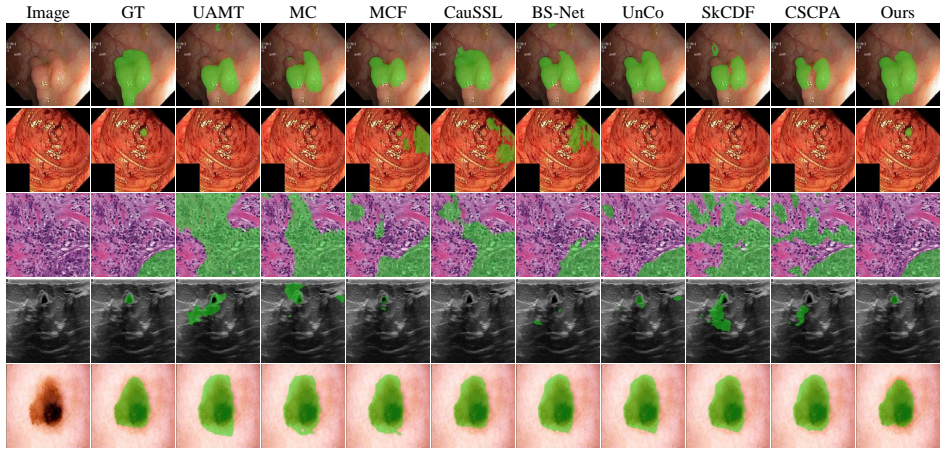
- Performance exceeds current state-of-the-art semi-supervised segmentation methods on varied medical datasets.
- Scene adaptability improves because the model learns structured feature consistency instead of relying solely on mask supervision.
Where Pith is reading between the lines
- The same dual-alignment pattern could be tested on non-medical images where dense labels remain costly.
- Clinical workflows might need fewer expert annotations if the consistency modules transfer to new imaging modalities.
- Pairing the alignment loss with other generative priors might further stabilize training when label counts drop below current tested levels.
- Measuring whether the learned distributions remain aligned on out-of-distribution scans would test the robustness claim directly.
Load-bearing premise
That enforcing alignment between image and mask feature distributions will reliably boost semantic learning and performance without creating new problems such as mode collapse or overfitting to the alignment goal.
What would settle it
Training and testing SemiGDA against standard semi-supervised baselines on a fresh low-label medical dataset and finding equal or lower segmentation accuracy would show the alignment does not deliver the claimed gains.
Figures


read the original abstract
Semi-supervised learning addresses label scarcity and high annotation costs in medical image segmentation by exploiting the latent information in unlabeled data to enhance model performance. Traditional discriminative segmentation relies on segmentation masks, neglecting feature-level distribution constraints. This limits robust semantic representation learning and adaptive modeling of unlabeled data in scenarios with few labels. To address these limitations, we propose SemiGDA, a novel Generative Dual-distribution Alignment framework for semi-supervised medical image segmentation. Our SemiGDA overcomes the reliance of discriminative methods on large labeled datasets by aligning feature and semantic distributions to boost semantic learning and scene adaptability. Specifically, we propose a Dual-distribution Alignment Module (DAM), which employs two structurally distinct encoders to model image and mask feature distributions. It enforces their alignment in the latent space via distributional constraints, establishing structured feature consistency. Moreover, we design a Consistency-Driven Skip Adapter (CDSA) strategy, which introduces dual skip adapters (Image and Mask) to fuse multi-scale features via skip connections. Using a consistency loss, CDSA enhances cross-branch semantic alignment and reinforces fine-grained semantic consistency. Experimental results on diverse medical datasets show that our method outperforms other state-of-the-art semi-supervised segmentation methods. Code is released at: https://github.com/taozh2017/SemiGDA.
Editorial analysis
A structured set of objections, weighed in public.
Referee Report
Summary. The manuscript proposes SemiGDA, a generative dual-distribution alignment framework for semi-supervised medical image segmentation. It introduces the Dual-distribution Alignment Module (DAM) using two distinct encoders to align image and mask feature distributions in latent space via distributional constraints, and the Consistency-Driven Skip Adapter (CDSA) with dual skip adapters and a consistency loss to fuse multi-scale features and reinforce semantic consistency. The central claim is that this overcomes limitations of purely discriminative methods and outperforms state-of-the-art semi-supervised segmentation approaches on diverse medical datasets.
Significance. If the claimed performance gains hold under rigorous validation, the work could advance semi-supervised medical image segmentation by incorporating generative alignment to improve feature learning in low-label regimes. The public code release is a positive factor for reproducibility.
major comments (3)
- [§3.2] §3.2: The DAM is described as enforcing alignment between image and mask feature distributions via distributional constraints, but no explicit loss formulation or derivation is provided showing how this alignment is independent of the main segmentation objective; without this, the claim that it boosts semantic learning cannot be evaluated for circularity or added failure modes.
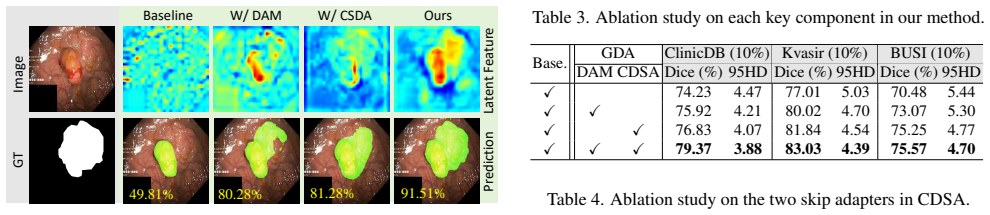
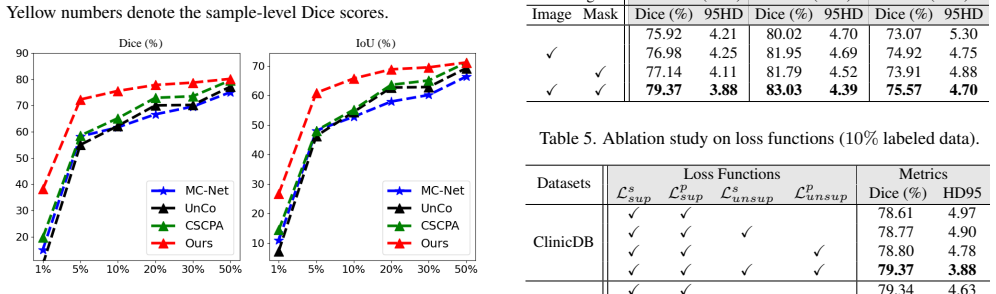
- [Table 3] Table 3 and §4.3: Ablation studies report Dice improvements from adding DAM and CDSA, but the baseline (supervised-only) performance and variance across multiple runs are not shown; this undermines the assertion that the modules reliably improve results without overfitting to the alignment objective.
- [§4.2] §4.2, Eq. (5): The consistency loss in CDSA is introduced to enhance cross-branch alignment, yet the weighting hyperparameter λ is not analyzed for sensitivity, and no comparison to standard consistency regularization baselines is given to isolate the contribution of the dual skip adapters.
minor comments (3)
- [Abstract] Abstract: The claim of outperformance on 'diverse medical datasets' should specify the exact datasets, label ratios (e.g., 5%, 10%), and metrics used, as these details are essential for interpreting the results.
- [Figure 4] Figure 4: The visualization of feature distributions before and after DAM alignment lacks quantitative metrics (e.g., MMD or Wasserstein distance) to support the qualitative improvement shown.
- [Related Work] Related Work section: Several recent semi-supervised segmentation papers using adversarial or contrastive alignment are cited but not directly compared in the experiments; a brief discussion of why they were not included as baselines would strengthen the positioning.
Simulated Author's Rebuttal
Thank you for the detailed review and valuable suggestions. We have carefully addressed each major comment and revised the manuscript to improve clarity and rigor.
read point-by-point responses
-
Referee: [§3.2] §3.2: The DAM is described as enforcing alignment between image and mask feature distributions via distributional constraints, but no explicit loss formulation or derivation is provided showing how this alignment is independent of the main segmentation objective; without this, the claim that it boosts semantic learning cannot be evaluated for circularity or added failure modes.
Authors: We thank the referee for pointing this out. Upon re-examination, we realize that while the DAM is presented as a separate module, the specific loss terms for distributional alignment were not explicitly formulated in §3.2. In the revised version, we have added the mathematical formulation of the alignment loss, which is independent of the segmentation loss, and provided a brief derivation showing it promotes structured feature consistency without introducing circularity. This addition clarifies that the alignment serves as an auxiliary objective to enhance semantic representation learning. revision: yes
-
Referee: Table 3 and §4.3: Ablation studies report Dice improvements from adding DAM and CDSA, but the baseline (supervised-only) performance and variance across multiple runs are not shown; this undermines the assertion that the modules reliably improve results without overfitting to the alignment objective.
Authors: We agree that reporting the supervised-only baseline and variance is important for validating the reliability of the improvements. In the revised manuscript, we have updated Table 3 to include the supervised baseline performance and have added standard deviations computed over multiple independent runs (e.g., 3 runs with different random seeds) for all ablation configurations. This demonstrates that the gains from DAM and CDSA are consistent and not attributable to overfitting. revision: yes
-
Referee: §4.2, Eq. (5): The consistency loss in CDSA is introduced to enhance cross-branch alignment, yet the weighting hyperparameter λ is not analyzed for sensitivity, and no comparison to standard consistency regularization baselines is given to isolate the contribution of the dual skip adapters.
Authors: We appreciate this suggestion for more thorough analysis. We have conducted a sensitivity analysis on the hyperparameter λ and included the results in the revised §4.2, showing that performance remains stable across a range of λ values. To isolate the contribution of the dual skip adapters, we have added a comparison experiment with a standard consistency regularization baseline (without the dual adapters) in the ablation studies. This helps highlight the specific benefits of our CDSA design. revision: yes
Circularity Check
No significant circularity detected
full rationale
The paper describes a novel architectural framework (SemiGDA with DAM and CDSA modules) for semi-supervised segmentation and validates it via experiments on medical datasets. No equations, derivations, or first-principles predictions are presented that reduce by construction to fitted inputs, self-defined quantities, or self-citation chains. The central claims rest on empirical outperformance rather than any load-bearing theoretical step that collapses to the method's own definitions or prior self-citations. This is a standard empirical method paper with independent experimental content.
Axiom & Free-Parameter Ledger
axioms (1)
- domain assumption Aligning feature distributions from images and masks improves semantic representation learning in low-label settings.
invented entities (2)
-
Dual-distribution Alignment Module (DAM)
no independent evidence
-
Consistency-Driven Skip Adapter (CDSA)
no independent evidence
Reference graph
Works this paper leans on
-
[1]
Dataset of breast ultrasound images.Data in brief, 28:104863, 2020
Walid Al-Dhabyani, Mohammed Gomaa, Hussien Khaled, and Aly Fahmy. Dataset of breast ultrasound images.Data in brief, 28:104863, 2020. 6
2020
-
[2]
Structured crowdsourcing enables convolutional segmentation of histology images.Bioinformatics, 35(18): 3461–3467, 2019
Mohamed Amgad, Habiba Elfandy, Hagar Hussein, Lamees A Atteya, Mai AT Elsebaie, Lamia S Abo Elnasr, Rokia A Sakr, Hazem SE Salem, Ahmed F Ismail, Anas M Saad, et al. Structured crowdsourcing enables convolutional segmentation of histology images.Bioinformatics, 35(18): 3461–3467, 2019. 6
2019
-
[3]
An exceedingly simple consistency regularization method for semi-supervised medical image segmentation
Hritam Basak, Rajarshi Bhattacharya, Rukhshanda Hussain, and Agniv Chatterjee. An exceedingly simple consistency regularization method for semi-supervised medical image segmentation. InInternational Symposium on Biomedical Imaging, pages 1–4. IEEE, 2022. 2
2022
-
[4]
WM-DOV A maps for accurate polyp highlighting in colonoscopy: Validation vs
Jorge Bernal, F Javier S ´anchez, Gloria Fern´andez-Esparrach, Debora Gil, Cristina Rodr ´ıguez, and Fernando Vilari ˜no. WM-DOV A maps for accurate polyp highlighting in colonoscopy: Validation vs. saliency maps from physicians. Computerized Medical Imaging and Graphics, 43:99–111,
-
[5]
Swin-unet: Unet-like pure transformer for medical image segmentation
Hu Cao, Yueyue Wang, Joy Chen, Dongsheng Jiang, Xi- aopeng Zhang, Qi Tian, and Manning Wang. Swin-unet: Unet-like pure transformer for medical image segmentation. InEuropean Conference on Computer Vision, pages 205–
-
[6]
Mtans: multi-scale mean teacher combined adversarial net- work with shape-aware embedding for semi-supervised brain lesion segmentation.NeuroImage, 244:118568, 2021
Gaoxiang Chen, Jintao Ru, Yilin Zhou, Islem Rekik, Zhifang Pan, Xiaoming Liu, Yezhi Lin, Beichen Lu, and Jialin Shi. Mtans: multi-scale mean teacher combined adversarial net- work with shape-aware embedding for semi-supervised brain lesion segmentation.NeuroImage, 244:118568, 2021. 2
2021
-
[7]
Genera- tive semantic segmentation
Jiaqi Chen, Jiachen Lu, Xiatian Zhu, and Li Zhang. Genera- tive semantic segmentation. InProceedings of the IEEE/CVF Conference on Computer Vision and Pattern Recognition, pages 7111–7120, 2023. 3
2023
-
[8]
Semi-supervised semantic segmentation with cross pseudo supervision
Xiaokang Chen, Yuhui Yuan, Gang Zeng, and Jingdong Wang. Semi-supervised semantic segmentation with cross pseudo supervision. InProceedings of the IEEE/CVF Con- ference on Computer Vision and Pattern Recognition, pages 2613–2622, 2021. 1
2021
-
[9]
Noel Codella, Veronica Rotemberg, Philipp Tschandl, M Emre Celebi, Stephen Dusza, David Gutman, et al. Skin lesion analysis toward melanoma detection 2018: A chal- lenge hosted by the international skin imaging collaboration (isic).arXiv preprint arXiv:1902.03368, 2019. 6
work page Pith review arXiv 2018
-
[10]
Deep learning based synthesis of mri, ct and pet: Review and anal- ysis.Medical image analysis, 92:103046, 2024
Sanuwani Dayarathna, Kh Tohidul Islam, Sergio Uribe, Guang Yang, Munawar Hayat, and Zhaolin Chen. Deep learning based synthesis of mri, ct and pet: Review and anal- ysis.Medical image analysis, 92:103046, 2024. 2
2024
-
[11]
Csc-pa: Cross-image semantic correlation via prototype attentions for single-network semi-supervised breast tumor segmentation
Zhenhui Ding, Guilian Chen, Qin Zhang, Huisi Wu, and Jing Qin. Csc-pa: Cross-image semantic correlation via prototype attentions for single-network semi-supervised breast tumor segmentation. InProceedings of the Computer Vision and Pattern Recognition Conference, pages 15632–15641, 2025. 6, 7
2025
-
[12]
Pranet: Parallel reverse attention network for polyp segmentation
Deng-Ping Fan, Ge-Peng Ji, Tao Zhou, Geng Chen, Huazhu Fu, Jianbing Shen, and Ling Shao. Pranet: Parallel reverse attention network for polyp segmentation. InInternational Conference on Medical Image Computing and Computer- Assisted Intervention, pages 263–273. Springer, 2020. 6
2020
-
[13]
PMT: Progressive mean teacher via exploring temporal con- sistency for semi-supervised medical image segmentation
Ning Gao, Sanping Zhou, Le Wang, and Nanning Zheng. PMT: Progressive mean teacher via exploring temporal con- sistency for semi-supervised medical image segmentation. European Conference on Computer Vision, 2024. 6, 7
2024
-
[14]
Correlation-aware mutual learning for semi- supervised medical image segmentation
Shengbo Gao, Ziji Zhang, Jiechao Ma, Zihao Li, and Shu Zhang. Correlation-aware mutual learning for semi- supervised medical image segmentation. InInternational Conference on Medical Image Computing and Computer- Assisted Intervention, pages 98–108. Springer, 2023. 2
2023
-
[15]
Generative adversarial nets.Advances in neural Information Processing Systems, 27, 2014
Ian J Goodfellow, Jean Pouget-Abadie, Mehdi Mirza, Bing Xu, David Warde-Farley, Sherjil Ozair, Aaron Courville, and Yoshua Bengio. Generative adversarial nets.Advances in neural Information Processing Systems, 27, 2014. 2
2014
-
[16]
Bilateral supervision network for semi-supervised medical image segmentation.IEEE Transactions on Medical Imag- ing, 43(5):1715–1726, 2024
Along He, Tao Li, Juncheng Yan, Kai Wang, and Huazhu Fu. Bilateral supervision network for semi-supervised medical image segmentation.IEEE Transactions on Medical Imag- ing, 43(5):1715–1726, 2024. 2, 6, 7
2024
-
[17]
Learnable prompt- ing sam-induced knowledge distillation for semi-supervised medical image segmentation.IEEE Transactions on Medical Imaging, 44(5):2295–2306, 2025
Kaiwen Huang, Tao Zhou, Huazhu Fu, Yizhe Zhang, Yi Zhou, Chen Gong, and Dong Liang. Learnable prompt- ing sam-induced knowledge distillation for semi-supervised medical image segmentation.IEEE Transactions on Medical Imaging, 44(5):2295–2306, 2025. 1
2025
-
[18]
Uncertainty-aware cross-training for semi-supervised medical image segmentation.IEEE Transactions on Image Processing, 34:5543–5556, 2025
Kaiwen Huang, Tao Zhou, Huazhu Fu, Yizhe Zhang, Yi Zhou, and Xiao-Jun Wu. Uncertainty-aware cross-training for semi-supervised medical image segmentation.IEEE Transactions on Image Processing, 34:5543–5556, 2025. 1
2025
-
[19]
Text-driven multiplanar visual inter- action for semi-supervised medical image segmentation
Kaiwen Huang, Yi Zhou, Huazhu Fu, Yizhe Zhang, Chen Gong, and Tao Zhou. Text-driven multiplanar visual inter- action for semi-supervised medical image segmentation. In International Conference on Medical Image Computing and Computer-Assisted Intervention, pages 604–613. Springer,
-
[20]
Generative medical segmentation
Jiayu Huo, Xi Ouyang, S ´ebastien Ourselin, and Rachel Sparks. Generative medical segmentation. InProceedings of the AAAI Conference on Artificial Intelligence, pages 3851– 3859, 2025. 3
2025
-
[21]
Kvasir-seg: A segmented polyp dataset
Debesh Jha, Pia H Smedsrud, Michael A Riegler, P ˚al Halvorsen, Thomas De Lange, Dag Johansen, and H˚avard D Johansen. Kvasir-seg: A segmented polyp dataset. InMMM, pages 451–462. Springer, 2020. 6
2020
-
[22]
PH-Net: Semi-supervised breast lesion segmentation via patch-wise hardness
Siyao Jiang, Huisi Wu, Junyang Chen, Qin Zhang, and Jing Qin. PH-Net: Semi-supervised breast lesion segmentation via patch-wise hardness. InProceedings of the IEEE/CVF Conference on Computer Vision and Pattern Recognition, pages 11418–11427, 2024. 2
2024
-
[23]
Learning with limited annotations: a survey on deep semi-supervised learning for medical image segmentation.Computers in Biology and Medicine, page 107840, 2023
Rushi Jiao, Yichi Zhang, Le Ding, Bingsen Xue, Jicong Zhang, Rong Cai, and Cheng Jin. Learning with limited annotations: a survey on deep semi-supervised learning for medical image segmentation.Computers in Biology and Medicine, page 107840, 2023. 1, 2
2023
-
[24]
Auto-Encoding Variational Bayes
Diederik P Kingma and Max Welling. Auto-encoding varia- tional bayes.arXiv preprint arXiv:1312.6114, 2013. 2
work page internal anchor Pith review arXiv 2013
-
[25]
Vclipseg: V oxel-wise clip-enhanced model for semi- supervised medical image segmentation
Lei Li, Sheng Lian, Zhiming Luo, Beizhan Wang, and Shaozi Li. Vclipseg: V oxel-wise clip-enhanced model for semi- supervised medical image segmentation. InInternational Conference on Medical Image Computing and Computer- Assisted Intervention, pages 692–701. Springer, 2024. 6, 7
2024
-
[26]
Segment anything model for semi- supervised medical image segmentation via selecting reliable pseudo-labels
Ning Li, Lianjin Xiong, Wei Qiu, Yudong Pan, Yiqian Luo, and Yangsong Zhang. Segment anything model for semi- supervised medical image segmentation via selecting reliable pseudo-labels. InInternational Conference on Neural Infor- mation Processing, pages 138–149. Springer, 2023. 2
2023
-
[27]
Gmmseg: Gaussian mixture based generative semantic seg- mentation models.Advances in Neural Information Process- ing Systems, 35:31360–31375, 2022
Chen Liang, Wenguan Wang, Jiaxu Miao, and Yi Yang. Gmmseg: Gaussian mixture based generative semantic seg- mentation models.Advances in Neural Information Process- ing Systems, 35:31360–31375, 2022. 3
2022
-
[28]
A convnet for the 2020s
Zhuang Liu, Hanzi Mao, Chao-Yuan Wu, Christoph Feicht- enhofer, Trevor Darrell, and Saining Xie. A convnet for the 2020s. InProceedings of the IEEE/CVF Conference on Com- puter Vision and Pattern Recognition, pages 11976–11986,
-
[29]
Semi-supervised medical image segmentation through dual- task consistency
Xiangde Luo, Jieneng Chen, Tao Song, and Guotai Wang. Semi-supervised medical image segmentation through dual- task consistency. InProceedings of the AAAI Conference on Artificial Intelligence, pages 8801–8809, 2021. 6, 7
2021
-
[30]
Semi-supervised medical im- age segmentation via uncertainty rectified pyramid consis- tency.Medical Image Analysis, 80:102517, 2022
Xiangde Luo, Guotai Wang, Wenjun Liao, Jieneng Chen, Tao Song, Yinan Chen, Shichuan Zhang, Dimitris N Metaxas, and Shaoting Zhang. Semi-supervised medical im- age segmentation via uncertainty rectified pyramid consis- tency.Medical Image Analysis, 80:102517, 2022. 6, 7
2022
-
[31]
A survey on deep learning for polyp segmentation: Techniques, challenges and future trends.Visual Intelligence, 3(1):1, 2025
Jiaxin Mei, Tao Zhou, Kaiwen Huang, Yizhe Zhang, Yi Zhou, Ye Wu, and Huazhu Fu. A survey on deep learning for polyp segmentation: Techniques, challenges and future trends.Visual Intelligence, 3(1):1, 2025. 1
2025
-
[32]
Caussl: Causality-inspired semi-supervised learning for medical image segmentation
Juzheng Miao, Cheng Chen, Furui Liu, Hao Wei, and Pheng- Ann Heng. Caussl: Causality-inspired semi-supervised learning for medical image segmentation. InProceedings of the IEEE/CVF International Conference on Computer Vi- sion, pages 21426–21437, 2023. 6, 7
2023
-
[33]
Duo-segnet: adversarial dual-views for semi- supervised medical image segmentation
Himashi Peiris, Zhaolin Chen, Gary Egan, and Mehrtash Harandi. Duo-segnet: adversarial dual-views for semi- supervised medical image segmentation. InInternational Conference on Medical Image Computing and Computer- Assisted Intervention, pages 428–438. Springer, 2021. 2
2021
-
[34]
High-resolution image synthesis with latent diffusion models
Robin Rombach, Andreas Blattmann, Dominik Lorenz, Patrick Esser, and Bj ¨orn Ommer. High-resolution image synthesis with latent diffusion models. InProceedings of the IEEE/CVF Conference on Computer Vision and Pattern Recognition, pages 10684–10695, 2022. 3, 4, 6
2022
-
[35]
U- net: Convolutional networks for biomedical image segmen- tation
Olaf Ronneberger, Philipp Fischer, and Thomas Brox. U- net: Convolutional networks for biomedical image segmen- tation. InInternational Conference on Medical Image Com- puting and Computer-Assisted Intervention, pages 234–241. Springer, 2015. 1
2015
-
[36]
Cross-mix monitoring for medical image segmentation with limited supervision.IEEE Transactions on Multimedia, 25:1700–1712, 2022
Yucheng Shu, Hengbo Li, Bin Xiao, Xiuli Bi, and Weisheng Li. Cross-mix monitoring for medical image segmentation with limited supervision.IEEE Transactions on Multimedia, 25:1700–1712, 2022. 2
2022
-
[37]
Mean teachers are better role models: Weight-averaged consistency targets improve semi-supervised deep learning results.Advances in neural information processing systems, 30, 2017
Antti Tarvainen and Harri Valpola. Mean teachers are better role models: Weight-averaged consistency targets improve semi-supervised deep learning results.Advances in neural information processing systems, 30, 2017. 2
2017
-
[38]
A benchmark for en- doluminal scene segmentation of colonoscopy images.Jour- nal of Healthcare Engineering, 2017(1):4037190, 2017
David V ´azquez, Jorge Bernal, F Javier S ´anchez, Gloria Fern´andez-Esparrach, Antonio M L ´opez, Adriana Romero, Michal Drozdzal, and Aaron Courville. A benchmark for en- doluminal scene segmentation of colonoscopy images.Jour- nal of Healthcare Engineering, 2017(1):4037190, 2017. 6
2017
-
[39]
Mcf: Mutual correction framework for semi- supervised medical image segmentation
Yongchao Wang, Bin Xiao, Xiuli Bi, Weisheng Li, and Xinbo Gao. Mcf: Mutual correction framework for semi- supervised medical image segmentation. InProceedings of the IEEE/CVF Conference on Computer Vision and Pattern Recognition, pages 15651–15660, 2023. 2, 6, 7
2023
-
[40]
Semi-supervised left atrium segmentation with mutual consistency training
Yicheng Wu, Minfeng Xu, Zongyuan Ge, Jianfei Cai, and Lei Zhang. Semi-supervised left atrium segmentation with mutual consistency training. InInternational Conference on Medical Image Computing and Computer-Assisted Interven- tion, pages 297–306. Springer, 2021. 6, 7
2021
-
[41]
Dual uncertainty- guided mixing consistency for semi-supervised 3d medical image segmentation.IEEE Transactions on Big Data, 9(4): 1156–1170, 2023
Chenchu Xu, Yuan Yang, Zhiqiang Xia, Boyan Wang, Dong Zhang, Yanping Zhang, and Shu Zhao. Dual uncertainty- guided mixing consistency for semi-supervised 3d medical image segmentation.IEEE Transactions on Big Data, 9(4): 1156–1170, 2023. 2
2023
-
[42]
Revisiting weak-to-strong consistency in semi-supervised semantic segmentation
Lihe Yang, Lei Qi, Litong Feng, Wayne Zhang, and Yinghuan Shi. Revisiting weak-to-strong consistency in semi-supervised semantic segmentation. InProceedings of the IEEE/CVF Conference on Computer Vision and Pattern Recognition, pages 7236–7246, 2023. 1, 2
2023
-
[43]
Enhancing pseudo label quality for semi-supervised domain-generalized medical image segmentation
Huifeng Yao, Xiaowei Hu, and Xiaomeng Li. Enhancing pseudo label quality for semi-supervised domain-generalized medical image segmentation. InProceedings of the AAAI Conference on Artificial Intelligence, pages 3099–3107,
-
[44]
Synthetic augmentation with large-scale uncon- ditional pre-training
Jiarong Ye, Haomiao Ni, Peng Jin, Sharon X Huang, and Yuan Xue. Synthetic augmentation with large-scale uncon- ditional pre-training. InInternational Conference on Med- ical Image Computing and Computer-Assisted Intervention, pages 754–764. Springer, 2023. 2
2023
-
[45]
Uncertainty-aware self-ensembling model for semi-supervised 3D left atrium segmentation
Lequan Yu, Shujun Wang, Xiaomeng Li, Chi-Wing Fu, and Pheng-Ann Heng. Uncertainty-aware self-ensembling model for semi-supervised 3D left atrium segmentation. InIn- ternational Conference on Medical Image Computing and Computer-Assisted Intervention, pages 605–613. Springer,
-
[46]
Ling-Li Zeng, Kai Gao, Dewen Hu, Zhichao Feng, Chen- ping Hou, Pengfei Rong, and Wei Wang. SS-TBN: A semi- supervised tri-branch network for covid-19 screening and le- sion segmentation.IEEE Transactions on Pattern Analysis and Machine Intelligence, 45(8):10427–10442, 2023. 1, 2
2023
-
[47]
Uncertainty co-estimator for improving semi- supervised medical image segmentation.IEEE Transactions on Medical Imaging, 44(9):3870–3881, 2025
Xiang Zeng, Shengwu Xiong, Jinming Xu, Guangxing Du, and Yi Rong. Uncertainty co-estimator for improving semi- supervised medical image segmentation.IEEE Transactions on Medical Imaging, 44(9):3870–3881, 2025. 6, 7
2025
-
[48]
Genera- tive ai enables medical image segmentation in ultra low-data regimes.Nature Communications, 16(1):6486, 2025
Li Zhang, Basu Jindal, Ahmed Alaa, Robert Weinreb, David Wilson, Eran Segal, James Zou, and Pengtao Xie. Genera- tive ai enables medical image segmentation in ultra low-data regimes.Nature Communications, 16(1):6486, 2025. 2, 3
2025
-
[49]
Discriminative error prediction network for semi-supervised colon gland segmentation.Medical Image Analysis, 79:102458, 2022
Zhenxi Zhang, Chunna Tian, Harrison X Bai, Zhicheng Jiao, and Xilan Tian. Discriminative error prediction network for semi-supervised colon gland segmentation.Medical Image Analysis, 79:102458, 2022. 2
2022
-
[50]
A semantic knowledge complementarity based decoupling framework for semi- supervised class-imbalanced medical image segmentation
Zheng Zhang, Guanchun Yin, et al. A semantic knowledge complementarity based decoupling framework for semi- supervised class-imbalanced medical image segmentation. InProceedings of the Computer Vision and Pattern Recog- nition Conference, pages 25940–25949, 2025. 6, 7
2025
-
[51]
Alternate diverse teaching for semi-supervised medical image segmentation
Zhen Zhao, Zicheng Wang, Longyue Wang, Dian Yu, Yix- uan Yuan, and Luping Zhou. Alternate diverse teaching for semi-supervised medical image segmentation. InEuropean Conference on Computer Vision, pages 227–243. Springer,
-
[52]
Semi-supervised pathological image segmentation via cross distillation of multiple attentions
Lanfeng Zhong, Xin Liao, Shaoting Zhang, and Guotai Wang. Semi-supervised pathological image segmentation via cross distillation of multiple attentions. InInternational Conference on Medical Image Computing and Computer- Assisted Intervention, pages 570–579. Springer, 2023. 6, 7
2023
discussion (0)
Sign in with ORCID, Apple, or X to comment. Anyone can read and Pith papers without signing in.