Recognition: unknown
Partial exploiters sustain cooperation: the hump-shaped strategy stably coexists with unconditional cooperators
Pith reviewed 2026-05-08 07:05 UTC · model grok-4.3
The pith
The hump-shaped strategy forms a stable equilibrium with unconditional cooperators that excludes defectors across many environments.
A machine-rendered reading of the paper's core claim, the machinery that carries it, and where it could break.
Core claim
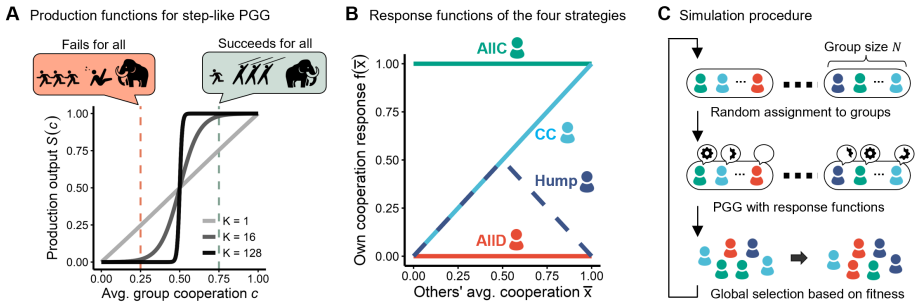
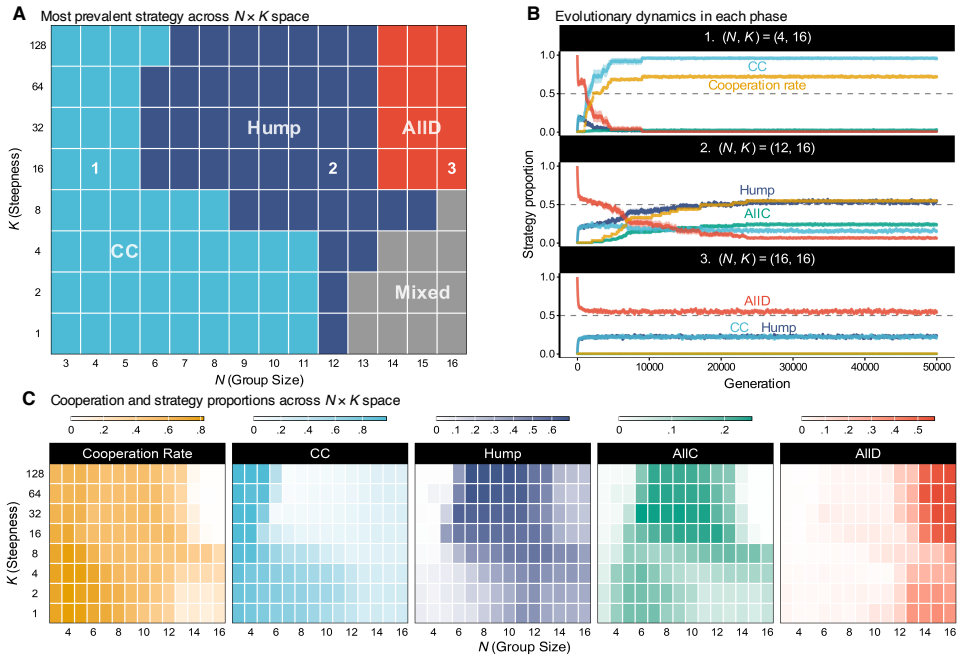
Using agent-based simulations across group sizes and production-function shapes, we find that Hump is individually adaptive, especially in intermediate-sized groups with step-like production functions. Despite its exploitative nature, Hump also elevates population-level cooperation. The underlying mechanism is that Hump can form a stable equilibrium with unconditional cooperators (AllC), which jointly exclude defectors across a broad range of environments.
What carries the argument
The stable coexistence equilibrium between the hump-shaped strategy and unconditional cooperators (AllC) under evolutionary update rules in the agent-based model.
If this is right
- Hump is individually adaptive especially in intermediate-sized groups with step-like production functions.
- The Hump-AllC equilibrium raises population-level cooperation.
- Defectors are jointly excluded by this pairing across a broad range of group sizes and production functions.
- Behavioral heterogeneity involving both Hump and AllC supports large-scale cooperation.
Where Pith is reading between the lines
- The same pairing could appear in other dilemma structures such as network or repeated games.
- Real-world groups facing environmental or resource problems may sustain cooperation through similar mixes of partial and full contributors.
- Experiments could test whether human subjects adopt hump-shaped contribution patterns when group size or return functions vary.
- Policy designs that encourage both committed cooperators and conditional responders might help maintain collective action.
Load-bearing premise
The specific definition of the hump-shaped strategy together with the chosen evolutionary update rules in the simulations permit stable coexistence without further conditions on mutation or payoff comparison.
What would settle it
If simulations with altered mutation rates or different payoff comparisons show defectors invading and displacing the Hump-AllC mix, the stability claim fails.
Figures


read the original abstract
From collective hunting to environmental problems, social dilemmas are pervasive in human societies. Prior research has documented highly heterogeneous behavioral patterns in such settings. However, how this heterogeneity emerges and how it shapes large-scale cooperation remain unclear. Here, we focus on a robustly observed but underexplored pattern: the hump-shaped strategy (Hump). Individuals adopting Hump match others' contributions up to a threshold, only to reduce their own above it. Using agent-based simulations across group sizes and production-function shapes, we find that Hump is individually adaptive, especially in intermediate-sized groups with step-like production functions. Despite its exploitative nature, Hump also elevates population-level cooperation. The underlying mechanism is that Hump can form a stable equilibrium with unconditional cooperators (AllC), which jointly exclude defectors across a broad range of environments. Our findings suggest that underexplored patterns of behavioral heterogeneity -- including both Hump and AllC -- play a functional role in sustaining large-scale cooperation.
Editorial analysis
A structured set of objections, weighed in public.
Referee Report
Summary. The paper uses agent-based simulations of social dilemmas to examine the hump-shaped strategy (Hump), in which agents match others' contributions up to a threshold and then reduce their own. It claims that Hump is individually adaptive, particularly in intermediate-sized groups with step-like production functions, and that Hump forms a stable equilibrium with unconditional cooperators (AllC) that jointly excludes defectors, thereby elevating population-level cooperation across varied group sizes and production-function shapes.
Significance. If robust, the result provides a concrete mechanism by which observed behavioral heterogeneity—including partial exploiters—can sustain large-scale cooperation without requiring universal conditional cooperation. The forward simulations across parameter regimes constitute a strength, offering falsifiable predictions for how Hump-AllC coexistence depends on group size and production-function shape rather than circular fitting.
major comments (2)
- [Methods (agent-based model)] Methods section on the agent-based model and evolutionary dynamics: the imitation rule (payoff-proportional or Fermi) and mutation rate appear fixed at default values with no reported sweeps or sensitivity analyses. This is load-bearing for the central claim because the reported stability of the Hump-AllC equilibrium against defector invasion could be an artifact of low mutation and the specific update rule; varying these parameters might allow invasion and narrow the range of environments where coexistence holds.
- [Results (equilibrium analysis)] Results on equilibrium coexistence: the claim that Hump and AllC 'jointly exclude defectors across a broad range of environments' rests on numerical outcomes for specific hump thresholds and production functions; without an accompanying phase diagram or analytical stability condition (e.g., invasion fitness of defectors when rare), it is unclear whether the equilibrium is structurally stable or sensitive to the unvaried free parameters listed in the model.
minor comments (2)
- [Model description] The exact functional form of the hump threshold and how it is implemented in the contribution-matching rule should be stated explicitly in the model section with a mathematical definition, rather than only in the abstract.
- [Figures] Figure legends and captions should include the precise parameter values (group size, production-function exponent, mutation rate) used in each panel to allow direct replication.
Simulated Author's Rebuttal
We thank the referee for the constructive comments, which highlight important aspects of robustness in our agent-based simulations. We address each major comment below and describe the planned revisions.
read point-by-point responses
-
Referee: Methods section on the agent-based model and evolutionary dynamics: the imitation rule (payoff-proportional or Fermi) and mutation rate appear fixed at default values with no reported sweeps or sensitivity analyses. This is load-bearing for the central claim because the reported stability of the Hump-AllC equilibrium against defector invasion could be an artifact of low mutation and the specific update rule; varying these parameters might allow invasion and narrow the range of environments where coexistence holds.
Authors: We agree that the stability of the Hump-AllC equilibrium should be tested under variation in the update rule and mutation rate. The main text employs the standard Fermi update with intensity beta=1 and mutation rate 0.01, as is conventional in this literature. We have now run additional simulations across mutation rates 0.001-0.05 and both payoff-proportional and Fermi updates. These confirm that Hump-AllC coexistence and defector exclusion persist, although the time to equilibrium lengthens and the basin narrows at higher mutation. We will add a dedicated supplementary section with the corresponding figures and summary statistics. revision: yes
-
Referee: Results on equilibrium coexistence: the claim that Hump and AllC 'jointly exclude defectors across a broad range of environments' rests on numerical outcomes for specific hump thresholds and production functions; without an accompanying phase diagram or analytical stability condition (e.g., invasion fitness of defectors when rare), it is unclear whether the equilibrium is structurally stable or sensitive to the unvaried free parameters listed in the model.
Authors: The reported results already span group sizes N=4-20, linear/step/concave production functions, and a range of hump thresholds, as shown in Figures 3-5 and the supplementary material. We acknowledge that a compact phase diagram summarizing the coexistence region is absent. We will add such a diagram in the revised supplementary information, delineating the parameter combinations (group size, production-function steepness, hump threshold) that support stable Hump-AllC coexistence versus defector invasion. A full analytical invasion-fitness derivation is not feasible for this finite-population stochastic model with continuous strategies; however, we will supplement the phase diagram with numerical invasion probabilities obtained by introducing rare defectors into Hump-AllC populations. revision: partial
Circularity Check
No circularity: results emerge from forward simulations
full rationale
The paper derives its claims exclusively from agent-based simulations of evolutionary dynamics under varying group sizes, production functions, and strategy sets. The reported stable coexistence of the hump-shaped strategy with AllC (and exclusion of defectors) is an observed outcome of the imitation process and payoff comparisons in the model, not a mathematical derivation, parameter fit, or self-referential definition that reduces to its own inputs. No equations or results are shown to be tautological by construction, and no load-bearing steps rely on self-citations or imported uniqueness theorems. This is the standard non-circular case for computational exploration of strategy stability.
Axiom & Free-Parameter Ledger
free parameters (2)
- hump threshold
- group size and production function shape
axioms (1)
- domain assumption Evolutionary dynamics follow imitation based on payoff differences in finite populations.
Reference graph
Works this paper leans on
-
[1]
R. M. Dawes. Social dilemmas.Annu. Rev. Psychol., 31(1):169–193, 1980
1980
-
[2]
P . A. M. Van Lange, J. Joireman, C. D. Parks, and E. Van Dijk. The psychology of social dilemmas: A review.Organ. Behav. Hum. Decis. Process., 120(2):125–141, 2013
2013
-
[3]
Olson.The Logic of Collective Action: Public Goods and the Theory of Groups
M. Olson.The Logic of Collective Action: Public Goods and the Theory of Groups. Harvard University Press, Cambridge, 1965
1965
-
[4]
C. F . Camerer.Behavioral Game Theory: Experiments in Strategic Interaction. Prince- ton University Press, Princeton, NJ, 2003
2003
-
[5]
J. O. Ledyard. Public goods: A survey of experimental research. In J. H. Kagel and A. E. Roth, editors,The Handbook of Experimental Economics, pages 111–194. Princeton University Press, 1995
1995
-
[6]
J. Zelmer. Linear public goods experiments: A meta-analysis.Exp. Econ., 6(3):299– 310, 2003
2003
-
[7]
Fischbacher, S
U. Fischbacher, S. Gächter, and E. Fehr. Are people conditionally cooperative? evi- dence from a public goods experiment.Econ. Lett., 71(3):397–404, 2001
2001
-
[8]
Kurzban and D
R. Kurzban and D. Houser. Experiments investigating cooperative types in humans: A complement to evolutionary theory and simulations.Proc. Natl. Acad. Sci. U. S. A., 102 (5):1803–1807, 2005
2005
-
[9]
Thöni and S
C. Thöni and S. Volk. Conditional cooperation: Review and refinement.Econ. Lett., 171:37–40, 2018
2018
-
[10]
Gruji ´c, J
J. Gruji ´c, J. A. Cuesta, and A. Sánchez. On the coexistence of cooperators,defectors and conditional cooperators in the multiplayer iterated prisoner’s dilemma.J. Theor. Biol., 300:299–308, 2012
2012
-
[11]
Bogaert, C
S. Bogaert, C. Boone, and C. Declerck. Social value orientation and cooperation in social dilemmas: A review and conceptual model.Br. J. Soc. Psychol., 47(Pt 3):453– 480, 2008
2008
-
[12]
Chaudhuri
A. Chaudhuri. Sustaining cooperation in laboratory public goods experiments: A selec- tive survey of the literature.Exp. Econ., 14(1):47–83, 2011
2011
-
[13]
condi- tional cooperation
B. S. Frey and S. Meier. Social comparisons and pro-social behavior: Testing “condi- tional cooperation” in a field experiment.Am. Econ. Rev., 94(5):1717–1722, 2004
2004
-
[14]
Rustagi, S
D. Rustagi, S. Engel, and M. Kosfeld. Conditional cooperation and costly monitoring explain success in forest commons management.Science, 330(6006):961–965, 2010
2010
-
[15]
M. G. Kocher, T. Cherry, S. Kroll, R. J. Netzer, and M. Sutter. Conditional cooperation on three continents.Econ. Lett., 101(3):175–178, 2008
2008
-
[16]
Martinsson, N
P . Martinsson, N. Pham-Khanh, and C. Villegas-Palacio. Conditional cooperation and disclosure in developing countries.J. Econ. Psychol., 34:148–155, February 2013
2013
-
[17]
Herrmann and C
B. Herrmann and C. Thöni. Measuring conditional cooperation: A replication study in russia.Exp. Econ., 12(1):87–92, 2009
2009
-
[18]
Fischbacher, S
U. Fischbacher, S. Gächter, and S. Quercia. The behavioral validity of the strategy method in public good experiments.J. Econ. Psychol., 33(4):897–913, 2012
2012
-
[19]
S. Volk, C. Thöni, and W. Ruigrok. Temporal stability and psychological foundations of cooperation preferences.J. Econ. Behav. Organ., 81(2):664–676, 2012
2012
-
[20]
Fischbacher and S
U. Fischbacher and S. Gächter. Social preferences, beliefs, and the dynamics of free riding in public goods experiments.Am. Econ. Rev., 100(1):541–556, 2010
2010
-
[21]
Keser and F
C. Keser and F . Van Winden. Conditional cooperation and voluntary contributions to public goods.Scand. J. Econ., 102(1):23–39, 2000
2000
-
[22]
Kurokawa and Y
S. Kurokawa and Y . Ihara. Emergence of cooperation in public goods games.Proc. Biol. Sci., 276(1660):1379–1384, 2009
2009
-
[23]
R. Mori, N. Hanaki, and T. Kameda. An outside individual option increases optimism and facilitates collaboration when groups form flexibly.Nat. Commun., 15(1):5520, 2024
2024
-
[24]
R. Axelrod. Effective choice in the prisoner’s dilemma.J. Conflict Resolut., 24(1):3–25, 1980
1980
-
[25]
R. Axelrod. The emergence of cooperation among egoists.Am. Polit. Sci. Rev., 75(2): 306–318, 1981
1981
-
[26]
Efferson, H
C. Efferson, H. Bernhard, U. Fischbacher, and E. Fehr. Super-additive cooperation. Nature, 626(8001):1034–1041, 2024
2024
-
[27]
N. P . Li, M. Van Vugt, and S. M. Colarelli. The evolutionary mismatch hypothesis: Implications for psychological science.Curr. Dir. Psychol. Sci., 27(1):38–44, 2018
2018
-
[28]
D. G. Rand, A. Peysakhovich, G. T. Kraft-Todd, G. E. Newman, O. Wurzbacher, M. A. Nowak, and J. D. Greene. Social heuristics shape intuitive cooperation.Nat. Commun., 5(1):3677, 2014
2014
-
[29]
Peysakhovich and D
A. Peysakhovich and D. G. Rand. Habits of virtue: Creating norms of cooperation and defection in the laboratory.Manage. Sci., 62(3):631–647, 2016
2016
-
[30]
J. A. Aimone, L. R. Iannaccone, M. D. Makowsky, and J. Rubin. Endogenous group formation via unproductive costs.Rev. Econ. Stud., 80(4):1215–1236, 2013
2013
-
[31]
K. Kamei. From locality to continent: A comment on the generalization of an experi- mental study.J. Socio Econ., 41(2):207–210, 2012
2012
-
[32]
M. D. Makowsky, W. H. Orman, and S. J. Peart. Playing with other people’s money: Contributions to public goods by trustees.J. Behav. Exp. Econ., 53:44–55, 2014
2014
-
[33]
P . Kollock. Social dilemmas: The anatomy of cooperation.Annu. Rev. Sociol., 24(1): 183–214, 1998
1998
-
[34]
Marwell and P
G. Marwell and P . Oliver.The critical mass in collective action. Cambridge University Press, Cambridge, 1993
1993
-
[35]
Milinski, R
M. Milinski, R. D. Sommerfeld, H.-J. Krambeck, F . A. Reed, and J. Marotzke. The collective-risk social dilemma and the prevention of simulated dangerous climate change.Proc. Natl. Acad. Sci. U. S. A., 105(7):2291–2294, 2008
2008
-
[36]
Archetti and I
M. Archetti and I. Scheuring. Game theory of public goods in one-shot social dilemmas without assortment.J. Theor. Biol., 299:9–20, 2012
2012
-
[37]
Archetti
M. Archetti. How to analyze models of nonlinear public goods.Games, 9(2):17, 2018
2018
-
[38]
T. R. Palfrey and H. Rosenthal. Participation and the provision of discrete public goods: A strategic analysis.Journal of Public Economics, 24(2):171–193, 1984
1984
-
[39]
Archetti and I
M. Archetti and I. Scheuring. Coexistence of cooperation and defection in public goods games.Evolution, 65(4):1140–1148, 2011
2011
-
[40]
Thöni, J.-R
C. Thöni, J.-R. Tyran, and E. Wengström. Microfoundations of social capital.J. Public Econ., 96(7-8):635–643, 2012
2012
-
[41]
Dariel and N
A. Dariel and N. Nikiforakis. Cooperators and reciprocators: A within-subject analysis of pro-social behavior.Econ. Lett., 122(2):163–166, 2014
2014
-
[42]
T. R. Fosgaard, L. G. Hansen, and E. Wengström. Understanding the nature of coop- eration variability.J. Public Econ., 120:134–143, 2014
2014
-
[43]
Cubitt, S
R. Cubitt, S. Gächter, and S. Quercia. Conditional cooperation and betrayal aversion. J. Econ. Behav. Organ., 141:110–121, 2017
2017
-
[44]
Gächter, F
S. Gächter, F . Kölle, and S. Quercia. Reciprocity and the tragedies of maintaining and providing the commons.Nat. Hum. Behav., 1(9):650–656, 2017
2017
-
[45]
Fallucchi, R
F . Fallucchi, R. A. Luccasen, III, and T. L. Turocy. Identifying discrete behavioural types: A re-analysis of public goods game contributions by hierarchical clustering.J. Econ. Sci. Assoc., 5(2):238–254, 2019
2019
-
[46]
M. A. Nowak. Five rules for the evolution of cooperation.Science, 314(5805):1560– 1563, 2006
2006
-
[47]
R. M. Anderson and R. M. May. Coevolution of hosts and parasites.Parasitology, 85 (2):411–426, 1982
1982
-
[48]
Kraft-Todd, E
G. Kraft-Todd, E. Y oeli, S. Bhanot, and D. Rand. Promoting cooperation in the field. Curr. Opin. Behav. Sci., 3:96–101, 2015
2015
-
[49]
S. Wang. Classifying heterogeneous cooperation in social dilemmas: Experimental evidence and simulation insights.J. Econ. Interact. Coord., 20:925–958, 2025. Otsubo et al. | Partial exploiters sustain cooperation: the hump-shaped strategy stably coexists with unconditional cooperators 9
2025
discussion (0)
Sign in with ORCID, Apple, or X to comment. Anyone can read and Pith papers without signing in.