Recognition: unknown
Nesting Controls Phase Transitions in Higher-Order Contagion
Pith reviewed 2026-05-08 07:00 UTC · model grok-4.3
The pith
A nesting coefficient measuring embedding of lower-order links in higher-order ones sets the type of phase transition in hypergraph contagion.
A machine-rendered reading of the paper's core claim, the machinery that carries it, and where it could break.
Core claim
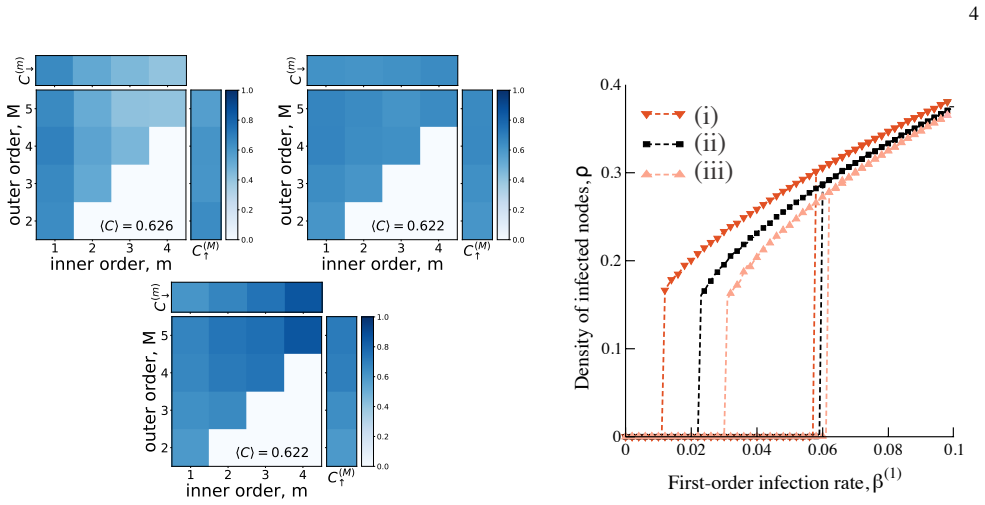
We introduce a nesting coefficient that quantifies how lower-order interactions are embedded inside higher-order ones and thereby locates any hypergraph on a continuum between simplicial complexes and random hypergraphs. In the higher-order SIS contagion process, raising this coefficient reduces the activation threshold and suppresses discontinuous transitions, whereas low nesting produces explosive outbreaks and large bistable regions. Correlations between nesting and interaction order affect the onset of activity while exerting only weak influence on transition discontinuity. Both synthetic and empirical hypergraphs confirm that nesting is a strong predictor of hysteresis.
What carries the argument
The nesting coefficient, which measures the degree to which lower-order interactions are contained within higher-order interactions and interpolates between simplicial complexes and random hypergraphs.
If this is right
- Raising nesting lowers the critical value at which contagion begins to spread.
- Strong nesting converts discontinuous transitions into continuous ones.
- Weak nesting produces explosive outbreaks accompanied by large hysteresis.
- Nesting-order correlations shift the onset of activity without substantially altering transition discontinuity.
- Nesting level forecasts the extent of hysteresis in both synthetic and observed hypergraphs.
Where Pith is reading between the lines
- Tuning nesting in engineered social or biological contact structures could be used to favor gradual rather than sudden spread of behaviors.
- The same structural measure may classify higher-order networks for other collective processes such as opinion dynamics or synchronization.
- Empirical studies could test whether altering nesting in a real system produces the predicted shift in observed transition type.
Load-bearing premise
The nesting coefficient, as defined, is the dominant structural feature that directly sets the activation threshold and the continuous or discontinuous character of the transition in the higher-order SIS model.
What would settle it
A hypergraph in which nesting is varied while holding other structural features fixed yet produces no corresponding change in epidemic threshold or in the presence of hysteresis.
Figures





read the original abstract
The organization of higher-order interactions plays a central role in shaping collective dynamics, yet a general structural principle governing contagion on hypergraphs remains lacking. Here we introduce a nesting coefficient that quantifies how lower-order interactions are embedded within higher-order ones, defining a continuum between simplicial complexes and random hypergraphs. Using a higher-order susceptible-infected-susceptible model, we show that increasing nesting lowers the activation threshold and suppresses discontinuous transitions, while weak embedding favors explosive behavior. We further demonstrate that correlations between nesting and interaction order modulate the onset of activity while only weakly affecting transition discontinuity. Analysis of synthetic and empirical networks reveals that nesting strongly predicts hysteresis, establishing it as a key structural determinant of phase transitions in higher-order systems.
Editorial analysis
A structured set of objections, weighed in public.
Referee Report
Summary. The manuscript introduces a nesting coefficient quantifying the embedding of lower-order interactions within higher-order ones on hypergraphs, spanning a continuum from simplicial complexes to random hypergraphs. Using a higher-order SIS contagion model, the authors report that higher nesting lowers the activation threshold and suppresses discontinuous transitions with hysteresis, while weaker nesting promotes explosive behavior. Correlations between nesting and interaction order are shown to modulate onset of activity but only weakly affect transition discontinuity. Analysis of synthetic and empirical hypergraphs indicates that nesting strongly predicts hysteresis, positioning the coefficient as a key structural determinant of phase transitions.
Significance. If the central claim holds after controls for confounders, the work supplies a compact structural metric that accounts for variation in higher-order contagion dynamics, bridging simplicial and random-hypergraph regimes. This could furnish falsifiable predictions for real systems and guide ensemble construction in future studies. The combination of model analysis, synthetic tests, and empirical validation is a positive feature.
major comments (2)
- [Results on synthetic and empirical networks] In the synthetic and empirical analyses (described in the results sections following the model definition), the predictive power of nesting for hysteresis is not shown to survive explicit controls for hyperedge-size distribution and node-degree variance. Because the abstract already notes correlations between nesting and interaction order, and because these features are structurally entangled in real hypergraphs, the claim that nesting is the primary determinant requires partial-correlation or matched-ensemble tests to rule out confounding.
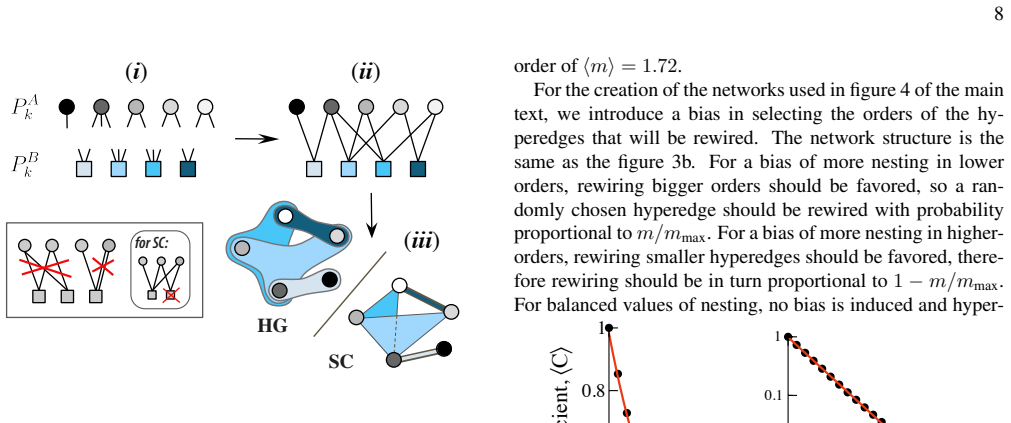
- [Definition and properties of the nesting coefficient] The nesting coefficient is introduced as the central new quantity, yet its precise algorithmic definition, normalization, and dependence on hyperedge cardinality are not stated with sufficient formality to permit independent reproduction or analytic derivation of its effect on the SIS threshold.
minor comments (2)
- [Figures] Figure captions should explicitly state the number of realizations, error-bar conventions, and parameter values used for each panel.
- [Abstract] The abstract would be clearer if it named the specific higher-order SIS process (e.g., the form of the infection rate on hyperedges) rather than referring only to 'a higher-order susceptible-infected-susceptible model'.
Simulated Author's Rebuttal
We thank the referee for their constructive and detailed review. We address each major comment below and have revised the manuscript accordingly to strengthen the presentation and robustness of our claims.
read point-by-point responses
-
Referee: [Results on synthetic and empirical networks] In the synthetic and empirical analyses (described in the results sections following the model definition), the predictive power of nesting for hysteresis is not shown to survive explicit controls for hyperedge-size distribution and node-degree variance. Because the abstract already notes correlations between nesting and interaction order, and because these features are structurally entangled in real hypergraphs, the claim that nesting is the primary determinant requires partial-correlation or matched-ensemble tests to rule out confounding.
Authors: We agree that demonstrating the independent predictive power of the nesting coefficient requires explicit controls for confounders such as hyperedge-size distribution and node-degree variance. We have performed additional partial-correlation analyses on both the synthetic ensembles and the empirical hypergraphs, as well as constructed matched ensembles in which hyperedge-size distributions and degree sequences are fixed while nesting is varied. These controls confirm that the association between nesting and hysteresis remains statistically significant and is not explained by the confounders. The revised manuscript includes a new subsection reporting these results, together with the corresponding correlation coefficients, p-values, and supplementary figures. revision: yes
-
Referee: [Definition and properties of the nesting coefficient] The nesting coefficient is introduced as the central new quantity, yet its precise algorithmic definition, normalization, and dependence on hyperedge cardinality are not stated with sufficient formality to permit independent reproduction or analytic derivation of its effect on the SIS threshold.
Authors: We appreciate the need for a more rigorous and reproducible definition. The revised Methods section now contains a dedicated subsection that states: (i) the exact mathematical definition of the nesting coefficient as a normalized measure of lower-order embedding, (ii) the normalization that renders the coefficient independent of hyperedge cardinality, (iii) the explicit dependence on hyperedge size through the combinatorial weighting, and (iv) pseudocode for its computation on any hypergraph. We have also added a short analytic sketch showing how the coefficient enters the mean-field expression for the SIS activation threshold. These additions enable independent reproduction and facilitate future analytic work. revision: yes
Circularity Check
No significant circularity; nesting coefficient and hysteresis link derived independently from model simulations and data analysis
full rationale
The paper introduces a new nesting coefficient as a structural measure on hypergraphs, applies the standard higher-order SIS contagion model to it, and reports empirical correlations from synthetic and real networks. No equations reduce a claimed prediction to a fitted parameter by construction, no self-citation chain bears the central result, and the continuum definition is not tautological with the observed phase-transition outcomes. The derivation chain remains self-contained against external benchmarks.
Axiom & Free-Parameter Ledger
axioms (2)
- domain assumption The higher-order susceptible-infected-susceptible model captures the essential contagion dynamics on hypergraphs.
- ad hoc to paper Hypergraph structure can be meaningfully quantified by a nesting coefficient that interpolates between simplicial complexes and random hypergraphs.
invented entities (1)
-
Nesting coefficient
no independent evidence
Reference graph
Works this paper leans on
-
[1]
S. N. Dorogovtsev and J. F. F. Mendes,The nature of complex networks(Oxford University Press, 2022) p. 481
2022
-
[2]
G. F. de Arruda, F. A. Rodrigues, and Y . Moreno, Physics Re- ports756, 1 (2018)
2018
-
[3]
Ferraz de Arruda, A
G. Ferraz de Arruda, A. Aleta, and Y . Moreno, Nature Reviews Physics6, 468 (2024)
2024
-
[4]
C. Bick, E. Gross, H. A. Harrington, and M. T. Schaub, SIAM Review65, 686 (2023)
2023
-
[5]
Iacopini, G
I. Iacopini, G. Petri, A. Baronchelli, and A. Barrat, Communi- cations Physics5, 64 (2022)
2022
-
[6]
A. E. Sizemore, C. Giusti, A. Kahn, J. M. Vettel, R. F. Betzel, and D. S. Bassett, Journal of Computational Neuroscience44, 115 (2018)
2018
-
[7]
G. Petri, P. Expert, F. Turkheimer, R. Carhart-Harris, D. Nutt, P. J. Hellyer, and F. Vaccarino, Journal of the Royal Society Interface11, 10.1098/rsif.2014.0873 (2014)
-
[8]
F. Battiston, V . Capraro, F. Karimi, S. Lehmann, A. B. Migliano, O. Sadekar, A. S´anchez, and M. Perc, Nature Human Behaviour 10.1038/s41562-025-02373-5 (2025)
-
[9]
Battiston, E
F. Battiston, E. Amico, A. Barrat, G. Bianconi, G. F. de Arruda, B. Franceschiello, I. Iacopini, S. K ´efi, V . Latora, Y . Moreno, M. M. Murray, T. P. Peixoto, F. Vaccarino, and G. Petri, Nature Physics17, 1093 (2021)
2021
-
[10]
Boccaletti, P
S. Boccaletti, P. D. Lellis, C. I. del Genio, K. Alfaro-Bittner, R. Criado, S. Jalan, and M. Romance, The structure and dy- namics of networks with higher order interactions (2023)
2023
-
[11]
Bianconi,Higher-Order Networks(Cambridge University Press, 2021)
G. Bianconi,Higher-Order Networks(Cambridge University Press, 2021)
2021
-
[12]
Iacopini, G
I. Iacopini, G. Petri, A. Barrat, and V . Latora, Nature Commu- nications10, 2485 (2019)
2019
-
[13]
Palafox-Castillo and A
G. Palafox-Castillo and A. Berrones-Santos, Physica A: Statis- tical Mechanics and its Applications606, 128053 (2022)
2022
-
[14]
N. W. Landry and J. G. Restrepo, Chaos: An Interdisciplinary Journal of Nonlinear Science30, 10.1063/5.0020034 (2020)
-
[15]
Ferraz de Arruda, G
G. Ferraz de Arruda, G. Petri, P. M. Rodriguez, and Y . Moreno, Nature communications14, 1375 (2023)
2023
-
[16]
Y . Zhang, M. Lucas, and F. Battiston, Nature Communications 14, 10.1038/s41467-023-37190-9 (2023)
-
[17]
G. Burgio, S. G ´omez, and A. Arenas, Physical Review Letters 132, 10.1103/PhysRevLett.132.077401 (2024)
-
[18]
Kim, D.-S
J. Kim, D.-S. Lee, and K.-I. Goh, Physical Review E108, 034313 (2023)
2023
-
[19]
F. Malizia, A. Guzm ´an, F. Battiston, and I. Z. Kiss, arXiv preprint arXiv:2601.10522 (2026)
-
[20]
Malizia, A
F. Malizia, A. Guzm ´an, I. Iacopini, and I. Z. Kiss, Physical Re- view Letters135, 207401 (2025)
2025
-
[21]
O. T. Courtney and G. Bianconi, Physical Review E93, 062311 (2016)
2016
-
[22]
Barrat, G
A. Barrat, G. F. de Arruda, I. Iacopini, and Y . Moreno, Social contagion on higher-order structures, inHigher-Order Systems, edited by G. B. Federico and Petri (Springer International Pub- lishing, 2022) pp. 329–346
2022
- [23]
-
[24]
Stehl ´e, N
J. Stehl ´e, N. V oirin, A. Barrat, C. Cattuto, L. Isella, J.-F. Pinton, M. Quaggiotto, W. Van den Broeck, C. R ´egis, B. Lina,et al., PloS one6, e23176 (2011)
2011
-
[25]
Mastrandrea, J
R. Mastrandrea, J. Fournet, and A. Barrat, PloS one10, e0136497 (2015)
2015
-
[26]
Vanhems, A
P. Vanhems, A. Barrat, C. Cattuto, J.-F. Pinton, N. Khanafer, C. R ´egis, B.-a. Kim, B. Comte, and N. V oirin, PloS one8, e73970 (2013)
2013
-
[27]
Barrat, C
A. Barrat, C. Cattuto, A. E. Tozzi, P. Vanhems, and N. V oirin, Clinical Microbiology and Infection20, 10 (2014)
2014
-
[28]
Isella, J
L. Isella, J. Stehl ´e, A. Barrat, C. Cattuto, J.-F. Pinton, and W. Van den Broeck, Journal of theoretical biology271, 166 (2011)
2011
-
[29]
G ´enois, C
M. G ´enois, C. L. Vestergaard, J. Fournet, A. Panisson, I. Bon- marin, and A. Barrat, Network Science3, 326 (2015)
2015
-
[30]
Ozella, D
L. Ozella, D. Paolotti, G. Lichand, J. P. Rodr ´ıguez, S. Haenni, J. Phuka, O. B. Leal-Neto, and C. Cattuto, EPJ Data Science 10, 46 (2021)
2021
-
[31]
Stehl ´e, N
J. Stehl ´e, N. V oirin, A. Barrat, C. Cattuto, V . Colizza, L. Isella, C. R´egis, J.-F. Pinton, N. Khanafer, W. Van den Broeck,et al., BMC medicine9, 1 (2011)
2011
-
[32]
A. R. Benson, R. Abebe, M. T. Schaub, A. Jadbabaie, and J. Kleinberg, Proceedings of the National Academy of Sciences 115, E11221 (2018)
2018
-
[33]
H. Yin, A. R. Benson, J. Leskovec, and D. F. Gleich, inPro- ceedings of the 23rd ACM SIGKDD international conference on knowledge discovery and data mining(2017) pp. 555–564
2017
-
[34]
Amburg, N
I. Amburg, N. Veldt, and A. Benson, inProceedings of the web conference 2020(2020) pp. 706–717
2020
-
[35]
N. W. Landry, M. Lucas, I. Iacopini, G. Petri, A. Schwarze, A. Patania, and L. Torres, Journal of Open Source Software8, 5162 (2023)
2023
-
[36]
O. T. Courtney and G. Bianconi, Generalized network struc- tures: The configuration model and the canonical ensemble of simplicial complexes, Phys. Rev. E93, 062311 (2016). 7 Supplemental Material for ”Nesting Controls Phase Transitions in Higher-Order Contagion” Additional comments on the Nesting coefficient Specific averages of nesting can be measured f...
2016
discussion (0)
Sign in with ORCID, Apple, or X to comment. Anyone can read and Pith papers without signing in.