Recognition: unknown
GeoFunFlow-3D: A Physics-Guided Generative Flow Matching Framework for High-Fidelity 3D Aerodynamic Inference over Complex Geometries
Pith reviewed 2026-05-08 07:21 UTC · model grok-4.3
The pith
GeoFunFlow-3D uses physics-guided flow matching to achieve high-fidelity 3D aerodynamic inference on complex geometries with pressure errors reduced to 0.0215 RRMSE.
A machine-rendered reading of the paper's core claim, the machinery that carries it, and where it could break.
Core claim
GeoFunFlow-3D demonstrates that a generative flow matching approach guided by physics, through optimal transport paths for stable dynamics, a No-AD high-order discrete engine to mitigate gradient stiffness, and the SATO module for localized physical law enforcement, can produce accurate 3D aerodynamic fields that maintain consistency in challenging regions like detached shocks.
What carries the argument
The generative flow matching framework integrating optimal transport for path construction, a No-AD high-order engine for spectral handling, and the SATO topology-aware super-resolution module for spatial physical enforcement.
If this is right
- Accurately captures 3D detached shock structures on test cases such as NASA Rotor37.
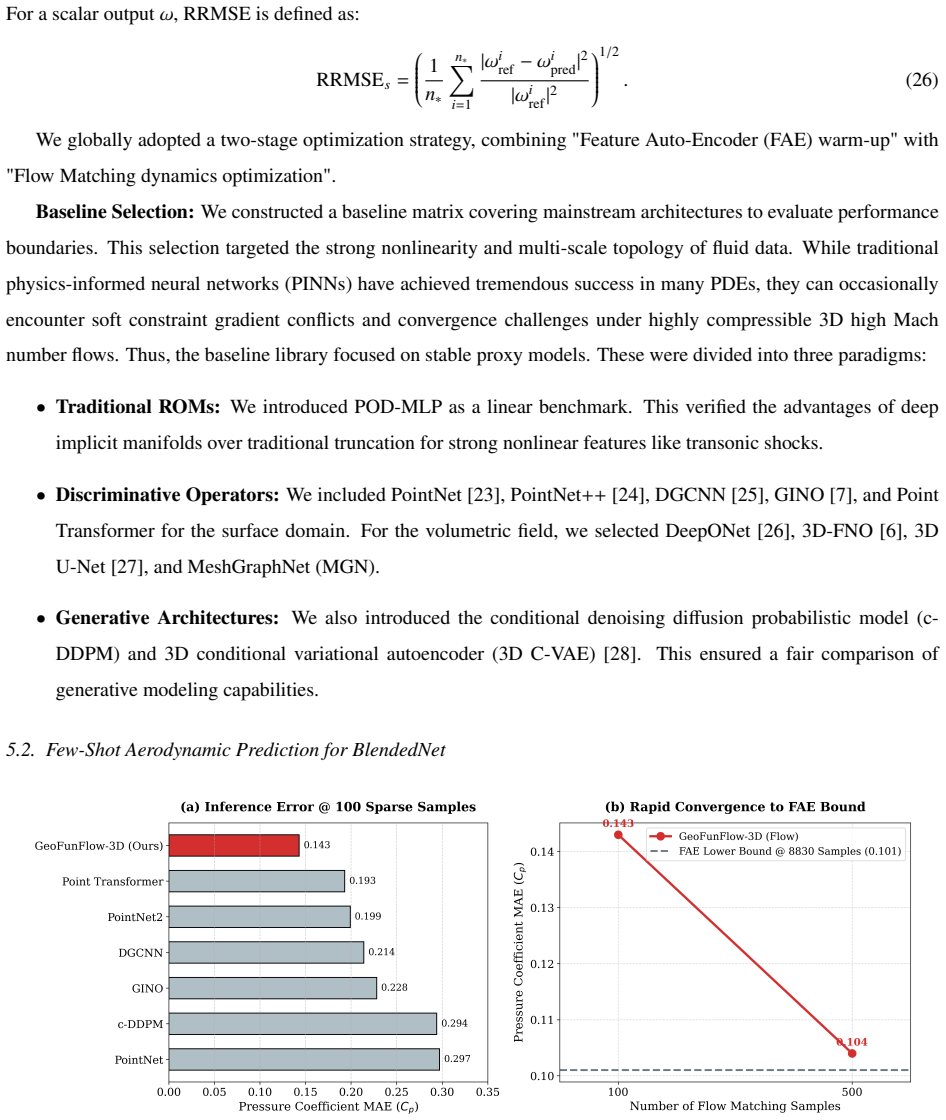
- Avoids mode collapse even with sparse data on the BlendedNet dataset.
- Reduces pressure field relative root mean square error to 0.0215 compared to conventional operators.
- Maintains competitive inference efficiency for high-dimensional fluid field generation.
- Offers a geometry-driven method for reliable aerodynamic predictions over complex shapes.
Where Pith is reading between the lines
- Similar flow matching techniques with physics guidance could address spectral bias in other domains like electromagnetic simulations or structural mechanics.
- Integration with design optimization loops might allow faster iteration in aerospace engineering workflows.
- The framework's success on industrial datasets suggests potential for extension to time-dependent or multi-physics flow problems.
- Further validation on varied geometry types could reveal the limits of the SATO module's topology awareness.
Load-bearing premise
The combination of optimal transport paths, the No-AD high-order engine, and the SATO super-resolution module enforces physical consistency in localized regions such as shock waves without introducing new artifacts or losing fidelity elsewhere.
What would settle it
If predictions on the NASA Rotor37 test case show mismatches in shock wave positions or strengths when compared to reference data, or if errors exceed 0.0215 RRMSE on BlendedNet-like datasets, the claim of improved physical consistency would be challenged.
Figures






read the original abstract
Deep generative models and neural operators have demonstrated significant potential for 3D aerodynamic inference. However, they often face inherent challenges in maintaining physical consistency and preserving high-frequency features, primarily due to spectral bias and gradient conflicts within the governing equations. To address these issues, we propose GeoFunFlow-3D, a physics-guided generative flow matching framework. Temporally, we utilize optimal transport theory to build the generation path, ensuring stable training dynamics. Spectrally, we introduce a high-order discrete engine without automatic differentiation (No-AD) to reduce gradient stiffness. Spatially, a topology-aware super-resolution module (SATO) is employed to rigorously enforce physical laws in localized regions such as shock waves. We evaluated our framework on complex industrial datasets. On the BlendedNet dataset, the model successfully avoids mode collapse even under sparse data conditions. For the NASA Rotor37 test, it accurately captures 3D detached shock structures. Compared to conventional operators, GeoFunFlow-3D significantly improves accuracy, reducing the pressure field error (RRMSE) to 0.0215 while maintaining competitive inference efficiency. Ultimately, this work provides a reliable, geometry-driven approach for generating high-dimensional fluid fields.
Editorial analysis
A structured set of objections, weighed in public.
Referee Report
Summary. The paper introduces GeoFunFlow-3D, a physics-guided generative flow matching framework for high-fidelity 3D aerodynamic inference over complex geometries. It employs optimal transport theory for stable generation paths, a No-AD high-order discrete engine to mitigate gradient stiffness, and a SATO topology-aware super-resolution module to enforce physical consistency in regions like shock waves. The framework is evaluated on the BlendedNet dataset and NASA Rotor37 test case, claiming to reduce the relative root mean square error (RRMSE) of the pressure field to 0.0215 compared to conventional operators, while capturing detached shock structures and avoiding mode collapse under sparse data conditions.
Significance. If the central claims hold with stronger localized validation, GeoFunFlow-3D could advance physics-informed generative models for aerodynamics by addressing spectral bias and gradient conflicts through optimal transport paths, high-order discretization without automatic differentiation, and topology-aware super-resolution. This would be valuable for efficient, geometry-driven inference in industrial CFD applications involving complex 3D flows and discontinuities. The reported avoidance of mode collapse on sparse data and capture of detached shocks are promising directions, though current evidence rests primarily on a single global scalar metric.
major comments (3)
- [Abstract] Abstract: The claim that GeoFunFlow-3D 'accurately captures 3D detached shock structures' and that SATO 'rigorously enforce[s] physical laws in localized regions such as shock waves' rests on a global pressure-field RRMSE of 0.0215; no per-region error breakdowns, shock-position errors, total-variation indicators, or local gradient preservation metrics are supplied to rule out diffusion artifacts or fidelity loss near discontinuities.
- [Abstract] Abstract: The statement that the method 'significantly improves accuracy' over 'conventional operators' provides no identification of the specific baseline methods, no data-split details, no error bars, and no statistical significance tests for the RRMSE reduction on BlendedNet or NASA Rotor37.
- [Methods] Methods description: Integration details for the No-AD high-order discrete engine and SATO module with the flow-matching backbone are insufficient to verify that they enforce the governing equations (e.g., via residual norms or conservation checks) rather than merely lowering average error; no ablation studies isolating their contribution to physical consistency are referenced.
minor comments (1)
- [Abstract] The acronym 'No-AD' is introduced without expansion on first use.
Simulated Author's Rebuttal
We thank the referee for the constructive and detailed feedback on our manuscript. The comments highlight important aspects of evidence presentation that we will strengthen in the revision. Below we respond point-by-point to each major comment.
read point-by-point responses
-
Referee: [Abstract] Abstract: The claim that GeoFunFlow-3D 'accurately captures 3D detached shock structures' and that SATO 'rigorously enforce[s] physical laws in localized regions such as shock waves' rests on a global pressure-field RRMSE of 0.0215; no per-region error breakdowns, shock-position errors, total-variation indicators, or local gradient preservation metrics are supplied to rule out diffusion artifacts or fidelity loss near discontinuities.
Authors: We acknowledge that reliance on the global RRMSE leaves the localized claims under-supported by quantitative evidence. The manuscript presents qualitative visualizations on the NASA Rotor37 case that show detached shocks without obvious diffusion artifacts, but we agree this is insufficient. In the revised version we will add per-region error breakdowns focused on shock regions, shock-position error metrics, total-variation indicators, and local gradient preservation statistics to directly address concerns about fidelity near discontinuities. revision: yes
-
Referee: [Abstract] Abstract: The statement that the method 'significantly improves accuracy' over 'conventional operators' provides no identification of the specific baseline methods, no data-split details, no error bars, and no statistical significance tests for the RRMSE reduction on BlendedNet or NASA Rotor37.
Authors: The baselines referenced are standard neural operators (FNO and DeepONet) as detailed in the experimental comparisons. We will revise both the abstract and results sections to explicitly name these baselines, specify the train/validation/test splits, report error bars from multiple independent runs, and include statistical significance tests (e.g., paired t-tests) for the RRMSE improvements on both datasets. revision: yes
-
Referee: [Methods] Methods description: Integration details for the No-AD high-order discrete engine and SATO module with the flow-matching backbone are insufficient to verify that they enforce the governing equations (e.g., via residual norms or conservation checks) rather than merely lowering average error; no ablation studies isolating their contribution to physical consistency are referenced.
Authors: We will substantially expand the Methods section with integration diagrams, pseudocode, and explicit descriptions of how the No-AD engine and SATO module interface with the flow-matching backbone. The revision will also report residual norms of the governing equations and conservation checks. In addition, we will include new ablation studies that isolate the contribution of each component to physical consistency and overall error reduction. revision: yes
Circularity Check
No circularity in derivation chain; claims rest on external validation
full rationale
The paper defines GeoFunFlow-3D via three introduced modules (optimal transport paths, No-AD engine, SATO super-resolution) to mitigate spectral bias and enforce consistency at shocks. These are presented as novel design choices rather than derived from prior results. Reported performance (RRMSE 0.0215 on pressure) is obtained by direct evaluation on independent external datasets (BlendedNet, NASA Rotor37), not by fitting parameters to the target metric or renaming internal quantities as predictions. No equations, self-citations, or uniqueness theorems are invoked that would reduce the central claims to tautologies or self-referential fits. The chain is therefore self-contained against external benchmarks.
Axiom & Free-Parameter Ledger
axioms (1)
- domain assumption Optimal transport theory builds a generation path that ensures stable training dynamics
invented entities (2)
-
No-AD high-order discrete engine
no independent evidence
-
SATO topology-aware super-resolution module
no independent evidence
Reference graph
Works this paper leans on
-
[1]
S. Wang, X. Yu, P. Perdikaris, When and why pinns fail to train: A neural tangent kernel perspective, Journal of Computational Physics 449 (2022) 110768
2022
- [2]
-
[3]
T. Y . Hou, X.-H. Wu, A multiscale finite element method for elliptic problems in composite materials and porous media, Journal of Computational Physics 134 (1) (1997) 169–189
1997
-
[4]
E. L. Allgower, K. Georg, Introduction to Numerical Continuation Methods, Society for Industrial and Applied Mathematics (SIAM), 2012
2012
-
[5]
Benamou, Y
J.-D. Benamou, Y . Brenier, A computational fluid mechanics solution to the monge-kantorovich mass transfer problem, Numerische Mathematik 84 (3) (2000) 375–393
2000
-
[6]
Z. Li, N. Kovachki, K. Azizzadenesheli, B. Liu, K. Bhattacharya, A. Stuart, A. Anandkumar, Fourier neural operator for parametric partial differential equations, arXiv (Cornell University) (2020)
2020
-
[7]
Z. Li, N. B. Kovachki, C. Choy, B. Li, J. Kossaifi, S. P. Otta, M. A. Nabian, M. Stadler, C. Hundt, K. Azizzade- nesheli, A. Anandkumar, Geometry-informed neural operator for large-scale 3d pdes, in: Advances in Neural Information Processing Systems (NeurIPS), 2023
2023
-
[8]
J. Song, W. Cao, W. Zhang, Fenn: Feature-enhanced neural network for solving partial differential equations involving fluid mechanics, Journal of Computational Physics 542 (2025) 114370
2025
- [9]
-
[10]
H. Gao, L. Sun, J.-X. Wang, Phygeonet: Physics-informed geometry-adaptive convolutional neural networks for solving parameterized steady-state pdes on irregular domain, Journal of Computational Physics 428 (2021) 110079
2021
-
[11]
T. De Ryck, S. Mishra, R. Molinaro, wpinns: Weak physics informed neural networks for approximating entropy solutions of hyperbolic conservation laws, arXiv preprint arXiv:2207.08483 (2022)
-
[12]
Y . Zhou, Z. Wang, K. Zhou, H. Tang, X. Li, Lt-pinn: Lagrangian topology-conscious physics-informed neural network for boundary-focused engineering optimization, Computer Methods in Applied Mechanics and Engi- neering 448 (2026) 118453. 38
2026
-
[13]
Peebles, S
W. Peebles, S. Xie, Scalable diffusion models with transformers, in: Proceedings of the IEEE/CVF International Conference on Computer Vision (ICCV), 2023, pp. 4199–4209
2023
-
[14]
X. Liu, C. Gong, Q. Liu, Flow straight and fast: Learning to generate and transfer data with rectified flow, in: The Eleventh International Conference on Learning Representations (ICLR), 2023
2023
-
[15]
J. Hu, L. Shen, S. Albanie, G. Sun, E. Wu, Squeeze-and-excitation networks, in: Proceedings of the IEEE Conference on Computer Vision and Pattern Recognition (CVPR), 2018, pp. 7132–7141
2018
-
[16]
S. Wen, A. Kumbhat, L. E. Lingsch, S. Mousavi, Y . Zhao, P. Chandrashekar, S. Mishra, Geometry aware op- erator transformer as an efficient and accurate neural surrogate for pdes on arbitrary domains, arXiv (Cornell University) (2025)
2025
-
[17]
Flow Matching is Adaptive to Manifold Structures
S. Kumar, Y . Wang, L. Lin, Flow matching is adaptive to manifold structures, arXiv preprint arXiv:2602.22486 (2026)
work page internal anchor Pith review Pith/arXiv arXiv 2026
-
[18]
Hansen, Rank-Deficient and Discrete Ill-Posed Problems, Society for Industrial and Applied Mathematics (SIAM), 1996
P. Hansen, Rank-Deficient and Discrete Ill-Posed Problems, Society for Industrial and Applied Mathematics (SIAM), 1996
1996
-
[19]
Kharazmi, Z
E. Kharazmi, Z. Zhang, G. Karniadakis, Variational physics-informed neural networks for solving partial differ- ential equations, arXiv.org (2019)
2019
-
[20]
Lipman, R
Y . Lipman, R. T. Q. Chen, H. Ben-Hamu, M. Nickel, M. Le, Flow matching for generative modeling, in: The Eleventh International Conference on Learning Representations (ICLR), 2023
2023
-
[21]
S. Wang, Y . Teng, P. Perdikaris, Understanding and mitigating gradient flow pathologies in physics-informed neural networks, SIAM Journal on Scientific Computing 43 (5) (2021) A3055–A3081
2021
- [22]
-
[23]
C. R. Qi, H. Su, K. Mo, L. J. Guibas, Pointnet: Deep learning on point sets for 3d classification and segmentation, in: Proceedings of the IEEE Conference on Computer Vision and Pattern Recognition (CVPR), 2017, pp. 652– 660
2017
-
[24]
C. R. Qi, L. Yi, H. Su, L. J. Guibas, Pointnet++: Deep hierarchical feature learning on point sets in a metric space, in: Advances in Neural Information Processing Systems (NeurIPS), 2017
2017
-
[25]
Y . Wang, Y . Sun, Z. Liu, S. E. Sarma, M. M. Bronstein, J. M. Solomon, Dynamic graph cnn for learning on point clouds, ACM Transactions on Graphics (TOG) 38 (5) (2019) 1–12
2019
-
[26]
L. Lu, P. Jin, G. E. Karniadakis, Deeponet: Learning nonlinear operators for identifying differential equations based on the universal approximation theorem of operators, Nature Machine Intelligence 3 (3) (2021) 218–229. 39
2021
-
[27]
Çiçek, A
O. Çiçek, A. Abdulkadir, S. S. Lienkamp, T. Brox, O. Ronneberger, 3d u-net: Learning dense volumetric seg- mentation from sparse annotation, in: Medical Image Computing and Computer-Assisted Intervention (MIC- CAI), Springer, 2016, pp. 424–432
2016
-
[28]
K. Sohn, H. Lee, X. Yan, Learning structured output representation using deep conditional generative models, in: Advances in Neural Information Processing Systems (NeurIPS), 2015
2015
-
[29]
arXiv preprint arXiv:2510.22491 , year=
G. Nehme, D. Shu, F. Ahmed, Y . Zhang, M. Klenk, Lamp: Data-efficient linear affine weight-space models for parameter-controlled 3d shape generation and extrapolation, arXiv preprint arXiv:2510.22491 (2026)
-
[30]
W. E, B. Yu, The deep ritz method: a deep learning-based numerical algorithm for solving variational problems, Communications in Mathematics and Statistics 6 (1) (2018) 1–12. 40
2018
discussion (0)
Sign in with ORCID, Apple, or X to comment. Anyone can read and Pith papers without signing in.