Recognition: unknown
Selecting the optimal Parameters Results in Double Interpolation: Double AFD
Pith reviewed 2026-05-08 06:37 UTC · model grok-4.3
The pith
Optimally chosen points make orthogonal projections double-interpolate functions in the Hardy space
A machine-rendered reading of the paper's core claim, the machinery that carries it, and where it could break.
Core claim
When the parameters a_k are optimally selected according to the energy matching pursuit principle, the orthogonal projection P of f onto the span of the corresponding normalized Szegő kernels satisfies both P(f)(a_k) = f(a_k) and P'(f)(a_k) = f'(a_k) for each k. This double interpolation at the selected points allows construction of the double Takenaka-Malmquist system, for which norm convergence holds as n tends to infinity, and n-best approximations are achieved for fixed n. The resulting double AFD sparse representation outperforms the classical AFD, with extensions to higher-order interpolations and the upper half-plane case.
What carries the argument
The energy matching pursuit principle used to select the points a_k that define the normalized Szegő kernels, which enforces the double interpolation property in the orthogonal projection.
If this is right
- The expansions converge in norm to the function as n increases.
- Fixed-n approximations achieve the best possible in the space.
- Boundary interpolations are obtained.
- Higher-order m>2 interpolations follow similarly.
- The theory carries over to the upper half-plane Hardy space.
Where Pith is reading between the lines
- Algorithms based on this selection might achieve better derivative accuracy with fewer terms.
- Extensions to m>2 could be tested numerically for smooth functions to see sparsity gains.
- Similar principles may apply to other reproducing kernel spaces.
- This could inform choices in numerical methods for analytic function approximation.
Load-bearing premise
That there exists an optimal selection of the points a_k via the energy matching pursuit principle which guarantees the double interpolation property for the orthogonal projection.
What would settle it
Finding a function f and points selected by the energy matching pursuit for which the resulting projection does not match the derivative of f at one of the points would falsify the result.
Figures
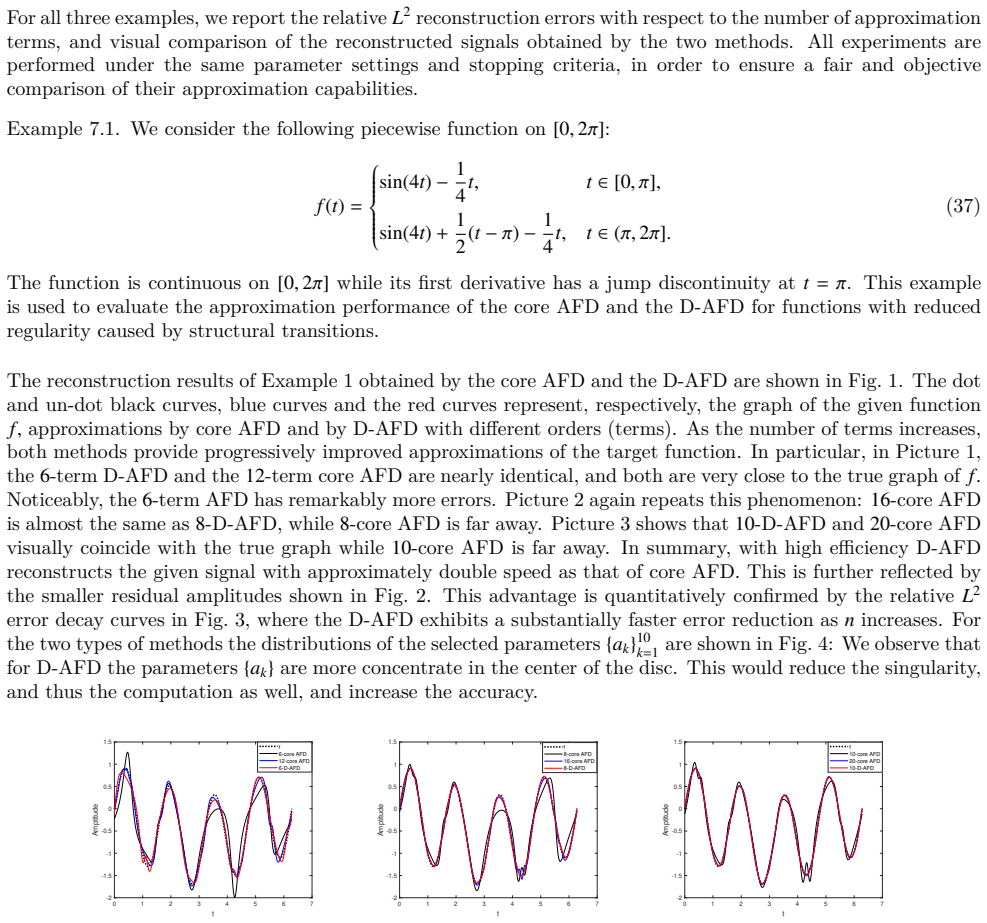


read the original abstract
Let $f$ belong to the Hardy space $H^2(\mathbb{D})$ of the unit disc, and $e_a$ the normalized Szeg\"o (reproducing) kernel of $H^2(\mathbb{D}).$ It is well known that, due to the reproducing kernel property, for any distinct $n$ points $a_1,\cdots,a_n$ in $\mathbb{D}$ the orthogonal projection of $f$ into ${\rm span}\{e_{a_1},\cdots,e_{a_n}\},$ denoted as $P_{{\rm span}\{e_{a_1},\cdots,e_{a_n}\}}(f),$ interpolates $f$ at the points $a_k$'s. The present study further proves that if the $a_k$'s are optimally selected according to certain energy matching pursuit principle, then $P_{{\rm span}\{e_{a_1},\cdots,e_{a_n}\}}(f)$ double interpolates $f$ at the points $a_k$'s, or order $m=2$ interpolation, that is, \[ P_{{\rm span}\{e_{a_1},\cdots,e_{a_n}\}}(f)(a_k)=f(a_k), \quad {\rm and}\quad P_{{\rm span}\{e_{a_1},\cdots,e_{a_n}\}}'(f)(a_k)=f'(a_k),\quad k=1,\cdots,n.\] With the accordingly newly defined double Takenaka-Malmquist system, the norm convergence for $n\to \infty,$ the $n$-best approximation for $n$ being fixed, and the related boundary function interpolation are studied. The such generated new sparse representation, named as double AFD, is shown to outperform the classical AFD. Pointwise interpolations for orders $m>2,$ meaning to simultaneously interpolates all functions $f,f',\cdots,f^{(m-1)}$ at a set of $a_k$'s are, additionally, discussed. For the Hardy space of the upper-half complex plane there exists a counterpart theory.
Editorial analysis
A structured set of objections, weighed in public.
Referee Report
Summary. The paper claims that for f in H²(𝔻), if the points a₁,…,aₙ are chosen optimally according to an energy matching pursuit principle, then the orthogonal projection P onto span{e_{a₁},…,e_{aₙ}} (normalized Szegő kernels) satisfies both P(f)(a_k)=f(a_k) and P'(f)(a_k)=f'(a_k) for each k (double interpolation). It introduces a double Takenaka-Malmquist system, proves norm convergence as n→∞, studies the n-best approximation property, boundary interpolation, and shows that the resulting double AFD sparse representation outperforms classical AFD; extensions to higher-order pointwise interpolation and the upper half-plane are also discussed.
Significance. If the central claim is rigorously established, the work would provide a new adaptive approximation scheme in Hardy spaces that achieves second-order interpolation using the same number of terms as standard AFD, potentially improving convergence rates and sparsity. The explicit construction of the double Takenaka-Malmquist system together with the convergence and comparison results would constitute a concrete advance in the theory of adaptive bases for H².
major comments (2)
- [Abstract and proof of the main theorem] Abstract: The claim that energy-maximizing selection of the a_k automatically enforces the derivative-matching conditions is not immediate from the reproducing-kernel property alone. The first-order stationarity condition for the captured energy yields one complex equation per point, but derivative interpolation additionally requires orthogonality of the residual to the Riesz representers of the functionals g↦g'(a_k); these representers lie outside the span of the e_{a_j} in general. The manuscript must explicitly derive that the optimality condition implies these extra n conditions.
- [Definition and properties of the double Takenaka-Malmquist system] Double Takenaka-Malmquist system (introduced after the main claim): If this system merely re-orthogonalizes the identical n-dimensional span, then P remains the standard orthogonal projection and the double-interpolation property still hinges entirely on the selection rule satisfying the extra orthogonality; the paper must clarify whether the double system alters the projection or only the basis representation.
minor comments (2)
- [Introduction] The precise mathematical formulation of the energy matching pursuit selection criterion (maximization of |⟨residual, e_a⟩|² or the corresponding factor in the orthogonalization) should be stated explicitly at the first appearance rather than left implicit.
- [Main theorem statement] Notation for the derivative of the projection P'(f) should be introduced with a brief reminder that it is the derivative of the function P(f), not the projection of the derivative.
Simulated Author's Rebuttal
We thank the referee for the careful reading and valuable comments, which help us improve the clarity of the manuscript. We address each major comment below and indicate the revisions planned for the next version.
read point-by-point responses
-
Referee: Abstract: The claim that energy-maximizing selection of the a_k automatically enforces the derivative-matching conditions is not immediate from the reproducing-kernel property alone. The first-order stationarity condition for the captured energy yields one complex equation per point, but derivative interpolation additionally requires orthogonality of the residual to the Riesz representers of the functionals g↦g'(a_k); these representers lie outside the span of the e_{a_j} in general. The manuscript must explicitly derive that the optimality condition implies these extra n conditions.
Authors: We agree that the abstract is concise and that an explicit link between the stationarity condition and the extra orthogonality conditions strengthens the presentation. In the full manuscript (particularly the derivation following the energy matching pursuit definition), the critical-point condition on the captured energy is shown to imply that the residual is orthogonal to both the normalized Szegő kernel and the Riesz representer of the derivative evaluation functional at each selected a_k. This follows because the variation of the point a_k in the energy functional produces a complex equation whose real and imaginary parts together enforce the two required orthogonality relations. We will revise the abstract to reference this derivation and insert a short lemma (new Lemma 3.2) that isolates the implication from stationarity to double interpolation, making the argument fully self-contained without altering the existing proof. revision: yes
-
Referee: Double Takenaka-Malmquist system (introduced after the main claim): If this system merely re-orthogonalizes the identical n-dimensional span, then P remains the standard orthogonal projection and the double-interpolation property still hinges entirely on the selection rule satisfying the extra orthogonality; the paper must clarify whether the double system alters the projection or only the basis representation.
Authors: The double Takenaka-Malmquist system is constructed precisely as an orthonormal basis for the identical n-dimensional subspace spanned by the selected normalized Szegő kernels; it does not change the underlying subspace or the orthogonal projection P onto that subspace. The double-interpolation property therefore continues to rest entirely on the optimality of the point selection. We will add an explicit clarifying sentence immediately after the definition of the double system, stating that P is the standard orthogonal projection and that the new basis serves only to furnish a convenient representation that respects the double-interpolation property already guaranteed by the selection rule. revision: yes
Circularity Check
No circularity: double interpolation is derived as a consequence of independent energy-maximization criterion
full rationale
The central claim is presented as a theorem: single interpolation holds for arbitrary distinct points by the reproducing-kernel property of the normalized Szegő kernels, while the additional derivative-matching condition is asserted to follow from the first-order stationarity condition of the energy-matching-pursuit selection rule. The energy criterion itself is defined independently (maximizing captured energy at each greedy step) and is not redefined to include orthogonality to derivative representers. The newly introduced double Takenaka-Malmquist system is constructed after the selection rule, not used to force the result. No self-citation chains, fitted parameters renamed as predictions, or ansatz smuggling appear in the load-bearing steps. The derivation is therefore self-contained against the stated assumptions.
Axiom & Free-Parameter Ledger
axioms (1)
- standard math The normalized Szego kernels are reproducing kernels for H^2(D) and the orthogonal projection onto their finite span interpolates f at the chosen points.
Reference graph
Works this paper leans on
-
[1]
Baratchart, M
L. Baratchart, M. Olivi, F. Wielonsky, On a rational approximation problem in the real Hardy space H2, Theor. Comput. Sci. 94 (2) (1992) 175–197
1992
-
[2]
Coifman, S
R. Coifman, S. Steinerberger, Nonlinear phase unwinding of functions, J. Fourier Anal. Appl. 23 (2017) 778–809
2017
-
[3]
Coifman, J
R.R. Coifman, J. Peyrière, Phase unwinding, or invariant subspace decompositions of Hardy spaces, J. Fourier Anal. Appl. 25 (2019) 684–695
2019
-
[4]
DeVore, V.N
R.A. DeVore, V.N. Temlyakov, Some remarks on greedy algorithms, Adv. Comput. Math. 5 (1996) 173–187
1996
-
[5]
Garnett, Bounded Analytic Functions, Academic Press, New York, 1987
J.B. Garnett, Bounded Analytic Functions, Academic Press, New York, 1987
1987
-
[6]
Jin, Z.-T
M. Jin, Z.-T. Han, T. Qian, J.-X. Wang, A direct proof for existence of best approximation of random signals, Complex Anal. Oper. Theory 20 (2026) 19-20
2026
-
[7]
M. Jin, T. Qian, I. Sabadini, J.-X. Wang, N-best adaptive Fourier decomposition for slice hyperholomorphic functions, Adv. Math. 480 (2025) 110498
2025
-
[8]
C. Lin, T. Qian, Frequency analysis with multiple kernels and complete dictionary, Appl. Math. Comput. 466 (2024) 128477
2024
-
[9]
Qian, Boundary derivatives of the phases of inner and outer functions and applications, Math
T. Qian, Boundary derivatives of the phases of inner and outer functions and applications, Math. Methods Appl. Sci. 32 (2009) 253–263
2009
-
[10]
Qian, Intrinsic mono-component decomposition of functions: An advance of Fourier theory, Math
T. Qian, Intrinsic mono-component decomposition of functions: An advance of Fourier theory, Math. Meth- ods Appl. Sci. 33 (7) (2010) 880–891
2010
-
[11]
Qian, A sparse representation of random signals, Math
T. Qian, A sparse representation of random signals, Math. Methods Appl. Sci. 45 (8) (2022) 4210–4230. 17
2022
-
[12]
Qian, Y.B
T. Qian, Y.B. Wang, Adaptive Fourier series—a variation of greedy algorithm, Adv. Comput. Math. 34 (2010) 279–293
2010
-
[13]
Qian, Y.B
T. Qian, Y.B. Wang, Remarks on adaptive Fourier decomposition, Int. J. Wavelets Multiresolut. Inf. Process. 11 (1) (2013) 1350008
2013
-
[14]
W. Qu, T. Qian, G.-T. Deng, A stochastic sparse representation: N-best approximation to random signals and computation, Appl. Comput. Harmon. Anal. 55 (2021) 185–198
2021
-
[15]
W. Qu, T. Qian, H.C. Li, K.H. Zhu, Best kernel approximation in Bergman spaces, Appl. Math. Comput. 416 (2022) 126749
2022
-
[16]
T. Qian, Y. Zhang, W. Liu, W. Qu, Adaptive Fourier decomposition-type sparse representations versus the Karhunen–Loève expansion for decomposing stochastic processes, Math. Methods Appl. Sci. 46 (13) (2023) 14007–14025
2023
-
[17]
Walsh, Interpolation and Approximation by Rational Functions in the Complex Plane, American Math- ematical Society, Providence, RI, 1969
J.L. Walsh, Interpolation and Approximation by Rational Functions in the Complex Plane, American Math- ematical Society, Providence, RI, 1969. 18
1969
discussion (0)
Sign in with ORCID, Apple, or X to comment. Anyone can read and Pith papers without signing in.