Recognition: unknown
Spectral Butterfly Effect and Resilient Ringdown in Thick Braneworlds
Pith reviewed 2026-05-08 07:43 UTC · model grok-4.3
The pith
Thick braneworlds exhibit a spectral butterfly effect where infinitesimal deformations of the effective potential cause dramatic quasinormal mode migrations while the early ringdown signal remains dominated by the original fundamental mode.
A machine-rendered reading of the paper's core claim, the machinery that carries it, and where it could break.
Core claim
In thick braneworlds, infinitesimal deformations of the effective potential trigger dramatic migrations of quasinormal modes whose frequency-domain instabilities depend sensitively on the perturbation's location and strength. Near-brane perturbations primarily modify the early ringdown, while far-brane perturbations generate clean late-time echoes. The graviton zero mode remains localized, preserving four-dimensional gravity. Despite this spectral fragility, the observable early-stage signal under current detector sensitivities is still dominated by the original fundamental mode.
What carries the argument
The effective potential governing perturbations in the thick braneworld geometry, whose localized deformations drive the frequency shifts and damping changes in quasinormal modes.
If this is right
- Frequency instabilities in the quasinormal spectrum arise sensitively from the location and strength of potential deformations.
- Near-brane perturbations alter the early ringdown phase while far-brane ones produce distinct late-time echoes.
- The graviton zero mode stays localized, keeping four-dimensional gravity intact.
- Early-stage signals detectable by current instruments remain dominated by the unperturbed fundamental mode.
- The quasinormal spectrum cannot be treated as an unconditionally stable fingerprint of extra-dimensional geometry.
Where Pith is reading between the lines
- Detailed modeling of potential deformations could help distinguish braneworld signatures from standard black-hole ringdowns once detector sensitivity improves.
- Similar spectral sensitivity might appear in other modified-gravity scenarios where an effective potential is tunable by small parameters.
- The resilience of the early signal suggests that current gravitational-wave catalogs can still be analyzed with standard quasinormal templates without immediate correction for braneworld effects.
- Late-time echo searches in high-sensitivity data could serve as a direct probe of far-brane perturbations.
Load-bearing premise
Perturbations to the effective potential can be modeled as localized deformations that do not backreact on the brane geometry or alter the localization of the graviton zero mode.
What would settle it
A gravitational-wave ringdown observation that shows either late-time echoes matching far-brane perturbation predictions or a complete absence of the original fundamental mode at early times would support or contradict the claimed coexistence of fragility and resilience.
Figures


read the original abstract
The quasinormal mode spectrum is a unique fingerprint linking gravitational-wave observations to extra-dimensional geometry. In this Letter, we show that thick braneworlds exhibit a spectral butterfly effect: infinitesimal deformations of the effective potential trigger dramatic migrations of quasinormal modes, challenging the presumed stability of this fingerprint. Frequency-domain instabilities depend sensitively on the perturbation's location and strength. In the time domain, near-brane perturbations primarily modify the early ringdown, while far-brane perturbations generate clean late-time echoes. Crucially, the graviton zero mode remains localized, preserving four-dimensional gravity. Despite this pronounced spectral fragility, the observable early-stage signal under current detector sensitivities is still dominated by the original fundamental mode. Hence, thick braneworlds display a nontrivial coexistence of a fragile spectrum and a resilient ringdown, supporting the continued use of the standard fingerprint in present-day gravitational-wave astronomy while revealing its hidden sensitivity.
Editorial analysis
A structured set of objections, weighed in public.
Referee Report
Summary. The paper examines quasinormal modes (QNMs) for gravitational perturbations in thick braneworld models. It reports a 'spectral butterfly effect' in which small, localized deformations of the effective potential induce large migrations of the QNM frequencies and damping rates. Frequency-domain results show sensitivity to perturbation location and amplitude, while time-domain waveforms exhibit early-time modifications or late-time echoes depending on the deformation. The graviton zero mode is stated to remain localized, and the early ringdown is claimed to stay dominated by the unperturbed fundamental mode within current detector sensitivities.
Significance. If the numerical results are robust, the work identifies a regime in which extra-dimensional geometry can produce observable late-time echoes or frequency instabilities while leaving the leading ringdown signal compatible with four-dimensional expectations. This coexistence of spectral fragility and ringdown resilience could inform both the interpretation of current gravitational-wave data and the design of future probes sensitive to sub-dominant echoes.
major comments (2)
- [§2] §2 (effective potential and zero-mode analysis): The deformations of V(z) are introduced as independent localized functions without an explicit construction from a consistent 5D bulk solution obeying the Einstein equations and the required asymptotic behavior of the warp factor a(z). The claim that the nodeless zero mode remains exactly normalizable after each deformation therefore needs to be demonstrated by recomputing the zero-mode wave function and its L2 norm for the deformed potentials, rather than asserted from the undeformed case.
- [§4] §4 (time-domain results): The statement that the early-stage signal remains dominated by the original fundamental mode under current detector sensitivities relies on a specific choice of perturbation amplitude and location. A quantitative assessment of the signal-to-noise ratio for the migrated modes versus the fundamental mode, including the effect of the deformation on the excitation coefficients, is required to substantiate the resilience claim.
minor comments (2)
- [Figure 3] Figure 3 caption: the color scale for the QNM migration trajectories is not labeled with the deformation strength parameter; adding this label would improve readability.
- [Eq. (7)] The definition of the perturbation function f(z) in Eq. (7) uses a Gaussian width that is not related to any physical brane thickness scale; a brief remark on how this width is chosen relative to the brane width would clarify the physical regime.
Simulated Author's Rebuttal
We thank the referee for the careful reading of our manuscript and the constructive comments, which have helped us identify areas for improvement. We address each major comment below and indicate the revisions we will implement.
read point-by-point responses
-
Referee: [§2] §2 (effective potential and zero-mode analysis): The deformations of V(z) are introduced as independent localized functions without an explicit construction from a consistent 5D bulk solution obeying the Einstein equations and the required asymptotic behavior of the warp factor a(z). The claim that the nodeless zero mode remains exactly normalizable after each deformation therefore needs to be demonstrated by recomputing the zero-mode wave function and its L2 norm for the deformed potentials, rather than asserted from the undeformed case.
Authors: We acknowledge that the deformations are introduced phenomenologically at the level of the effective potential, which is a standard approach for exploring possible signatures without a complete bulk solution. To directly address the referee's point on the zero mode, we have now explicitly recomputed the zero-mode wave function and its L2 norm for representative deformed potentials. The asymptotic behavior of the warp factor is preserved by construction, and the recomputed norms confirm that the zero mode remains normalizable with only O(δ) corrections for small localized deformations. We will add these explicit calculations, the resulting wave functions, and a brief discussion of the L2 norms to a new paragraph in §2 of the revised manuscript. revision: yes
-
Referee: [§4] §4 (time-domain results): The statement that the early-stage signal remains dominated by the original fundamental mode under current detector sensitivities relies on a specific choice of perturbation amplitude and location. A quantitative assessment of the signal-to-noise ratio for the migrated modes versus the fundamental mode, including the effect of the deformation on the excitation coefficients, is required to substantiate the resilience claim.
Authors: We agree that a quantitative SNR analysis, including excitation coefficients, provides stronger support for the resilience claim. While the original manuscript demonstrated early-time waveform agreement with the unperturbed fundamental mode for the chosen parameters, we have performed additional calculations of the signal-to-noise ratios for both the fundamental and migrated modes, accounting for the deformation-induced changes in excitation amplitudes. These results confirm that the fundamental mode dominates the early ringdown within current detector sensitivities for the amplitudes considered. We will incorporate the SNR estimates, the modified excitation coefficients, and the associated discussion into §4 of the revised manuscript. revision: yes
Circularity Check
No significant circularity in the derivation chain
full rationale
The paper derives its claims about the spectral butterfly effect and resilient ringdown through numerical solutions of the Schrödinger-like equation for quasinormal modes under localized deformations of the effective potential V(z). These deformations are treated as independent inputs whose consequences are computed directly, with the localization of the graviton zero mode verified as part of the analysis rather than imposed by definition or by renaming a fitted result. No load-bearing step reduces to a self-citation chain, an ansatz smuggled from prior work, or a uniqueness theorem imported from the authors themselves; the central results follow from the standard braneworld perturbation equations and time-domain evolution without tautological closure. The derivation remains self-contained against external numerical benchmarks.
Axiom & Free-Parameter Ledger
Reference graph
Works this paper leans on
-
[1]
The Hierarchy Problem and New Dimensions at a Millimeter
N. Arkani-Hamed, S. Dimopoulos, and G. R. Dvali, The Hierarchy problem and new dimensions at a millimeter , Phys. Lett. B 429, 263 (1998), [ arXiv:hep-ph/9803315]
work page Pith review arXiv 1998
-
[2]
New Dimensions at a Millimeter to a Fermi and Superstrings at a TeV
I. Antoniadis, N. Arkani-Hamed, S. Dimopoulos, and G. R. Dvali, New dimensions at a millimeter to a Fermi and superstrings at a TeV , Phys. Lett. B 436, 257 (1998), [arXiv:hep-ph/9804398]
work page Pith review arXiv 1998
-
[3]
A Large Mass Hierarchy from a Small Extra Dimension
L. Randall and R. Sundrum, A Large mass hierarchy from a small extra dimension , Phys. Rev. Lett. 83, 3370 (1999), [ arXiv:hep-ph/9905221]
work page internal anchor Pith review arXiv 1999
-
[4]
An Alternative to Compactification
L. Randall and R. Sundrum, An Alternative to compactification, Phys. Rev. Lett. 83, 4690 (1999), [arXiv:hep-th/9906064]
work page Pith review arXiv 1999
-
[5]
Modeling the fifth dimension with scalars and gravity
O. DeWolfe, D. Z. Freedman, S. S. Gubser, and A. Karch, Modeling the fifth-dimension with scalars and gravity , Phys. Rev. D 62, 046008 (2000), [arXiv:hep-th/9909134]
work page Pith review arXiv 2000
-
[6]
Gremm, Four-dimensional gravity on a thick domain wall , Phys
M. Gremm, Four-dimensional gravity on a thick domain wall , Phys. Lett. B 478, 434 (2000), [arXiv:hep-th/9912060]
- [7]
-
[8]
A. Herrera-Aguilar, D. Malagon-Morejon, and R. R. Mora-Luna, Localization of gravity on a de Sitter thick braneworld without scalar fields , JHEP 11, 015 (2010), [ arXiv:1009.1684]
-
[9]
S. S. Seahra, Ringing the Randall-Sundrum braneworld: Metastable gravity wave bound states , Phys. Rev. D 72, 066002 (2005), [ arXiv:hep-th/0501175]
work page internal anchor Pith review arXiv 2005
- [10]
- [11]
- [12]
- [13]
- [14]
- [15]
- [16]
- [17]
- [18]
-
[19]
Y. Zhong and Y.-X. Liu, Linearization of a warped f (R) theory in the higher-order frame , Phys. Rev. D 95, 104060 (2017), [ arXiv:1611.08237]
- [20]
- [21]
-
[22]
The NANOGrav 15-year Data Set: Evidence for a Gravitational-Wave Background
G. Agazie et al. [NANOGrav], The NANOGrav 15 yr Data Set: Evidence for a Gravitational-wave Background , Astrophys. J. Lett. 951, L8 (2023), [ arXiv:2306.16213]
work page internal anchor Pith review arXiv 2023
-
[23]
K. Koyama, Late time behavior of cosmological pertur- bations in a single brane model , JCAP 09, 010 (2004), [arXiv:astro-ph/0407263]
-
[24]
Cosmological Backgrounds of Gravitational Waves,
C. Caprini and D. G. Figueroa, Cosmological Back- grounds of Gravitational Waves , Class. Quant. Grav. 35, 163001 (2018), [ arXiv:1801.04268]
- [25]
-
[26]
G. Bhattacharyya, A. Datta, S. K. Majee, and A. Raychaudhuri, Exploring the Universal Extra Di- mension at the LHC , Nucl. Phys. B 821, 48 (2009), [arXiv:0904.0937]
-
[27]
M. V. Savina, Searches for Kaluza-Klein graviton excita- tions and microscopic black holes with the aid of the CMS detector at the LHC , Phys. Atom. Nucl. 78, 532 (2015)
2015
- [28]
-
[29]
P. Callin and F. Ravndal, Higher order correc- tions to the Newtonian potential in the Randall- Sundrum model , Phys. Rev. D 70, 104009 (2004), [arXiv:hep-ph/0403302]
work page internal anchor Pith review arXiv 2004
- [30]
- [31]
- [32]
- [33]
- [34]
- [35]
-
[36]
J. Chen, W.-D. Guo, and Y.-X. Liu, Thick branes with inner structure in mimetic f(R) gravity , Eur. Phys. J. C 81, 709 (2021), [ arXiv:2011.03927]
-
[37]
Campos, Critical phenomena of thick branes in warped space-times, Phys
A. Campos, Critical phenomena of thick branes in warped space-times, Phys. Rev. Lett. 88, 141602 (2002), [arXiv:hep-th/0111207]
-
[38]
D. Bazeia and A. R. Gomes, Bloch brane, JHEP 05, 012 (2004), [ arXiv:hep-th/0403141]
-
[39]
Dzhunushaliev, Thick brane solution in the presence of two interacting scalar fields , Grav
V. Dzhunushaliev, Thick brane solution in the presence of two interacting scalar fields , Grav. Cosmol. 13, 302 (2007), [ arXiv:gr-qc/0603020]
- [40]
-
[41]
S. Fortuna and I. Vega, Bernstein spectral method for quasinormal modes and other eigenvalue problems , Eur. Phys. J. C 83, 1170 (2023), [ arXiv:2003.06232]
-
[42]
Pani, Advanced Methods in Black-Hole Perturba- tion Theory , Int
P. Pani, Advanced Methods in Black-Hole Perturba- tion Theory , Int. J. Mod. Phys. A 28, 1340018 (2013), [arXiv:1305.6759]. 7 SUPPLEMENTAL MATERIAL
-
[43]
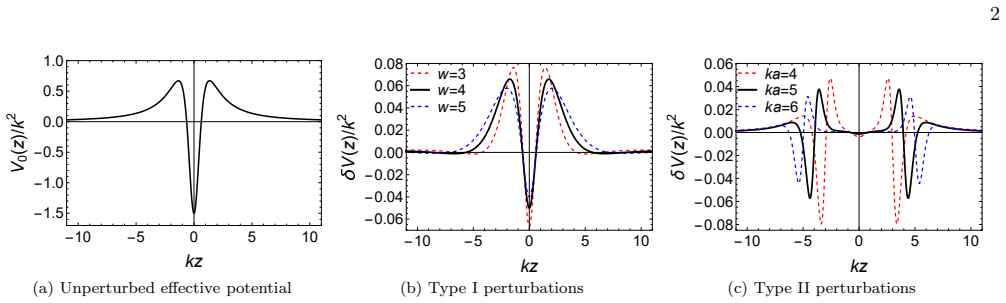
Representative perturbations and their scope The Letter studies representative parameterized defor- mations of the tensor potential designed to isolate two universal mechanisms of spectral response: local barrier reshaping and remote cavity formation. The physical requirement imposed throughout is that the deformed potential must still support a normaliza...
-
[44]
(21) For the parameterized family used here, the most di- rect way to check localization is to examine the large- |z| asymptotics of W (z)
Zero-mode localization Because the tensor potential always admits the factor- ized form −∂ 2 z +V (z) = ( −∂z +W ) (∂z +W ), (19) the graviton zero mode satisfies (∂z +W )ψ 0(z) = 0, (20) 8 and therefore ψ 0(z) ∝ exp [ − ∫ z W (z′)dz′ ] . (21) For the parameterized family used here, the most di- rect way to check localization is to examine the large- |z| a...
-
[45]
Quasinormal modes are defined by the outgoing boundary conditions ψ (z) ∝ { eimz, z → +∞ , e− imz, z → −∞
Numerical procedures and robustness checks Frequency domain. Quasinormal modes are defined by the outgoing boundary conditions ψ (z) ∝ { eimz, z → +∞ , e− imz, z → −∞ . (27) The least-damped QNM is denoted by ¯ m(ǫ) and is dis- tinct from the graviton zero mode. For Type I we use the Bernstein spectral method [ 41]. Following the standard compactification u...
discussion (0)
Sign in with ORCID, Apple, or X to comment. Anyone can read and Pith papers without signing in.