Recognition: unknown
Forecasting graviton-mass constraints from the full covariance of PTA-astrometry ORF estimators
Pith reviewed 2026-05-08 07:37 UTC · model grok-4.3
The pith
Full covariance between PTA and astrometry data improves graviton-mass limits from nanohertz gravitational waves.
A machine-rendered reading of the paper's core claim, the machinery that carries it, and where it could break.
Core claim
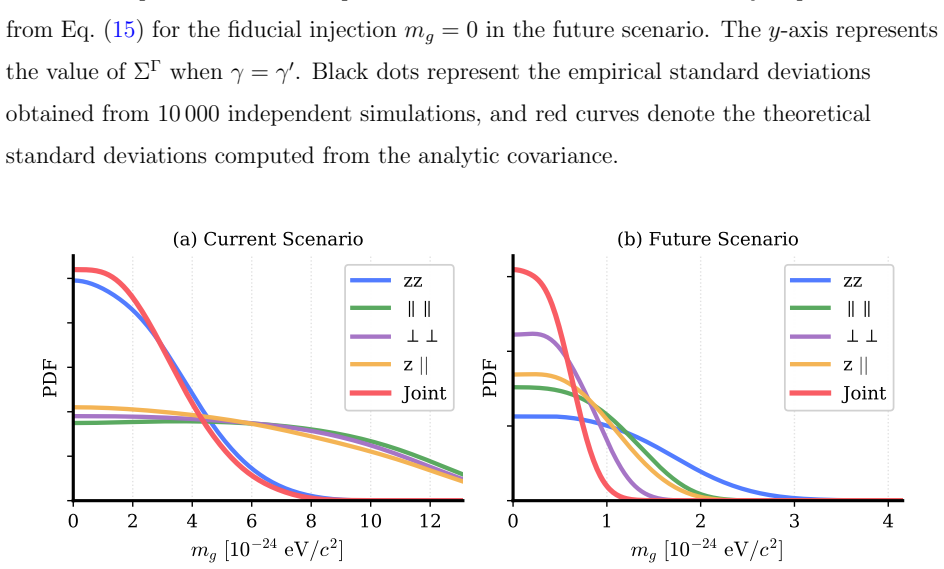
Deriving closed-form expressions for the complete covariance matrix of PTA-astrometry ORF estimators, including signal-signal, noise-noise, and signal-noise pieces, shows that joint analysis of timing and astrometric data from a nanohertz SGWB yields an expected 90 percent upper limit of m_g < 4.41 × 10^{-24} eV/c² for NANOGrav-Gaia sensitivities and m_g < 0.48 × 10^{-24} eV/c² for SKA-Theia sensitivities, with astrometry contributing substantially in the latter case.
What carries the argument
The full-covariance formalism for PTA-astrometry overlap reduction function estimators, which folds all auto- and cross-channel covariances into the likelihood for a graviton-mass-dependent SGWB spectrum.
If this is right
- Joint PTA-astrometry inference remains PTA-dominated today but becomes meaningfully stronger once sensitivities reach SKA and Theia levels.
- Astrometric channels supply independent information that reduces the upper bound on graviton mass by almost a factor of ten in the future configuration.
- The analytic covariance expressions match numerical simulations, confirming that the multichannel approach is statistically well-defined.
- Multichannel PTA-astrometry analysis offers a practical route to tighter graviton-mass constraints without requiring entirely new detector types.
Where Pith is reading between the lines
- The same covariance machinery could be applied to other frequency-dependent modifications of the SGWB spectrum beyond simple massive-graviton dispersion.
- Combining timing and astrometry might also help separate a cosmological SGWB from other nanohertz sources once both datasets mature.
- The formalism is likely portable to any wave-like background whose overlap reduction function can be written in closed form.
Load-bearing premise
The forecasts rely on assumed noise levels, sensitivities, and lack of unmodeled systematics for future instruments together with a specific shape for the nanohertz SGWB spectrum.
What would settle it
Comparison of the forecasted joint limit of 0.48 × 10^{-24} eV/c² against the actual limit obtained once SKA and Theia/Gaia-NIR data are in hand.
Figures


read the original abstract
We develop a full-covariance formalism for pulsar timing array(PTA) -- astrometry verlap reduction function (ORF) estimators and use it to forecast graviton-mass constraints from a nanohertz stochastic gravitational-wave background (SGWB). Analytic covariance expressions are derived for auto- and cross-channel ORF estimators, including signal-signal, noise-noise, and signal-noise contributions, and are validated against numerical simulations. For an observational configuration with sensitivities comparable to NANOGrav and Gaia, we obtain an expected joint 90\% upper limit of $m_g<4.41\times10^{-24}\,\mathrm{eV}/c^2$, which remains PTA-dominated and lies at the same order of magnitude as the existing NANOGrav 15-year PTA-only bound. For a future-like configuration with sensitivities comparable to the SKA and Theia/Gaia-NIR, the astrometric channels contribute significantly to the constraining power, and the joint limit improves to $m_g<0.48 \times 10^{-24} \, \mathrm{eV}/c^2$. These forecasts indicate that PTA -- astrometry multichannel inference provides a viable avenue for improving graviton-mass constraints under next-generation observational conditions.
Editorial analysis
A structured set of objections, weighed in public.
Referee Report
Summary. The manuscript develops a full-covariance formalism for pulsar timing array (PTA) and astrometry overlap reduction function (ORF) estimators, deriving analytic expressions that include signal-signal, noise-noise, and signal-noise contributions. These are validated against numerical simulations and then applied to forecast 90% upper limits on the graviton mass from a nanohertz stochastic gravitational wave background, yielding m_g < 4.41 × 10^{-24} eV/c² for a NANOGrav+Gaia-like configuration and m_g < 0.48 × 10^{-24} eV/c² for an SKA+Theia/Gaia-NIR-like configuration.
Significance. If the forecasts prove robust, the work supplies a technically sound multichannel framework that can tighten graviton-mass bounds beyond current PTA-only results once next-generation instruments reach the assumed sensitivities. The explicit derivation of the complete analytic covariance matrix and its numerical validation constitute a clear methodological contribution that supports more accurate joint inference than approximate treatments.
major comments (2)
- [Abstract and forecast results] Abstract (future-like configuration paragraph) and associated forecast results: the reported improvement to m_g < 0.48 × 10^{-24} eV/c² is stated to arise from significant astrometric contribution, yet the calculation adopts fixed noise PSDs, astrometric precisions, and a specific SGWB spectral form without any parameter variation, marginalization, or systematic tests; because these inputs directly determine the numerical value of the joint limit, the central forecasting claim requires explicit robustness checks to be load-bearing.
- [Covariance validation section] Validation of analytic covariances: while the manuscript states that the full covariance expressions (including cross terms) are validated against simulations, the validation details do not address whether the mass-dependent modifications to the ORF are accurately reproduced across the frequency band and instrument configurations used for the SKA/Theia forecasts.
minor comments (1)
- The abstract and methods could more explicitly state the precise power-law index or broken-power-law parameters adopted for the nanohertz SGWB spectrum, as these enter the mass-dependent ORF and therefore affect the quoted limits.
Simulated Author's Rebuttal
We thank the referee for the constructive comments on our manuscript. We address the two major points below regarding the robustness of the forecast results and the details of the covariance validation. We indicate planned revisions where appropriate.
read point-by-point responses
-
Referee: [Abstract and forecast results] Abstract (future-like configuration paragraph) and associated forecast results: the reported improvement to m_g < 0.48 × 10^{-24} eV/c² is stated to arise from significant astrometric contribution, yet the calculation adopts fixed noise PSDs, astrometric precisions, and a specific SGWB spectral form without any parameter variation, marginalization, or systematic tests; because these inputs directly determine the numerical value of the joint limit, the central forecasting claim requires explicit robustness checks to be load-bearing.
Authors: We agree that the specific numerical forecast values depend on the assumed parameters and that explicit robustness checks would make the claims more load-bearing. The configurations are chosen as representative benchmarks drawn from the literature (NANOGrav/Gaia for current-like and SKA/Theia for future-like), with the primary aim of the paper being to present and validate the full-covariance formalism rather than to perform exhaustive parameter scans or marginalizations. In the revised manuscript we will add a short paragraph in the forecast section (near the presentation of the 0.48 × 10^{-24} result) that qualitatively discusses the sensitivity of the joint limit to variations in noise PSDs and astrometric precision, noting how these would affect the relative weight of the astrometric channels. A full marginalization over these parameters lies outside the scope of the present work but is a natural direction for follow-up. revision: partial
-
Referee: [Covariance validation section] Validation of analytic covariances: while the manuscript states that the full covariance expressions (including cross terms) are validated against simulations, the validation details do not address whether the mass-dependent modifications to the ORF are accurately reproduced across the frequency band and instrument configurations used for the SKA/Theia forecasts.
Authors: The mass-dependent modifications enter the ORF through the altered dispersion relation for a massive graviton, which modifies the frequency-dependent phase and amplitude factors in the signal covariance. Our analytic expressions retain these terms explicitly. The Monte Carlo validation compares the full analytic covariance matrix (signal-signal, noise-noise, and cross terms) against simulations that employ the identical mass-dependent ORF model. The simulated frequency bands and pulsar/astrometric configurations span the nanohertz range used for both the current-like and SKA/Theia forecasts. Consequently the reported agreement already covers the mass-dependent behavior for the configurations in question. In the revision we will insert an explicit sentence in the validation section stating that the tested frequency range and instrument setups encompass those adopted for the SKA/Theia forecasts. revision: yes
Circularity Check
No significant circularity in derivation or forecasts
full rationale
The paper derives analytic covariance expressions for auto- and cross-channel ORF estimators (signal-signal, noise-noise, signal-noise terms) from first principles and validates them numerically against simulations. These expressions are then applied to externally assumed instrument configurations (NANOGrav/Gaia and SKA/Theia-like sensitivities) and a standard nanohertz SGWB spectrum to produce forecasts for graviton-mass limits. No load-bearing step reduces the claimed results to quantities fitted from the same data, self-defined quantities, or a self-citation chain; the forecasts are direct applications of the independent formalism to specified external inputs.
Axiom & Free-Parameter Ledger
free parameters (1)
- instrument noise and sensitivity parameters
axioms (2)
- domain assumption The nanohertz SGWB is isotropic, stationary, and follows a power-law spectrum modified by a massive-graviton dispersion relation
- domain assumption The full covariance matrix of PTA and astrometry ORF estimators can be computed analytically from signal and noise contributions
Reference graph
Works this paper leans on
-
[1]
C. de Rham, J. T. Deskins, A. J. Tolley, and S.-Y. Zhou, Rev. Mod. Phys.89, 025004 (2017), arXiv:1606.08462 [astro-ph.CO]
work page Pith review arXiv 2017
-
[2]
C. M. Will, Living Rev. Rel.17, 4 (2014), arXiv:1403.7377 [gr-qc]
work page internal anchor Pith review arXiv 2014
-
[3]
Fierz and W
M. Fierz and W. Pauli, Proc. Roy. Soc. Lond. A173, 211 (1939)
1939
- [4]
-
[5]
1999, apj, 517, 565, doi: 10.1086/307221
S. Perlmutteret al.(Supernova Cosmology Project), Astrophys. J.517, 565 (1999), arXiv:astro-ph/9812133
work page internal anchor Pith review arXiv 1999
-
[6]
C. de Rham, G. Gabadadze, and A. J. Tolley, Phys. Rev. Lett.106, 231101 (2011), arXiv:1011.1232 [hep-th]
-
[7]
G. ’t Hooft, Found. Phys.38, 733 (2008), arXiv:0804.0328 [gr-qc]
-
[8]
Navaset al.(Particle Data Group), Phys
S. Navaset al.(Particle Data Group), Phys. Rev. D110, 030001 (2024)
2024
-
[9]
Constraining the mass of the graviton with the planetary ephemeris INPOP,
L. Bernus, O. Minazzoli, A. Fienga, M. Gastineau, J. Laskar, and P. Deram, Phys. Rev. Lett. 123, 161103 (2019), arXiv:1901.04307 [gr-qc]
-
[10]
S. Desai, Phys. Lett. B778, 325 (2018), arXiv:1708.06502 [astro-ph.CO]
-
[11]
C. M. Will, Phys. Rev. D57, 2061 (1998), arXiv:gr-qc/9709011
work page Pith review arXiv 2061
-
[12]
R. Abbottet al.(LIGO Scientific, Virgo), Phys. Rev. D103, 122002 (2021), arXiv:2010.14529 [gr-qc]. 20
work page internal anchor Pith review arXiv 2021
- [13]
-
[14]
The NANOGrav 15-year Data Set: Evidence for a Gravitational-Wave Background
G. Agazieet al.(NANOGrav), Astrophys. J. Lett.951, L8 (2023), arXiv:2306.16213 [astro- ph.HE]
work page internal anchor Pith review arXiv 2023
-
[15]
Antoniadiset al.(EPTA, InPTA:), Astron
J. Antoniadiset al.(EPTA, InPTA), Astron. Astrophys.678, A50 (2023), arXiv:2306.16214 [astro-ph.HE]
-
[16]
D. J. Reardonet al., Astrophys. J. Lett.951, L6 (2023), arXiv:2306.16215 [astro-ph.HE]
work page internal anchor Pith review arXiv 2023
-
[17]
H. Xuet al., Res. Astron. Astrophys.23, 075024 (2023), arXiv:2306.16216 [astro-ph.HE]
work page internal anchor Pith review arXiv 2023
- [18]
- [19]
-
[20]
S. Wang and Z.-C. Zhao, Phys. Rev. D109, L061502 (2024), arXiv:2307.04680 [astro-ph.HE]
- [21]
-
[22]
R. W. Hellings and G. S. Downs, Astrophys. J. Lett.265, L39 (1983)
1983
-
[23]
B. Allen and J. D. Romano, Phys. Rev. D108, 043026 (2023), arXiv:2208.07230 [gr-qc]
- [24]
-
[25]
L. G. Book and E. E. Flanagan, Phys. Rev. D83, 024024 (2011), arXiv:1009.4192 [astro- ph.CO]
work page Pith review arXiv 2011
-
[26]
W. Qin, K. K. Boddy, M. Kamionkowski, and L. Dai, Phys. Rev. D99, 063002 (2019), arXiv:1810.02369 [astro-ph.CO]
work page Pith review arXiv 2019
- [27]
- [28]
- [29]
-
[30]
M. C ¸ alı¸ skan, Y. Chen, L. Dai, N. Anil Kumar, I. Stomberg, and X. Xue, JCAP05, 030 (2024), arXiv:2312.03069 [gr-qc]
-
[31]
D. P. Mihaylov, C. J. Moore, J. R. Gair, A. Lasenby, and G. Gilmore, Phys. Rev. D97, 124058 (2018), arXiv:1804.00660 [gr-qc]. 21
work page Pith review arXiv 2018
- [32]
- [33]
-
[34]
T. Prustiet al.(Gaia), Astron. Astrophys.595, A1 (2016), arXiv:1609.04153 [astro-ph.IM]
work page Pith review arXiv 2016
- [35]
- [36]
-
[37]
Gravitational wave astronomy with the SKA
G. Janssenet al., PoSAASKA14, 037 (2015), arXiv:1501.00127 [astro-ph.IM]
work page Pith review arXiv 2015
-
[38]
D. Hobbset al., Exper. Astron.51, 783 (2021), arXiv:1907.12535 [astro-ph.IM]
-
[39]
Theia: Faint objects in motion or the new astrometry frontier
C. Boehmet al.(Theia), (2017), arXiv:1707.01348 [astro-ph.IM]
work page Pith review arXiv 2017
-
[40]
Gravitational Wave Experiments and Early Universe Cosmology
M. Maggiore, Phys. Rept.331, 283 (2000), arXiv:gr-qc/9909001
work page Pith review arXiv 2000
-
[41]
Allen, inLes Houches School of Physics: Astrophysical Sources of Gravitational Radiation (1996) pp
B. Allen, inLes Houches School of Physics: Astrophysical Sources of Gravitational Radiation (1996) pp. 373–417, arXiv:gr-qc/9604033
-
[42]
S. L. Detweiler, Astrophys. J.234, 1100 (1979)
1979
-
[43]
M. V. Sazhin, Sov. Astron.22, 36 (1978)
1978
-
[44]
V. B. Braginsky, N. S. Kardashev, I. D. Novikov, and A. G. Polnarev, Nuovo Cim. B105, 1141 (1990)
1990
-
[45]
B. Allen and J. D. Romano, Phys. Rev. D59, 102001 (1999), arXiv:gr-qc/9710117
work page Pith review arXiv 1999
-
[46]
E. S. Phinney, (2001), arXiv:astro-ph/0108028
work page internal anchor Pith review arXiv 2001
-
[47]
Christensen, Phys
N. Christensen, Phys. Rev. D46, 5250 (1992)
1992
- [48]
- [49]
-
[50]
Asymptotic formulae for likelihood-based tests of new physics
G. Cowan, K. Cranmer, E. Gross, and O. Vitells, Eur. Phys. J. C71, 1554 (2011), [Erratum: Eur.Phys.J.C 73, 2501 (2013)], arXiv:1007.1727 [physics.data-an]
work page internal anchor Pith review arXiv 2011
-
[51]
K. M. G´ orski, E. Hivon, A. J. Banday, B. D. Wandelt, F. K. Hansen, M. Reinecke, and M. Bartelman, Astrophys. J.622, 759 (2005), arXiv:astro-ph/0409513
work page internal anchor Pith review arXiv 2005
-
[52]
X. Siemens, J. Ellis, F. Jenet, and J. D. Romano, Class. Quant. Grav.30, 224015 (2013), arXiv:1305.3196 [astro-ph.IM]
- [53]
-
[54]
G. Agazieet al.(NANOGrav), Astrophys. J. Lett.951, L10 (2023), arXiv:2306.16218 [astro- ph.HE]
-
[55]
J. Carron, Astron. Astrophys.551, A88 (2013), arXiv:1204.4724 [astro-ph.CO]
- [56]
- [57]
- [58]
-
[59]
Q. Liang, M.-X. Lin, M. Trodden, and S. S. C. Wong, Phys. Rev. D109, 083028 (2024), arXiv:2309.16666 [astro-ph.CO]. 23
discussion (0)
Sign in with ORCID, Apple, or X to comment. Anyone can read and Pith papers without signing in.