Recognition: unknown
Beyond Local vs. External: A Game-Theoretic Framework for Trustworthy Knowledge Acquisition
Pith reviewed 2026-05-08 08:12 UTC · model grok-4.3
The pith
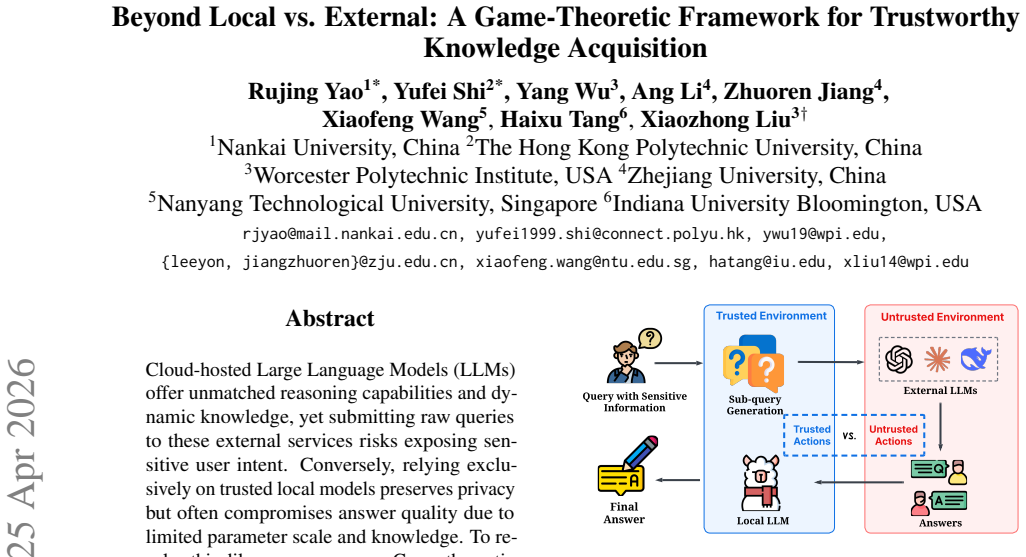
A game-theoretic framework trains a sub-query generator against an attacker to hide sensitive intent while querying external LLMs for accurate answers.
A machine-rendered reading of the paper's core claim, the machinery that carries it, and where it could break.
Core claim
GTKA formulates the trade-off between knowledge utility and privacy as a strategic game. It consists of a privacy-aware sub-query generator that decomposes sensitive intent into generalized low-risk fragments, an adversarial reconstruction attacker that infers the original query from fragments to supply leakage signals, and a trusted local integrator that synthesizes external responses. Training the generator and attacker in an alternating adversarial manner optimizes the sub-query policy to maximize acquisition accuracy while minimizing reconstructability of the original intent.
What carries the argument
The alternating adversarial training between the privacy-aware sub-query generator and the reconstruction attacker that supplies adaptive leakage signals.
If this is right
- GTKA reduces intent leakage relative to state-of-the-art baselines on the constructed biomedical and legal benchmarks.
- Answer quality remains comparable to direct external queries despite the added privacy steps.
- The framework applies directly to any domain where raw query text risks exposing confidential intent.
- Local integration of external responses occurs inside a secure boundary after sub-query processing.
Where Pith is reading between the lines
- The same decomposition-plus-attacker pattern could be tested on non-LLM external services such as search APIs or specialized databases.
- If stable equilibria prove domain-general, organizations might shift from fully local deployments to hybrid setups for cost-sensitive privacy tasks.
- A direct test would measure whether reconstruction accuracy correlates with downstream task performance across additional fields such as finance or personnel records.
Load-bearing premise
The adversarial training reaches a stable equilibrium in which the generator produces useful sub-queries instead of uninformative fragments that evade reconstruction at the expense of answer quality.
What would settle it
An experiment in which minimizing reconstruction success causes answer quality on the biomedical or legal benchmarks to fall below the level of local-only baselines would show the claimed equilibrium does not exist.
Figures


read the original abstract
Cloud-hosted Large Language Models (LLMs) offer unmatched reasoning capabilities and dynamic knowledge, yet submitting raw queries to these external services risks exposing sensitive user intent. Conversely, relying exclusively on trusted local models preserves privacy but often compromises answer quality due to limited parameter scale and knowledge. To resolve this dilemma, we propose Game-theoretic Trustworthy Knowledge Acquisition (GTKA), a framework that formulates the trade-off between knowledge utility and privacy as a strategic game. GTKA consists of three components: (i) a privacy-aware sub-query generator that decomposes sensitive intent into generalized, low-risk fragments; (ii) an adversarial reconstruction attacker that attempts to infer the original query from these fragments, providing adaptive leakage signals; and (iii) a trusted local integrator that synthesizes external responses within a secure boundary. By training the generator and attacker in an alternating adversarial manner, GTKA optimizes the sub-query generation policy to maximize knowledge acquisition accuracy while minimizing the reconstructability of the original sensitive intent. To validate our approach, we construct two sensitive-domain benchmarks in the biomedical and legal fields. Extensive experiments demonstrate that GTKA significantly reduces intent leakage compared to state-of-the-art baselines while maintaining high-fidelity answer quality.
Editorial analysis
A structured set of objections, weighed in public.
Referee Report
Summary. The paper proposes Game-theoretic Trustworthy Knowledge Acquisition (GTKA), a framework that models the privacy-utility tradeoff when querying external LLMs as a strategic game. It introduces a privacy-aware sub-query generator that decomposes sensitive user intent into generalized low-risk fragments, an adversarial reconstruction attacker that provides leakage signals during alternating training, and a trusted local integrator that synthesizes external responses. New benchmarks in the biomedical and legal domains are constructed, and the abstract asserts that extensive experiments show GTKA significantly reduces intent leakage relative to state-of-the-art baselines while preserving high-fidelity answer quality.
Significance. If the empirical claims hold after addressing the equilibrium-stability concerns, GTKA would represent a useful game-theoretic contribution to privacy-preserving LLM interactions in sensitive domains. The adversarial formulation and introduction of domain-specific benchmarks are strengths that could inform subsequent work on secure knowledge acquisition.
major comments (2)
- [Abstract] Abstract: the central claim that GTKA 'significantly reduces intent leakage' while 'maintaining high-fidelity answer quality' is asserted without any quantitative results, baseline descriptions, statistical tests, ablation details, or effect sizes. This absence makes it impossible to evaluate whether the reported leakage reduction is achieved via a non-trivial equilibrium or the trivial low-information policy identified in the stress-test note.
- [Game formulation and training procedure] Game formulation and training procedure: the alternating min-max optimization between the sub-query generator and reconstruction attacker is described without any regularization term, diversity penalty, or Pareto-frontier analysis that would prevent the generator from converging to uninformative generic fragments. This directly threatens the load-bearing assumption that answer accuracy remains high at the Nash equilibrium rather than collapsing at the cost of the local integrator's performance.
minor comments (2)
- [Abstract] The abstract would be improved by including at least one key quantitative result (e.g., leakage reduction percentage or answer accuracy delta) to ground the claims.
- [Benchmarks] Details on benchmark construction (how sensitive intent is operationalized in the biomedical and legal datasets) are missing from the summary, which affects reproducibility assessment.
Simulated Author's Rebuttal
We thank the referee for the constructive comments, which help clarify how to strengthen the presentation of our empirical claims and the stability analysis of the proposed game. We respond point-by-point below and will incorporate revisions to address the concerns.
read point-by-point responses
-
Referee: [Abstract] Abstract: the central claim that GTKA 'significantly reduces intent leakage' while 'maintaining high-fidelity answer quality' is asserted without any quantitative results, baseline descriptions, statistical tests, ablation details, or effect sizes. This absence makes it impossible to evaluate whether the reported leakage reduction is achieved via a non-trivial equilibrium or the trivial low-information policy identified in the stress-test note.
Authors: We agree that the abstract would benefit from quantitative support for the central claims. In the revised manuscript we will update the abstract to include concise references to the key experimental outcomes on the biomedical and legal benchmarks (e.g., measured leakage reductions relative to baselines and maintained answer fidelity metrics), together with pointers to the relevant tables, ablation studies, and any statistical tests. This will allow readers to directly assess whether the observed equilibrium is non-trivial. revision: yes
-
Referee: [Game formulation and training procedure] Game formulation and training procedure: the alternating min-max optimization between the sub-query generator and reconstruction attacker is described without any regularization term, diversity penalty, or Pareto-frontier analysis that would prevent the generator from converging to uninformative generic fragments. This directly threatens the load-bearing assumption that answer accuracy remains high at the Nash equilibrium rather than collapsing at the cost of the local integrator's performance.
Authors: The referee correctly notes that the current description of the alternating optimization does not explicitly include regularization or Pareto analysis. Our existing stress-test note and benchmark results already show that answer quality remains high while leakage is reduced, indicating that the learned policy does not collapse to the trivial low-information solution. Nevertheless, to make the stability of the Nash equilibrium more explicit, we will add a diversity penalty to the generator objective and include a Pareto-frontier analysis in the experiments section of the revised manuscript. We will also expand the training-procedure description with convergence monitoring details. revision: yes
Circularity Check
No circularity: GTKA is a novel adversarial construction validated on external benchmarks
full rationale
The paper introduces GTKA as an explicit three-component game (generator, attacker, integrator) with alternating min-max training. Performance claims rest on experiments using newly constructed biomedical and legal benchmarks, not on any equation or parameter that reduces by construction to the inputs. No self-definitional relations, fitted inputs renamed as predictions, load-bearing self-citations, or smuggled ansatzes appear in the derivation chain.
Axiom & Free-Parameter Ledger
axioms (1)
- domain assumption The interaction between query generator and reconstruction attacker can be modeled as an alternating adversarial game whose equilibrium improves both objectives.
invented entities (3)
-
Privacy-aware sub-query generator
no independent evidence
-
Adversarial reconstruction attacker
no independent evidence
-
Trusted local integrator
no independent evidence
Reference graph
Works this paper leans on
-
[1]
Badhan Chandra Das, M Hadi Amini, and Yanzhao Wu
Stackelberg game preference optimization for data-efficient alignment of language models.arXiv preprint arXiv:2502.18099. Badhan Chandra Das, M Hadi Amini, and Yanzhao Wu
-
[2]
Giuseppe De Nittis and Francesco Trovo
Security and privacy challenges of large lan- guage models: A survey.ACM Computing Surveys, 57(6):1–39. Giuseppe De Nittis and Francesco Trovo. 2016. Ma- chine learning techniques for stackelberg security games: a survey.arXiv preprint arXiv:1609.09341. Tanner Fiez, Benjamin Chasnov, and Lillian Ratliff
-
[3]
Explaining and Harnessing Adversarial Examples
Implicit learning dynamics in stackelberg games: Equilibria characterization, convergence anal- ysis, and empirical study. InInternational conference on machine learning, pages 3133–3144. PMLR. Craig Gentry. 2009. Fully homomorphic encryption using ideal lattices. InProceedings of the forty-first annual ACM symposium on Theory of computing, pages 169–178....
work page internal anchor Pith review arXiv 2009
-
[4]
Ppfl: Privacy-preserving federated learning with trusted execution environments. InProceedings of the 19th annual international conference on mobile systems, applications, and services, pages 94–108. Olga Ohrimenko, Felix Schuster, Cédric Fournet, Aastha Mehta, Sebastian Nowozin, Kapil Vaswani, and Manuel Costa. 2016. Oblivious {Multi-Party} machine learn...
-
[5]
Sofia Eleni Spatharioti, David Rothschild, Daniel G Goldstein, and Jake M Hofman
Direct preference optimization: Your language model is secretly a reward model.Advances in neural information processing systems, 36:53728–53741. Sofia Eleni Spatharioti, David Rothschild, Daniel G Goldstein, and Jake M Hofman. 2025. Effects of llm- based search on decision making: Speed, accuracy, and overreliance. InProceedings of the 2025 CHI Conferenc...
2025
-
[6]
Privacy leak detection in llm interactions with a user-centric approach. In2024 IEEE 23rd Interna- tional Conference on Trust, Security and Privacy in Computing and Communications (TrustCom), pages 1647–1652. IEEE. Latanya Sweeney. 2002. k-anonymity: A model for pro- tecting privacy.International journal of uncertainty, fuzziness and knowledge-based syste...
-
[9]
Output Format:Return only a valid JSON object
Inference Utility: Ensure the generated ques- tions are valuable such that their combined answers allow a local model to infer the orig- inal answer, without exposing specific re- search targets to external models. Output Format:Return only a valid JSON object. User Prompt:Original question: {question}. Please generaten new general-knowledge ques- tions. ...
-
[12]
Output Format:Return strictly in JSON for- mat only
Inference Utility: Ensure the generated ques- tions are valuable such that their combined answers allow a local model to infer the orig- inal answer, without exposing specific case strategies or client matters to external mod- els. Output Format:Return strictly in JSON for- mat only. User Prompt:Original question: {question}. Please generaten new general-...
-
[13]
Instead, generate multiple new questions derived from broader concepts, underlying princi- ples, mechanisms, and general knowledge in related domains
Abstraction Strategy: Do not paraphrase or rewrite the original question. Instead, generate multiple new questions derived from broader concepts, underlying princi- ples, mechanisms, and general knowledge in related domains
-
[14]
This strictly prohibits: lab/project names, specific gene/protein names, cell types, specific diseases, drugs, named bi- ological processes, or concrete experimental data
Strict Privacy Constraints: The generated questions must not contain any specific iden- tifiers. This strictly prohibits: lab/project names, specific gene/protein names, cell types, specific diseases, drugs, named bi- ological processes, or concrete experimental data
-
[15]
Output Format:Return only a valid JSON object
Inference Utility: Ensure the generated ques- tions are valuable such that their combined answers allow a local model to infer the orig- inal answer, without exposing specific re- search targets to external models. Output Format:Return only a valid JSON object. User Prompt:Original question: {question}. Please generaten new general-knowledge ques- tions. ...
-
[16]
Instead, gen- erate multiple new questions derived from broader legal concepts, underlying princi- ples, doctrines, and general standards in re- lated domains
Abstraction Strategy: Do not paraphrase or rewrite the original question. Instead, gen- erate multiple new questions derived from broader legal concepts, underlying princi- ples, doctrines, and general standards in re- lated domains
-
[17]
This strictly prohibits: party names, specific case numbers, docket num- bers, judge names, geographic locations, or confidential case details
Strict Privacy Constraints: The generated questions must not contain any specific identifiers. This strictly prohibits: party names, specific case numbers, docket num- bers, judge names, geographic locations, or confidential case details
-
[18]
Output Format:Return only a valid JSON object
Inference Utility: Ensure the generated ques- tions are valuable such that their combined answers allow a local model to infer the orig- inal answer, without exposing specific case strategies or client matters to external mod- els. Output Format:Return only a valid JSON object. User Prompt:Original question: {question}. Please generaten new general-knowle...
discussion (0)
Sign in with ORCID, Apple, or X to comment. Anyone can read and Pith papers without signing in.