Recognition: unknown
On closed Ramsey numbers of small countable ordinals
Pith reviewed 2026-05-08 06:42 UTC · model grok-4.3
The pith
The closed Ramsey number R^{cl}(ω·n+1, 3) satisfies ω^4·(n-2)+1 < R^{cl}(ω·n+1, 3) < ω^5 for every integer n ≥ 3.
A machine-rendered reading of the paper's core claim, the machinery that carries it, and where it could break.
Core claim
The central claim is that the closed partition relation yields the strict inequality ω^4 · (n-2)+1 < R^{cl}(ω · n+1,3) < ω^5 for every integer n ≥ 3, together with the auxiliary result that ω^θ ↛_cl (ω^α,3)^2 whenever 1 ≤ α ≤ θ < ω_1 satisfy θ < R(α,3).
What carries the argument
The closed arrow notation ↛_cl and the associated closed Ramsey number R^{cl}(α, k), which records the least ordinal β such that every closed 2-coloring of pairs from β has a monochromatic closed subset of order type α or k.
If this is right
- The upper bound ω^5 holds uniformly for all n ≥ 3.
- Lower bounds for R^{cl}(ω·n+1, 3) are strengthened by a linear factor in n inside the coefficient of ω^4.
- The non-arrowing result supplies asymptotic lower bounds for the sequence R^{cl}(ω^n, 3).
- The necessary condition for an ordinal to be a topological partition ordinal is strengthened by the restriction θ < R(α,3).
- The gap between the new lower and upper bounds remains a power of ω.
Where Pith is reading between the lines
- The uniform upper bound of ω^5 may suggest that closed Ramsey numbers for higher multiples of ω stabilize at the same level.
- The dependence on the ordinary Ramsey number R(α,3) links closed partition behavior directly to classical finite and countable Ramsey numbers.
- The techniques might extend to obtain bounds for R^{cl}(ω·n+1, k) with k > 3 or for slightly larger ordinals.
Load-bearing premise
The combinatorial constructions that produce the stated lower and upper bounds on the closed partition relations are correct.
What would settle it
An explicit closed 2-coloring of the pairs from ω^5 with no monochromatic closed copy of ω·n+1 for some n ≥ 3, or a closed coloring of an ordinal of size ω^4·(n-2)+1 that avoids monochromatic closed copies of both ω·n+1 and 3.
Figures
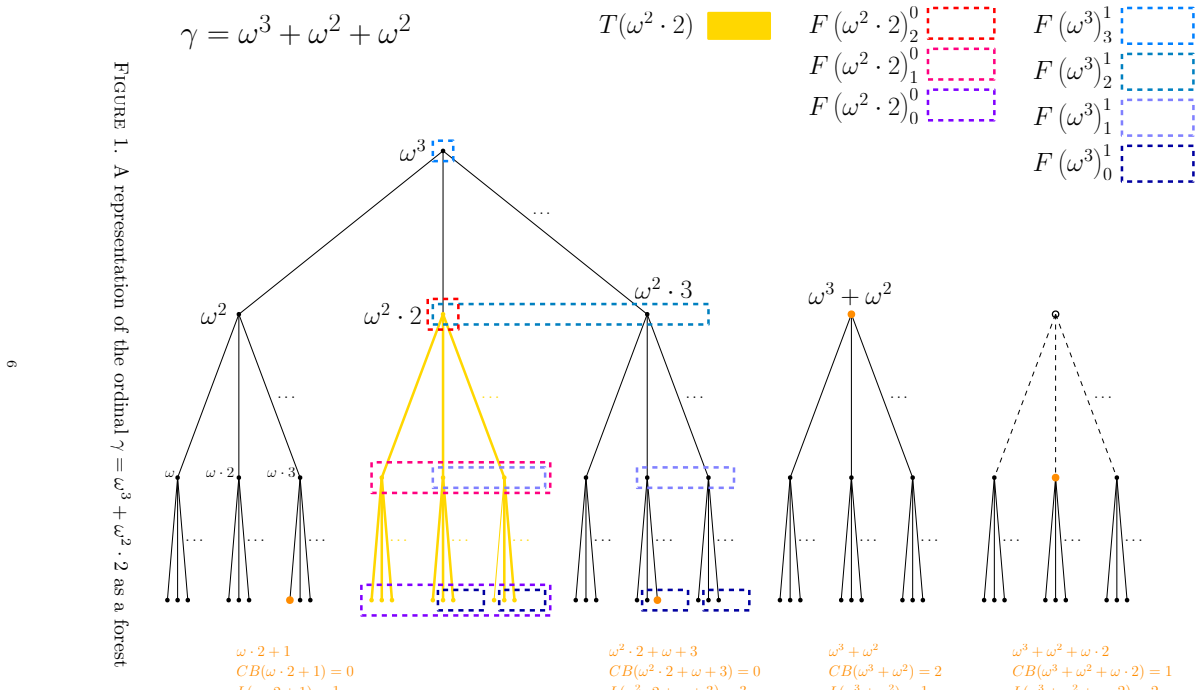

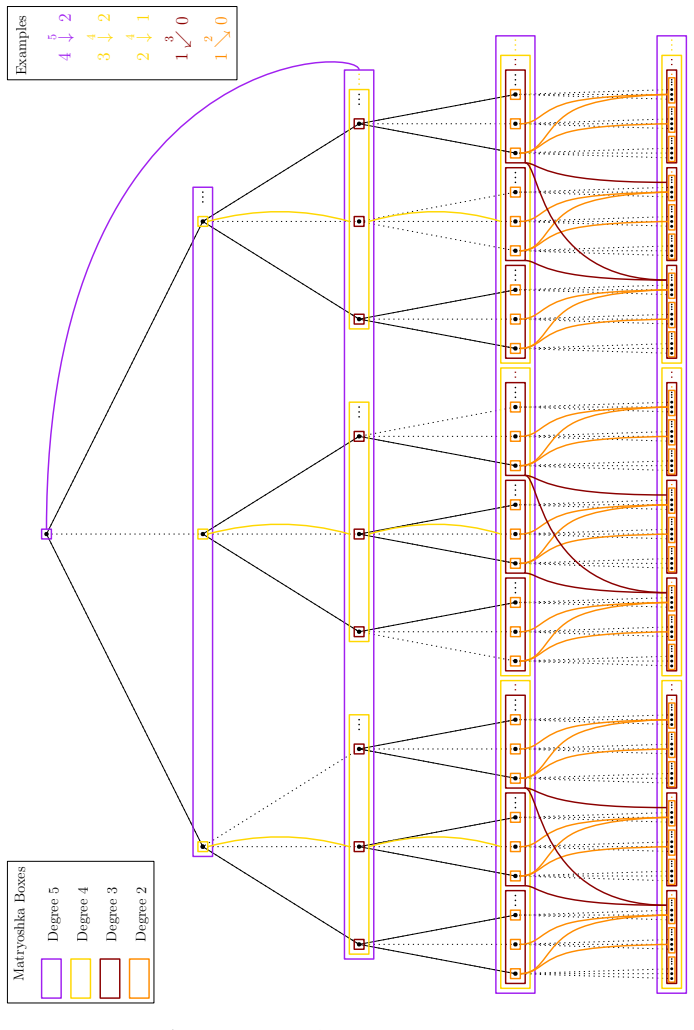
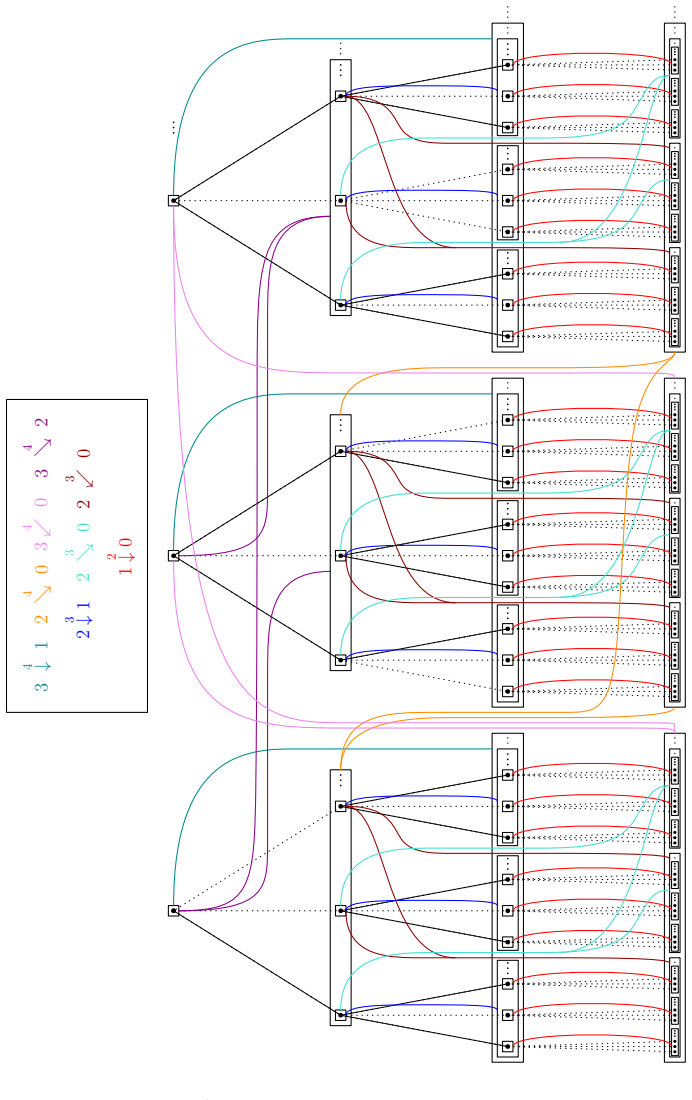
read the original abstract
This paper is a contribution to the investigation of closed partition relations for pairs of countable ordinals. As our main result, we prove that \[\omega^4 \cdot (n-2)+1 < R^{cl}(\omega \cdot n+1,3)<\omega^5\] for every integer $n \geq 3$. This result significantly improves the existing upper and lower bounds for these closed Ramsey numbers. In addition, we prove that \[\omega^{\theta}\nrightarrow_{cl} (\omega^{\alpha},3)^2\] whenever $1 \leq \alpha \leq \theta<\omega_1$ satisfy $\theta < R(\alpha,3)$. This result asymptotically improves the existing lower bounds for $R^{cl}(\omega^n,3)$ and slightly strengthens the existing necessary condition for being a topological partition ordinal.
Editorial analysis
A structured set of objections, weighed in public.
Referee Report
Summary. The paper proves improved bounds on closed Ramsey numbers for countable ordinals: specifically, that ω⁴ ⋅ (n-2) + 1 < R^{cl}(ω ⋅ n + 1, 3) < ω⁵ holds for every integer n ≥ 3. It also establishes the general non-arrowing result ω^θ ↛_cl (ω^α, 3)^2 whenever 1 ≤ α ≤ θ < ω₁ satisfy θ < R(α,3). These are obtained via explicit combinatorial constructions for the lower bound and an upper-bound argument based on ordinal arithmetic and closed partition relations, together with an asymptotic improvement to lower bounds for R^{cl}(ω^n, 3).
Significance. If the derivations are correct, the results tighten existing bounds on closed partition relations for small countable ordinals and provide a strengthened necessary condition for topological partition ordinals. The explicit, parameter-free constructions and direct verifications constitute a concrete advance in infinitary combinatorics, offering sharper tools for determining exact values of these Ramsey numbers.
minor comments (4)
- [§2] §2, Definition 2.3: the notation for the closed partition relation ↛_cl is introduced without an explicit reminder of the underlying topology on the ordinals; a one-sentence clarification would aid readers unfamiliar with the closed variant.
- [Theorem 3.1] Theorem 3.1: the upper-bound argument that R^{cl}(ω ⋅ n + 1, 3) < ω^5 is stated to follow from a general lemma, but the precise invocation of that lemma (including the value of the parameter k) is not cross-referenced in the proof paragraph.
- [§4] §4, Corollary 4.3: the asymptotic improvement to lower bounds for R^{cl}(ω^n, 3) is derived from the general non-arrowing result, yet the paper does not include a short table comparing the new bounds with the previous best known values for small n.
- [Bibliography] The bibliography lists several foundational papers on ordinal Ramsey theory but omits the most recent arXiv preprints on closed partition relations from 2022–2023; adding two or three such references would strengthen the contextual framing.
Simulated Author's Rebuttal
We thank the referee for the positive summary of our results on closed Ramsey numbers and the recommendation for minor revision. We appreciate the recognition that the explicit constructions and asymptotic improvements constitute a concrete advance.
Circularity Check
No significant circularity identified
full rationale
The paper establishes its main inequalities for closed Ramsey numbers R^{cl}(ω⋅n+1,3) via explicit combinatorial constructions for the lower bound and direct upper-bound arguments using ordinal arithmetic, all grounded in the standard definitions of closed partition relations. The secondary result on non-arrowing under θ < R(α,3) likewise follows from known properties of ordinary Ramsey numbers and direct verification of colorings, without any reduction to self-defined quantities, fitted parameters renamed as predictions, or load-bearing self-citations. The derivations are self-contained against external combinatorial benchmarks and do not exhibit any of the enumerated circularity patterns.
Axiom & Free-Parameter Ledger
axioms (1)
- standard math Standard axioms of ZFC set theory together with the usual definitions of ordinal arithmetic and closed subsets in the order topology.
Reference graph
Works this paper leans on
-
[1]
Baumgartner, Partition relations for countable topological spaces , J
[Bau86] James E. Baumgartner, Partition relations for countable topological spaces , J. Combin. Theory Ser. A 43 (1986), no. 2, 178–195. MR 867644 [CH17] Andr´ es Eduardo Caicedo and Jacob Hilton, Topological Ramsey numbers and countable ordinals, Foundations of mathematics, Contemp. Math., vol. 690, Ame r. Math. Soc., Providence, RI, 2017, pp. 87–120. MR...
1986
-
[2]
3, 173–207
[Kim95] Jeong Han Kim, The Ramsey number R(3, t ) has order of magnitude t2/ log t, Random Structures Algorithms 7 (1995), no. 3, 173–207. MR 1369063 [KS21] Burak Kaya and Irmak Sa˘ glam, On the closed Ramsey numbers Rcl(ω + n, 3), Israel J. Math. 245 (2021), no. 2, 963–989. MR 4358268 [LM97] Jean A. Larson and William J. Mitchell, On a problem of Erd¨ os...
1995
-
[3]
= ω 6, Proc. Amer. Math. Soc. 148 (2020), no. 1, 413–419. MR 4042862 [Ram29] F. P. Ramsey, On a Problem of Formal Logic , Proc. London Math. Soc. (2) 30 (1929), no. 4, 264–286. MR 1576401 [Sch10] Rene Schipperus, Countable partition ordinals , Ann. Pure Appl. Logic 161 (2010), no. 10, 1195–1215. MR 2652192 Department of Mathematics, Middle East Technical ...
2020
discussion (0)
Sign in with ORCID, Apple, or X to comment. Anyone can read and Pith papers without signing in.