Recognition: unknown
Disentangling the Effect of Ionic Coupling and Multiple Interfering Terms in Attosecond Molecular Interferometry
Pith reviewed 2026-05-08 06:40 UTC · model grok-4.3
The pith
The near-infrared field couples to the CO2 cation and opens a third quantum pathway that shapes sideband signals in attosecond interferometry.
A machine-rendered reading of the paper's core claim, the machinery that carries it, and where it could break.
Core claim
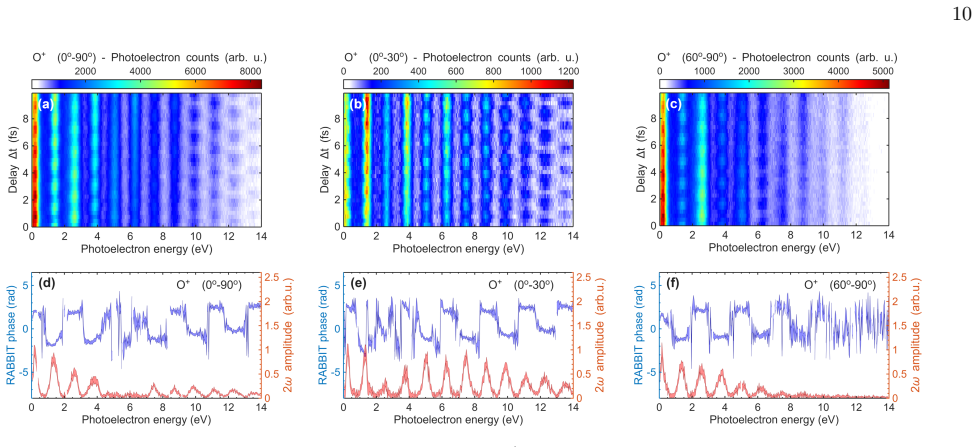
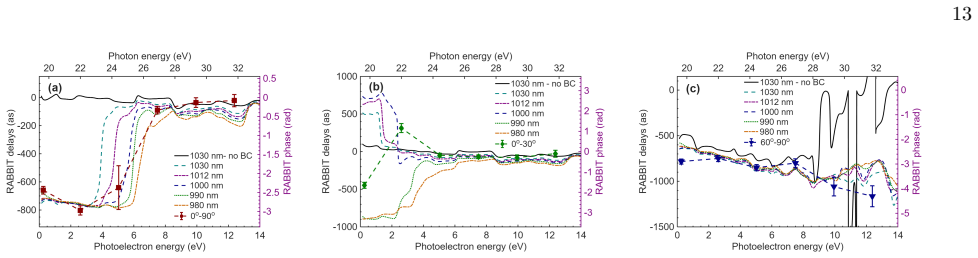
In two-color attosecond interferometry, an extreme-ultraviolet comb ejects a photoelectron that then absorbs or emits near-infrared photons to form sidebands. For CO2 dissociative channels the near-infrared field additionally couples to the molecular cation, creating a third pathway that interferes with the conventional photoelectron pathways. Angle- and energy-resolved measurements of the sideband oscillations reveal a reduction in amplitude upon angle integration; comparison with theoretical predictions that include the ionic-coupling term reproduces this reduction and allows the separate contributions of the pathways to be identified.
What carries the argument
The ionic-coupling pathway, in which the near-infrared field induces transitions between electronic levels of the molecular cation and thereby contributes an additional amplitude and phase to the sideband signal.
If this is right
- Models of molecular attosecond interferometry must include near-infrared coupling to the cation when extracting phases or timings from sideband data.
- Angle-resolved detection combined with energy gating can separate ionic-coupling contributions from ordinary photoelectron pathways.
- The additional pathway carries information about the cation's electronic dynamics during the few-femtosecond near-infrared pulse.
- The same multi-pathway analysis applies to other molecules or clusters where the near-infrared field can drive transitions in the parent ion.
Where Pith is reading between the lines
- Correcting for this pathway may improve the accuracy of molecular clocks or pump-probe schemes that rely on sideband phase shifts.
- The effect could become a diagnostic tool for mapping ionic state couplings in larger polyatomic systems where direct spectroscopy is difficult.
- In dense or condensed-phase environments the ionic-coupling term might dominate and require revised analysis methods for attosecond signals.
Load-bearing premise
That the measured reduction in interference amplitude after angle integration is caused specifically by the ionic-coupling pathway and that the theoretical model cleanly separates its contribution from all other interfering terms.
What would settle it
An experiment on the same CO2 channels that shows no reduction in sideband amplitude upon angle integration when the near-infrared intensity is lowered below the threshold for cation transitions, or a calculation that includes ionic coupling yet still fails to match the observed amplitude drop.
Figures






read the original abstract
Attosecond interferometry in a two-color field is central to attosecond metrology and spectroscopy. In this technique, a photoelectron wave packet is released when a single photon from an extreme ultraviolet comb is absorbed. The wave packet then either emits or absorbs one or more near-infrared photons, leading to the formation of sidebands of the main photoelectron peaks. This picture applies well to atoms and assumes that the near-infrared laser pulse only acts on the photoelectron leaving the parent ion. The effect of the near-infrared pulse on the electronic structure of the cation is not considered, since the field usually cannot induce transitions between its electronic levels. Here, we demonstrate how dynamics induced by the near-infrared field in the cation can significantly impact the amplitude and phases of the sideband signal of the photoelectrons associated with specific dissociative channels of CO$_2$ molecules. This coupling of the near-infrared field with the molecular cation opens a third quantum pathway contributing to the signal measured in attosecond interferometry. Through angle- and energy-resolved characterization of the sideband oscillations, we observe reduction of interference amplitude over specific energy range upon angle integration. By comparison with theoretical predictions, we can isolate the contributions of specific interfering pathways to the two-color multi-pathway photoionization process. The scheme investigated in our work is general, and our observations highlight the importance of the additional pathway for accurately interpreting attosecond interferometry experiments involving molecules and more complex quantum systems.
Editorial analysis
A structured set of objections, weighed in public.
Referee Report
Summary. The manuscript reports angle- and energy-resolved attosecond interferometry measurements on dissociative channels of CO2 in a two-color (XUV+NIR) field. It claims that NIR-induced coupling within the molecular cation opens a third quantum pathway that contributes to the observed sideband oscillations, leading to a reduction in interference amplitude upon angle integration over specific energy ranges. Comparison with theoretical predictions is used to isolate the contributions of this ionic-coupling pathway from the standard two-pathway interference.
Significance. If the theoretical isolation of the third pathway holds, the result identifies a previously under-appreciated mechanism that must be accounted for in molecular attosecond interferometry. The work supplies concrete experimental signatures (energy-specific amplitude drop after angle integration) and a general scheme for disentangling multiple interfering terms, which strengthens the interpretive framework for attosecond metrology in polyatomic systems.
major comments (2)
- [§3.2, Figure 4] §3.2 and Figure 4: The central claim that the observed amplitude reduction is due to the ionic-coupling pathway requires an explicit control calculation in which the cation-coupling matrix elements are set to zero while retaining all other terms (partial-wave interference, Franck-Condon factors, orientation averaging). The manuscript compares full theory to data but does not show that the reduction vanishes in the absence of the third pathway; without this, alternative dephasing sources cannot be excluded.
- [§4.1, Eq. (7)] §4.1, Eq. (7): The angle-integration procedure applied to the experimental sideband oscillations must be identical to that used in the theoretical model. The text states that integration is performed over the same angular range, but it is unclear whether the theoretical partial-wave expansion is truncated or converged at the same maximum L before integration; any mismatch would produce an artificial reduction unrelated to ionic coupling.
minor comments (2)
- [Abstract, §2] The abstract and §2 refer to 'specific dissociative channels' without listing the exact final ionic states or their dissociation limits; adding this information would clarify which channels are being compared.
- [Figure 3] Error bars on the experimental oscillation amplitudes (Figure 3) are not described in the caption or methods; their inclusion would allow quantitative assessment of the significance of the reported reduction.
Simulated Author's Rebuttal
We thank the referee for the careful reading of our manuscript and the constructive comments, which help strengthen the presentation of our results on ionic coupling in molecular attosecond interferometry. We address each major comment point by point below.
read point-by-point responses
-
Referee: [§3.2, Figure 4] §3.2 and Figure 4: The central claim that the observed amplitude reduction is due to the ionic-coupling pathway requires an explicit control calculation in which the cation-coupling matrix elements are set to zero while retaining all other terms (partial-wave interference, Franck-Condon factors, orientation averaging). The manuscript compares full theory to data but does not show that the reduction vanishes in the absence of the third pathway; without this, alternative dephasing sources cannot be excluded.
Authors: We agree that an explicit control calculation with the cation-coupling matrix elements set to zero (while keeping partial-wave interference, Franck-Condon factors, and orientation averaging) would provide direct evidence that the amplitude reduction arises specifically from the third pathway. In the revised manuscript we will add this calculation to §3.2 and update Figure 4 to display the sideband amplitude with and without ionic coupling. This will show that the reduction disappears when the third pathway is excluded, thereby ruling out alternative dephasing mechanisms and reinforcing our interpretation. revision: yes
-
Referee: [§4.1, Eq. (7)] §4.1, Eq. (7): The angle-integration procedure applied to the experimental sideband oscillations must be identical to that used in the theoretical model. The text states that integration is performed over the same angular range, but it is unclear whether the theoretical partial-wave expansion is truncated or converged at the same maximum L before integration; any mismatch would produce an artificial reduction unrelated to ionic coupling.
Authors: The angle integration in the theoretical model is performed over precisely the same angular range as the experiment. Our partial-wave expansion is converged with a maximum L that fully captures the relevant contributions in the energy range of interest (L_max = 6). We will revise the text in §4.1 to state this convergence explicitly and confirm that the integration procedure applied to the theoretical sideband oscillations matches the experimental one exactly, including a clarifying note on Eq. (7). This removes any ambiguity regarding possible truncation artifacts. revision: yes
Circularity Check
No circularity; claims rest on independent theory-experiment comparison
full rationale
The paper's central claim—that NIR-induced ionic coupling opens a third pathway whose contribution can be isolated via angle-integrated amplitude reduction—relies on experimental sideband oscillation data compared against separate theoretical modeling of multi-pathway photoionization. No self-definitional loops, fitted parameters renamed as predictions, or load-bearing self-citations appear in the provided abstract or skeptic analysis. The theoretical predictions are presented as treating interfering terms on equal footing with explicit controls (removal of cation-coupling term), making the isolation falsifiable against external benchmarks rather than tautological. This is the expected non-circular outcome for a paper grounded in first-principles computation and direct measurement.
Axiom & Free-Parameter Ledger
Reference graph
Works this paper leans on
-
[1]
P. M. Paul, E. S. Toma, P. Breger, G. Mullot, F. Aug´ e, Ph. Balcou, H. G. Muller, and P. Agostini, Science292, 1689 (2001)
2001
-
[2]
Varj´ u, Y
K. Varj´ u, Y. Mairesse, B. Carr´ e, M. B. Gaarde, P. Johnsson, S. Kazamias, R. L´ opez-Martens, J. Mauritsson, K. J. Schafer, PH. Balcou, A. L’huillier, and P. Sali` eres, Journal of Modern Optics52, 379 (2005)
2005
-
[3]
Sansone, T
G. Sansone, T. Pfeifer, K. Simeonidis, and A. I. Kuleff, ChemPhysChem13, 661 (2012)
2012
-
[4]
Calegari, G
F. Calegari, G. Sansone, S. Stagira, C. Vozzi, and M. Nisoli, Journal of Physics B49, 062001 (2016)
2016
-
[5]
Nisoli, P
M. Nisoli, P. Decleva, F. Calegari, A. Palacios, and F. Mart´ ın, Chemical Reviews117, 10760 (2017)
2017
-
[6]
Huppert, I
M. Huppert, I. Jordan, D. Baykusheva, A. von Conta, and H. J. W¨ orner, Physical Review Letters117, 093001 (2016)
2016
-
[7]
Nandi, E
S. Nandi, E. Pl´ esiat, S. Zhong, A. Palacios, D. Busto, M. Isinger, L. Neoriˇ ci´ c, C. L. Arnold, R. J. Squibb, R. Feifel, P. Decleva, A. L’Huillier, F. Mart´ ın, and M. Gisselbrecht, Science Advances6, eaba7762 (2020)
2020
-
[8]
X. Gong, W. Jiang, J. Tong, J. Qiang, P. Lu, H. Ni, R. Lucchese, K. Ueda, and J. Wu, Physical Review X12, 011002 (2022)
2022
-
[9]
J. Vos, L. Cattaneo, S. Patchkovskii, T. Zimmermann, C. Cirelli, M. Lucchini, A. Kheifets, A. S. Landsman, and U. Keller, Science360, 1326 (2018)
2018
-
[10]
Ahmadi, E
H. Ahmadi, E. Pl´ esiat, M. Moioli, F. Frassetto, L. Poletto, P. Decleva, C. D. Schr¨ oter, T. Pfeifer, R. Moshammer, A. Palacios, F. Martin, and G. Sansone, Nature Communications13, 1242 (2022)
2022
-
[11]
Kasmi, M
L. Kasmi, M. Lucchini, L. Castiglioni, P. Kliuiev, J. Osterwalder, M. Hengsberger, L. Gallmann, P. Kr¨ uger, and U. Keller, Optica4, 1492 (2017)
2017
-
[12]
M. J. Ambrosio and U. Thumm, Phys. Rev. A100, 043412 (2019)
2019
-
[13]
Q. Liao, W. Cao, Q. Zhang, K. Liu, F. Wang, P. Lu, and U. Thumm, Phys. Rev. Lett.125, 043201 (2020)
2020
-
[14]
Benda, Z
J. Benda, Z. Maˇ s´ ın, and J. D. Gorfinkiel, Physical Review A105, 053101 (2022)
2022
-
[15]
Hoang and U
V.-H. Hoang and U. Thumm, Physical Review A109, 033117 (2024)
2024
-
[16]
Ruberti, P
M. Ruberti, P. Decleva, and V. Averbukh, Physical Chemistry Chemical Physics20, 8311 (2018)
2018
-
[17]
Makos, D
I. Makos, D. Busto, J. Benda, D. Ertel, B. Merzuk, B. Steiner, F. Frassetto, L. Poletto, C. D. Schr¨ oter, T. Pfeifer, R. Moshammer, S. Patchkovskii, Z. Maˇ s´ ın, and G. Sansone, Nature Communications16, 8554 (2025)
2025
-
[18]
Delgado, C
J. Delgado, C. M. Gonz´ alez-Collado, P. Decleva, A. Palacios, and F. Mart´ ın, Physical Review A111, 063107 (2025)
2025
-
[19]
Smirnova, Y
O. Smirnova, Y. Mairesse, S. Patchkovskii, N. Dudovich, D. Villeneuve, P. Corkum, and M. Y. Ivanov, Nature460, 972 (2009)
2009
-
[20]
Timmers, Z
H. Timmers, Z. Li, N. Shivaram, R. Santra, O. Vendrell, and A. Sandhu, Physical Review Letters113, 113003 (2014). 20
2014
-
[21]
A. Kamalov, A. L. Wang, P. H. Bucksbaum, D. J. Haxton, and J. P. Cryan, Physical Review A102, 10.1103/PhysRevA.102.023118 (2020)
-
[22]
Moshammer, M
R. Moshammer, M. Unverzagt, W. Schmitt, J. Ullrich, and H. Schmidt-B¨ ocking, Nuclear Instruments and Methods in Physics Research Section B: Beam Interactions with Materials and Atoms108, 425 (1996)
1996
-
[23]
D¨ orner, V
R. D¨ orner, V. Mergel, O. Jagutzki, L. Spielberger, J. Ullrich, R. Moshammer, and H. Schmidt-B¨ ocking, Physics Reports 330, 95 (2000)
2000
-
[24]
Gong, ´E
X. Gong, ´E. Pl´ esiat, A. Palacios, S. Heck, F. Mart´ ın, and H. J. W¨ orner, Nature Communications14, 4402 (2023)
2023
-
[25]
Ertel, D
D. Ertel, D. Busto, I. Makos, M. Schmoll, J. Benda, H. Ahmadi, M. Moioli, F. Frassetto, L. Poletto, C. D. Schr¨ oter, T. Pfeifer, R. Moshammer, Z. Maˇ s´ ın, S. Patchkovskii, and G. Sansone, Science Advances9, eadh7747 (2023)
2023
-
[26]
X. Gong, S. Heck, D. Jelovina, C. Perry, K. Zinchenko, R. Lucchese, and H. J. W¨ orner, Nature609, 507 (2022)
2022
-
[27]
Ertel, D
D. Ertel, D. Busto, I. Makos, M. Schmoll, J. Benda, F. Bragheri, R. Osellame, E. Lindroth, S. Patchkovskii, Z. Maˇ s´ ın, and G. Sansone, The Journal of Physical Chemistry A128, 1685 (2024)
2024
-
[28]
Han, J.-B
M. Han, J.-B. Ji, A. Blech, R. E. Goetz, C. Allison, L. Greenman, C. P. Koch, and H. J. W¨ orner, Nature645, 95 (2025)
2025
-
[29]
Sabbar, S
M. Sabbar, S. Heuser, R. Boge, M. Lucchini, L. Gallmann, C. Cirelli, and U. Keller, Review of Scientific Instruments85, 103113 (2014)
2014
-
[30]
Srinivas, F
H. Srinivas, F. Shobeiry, D. Bharti, T. Pfeifer, R. Moshammer, and A. Harth, Optics Express30, 13630 (2022)
2022
-
[31]
Ertel, M
D. Ertel, M. Schmoll, S. Kellerer, A. J¨ ager, R. Weissenbilder, M. Moioli, H. Ahmadi, D. Busto, I. Makos, F. Frassetto, L. Poletto, C. D. Schr¨ oter, T. Pfeifer, R. Moshammer, and G. Sansone, Review of Scientific Instruments94, 073001 (2023)
2023
-
[32]
Eland, International Journal of Mass Spectrometry and Ion Physics9, 397 (1972)
J. Eland, International Journal of Mass Spectrometry and Ion Physics9, 397 (1972)
1972
-
[33]
M. T. Praet, J. C. Lorquet, and G. Raeev, The Journal of Chemical Physics77, 4611 (1982)
1982
-
[34]
J. Liu, W. Chen, M. Hochlaf, X. Qian, C. Chang, and C. Y. Ng, The Journal of Chemical Physics118, 149 (2003)
2003
-
[35]
Meng, M.-B
Q. Meng, M.-B. Huang, and H.-B. Chang, The journal of physical chemistry. A113, 12825 (2009)
2009
-
[36]
M. Yang, L. Zhang, X. Zhuang, L. Lai, and S. Yu, The Journal of Chemical Physics128, 164308 (2008)
2008
-
[37]
L E Berg, A Karawajczyk, and C Stromholm, Journal of Physics B27, 2971 (1994)
1994
-
[38]
Bombach, J
R. Bombach, J. Dannacher, J. Stadelmann, and J. C. Lorquet, The Journal of Chemical Physics79, 4214 (1983)
1983
-
[39]
J. H. D. Eland and J. Berkowitz, The Journal of Chemical Physics67, 2782 (1977)
1977
-
[40]
G. J. Rathbone, E. D. Poliakoff, J. D. Bozek, R. R. Lucchese, and P. Lin, The Journal of Chemical Physics120, 612 (2004)
2004
-
[41]
Kovaˇ c, The Journal of Chemical Physics78, 1684 (1983)
B. Kovaˇ c, The Journal of Chemical Physics78, 1684 (1983)
1983
-
[42]
P. Roy, I. Nenner, M. Adam, J. Delwiche, M. Franskin, P. Lablanquie, and D. Roy, Chemical Physics Letters109, 607 (1984)
1984
-
[43]
Ahmadi, S
H. Ahmadi, S. Kellerer, D. Ertel, M. Moioli, M. Reduzzi, P. K. Maroju, A. J¨ ager, R. N. Shah, J. Lutz, F. Frassetto, L. Poletto, F. Bragheri, R. Osellame, T. Pfeifer, C. D. Schr¨ oter, R. Moshammer, and G. Sansone, Journal of Physics: Photonics2, 024006 (2020)
2020
-
[44]
M. R. F. Siggel, J. B. West, M. A. Hayes, A. C. Parr, J. L. Dehmer, and I. Iga, The Journal of chemical physics99, 1556 (1993)
1993
-
[45]
F. A. Grimm, J. D. Allen, Jr., T. A. Carlson, M. O. Krause, D. Mehaffy, P. R. Keller, and J. W. Taylor, The Journal of Chemical Physics75, 92 (1981)
1981
-
[46]
G. J. Rathbone, E. D. Poliakoff, J. D. Bozek, and R. R. Lucchese, The Journal of Chemical Physics114, 8240 (2001)
2001
-
[47]
Cheng, J
B.-M. Cheng, J. R. Grover, E. A. Walters, and J. T. Clay, Physical Chemistry Chemical Physics20, 21034 (2018)
2018
-
[48]
R. Frey, B. Gotchev, O. Kalman, W. Peatman, H. Pollak, and E. Schlag, Chemical Physics21, 89 (1977)
1977
-
[49]
Reineck, C
I. Reineck, C. Nohre, R. Maripuu, P. Lodin, S. Al-Shamma, H. Veenhuizen, L. Karlsson, and K. Siegbahn, Chemical Physics78, 311 (1983)
1983
-
[50]
Benda and Z
J. Benda and Z. Maˇ s´ ın, Scientific Reports11, 11686 (2021)
2021
-
[51]
Maˇ s´ ın, J
Z. Maˇ s´ ın, J. Benda, J. D. Gorfinkiel, A. G. Harvey, and J. Tennyson, Computer Physics Communications249, 107092 (2020)
2020
-
[52]
Werner, P
H.-J. Werner, P. J. Knowles, F. R. Manby, J. A. Black, K. Doll, A. Heelmann, D. Kats, A. Khn, T. Korona, D. A. Kreplin, Q. Ma, I. Miller, Thomas F., A. Mitrushchenkov, K. A. Peterson, I. Polyak, G. Rauhut, and M. Sibaev, The Journal of Chemical Physics152, 144107 (2020)
2020
-
[53]
Pranjal, J
P. Pranjal, J. Gonz´ alez-V´ azquez, R. Y. Bello, and F. Mart´ ın, The Journal of Physical Chemistry A128, 182 (2024)
2024
-
[54]
Benda and Z
J. Benda and Z. Maˇ s´ ın, Physical Review A109, 013106 (2024)
2024
-
[55]
Benda, Z
J. Benda, Z. Maˇ s´ ın, S. Palakkal, F. L´ epine, S. Nandi, and V. Loriot, Physical Review A111, 013110 (2025)
2025
-
[56]
Busto, H
D. Busto, H. Laurell, D. Finkelstein-Shapiro, C. Alexandridi, M. Isinger, S. Nandi, R. J. Squibb, M. Turconi, S. Zhong, C. L. Arnold, R. Feifel, M. Gisselbrecht, P. Sali` eres, T. Pullerits, F. Mart´ ın, L. Argenti, and A. L’Huillier, The European Physical Journal D76, 112 (2022)
2022
discussion (0)
Sign in with ORCID, Apple, or X to comment. Anyone can read and Pith papers without signing in.