Recognition: unknown
IndustryAssetEQA: A Neurosymbolic Operational Intelligence System for Embodied Question Answering in Industrial Asset Maintenance
Pith reviewed 2026-05-08 08:09 UTC · model grok-4.3
The pith
A neurosymbolic system fuses telemetry representations with a failure modes knowledge graph to answer questions about industrial assets more validly than language models alone.
A machine-rendered reading of the paper's core claim, the machinery that carries it, and where it could break.
Core claim
IndustryAssetEQA shows that episodic telemetry representations combined with an FMEA-KG produce embodied answers and explanations whose structural validity, counterfactual accuracy, and entailment exceed LLM-only baselines by the reported margins, with a 93 percent reduction in severe overclaims across rotating machinery, turbofan engines, hydraulic systems, and cyber-physical production systems.
What carries the argument
The neurosymbolic fusion of episodic telemetry representations and the FMEA-KG, which supplies graph paths and failure-mode relations to ground answers and enable counterfactual reasoning.
Load-bearing premise
The FMEA knowledge graph is complete and accurate for the four tested asset types, and the chosen metrics correctly capture whether explanations are valid and non-overclaiming.
What would settle it
Running the same evaluation protocol on a fifth asset type supplied with an incomplete or missing FMEA-KG would reveal whether the reported gains in validity and overclaim reduction hold or disappear.
Figures


read the original abstract
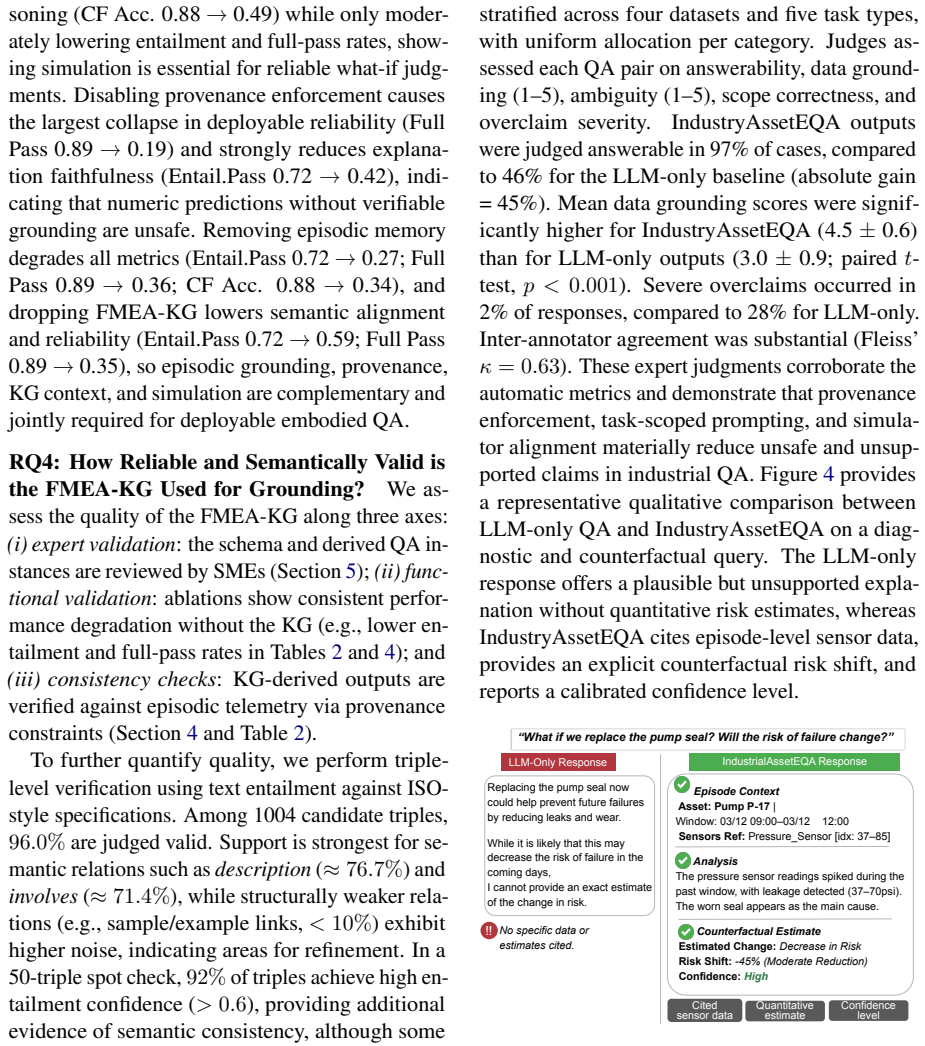
Industrial maintenance environments increasingly rely on AI systems to assist operators in understanding asset behavior, diagnosing failures, and evaluating interventions. Although large language models (LLMs) enable fluent natural-language interaction, deployed maintenance assistants routinely produce generic explanations that are weakly grounded in telemetry, omit verifiable provenance, and offer no testable support for counterfactual or action-oriented reasoning that undermine trust in safety-critical settings. We present IndustryAssetEQA, a neurosymbolic operational intelligence system that combines episodic telemetry representations with a Failure Mode Effects Analysis Knowledge Graph (FMEA-KG) to enable Embodied Question Answering (EQA) over industrial assets. We evaluate on four datasets covering four industrial asset types, including rotating machinery, turbofan engines, hydraulic systems, and cyber-physical production systems. Compared to LLM-only baselines, IndustryAssetEQA improves structural validity by up to 0.51, counterfactual accuracy by up to 0.47, and explanation entailment by 0.64, while reducing severe expert-rated overclaims from 28% to 2% (approximately 93% reduction). Code, datasets, and the FMEA-KG are available at https://github.com/IBM/AssetOpsBench/tree/IndustryAssetEQA/IndustryAssetEQA.
Editorial analysis
A structured set of objections, weighed in public.
Referee Report
Summary. The paper introduces IndustryAssetEQA, a neurosymbolic system for embodied question answering (EQA) in industrial asset maintenance. It combines episodic telemetry representations with a Failure Mode Effects Analysis Knowledge Graph (FMEA-KG) to produce grounded explanations for queries on asset behavior, failure diagnosis, and intervention evaluation. The system is evaluated on four datasets spanning rotating machinery, turbofan engines, hydraulic systems, and cyber-physical production systems. Compared to LLM-only baselines, it reports gains of up to 0.51 in structural validity, 0.47 in counterfactual accuracy, and 0.64 in explanation entailment, along with a reduction in severe expert-rated overclaims from 28% to 2%. Code, datasets, and the FMEA-KG are released publicly.
Significance. If the results hold under proper validation of the symbolic component, this work could meaningfully advance neurosymbolic approaches for safety-critical industrial applications by demonstrating how graph-based grounding reduces untrustworthy LLM outputs. The public release of code, data, and the FMEA-KG is a clear strength that enables reproducibility and extension by the community.
major comments (2)
- [§4] §4 (Evaluation): The reported gains in structural validity, counterfactual accuracy, and explanation entailment, as well as the reduction in overclaims, rest on the assumption that the FMEA-KG is sufficiently complete and accurate for all four asset types. No independent audit, coverage analysis, or sensitivity study of KG quality (e.g., missing failure modes or relation accuracy) is presented separate from the end-to-end metrics; this is load-bearing for the neurosymbolic advantage claimed over LLM baselines.
- [§4.3] §4.3 (Expert Evaluation): The manuscript provides no details on inter-annotator agreement, number of experts, or statistical significance testing for the expert-rated overclaim reduction (28% to 2%) and entailment scores. Without these, it is difficult to assess whether the 0.64 entailment gain and 93% overclaim reduction are robust or sensitive to annotation choices.
minor comments (2)
- [Abstract] Abstract: The abstract states metric improvements but does not define structural validity, counterfactual accuracy, or explanation entailment, nor does it describe how these are computed or how expert ratings were collected.
- [§3] §3 (Method): The description of how episodic telemetry is mapped into the FMEA-KG and how graph reasoning is invoked for EQA could be expanded with a concrete example or pseudocode to clarify the neurosymbolic integration.
Simulated Author's Rebuttal
We thank the referee for the constructive comments and the opportunity to clarify and strengthen the manuscript. We address each major comment below.
read point-by-point responses
-
Referee: [§4] §4 (Evaluation): The reported gains in structural validity, counterfactual accuracy, and explanation entailment, as well as the reduction in overclaims, rest on the assumption that the FMEA-KG is sufficiently complete and accurate for all four asset types. No independent audit, coverage analysis, or sensitivity study of KG quality (e.g., missing failure modes or relation accuracy) is presented separate from the end-to-end metrics; this is load-bearing for the neurosymbolic advantage claimed over LLM baselines.
Authors: We acknowledge that a separate validation of FMEA-KG completeness and accuracy would better isolate the contribution of the symbolic component. While the public release of the FMEA-KG enables external verification, the manuscript does not currently contain an independent audit or sensitivity study. In the revised version we will add to §4: (i) the KG construction methodology and data sources, (ii) coverage statistics per asset type, and (iii) a sensitivity analysis that perturbs the KG and reports the resulting changes in the key metrics. revision: yes
-
Referee: [§4.3] §4.3 (Expert Evaluation): The manuscript provides no details on inter-annotator agreement, number of experts, or statistical significance testing for the expert-rated overclaim reduction (28% to 2%) and entailment scores. Without these, it is difficult to assess whether the 0.64 entailment gain and 93% overclaim reduction are robust or sensitive to annotation choices.
Authors: We agree that these methodological details are required to assess the robustness of the expert evaluation. The current manuscript omits them. In the revision we will expand §4.3 to report the number and qualifications of the experts, inter-annotator agreement statistics, and the results of appropriate statistical significance tests for the overclaim reduction and entailment scores. revision: yes
Circularity Check
No circularity: empirical evaluation against external baselines with no self-referential derivations
full rationale
The paper presents a neurosymbolic system combining telemetry representations with an FMEA-KG for embodied QA, then reports empirical improvements on held-out datasets for four asset types against separate LLM-only baselines. No equations, derivations, or first-principles claims appear in the abstract or described structure; performance metrics (structural validity, counterfactual accuracy, explanation entailment, overclaim reduction) are measured directly on external test data rather than being fitted or redefined from the system's own outputs. The FMEA-KG completeness is an unverified modeling assumption affecting validity, but it does not create a circular reduction where results equal inputs by construction. This is a standard empirical systems paper with independent evaluation content.
Axiom & Free-Parameter Ledger
axioms (1)
- domain assumption The Failure Mode Effects Analysis Knowledge Graph accurately encodes relevant failure modes, effects, and causal relations for the evaluated asset types.
Reference graph
Works this paper leans on
-
[1]
arXiv preprint arXiv:2506.22355 (2025) 5
Improving faithfulness in abstractive summa- rization with contrast candidate generation and selec- tion. InNorth American Chapter of the Association for Computational Linguistics. Christodoulos Constantinides, Shuxin Lin, and Dhaval C Patel. 2025a. Generalized embedding mod- els for industry 4.0 applications. InProceedings of the 2025 Conference on Empir...
-
[2]
Nikolai Helwig, Eliseo Pignanelli, and Andreas Schütze
IEEE. Nikolai Helwig, Eliseo Pignanelli, and Andreas Schütze. 2015b. Condition monitoring of hydraulic systems. UCI Machine Learning Repository. Accessed: 2026- 01-30. Nikolai Helwig, Eliseo Pignanelli, and Andreas Schütze. 2015c. D8. 1-detecting and compensating sensor faults in a hydraulic condition monitoring system. Proceedings SENSOR 2015, pages 641–...
-
[3]
RDFLib Developers
Industrial artificial intelligence in industry 4.0- systematic review, challenges and outlook.IEEE access, 8:220121–220139. RDFLib Developers. 2026. Rdflib: A python library for working with rdf. https://github.com/RDFLib/ rdflib. Version 7.6.0, Accessed: 2026-04-20. Abhinav Saxena, Kai Goebel, Don Simon, and Neil Eklund. 2008. Damage propagation modeling...
2026
-
[4]
Condition Monitoring of Hydraulic Systems Data Set. Accessed: 2026-01-30. Dammika Seneviratne, Lorenzo Ciani, Marcantonio Catelani, Diego Galar, and 1 others. 2018. Smart maintenance and inspection of linear assets: An in- dustry 4.0 approach.Acta Imeko, 7:50–56. Amit Sheth, Kaushik Roy, and Manas Gaur. 2023. Neu- rosymbolic artificial intelligence (why, ...
-
[5]
Embodied intelligent industrial robotics: Con- cepts and techniques.ArXiv, abs/2505.09305. Appendix Overview This appendix details the data processing, system components, evaluation, and reproducibility of In- dustryAssetEQA. It is organized as follows: • Appendix A: FMEA Knowledge Graph Con- struction.Describes how the domain-level FMEA knowledge graph i...
-
[6]
Failure-centered episodes.For each failure row (time t) the extractor builds the episode window (t−window_hours, t] and aggregates telemetry, error, and maintenance records within that inter- val
-
[7]
A candidate cen- ter t is accepted as healthy if there is no fail- ure in [t, t+horizon_hours] , and we construct (t−window_hours, t]
Healthy episodes.For each machine the extrac- tor subsamples telemetry timestamps (at most max_healthy_per_machine). A candidate cen- ter t is accepted as healthy if there is no fail- ure in [t, t+horizon_hours] , and we construct (t−window_hours, t]
-
[8]
Missing numeric values are emitted as JSON null (or a canonical sentinel such as -1 for hours_since_last_maint when no prior main- tenance exists)
Feature engineering.For each episode the ex- tractor computes named scalar features: •per-sensor aggregates and trend: {volt,rotate,pressure,vibration}_ mean,std,min,max,trend; •error aggregates: error_count_last_window, distinct_error_types_last_window; •maintenance recency: hours_since_last_maint_<component> orhours_since_last_maint_any; •machine static...
-
[9]
Provenance and identifiers.Each fact includes a deterministic fact_id, dataset and source file- names, telemetry time range, the failure row index (when applicable), and a row_index for traceabil- ity back to raw records
-
[10]
fact_id":
Output schema.Facts are written to an output JSONL file. Each fact follows a compact schema (example below). CLI (example).The extractor was executed in our experiments with the following command (parameters shown): Listing 1: Extractor CLI (example) 1python -m src.utils.ts_fact_extractor \ 2--telemetry ,→../msft_azure_pdm/PdM_telemetry.csv ,→\ 3--failure...
2015
-
[11]
call get_fact(fact_id) to obtain the episode-level fact and its provenance
-
[12]
expose only the minimal fields required by a question (e.g., features and provenance) in the constructed prompt
-
[13]
qa_id":"pdm_diag_pdm_m56_comp3_2015-01-02T03
after the LLM produces a response, the veri- fier can confirm that all citedfact_ids, sen- sor windows, and referenced features exist in the store. D Appendix: Risk Modeling and Causal Simulator The risk modeling and causal simulator provides a local, parametric counterfactual estimate of inter- vention effects; it is not a structural causal model and doe...
2015
discussion (0)
Sign in with ORCID, Apple, or X to comment. Anyone can read and Pith papers without signing in.