Recognition: unknown
Hyperaccreting Neutron Stars inside Massive Envelopes: The Implausibility of Thorne-\.Zytkow Objects
Pith reviewed 2026-05-08 05:41 UTC · model grok-4.3
The pith
Simulations show neutron stars in massive stellar envelopes accrete rapidly and collapse to black holes rather than forming stable Thorne-Zytkow objects.
A machine-rendered reading of the paper's core claim, the machinery that carries it, and where it could break.
Core claim
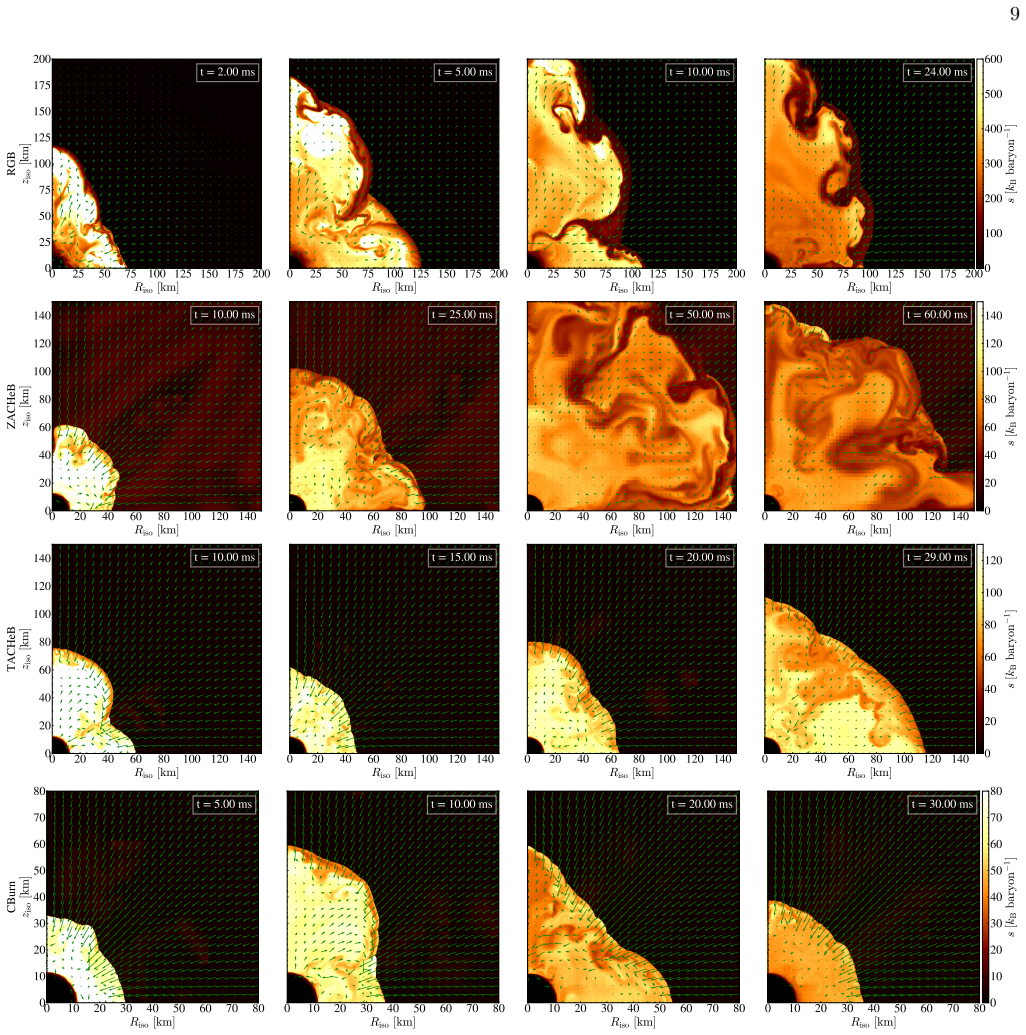
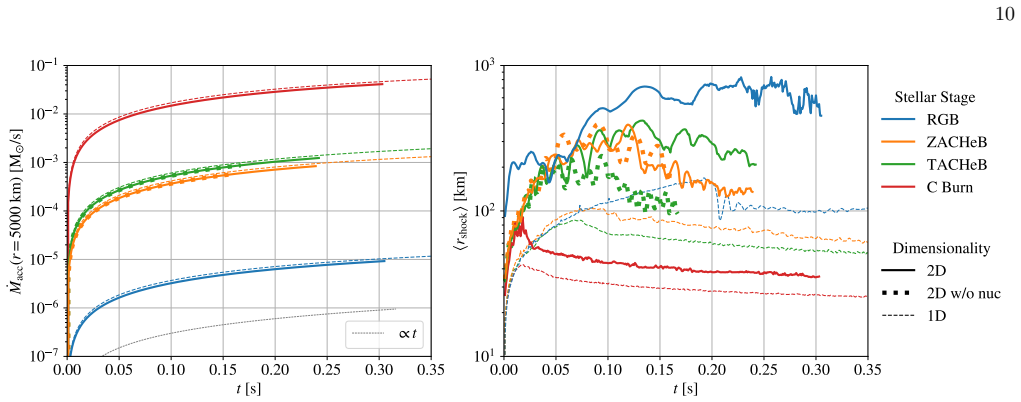
Simulations demonstrate that vigorous convection is triggered in the post-shock region yet the global energy budget is governed by neutrino cooling that balances accretion power. The efficient cooling sink and high ram pressure prevent any core-collapse supernova-like explosion despite neutrino absorption and localized heating. All nucleosynthetically processed material remains strictly gravitationally bound. Persistent hypercritical accretion rates cause the embedded neutron star to exceed the Tolman-Oppenheimer-Volkoff mass limit on timescales of minutes to hours, so these systems are transient precursors to black hole formation and potential central engines for high-energy transients.
What carries the argument
Fully coupled general relativistic hydrodynamics simulations with grey two-moment neutrino transport and an alpha-chain nuclear reaction network applied to four distinct progenitor evolutionary stages.
Load-bearing premise
The grey two-moment neutrino transport scheme combined with the alpha-chain nuclear network and chosen progenitor models fully captures the relevant physics without missing effects such as magnetic fields or more detailed neutrino interactions that could enable outflows.
What would settle it
Detection of a long-lived Thorne-Zytkow object surviving far beyond hours or clear observational evidence of ejected nucleosynthetic material from convective dredge-up in such a system would contradict the results.
Figures





read the original abstract
The evolution of neutron stars (NSs) embedded within massive stellar envelopes is a critical phase in binary stellar evolution, potentially leading to the formation of Thorne-\.Zytkow Objects (T\.ZOs) or catastrophic collapse. We present the first fully coupled general relativistic hydrodynamics (GRHD) simulations of hypercritical accretion onto NSs that simultaneously incorporate grey two-moment (M1) neutrino transport and an $\alpha$-chain nuclear reaction network. By investigating four distinct progenitor evolutionary stages, we resolve the complex interplay between intense neutrino cooling, multidimensional fluid dynamics, and nuclear feedback. Our results show that while vigorous convection is triggered in the post-shock region, the global energy budget is primarily governed by neutrino cooling, which effectively balances the accretion power. Crucially, even though our M1 transport scheme captures neutrino absorption and localized heating, the efficient cooling sink and high ram pressure of the infalling envelope prevent the formation of any core-collapse supernova-like explosion. We find that all nucleosynthetically processed material ($T > 5$~GK) remains strictly gravitationally bound, challenging the assumption that these systems contribute significantly to galactic nucleosynthetic yields via convective dredge-up. The lack of sustained outflows and the persistent hypercritical accretion rates suggest that embedded NSs will rapidly exceed the Tolman-Oppenheimer-Volkoff mass limit on timescales of minutes to hours. We conclude that these systems are not stable T\.ZOs, but are rather transient precursors to catastrophic black hole formation and potential central engines for high-energy transients.
Editorial analysis
A structured set of objections, weighed in public.
Referee Report
Summary. The manuscript reports the first fully coupled general relativistic hydrodynamics (GRHD) simulations of hypercritical accretion onto neutron stars embedded in massive stellar envelopes. Using grey two-moment (M1) neutrino transport and an α-chain nuclear reaction network, the authors simulate four distinct progenitor evolutionary stages and find that neutrino cooling dominates the energy budget despite vigorous post-shock convection. No core-collapse supernova-like explosions or unbound outflows occur, all processed material remains gravitationally bound, and the neutron star accretes rapidly enough to exceed the Tolman-Oppenheimer-Volkoff limit on timescales of minutes to hours, implying these systems are transient precursors to black-hole formation rather than stable Thorne-Żytkow objects.
Significance. If the central result holds, the work would be significant for models of common-envelope evolution and the formation channels of Thorne-Żytkow objects, high-energy transients, and compact-object binaries. The direct numerical integration of the GRHD equations with coupled neutrino transport and nuclear burning provides concrete, parameter-free evidence against long-lived TZOs and identifies these configurations as potential central engines. The absence of free parameters or fitted quantities in the core evolution strengthens the falsifiability of the no-stable-TZO claim.
major comments (2)
- [Abstract and Results (energy-budget discussion)] The central claim that neutrino cooling always prevents unbound material and sustained outflows (and therefore rules out stable TZOs) depends on the grey M1 closure accurately capturing the competition between neutrino absorption/heating and ram pressure in the semi-transparent post-shock region. Known limitations of the M1 scheme in this regime could suppress outflows that a Boltzmann solver or MHD treatment would produce; the manuscript does not present resolution or closure tests that quantify this uncertainty for the reported energy budgets.
- [Methods (nuclear network and transport description)] The α-chain nuclear network is used to track nucleosynthetic processing above 5 GK, yet the conclusion that all such material remains bound and contributes negligibly to galactic yields assumes no additional heating channels from omitted neutrino interactions or magnetic fields. If these channels enable even modest outflows, the transient-to-BH conclusion would not follow for realistic envelopes.
minor comments (2)
- [Abstract] The abstract states that 'vigorous convection is triggered' but does not quantify the convective velocities or turnover times relative to the accretion timescale; adding these numbers would strengthen the energy-budget argument.
- [Methods] The manuscript would benefit from an explicit statement of the numerical resolution employed and any convergence tests performed for the post-shock region, even if only in a methods appendix.
Simulated Author's Rebuttal
We thank the referee for their constructive and detailed comments. We address each major point below and have revised the manuscript to incorporate additional discussion and tests where feasible.
read point-by-point responses
-
Referee: [Abstract and Results (energy-budget discussion)] The central claim that neutrino cooling always prevents unbound material and sustained outflows (and therefore rules out stable TZOs) depends on the grey M1 closure accurately capturing the competition between neutrino absorption/heating and ram pressure in the semi-transparent post-shock region. Known limitations of the M1 scheme in this regime could suppress outflows that a Boltzmann solver or MHD treatment would produce; the manuscript does not present resolution or closure tests that quantify this uncertainty for the reported energy budgets.
Authors: We acknowledge the known limitations of the grey M1 scheme in semi-transparent regimes. In our simulations, however, the post-shock region is characterized by high optical depths where the M1 closure remains a reasonable approximation, and the dominant ram pressure from the infalling envelope strongly suppresses outflows. We have added resolution convergence tests for the energy budget in a new appendix and expanded the Methods section with a discussion of M1 validity, including references to prior benchmarks in similar accretion contexts. While a Boltzmann solver could introduce quantitative differences, the qualitative result that neutrino cooling balances accretion power and prevents unbound material is robust within the modeled physics. We have also added an explicit uncertainty paragraph in the Results section. revision: partial
-
Referee: [Methods (nuclear network and transport description)] The α-chain nuclear network is used to track nucleosynthetic processing above 5 GK, yet the conclusion that all such material remains bound and contributes negligibly to galactic yields assumes no additional heating channels from omitted neutrino interactions or magnetic fields. If these channels enable even modest outflows, the transient-to-BH conclusion would not follow for realistic envelopes.
Authors: The α-chain network captures the primary energy-generating reactions at the relevant temperatures and densities; more extensive networks do not materially change the net heating rates in this regime. Our neutrino transport already incorporates absorption, emission, and scattering, which are accounted for in the energy-budget analysis showing cooling dominance. Magnetic fields are omitted because the study focuses on GRHD plus neutrino effects; their inclusion would require a separate MHD framework. We have added a dedicated limitations paragraph in the Discussion acknowledging that strong magnetic fields could in principle drive additional outflows, though this does not alter the conclusions for the hydrodynamical setups presented. The transient-to-BH outcome remains supported by the simulated accretion rates and bound material. revision: partial
- Performing new simulations with a Boltzmann neutrino solver or full MHD treatment to quantify differences in outflow production, as this would require substantial additional code development and computational resources beyond the scope of the current work.
Circularity Check
No circularity: results follow from direct numerical integration of GRHD+M1+α-network on given progenitors
full rationale
The paper's derivation consists of running fully coupled GRHD simulations with grey two-moment neutrino transport and an α-chain network on four specified progenitor models, then reporting the resulting energy balance, absence of unbound material, and continued hypercritical accretion. No parameters are fitted to a data subset and then renamed as predictions, no self-citation chain supplies the central uniqueness or stability claim, and no ansatz or definition is smuggled in via prior work. The conclusion that the systems are transient precursors to black-hole formation is therefore an output of the integration under the stated physics, not a tautology that reduces to the inputs by construction.
Axiom & Free-Parameter Ledger
axioms (3)
- standard math Standard general relativistic hydrodynamics equations govern the fluid evolution
- domain assumption Grey two-moment (M1) closure is sufficient for neutrino transport in this regime
- domain assumption α-chain reactions dominate the relevant nucleosynthesis
Reference graph
Works this paper leans on
-
[1]
Specifically, the initial configurations is con- structed with central energy densityϵ c/c2 = 6.234× 10¹⁴ g·cm −3
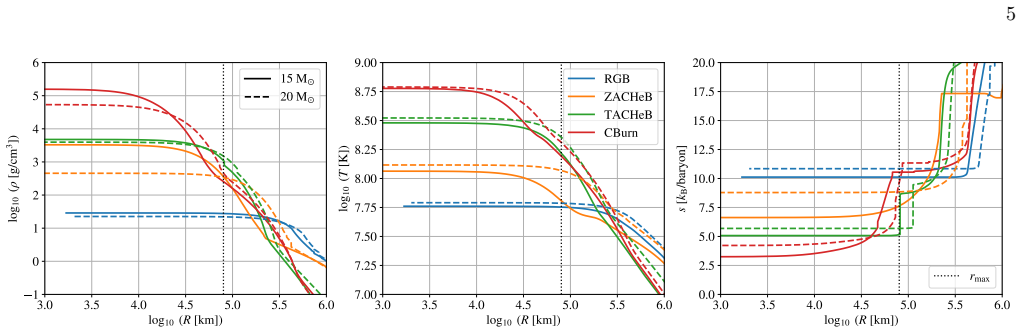
Neutron Star Model The initial NS model is generated with theRNS code [45]. Specifically, the initial configurations is con- structed with central energy densityϵ c/c2 = 6.234× 10¹⁴ g·cm −3. The gravitational mass is 1.39985 M ⊙, where the corresponding rest masses are 1.52803 M ⊙. This initial configuration is constructed with a fixed tem- perature of 0....
-
[2]
Stellar Models and Evolutionary Stages The stellar progenitors are generated usingMESA(Mod- ules for Experiments in Stellar Astrophysics, version 25.12.1) [46–51]. We evolve non-rotating stars from the pre-main sequence with an initial mass of 15M ⊙ and 20M ⊙ and solar metallicity (Z= 0.014), adopting Type II opacities appropriate for varying metal abunda...
-
[3]
K. S. Thorne and A. N. Zytkow, Red giants and su- pergiants with degenerate neutron cores., ApJ199, L19 (1975)
1975
-
[4]
K. S. Thorne and A. N. Zytkow, Stars with degenerate neutron cores. I. Structure of equilibrium models., ApJ 212, 832 (1977)
1977
-
[5]
R. E. Taam, P. Bodenheimer, and J. P. Ostriker, Double core evolution. I. A 16 M sun star with a 1 M sun neutron- star companion., ApJ222, 269 (1978)
1978
-
[6]
N. Ivanova, S. Justham, X. Chen, O. De Marco, C. L. Fryer, E. Gaburov, H. Ge, E. Glebbeek, Z. Han, X.-D. Li, G. Lu, T. Marsh, P. Podsiadlowski, A. Potter, N. Soker, R. Taam, T. M. Tauris, E. P. J. van den Heuvel, and R. F. Webbink, Common envelope evolution: where we stand and how we can move forward, A&A Rev.21, 59 (2013), arXiv:1209.4302 [astro-ph.HE]
-
[7]
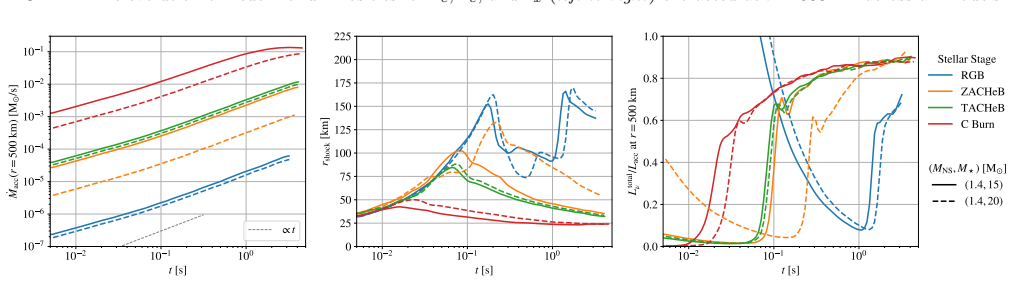
I. Ablimit, P. Podsiadlowski, R. Hirai, and J. Wicker, Stellar core-merger-induced collapse: new formation pathways for black holes, Thorne- ˙Zytkow objects, mag- netars, and superluminous supernovae, MNRAS513, 15 10 2 10 1 100 101 t [s] 10 7 10 6 10 5 10 4 10 3 10 2 10 1 Macc(r = 500 km) [M /s] t 10 2 10 1 100 101 t [s] 0 25 50 75 100 125 150 175 200 225...
- [8]
-
[9]
A. O’Grady, T. J. Moriya, M. Renzo, and A. Vigna- G´ omez, Thorne-˙Zytkow objects, inEncyclopedia of As- trophysics, Volume 3, Vol. 3 (2026) pp. 336–357, arXiv:2410.02896 [astro-ph.SR]
-
[10]
Benz and J
W. Benz and J. G. Hills, Three-dimensional Hydrody- namical Simulations of Colliding Stars. III. Collisions and Tidal Captures of Unequal-Mass Main-Sequence Stars, ApJ389, 546 (1992)
1992
-
[11]
P. J. T. Leonard, J. G. Hills, and R. J. Dewey, A New Way to Make Thorne-Zytkow Objects, ApJ423, L19 (1994)
1994
-
[12]
A. Grichener and N. Soker, Common envelope jets su- pernovae with a black hole companion as possible high- energy neutrino sources, MNRAS507, 1651 (2021), arXiv:2101.05118 [astro-ph.HE]
-
[13]
P. Mart´ ınez-Mirav´ e, I. Tamborra, and A. Vigna-G´ omez, Identifying Thorne– ˙Zytkow Objects through Neutrinos, ApJ984, L2 (2025), arXiv:2501.03330 [astro-ph.HE]
-
[14]
I. Esteban, J. F. Beacom, and J. Kopp, Detectable MeV Neutrino Signals from Neutron-Star Common- Envelope Systems, Phys. Rev. Lett.134, 181003 (2025), arXiv:2310.19868 [astro-ph.HE]
-
[15]
G. S. Bisnovatyi-Kogan and S. A. Lamzin, Stars with Neutron Cores - the Possibility of the Existence of Ob- jects with a Low Neutrino Luminosity, Soviet Ast.28, 187 (1984)
1984
-
[16]
C. Eich, M. E. Zimmermann, K. S. Thorne, and A. N. Zytkow, Giant and Supergiant Stars with Degenerate Neutron Cores, ApJ346, 277 (1989)
1989
-
[17]
G. T. Biehle, High-Mass Stars with Degenerate Neutron Cores, ApJ380, 167 (1991)
1991
-
[18]
G. T. Biehle, Observational Prospects for Massive Stars with Degenerate Neutron Cores, ApJ420, 364 (1994)
1994
- [19]
- [20]
- [21]
-
[22]
Pignatari, R
M. Pignatari, R. Gallino, M. Heil, M. Wiescher, F. K¨ appeler, F. Herwig, and S. Bisterzo, The Weak s- Process in Massive Stars and its Dependence on the Neu- tron Capture Cross Sections, ApJ710, 1557 (2010)
2010
- [23]
-
[24]
R. A. Chevalier, Neutron Star Accretion in a Stellar En- velope, ApJ411, L33 (1993)
1993
-
[25]
R. A. Chevalier, Neutron star accretion in dense environ- ments., Phys. Rep.256, 95 (1995)
1995
- [26]
-
[27]
P. Anninos, M. E. Portman, S. R. Carmichael, R. D. Hoff- man, and A. Sieverding, r-process Nucleosynthesis from Hyperaccreting Neutron Stars in Common Envelopes, ApJ997, 88 (2026), arXiv:2511.18584 [astro-ph.HE]
- [28]
-
[29]
W. Zhang and C. L. Fryer, The Merger of a Helium Star and a Black Hole: Gamma-Ray Bursts, ApJ550, 357 (2001), arXiv:astro-ph/0011236 [astro-ph]
- [30]
- [31]
-
[32]
J. Klencki and B. D. Metzger, Luminous Fast Blue Op- tical Transients as “Failed” Gravitational Wave Sources: Helium Core−Black Hole Mergers Following Delayed Dy- namical Instability, arXiv e-prints , arXiv:2510.09745 (2025), arXiv:2510.09745 [astro-ph.HE]
-
[33]
A. E. Nugent, V. A. Villar, B. D. Metzger, C. L. Fryer, E. Burns, A. Gordon, and D. Frostig, The En- vironments of Luminous Fast Blue Optical Transients: Evidence for a Compact Object and Wolf-Rayet Star Merger Origin, arXiv e-prints , arXiv:2603.23597 (2026), arXiv:2603.23597 [astro-ph.HE]
- [34]
-
[35]
M. MacLeod and E. Ramirez-Ruiz, On the Accretion-fed Growth of Neutron Stars during Common Envelope, ApJ 798, L19 (2015), arXiv:1410.5421 [astro-ph.SR]
-
[36]
Numerical Studies of Accretion Flows onto a Neutron Star Engulfed in a Massive Star
D. Sakurai, R. Akaho, and S. Yamada, Numerical Studies of Accretion Flows onto a Neutron Star Engulfed in a Massive Star, arXiv e-prints , arXiv:2604.19236 (2026), arXiv:2604.19236 [astro-ph.HE]
work page internal anchor Pith review Pith/arXiv arXiv 2026
- [37]
-
[38]
P. C.-K. Cheong and C. L. Fryer, Toward First- Principles Multi-Messenger Predictions: Coupling Nu- clear Networks with GR Radiation-MHD inGmunu, arXiv e-prints , arXiv:2510.12978 (2025), arXiv:2510.12978 [astro-ph.IM]
work page internal anchor Pith review Pith/arXiv arXiv 2025
-
[39]
M. Hempel and J. Schaffner-Bielich, A statistical model for a complete supernova equation of state, Nucl. Phys. A 837, 210 (2010), arXiv:0911.4073 [nucl-th]
-
[40]
F. X. Timmes and F. D. Swesty, The Accuracy, Con- sistency, and Speed of an Electron-Positron Equation of State Based on Table Interpolation of the Helmholtz Free Energy, ApJS126, 501 (2000)
2000
- [41]
- [42]
-
[43]
G. N. Minerbo, Maximum entropy Eddington factors., J. Quant. Spec. Radiat. Transf.20, 541 (1978)
1978
-
[44]
E. O’Connor, An Open-source Neutrino Radiation Hy- drodynamics Code for Core-collapse Supernovae, ApJS 219, 24 (2015), arXiv:1411.7058 [astro-ph.HE]
-
[45]
F. X. Timmes, Integration of Nuclear Reaction Networks for Stellar Hydrodynamics, ApJS124, 241 (1999)
1999
-
[46]
F. X. Timmes, R. D. Hoffman, and S. E. Woosley, An In- expensive Nuclear Energy Generation Network for Stellar Hydrodynamics, ApJS129, 377 (2000)
2000
-
[47]
N. Stergioulas and J. L. Friedman, Comparing Models of Rapidly Rotating Relativistic Stars Constructed by Two Numerical Methods, ApJ444, 306 (1995), arXiv:astro- ph/9411032 [astro-ph]
- [48]
-
[49]
2013, ApJS, 208, 4, doi: 10.1088/0067-0049/208/1/4 10
B. Paxton, M. Cantiello, P. Arras, L. Bildsten, E. F. Brown, A. Dotter, C. Mankovich, M. H. Montgomery, D. Stello, F. X. Timmes, and R. Townsend, Modules for Experiments in Stellar Astrophysics (MESA): Planets, Oscillations, Rotation, and Massive Stars, ApJS208, 4 (2013), arXiv:1301.0319 [astro-ph.SR]
work page internal anchor Pith review arXiv 2013
-
[50]
2015, ApJS, 220, 15, doi: 10.1088/0067-0049/220/1/15
B. Paxton, P. Marchant, J. Schwab, E. B. Bauer, L. Bild- sten, M. Cantiello, L. Dessart, R. Farmer, H. Hu, N. Langer, R. H. D. Townsend, D. M. Townsley, and F. X. Timmes, Modules for Experiments in Stellar Astro- physics (MESA): Binaries, Pulsations, and Explosions, ApJS220, 15 (2015), arXiv:1506.03146 [astro-ph.SR]
work page internal anchor Pith review arXiv 2015
-
[51]
B. Paxton, J. Schwab, E. B. Bauer, L. Bildsten, S. Blinnikov, P. Duffell, R. Farmer, J. A. Goldberg, P. Marchant, E. Sorokina, A. Thoul, R. H. D. Townsend, and F. X. Timmes, Modules for Experiments in Stellar Astrophysics (MESA): Convective Boundaries, Element Diffusion, and Massive Star Explosions, ApJS234, 34 (2018), arXiv:1710.08424 [astro-ph.SR]
-
[52]
B. Paxton, R. Smolec, J. Schwab, A. Gautschy, L. Bild- sten, M. Cantiello, A. Dotter, R. Farmer, J. A. Goldberg, A. S. Jermyn, S. M. Kanbur, P. Marchant, A. Thoul, R. H. D. Townsend, W. M. Wolf, M. Zhang, and F. X. Timmes, Modules for Experiments in Stellar As- trophysics (MESA): Pulsating Variable Stars, Rotation, Convective Boundaries, and Energy Conser...
-
[53]
A. S. Jermyn, E. B. Bauer, J. Schwab, R. Farmer, W. H. Ball, E. P. Bellinger, A. Dotter, M. Joyce, P. Marchant, J. S. G. Mombarg, W. M. Wolf, T. L. Sunny Wong, G. C. Cinquegrana, E. Farrell, R. Smolec, A. Thoul, M. Cantiello, F. Herwig, O. Toloza, L. Bild- sten, R. H. D. Townsend, and F. X. Timmes, Modules for Experiments in Stellar Astrophysics (MESA): T...
- [54]
- [55]
- [56]
-
[57]
Cavaglieri and T
D. Cavaglieri and T. Bewley, Low-storage im- plicit/explicit Runge-Kutta schemes for the simulation of stiff high-dimensional ODE systems, Journal of Computational Physics286, 172 (2015)
2015
-
[58]
A. Harten, P. Lax, and B. Leer, On upstream differencing and godunov-type schemes for hyper- bolic conservation laws, SIAM Review25, 35 (1983), https://doi.org/10.1137/1025002
-
[59]
Colella and P
P. Colella and P. R. Woodward, The Piecewise Parabolic Method (PPM) for Gas-Dynamical Simulations, Journal of Computational Physics54, 174 (1984)
1984
-
[60]
M. Zingale, L. J. Dursi, J. ZuHone, A. C. Calder, B. Fryx- ell, T. Plewa, J. W. Truran, A. Caceres, K. Olson, P. M. Ricker, K. Riley, R. Rosner, A. Siegel, F. X. Timmes, and N. Vladimirova, Mapping Initial Hydrostatic Models in Godunov Codes, ApJS143, 539 (2002), arXiv:astro- ph/0208031 [astro-ph]
-
[61]
D. Pochik and T. A. Thompson, Critical Condition of Core-collapse Supernovae. I. One-dimensional Models, ApJ985, 62 (2025), arXiv:2411.16857 [astro-ph.HE]
- [62]
-
[63]
F. Gittins, R. Matur, N. Andersson, and I. Hawke, Prob- lematic systematics in neutron-star merger simulations, Phys. Rev. D111, 023049 (2025), arXiv:2409.13468 [gr- qc]
-
[64]
R. A. Chevalier, Neutron Star Accretion in a Supernova, ApJ346, 847 (1989)
1989
-
[65]
A. Betranhandy and E. O’Connor, Impact of neu- trino pair-production rates in core-collapse supernovae, Phys. Rev. D102, 123015 (2020), arXiv:2010.02261 [astro-ph.HE]
- [66]
-
[67]
J. Keegans, C. L. Fryer, S. W. Jones, B. Cˆ ot´ e, K. Bel- czynski, F. Herwig, M. Pignatari, A. M. Laird, and C. A. Diget, Nucleosynthetic yields from neutron stars accreting in binary common envelopes, MNRAS485, 620 (2019), arXiv:1902.01661 [astro-ph.SR]
-
[68]
T. J. Boerner, S. Deems, T. R. Furlani, S. L. Knuth, and J. Towns, Access: Advancing innovation: Nsf’s advanced cyberinfrastructure coordination ecosystem: Services & support, inPractice and Experience in Advanced Re- search Computing, PEARC ’23 (Association for Comput- ing Machinery, New York, NY, USA, 2023) p. 173–176
2023
- [69]
-
[70]
C. R. Harris, K. J. Millman, S. J. van der Walt, R. Gom- mers, P. Virtanen, D. Cournapeau, E. Wieser, J. Tay- lor, S. Berg, N. J. Smith, R. Kern, M. Picus, S. Hoyer, M. H. van Kerkwijk, M. Brett, A. Haldane, J. F. del R´ ıo, M. Wiebe, P. Peterson, P. G´ erard-Marchant, K. Shep- pard, T. Reddy, W. Weckesser, H. Abbasi, C. Gohlke, and T. E. Oliphant, Array ...
2020
-
[71]
pandas development team, pandas-dev/pandas: Pan- das (2020)
T. pandas development team, pandas-dev/pandas: Pan- das (2020)
2020
-
[72]
Wes McKinney, Data Structures for Statistical Comput- ing in Python, inProceedings of the 9th Python in Science Conference, edited by St´ efan van der Walt and Jarrod Millman (2010) pp. 56 – 61
2010
-
[73]
Virtanen, R
P. Virtanen, R. Gommers, T. E. Oliphant, M. Haber- land, T. Reddy, D. Cournapeau, E. Burovski, P. Pe- terson, W. Weckesser, J. Bright, S. J. van der Walt, M. Brett, J. Wilson, K. J. Millman, N. Mayorov, A. R. J. Nelson, E. Jones, R. Kern, E. Larson, C. J. Carey, ˙I. Po- lat, Y. Feng, E. W. Moore, J. VanderPlas, D. Laxalde, J. Perktold, R. Cimrman, I. Henr...
2020
-
[74]
J. D. Hunter, Matplotlib: A 2D Graphics Environment, Computing in Science and Engineering9, 90 (2007)
2007
-
[75]
T. A. Caswell, A. Lee, E. S. de Andrade, M. Droet- tboom, T. Hoffmann, J. Klymak, J. Hunter, E. Fir- ing, D. Stansby, N. Varoquaux, J. H. Nielsen, B. Root, R. May, O. Gustafsson, P. Elson, J. K. Sepp¨ anen, J.-J. Lee, D. Dale, hannah, D. McDougall, A. Straw, P. Hob- son, K. Sunden, G. Lucas, C. Gohlke, A. F. Vincent, T. S. Yu, E. Ma, S. Silvester, and C. ...
2023
-
[76]
R. I. Klein, J. Arons, G. Jernigan, and J. J.-L. Hsu, Pho- ton Bubble Oscillations in Accretion-powered Pulsars, ApJ457, L85 (1996)
1996
- [77]
discussion (0)
Sign in with ORCID, Apple, or X to comment. Anyone can read and Pith papers without signing in.