Recognition: unknown
Time-Delayed Publicly Verifiable Quantum Computation for Classical Verifiers
Pith reviewed 2026-05-08 06:02 UTC · model grok-4.3
The pith
A classical verifier outsources quantum computation and receives a publicly checkable result after a built-in time delay enforced by time-lock puzzles.
A machine-rendered reading of the paper's core claim, the machinery that carries it, and where it could break.
Core claim
By wrapping a 2-round privately verifiable quantum computation scheme inside commitments and time-lock puzzles, the protocol produces timestamped proofs whose verification keys are released publicly only after a sufficient delay, allowing classical verifiers to confirm the correctness of outsourced quantum tasks under post-quantum assumptions in the quantum random oracle model with a common reference string.
What carries the argument
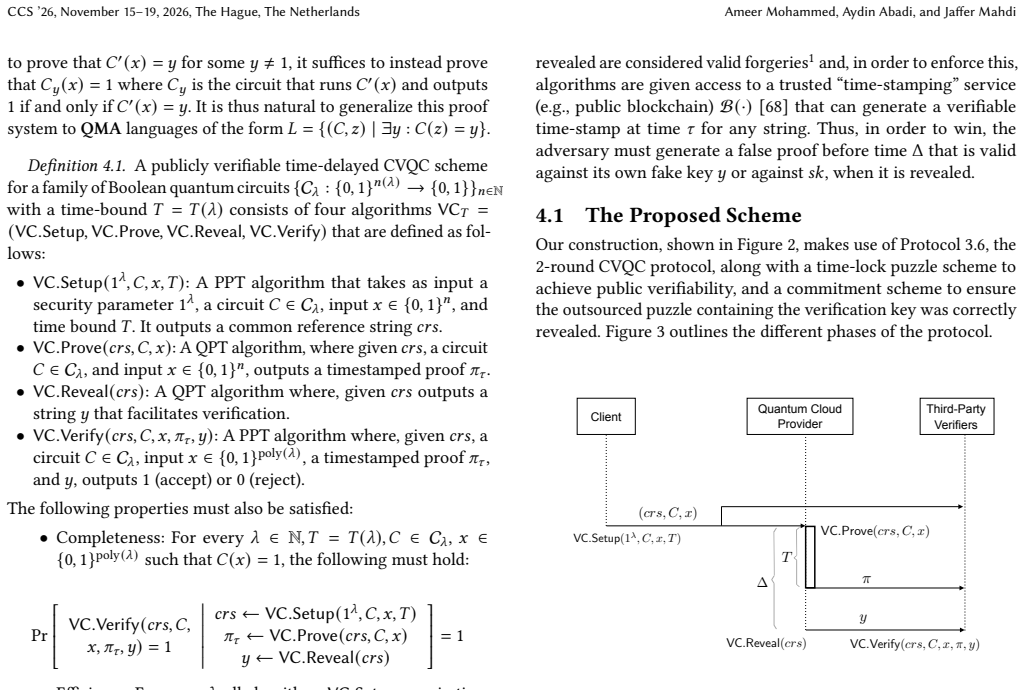
Time-lock puzzles that delay the public release of the verification key while committing to the proof, which converts the private 2-round interaction into a non-interactive public one with enforced timing.
If this is right
- The protocol allows outsourcing of quantum computation along with the time-lock puzzle solution to a single quantum prover.
- Security is established against quantum adversaries assuming standard post-quantum properties of the underlying primitives.
- Timestamped proofs become possible for quantum computation results without additional trusted setup beyond a common reference string.
- Verification can be performed by any classical party once the delay period has passed and the key is public.
Where Pith is reading between the lines
- Such time-delayed verification might support applications where premature result checking must be prevented, such as in sequential decision processes.
- The approach could be adapted to other resource-intensive computations where timing guarantees are valuable.
- Future work might explore reducing the delay parameter or combining with blockchain timestamps for the proofs.
Load-bearing premise
That 2-round privately verifiable quantum computation schemes can be securely combined with time-lock puzzles without creating new quantum attacks or undermining the time-delay guarantee, and that these puzzles admit efficient realizations under post-quantum assumptions.
What would settle it
Demonstration of a quantum algorithm that solves the time-lock puzzle and extracts the verification key in less time than the intended delay, or construction of a valid-looking proof that passes verification without correctly executing the quantum circuit.
Figures



read the original abstract
Publicly verifiable delegation is a well-known problem involving a user who wishes to outsource a resource-intensive computational task to a more powerful but potentially untrusted server such that any other party is able to efficiently check the veracity of the computation's result. This problem has been extensively studied in the classical domain where the user and server are both non-quantum machines. However, the problem becomes more challenging when the classical user wants to delegate a quantum circuit to a single prover with quantum-computing capabilities. Previous solutions have resorted to using impractical or non-standard cryptographic solutions (e.g. indistinguishability obfuscation) to achieve this requirement. In this work, we relax the requirement to have time-delayed publicly verifiable proofs, where the verification key is made known to the public only when the computation (and its proof) are guaranteed to have been completed. We propose a practical non-interactive scheme leveraging commitment schemes and time-lock puzzles, which can be efficiently realized through well-established and standard post-quantum assumptions. The main idea of our technique lies in using time-lock puzzles to compile a 2-round privately verifiable scheme into a non-interactive publicly verifiable scheme with timestamped proofs, outsourcing not only the quantum computation but the puzzle solving as well. Security is proven in the quantum random oracle model with a common reference string (CRS).
Editorial analysis
A structured set of objections, weighed in public.
Referee Report
Summary. The paper claims to solve the problem of publicly verifiable delegation of quantum circuits to a quantum prover by a classical user, by introducing a time-delayed non-interactive scheme. It leverages commitment schemes and time-lock puzzles to convert 2-round privately verifiable quantum computation protocols into publicly verifiable ones, where the verification key is released only after the computation is guaranteed to be completed via the time-lock. The scheme is practical under standard post-quantum assumptions, and security is proven in the quantum random oracle model with a common reference string (CRS).
Significance. If the central security claim holds, this work would offer a practical advancement in verifiable quantum computation by avoiding impractical primitives like indistinguishability obfuscation. By outsourcing puzzle solving as well and using time delays for timestamping, it enables public verification after a guaranteed period. The use of the quantum random oracle model and CRS with standard assumptions is a positive aspect, potentially making it more feasible for real-world applications in quantum cloud services.
major comments (2)
- The security reduction for compiling 2-round privately verifiable schemes via time-lock puzzles must explicitly address quantum superposition queries to the TLP and the interaction with the delegated quantum circuit (as required for the non-interactivity and time-delay guarantee). The abstract asserts a QROM+CRS proof, but without detailed lemmas showing that no new quantum attacks allow forgery before the puzzle deadline, the central claim cannot be verified.
- The weakest assumption—that existing 2-round private schemes compile securely without violating the time-delay against quantum adversaries—requires a concrete theorem and reduction in the construction section. The manuscript should state the specific post-quantum assumptions for efficient TLP realization and prove sequential hardness is preserved.
minor comments (1)
- The abstract refers to 'well-established and standard post-quantum assumptions' without naming them; this should be clarified with explicit references in the introduction or preliminaries.
Simulated Author's Rebuttal
We thank the referee for the detailed and constructive review. The comments highlight important aspects of the security argument that require clearer exposition. We address each major comment below and will incorporate the suggested clarifications in the revised manuscript.
read point-by-point responses
-
Referee: The security reduction for compiling 2-round privately verifiable schemes via time-lock puzzles must explicitly address quantum superposition queries to the TLP and the interaction with the delegated quantum circuit (as required for the non-interactivity and time-delay guarantee). The abstract asserts a QROM+CRS proof, but without detailed lemmas showing that no new quantum attacks allow forgery before the puzzle deadline, the central claim cannot be verified.
Authors: We agree that the high-level security sketch in the current version does not contain the full sequence of lemmas needed to handle quantum superposition queries to the time-lock puzzle. In the revised manuscript we will add a new subsection to the security proof that presents an explicit quantum reduction. The reduction will simulate the private verifier while answering superposition TLP queries via the quantum random oracle, and will prove that any forgery before the deadline contradicts the sequential hardness of the underlying TLP. The interaction between the delegated quantum circuit and the TLP is modeled by treating circuit outputs as additional oracle inputs; this preserves the time-delay guarantee because the reduction aborts on early extraction attempts. We will also state the precise QROM+CRS assumptions under which the reduction holds. revision: yes
-
Referee: The weakest assumption—that existing 2-round private schemes compile securely without violating the time-delay against quantum adversaries—requires a concrete theorem and reduction in the construction section. The manuscript should state the specific post-quantum assumptions for efficient TLP realization and prove sequential hardness is preserved.
Authors: We accept that a standalone theorem is required. The revised construction section will contain a new theorem (Theorem 4.3) that states: under the post-quantum sequential hardness of the TLP (realized via standard lattice-based or hash-based assumptions in the QROM), the compilation of any 2-round privately verifiable protocol yields a time-delayed publicly verifiable scheme. The proof will show that sequential hardness is preserved because any quantum adversary that solves the puzzle in parallel time less than the delay can be used to break the underlying TLP hardness assumption via a black-box reduction that rewinds the quantum oracle queries. We will explicitly list the concrete post-quantum assumptions (e.g., the quantum hardness of the short-integer-solution problem or the quantum random-oracle hardness of iterated hashing) and include the corresponding reduction. revision: yes
Circularity Check
No circularity: construction uses external primitives and QROM proof
full rationale
The paper constructs a non-interactive time-delayed publicly verifiable quantum computation scheme by compiling 2-round privately verifiable protocols via commitment schemes and time-lock puzzles under standard post-quantum assumptions, with security proven in the quantum random oracle model plus CRS. No load-bearing step reduces by definition, fitted input, or self-citation chain to the target result itself; the derivation depends on independent cryptographic building blocks and an external security model rather than internal renaming or ansatz smuggling.
Axiom & Free-Parameter Ledger
axioms (3)
- domain assumption Secure commitment schemes exist under post-quantum assumptions
- domain assumption Time-lock puzzles exist that are hard to solve before a set time but easy afterward under post-quantum assumptions
- domain assumption A 2-round privately verifiable quantum computation scheme exists that can be securely compiled
Reference graph
Works this paper leans on
-
[1]
Scott Aaronson, Alexandru Cojocaru, Alexandru Gheorghiu, and Elham Kashefi
-
[2]
en.LIPIcs, Volume 132, ICALP 2019, 132, 6:1–6:13
Complexity-Theoretic Limitations on Blind Delegated Quantum Com- putation. en.LIPIcs, Volume 132, ICALP 2019, 132, 6:1–6:13. Artwork Size: 13 pages, 591258 bytes ISBN: 9783959771092 Medium: application/pdf Publisher: Schloss Dagstuhl – Leibniz-Zentrum für Informatik Version Number: 1.0. doi:1 0.4230/LIPICS.ICALP.2019.6
2019
-
[3]
Aydin Abadi, Michele Ciampi, Aggelos Kiayias, and Vassilis Zikas. 2020. Timed signatures and zero-knowledge proofs - timestamping in the blockchain era -. InACNS(Lecture Notes in Computer Science). Springer
2020
-
[4]
Aydin Abadi and Aggelos Kiayias. 2021. Multi-instance publicly verifiable time-lock puzzle and its applications. InFC
2021
-
[5]
Hamza Abusalah and Gennaro Avitabile. 2024. Black-Box Timed Commitments from Time-Lock Puzzles. Publication info: Published by the IACR in TCC 2024. (2024). Retrieved Nov. 25, 2024 from https://eprint.iacr.org/2024/1786
2024
-
[6]
Shweta Agrawal, Giulio Malavolta, and Tianwei Zhang. 2024. Time-Lock Puz- zles from Lattices. en. InAdvances in Cryptology – CRYPTO 2024. Vol. 14922. Leonid Reyzin and Douglas Stebila, (Eds.) Series Title: Lecture Notes in Com- puter Science. Springer Nature Switzerland, Cham, 425–456.isbn: 978-3-031- 68382-4. doi:10.1007/978-3-031-68382-4_13
-
[7]
Dorit Aharonov, Michael Ben-Or, Elad Eban, and Urmila Mahadev. 2017. Inter- active Proofs for Quantum Computations. arXiv:1704.04487 [quant-ph]. (Apr. 2017). doi:10.48550/arXiv.1704.04487
-
[8]
Gorjan Alagic, Andrew M. Childs, Alex B. Grilo, and Shih-Han Hung. 2020. Non-interactive Classical Verification of Quantum Computation. en. InTheory of Cryptography. Vol. 12552. Rafael Pass and Krzysztof Pietrzak, (Eds.) Series Title: Lecture Notes in Computer Science. Springer International Publishing, Cham, 153–180. doi:10.1007/978-3-030-64381-2\_6
-
[9]
Arasu Arun, Joseph Bonneau, and Jeremy Clark. 2022. Short-lived Zero-Knowledge Proofs and Signatures. en. InAdvances in Cryptology – ASIACRYPT 2022. Shweta Agrawal and Dongdai Lin, (Eds.) Springer Nature Switzerland, Cham, 487–516. isbn: 978-3-031-22969-5. doi:10.1007/978-3-031-22969-5_17
-
[10]
James Bartusek, Andrea Coladangelo, Dakshita Khurana, and Fermi Ma. 2021. On the Round Complexity of Secure Quantum Computation. InAdvances in Cryptology – CRYPTO 2021: 41st Annual International Cryptology Conference, CRYPTO 2021, Virtual Event, August 16–20, 2021, Proceedings, Part I. Springer- Verlag, Berlin, Heidelberg, (Aug. 2021), 406–435.isbn: 978-3...
2021
-
[11]
James Bartusek, Aparna Gupte, Saachi Mutreja, and Omri Shmueli. 2026. Classical Obfuscation of Quantum Circuits via Publicly-Verifiable QFHE. en. arXiv:2510.08400 [quant-ph]. (Jan. 2026). doi:10.48550/arXiv.2510.08400
-
[12]
James Bartusek, Yael Tauman Kalai, Alex Lombardi, Fermi Ma, Giulio Malavolta, Vinod Vaikuntanathan, Thomas Vidick, and Lisa Yang. 2022. Succinct Classical Verification of Quantum Computation. en. InAdvances in Cryptology – CRYPTO
2022
-
[13]
Vol. 13508. Yevgeniy Dodis and Thomas Shrimpton, (Eds.) Series Title: Lecture Notes in Computer Science. Springer Nature Switzerland, Cham, 195–
-
[14]
doi:10.1007/978-3-031-15979-4_7
-
[15]
James Bartusek, Fuyuki Kitagawa, Ryo Nishimaki, and Takashi Yamakawa. 2023. Obfuscation of Pseudo-Deterministic Quantum Circuits. en. InProceedings of the 55th Annual ACM Symposium on Theory of Computing. ACM, Orlando FL USA, (June 2023), 1567–1578.isbn: 978-1-4503-9913-5. doi:10.1145/3564246.358 5179
-
[16]
James Bartusek and Giulio Malavolta. 2022. Indistinguishability Obfuscation of Null Quantum Circuits and Applications. en.LIPIcs, Volume 215, ITCS 2022, 215, 15:1–15:13. doi:10.4230/LIPICS.ITCS.2022.15
-
[17]
Fitzsimons, Elham Kashefi, and Philip Walther
Stefanie Barz, Joseph F. Fitzsimons, Elham Kashefi, and Philip Walther. 2013. Experimental verification of quantum computation. en.Nature Physics, 9, 11, (Nov. 2013), 727–731. Publisher: Nature Publishing Group. doi:10.1038/nphys2 763
-
[18]
Nir Bitansky, Ran Canetti, Alessandro Chiesa, Shafi Goldwasser, Huijia Lin, Aviad Rubinstein, and Eran Tromer. 2017. The Hunting of the SNARK. en. Journal of Cryptology, 30, 4, (Oct. 2017), 989–1066. doi:10.1007/s00145-016-924 1-9
-
[19]
Nir Bitansky, Ran Canetti, Alessandro Chiesa, and Eran Tromer. 2013. Recursive composition and bootstrapping for SNARKS and proof-carrying data. en. In Proceedings of the forty-fifth annual ACM symposium on Theory of Computing. ACM, Palo Alto California USA, (June 2013), 111–120.isbn: 978-1-4503-2029-0. doi:10.1145/2488608.2488623
-
[20]
Nir Bitansky, Alessandro Chiesa, Yuval Ishai, Omer Paneth, and Rafail Ostro- vsky. 2013. Succinct Non-interactive Arguments via Linear Interactive Proofs. en. InTheory of Cryptography. Amit Sahai, (Ed.) Springer, Berlin, Heidelberg, 315–333.isbn: 978-3-642-36594-2. doi:10.1007/978-3-642-36594-2_18
-
[21]
Dan Boneh, Joseph Bonneau, Benedikt Bünz, and Ben Fisch. [n. d.] Verifiable delay functions. InCRYPTO’18
-
[22]
Dan Boneh, Benedikt Bünz, and Ben Fisch. 2018. A survey of two verifiable delay functions.IACR Cryptol. ePrint Arch
2018
-
[23]
Dan Boneh, Özgür Dagdelen, Marc Fischlin, Anja Lehmann, Christian Schaffner, and Mark Zhandry. 2010. Random Oracles in a Quantum World. Publication info: Published elsewhere. Unknown where it was published. (2010). Retrieved Apr. 4, 2025 from https://eprint.iacr.org/2010/428
2010
-
[24]
Dan Boneh and Moni Naor. 2000. Timed commitments. InCRYPTO
2000
-
[25]
Zvika Brakerski, Paul Christiano, Urmila Mahadev, Umesh Vazirani, and Thomas Vidick. 2018. A Cryptographic Test of Quantumness and Certifiable Random- ness from a Single Quantum Device. In2018 IEEE 59th Annual Symposium on Foundations of Computer Science (FOCS). IEEE, Paris, (Oct. 2018), 320–331.isbn: 978-1-5386-4230-6. doi:10.1109/FOCS.2018.00038
-
[26]
Zvika Brakerski, Venkata Koppula, Umesh Vazirani, and Thomas Vidick. 2020. Simpler Proofs of Quantumness. en.LIPIcs, Volume 158, TQC 2020, 158, 8:1– 8:14. Artwork Size: 14 pages, 624972 bytes ISBN: 9783959771467 Medium: application/pdf Publisher: Schloss Dagstuhl – Leibniz-Zentrum für Informatik. doi:10.4230/LIPICS.TQC.2020.8
-
[27]
Zvika Brakerski and Gil Segev. 2018. Function-Private Functional Encryption in the Private-Key Setting. en.Journal of Cryptology, 31, 1, (Jan. 2018), 202–225. doi:10.1007/s00145-017-9255-y
-
[28]
Benedikt Bunz, Jonathan Bootle, Dan Boneh, Andrew Poelstra, Pieter Wuille, and Greg Maxwell. 2018. Bulletproofs: Short Proofs for Confidential Transac- tions and More. en. In2018 IEEE Symposium on Security and Privacy (SP). IEEE, San Francisco, CA, (May 2018), 315–334.isbn: 978-1-5386-4353-2. doi:10.1109 /SP.2018.00020
-
[29]
Ran Canetti. 2001. Universally composable security: A new paradigm for cryp- tographic protocols. InFOCS. IEEE Computer Society
2001
-
[30]
Nguyen and Adrian Vladu , editor =
Ran Canetti, Yilei Chen, Justin Holmgren, Alex Lombardi, Guy N. Rothblum, Ron D. Rothblum, and Daniel Wichs. 2019. Fiat-Shamir: from practice to theory. en. InProceedings of the 51st Annual ACM SIGACT Symposium on Theory of Computing. ACM, Phoenix AZ USA, (June 2019), 1082–1090.isbn: 978-1-4503- 6705-9. doi:10.1145/3313276.3316380
-
[31]
Nai-Hui Chia, Kai-Min Chung, and Takashi Yamakawa. 2020. Classical Ver- ification of Quantum Computations with Efficient Verifier. en. InTheory of Cryptography. Vol. 12552. Rafael Pass and Krzysztof Pietrzak, (Eds.) Series Title: Lecture Notes in Computer Science. Springer International Publishing, Cham, 181–206. doi:10.1007/978-3-030-64381-2_7
- [32]
-
[33]
James CL Chow. 2024. Quantum computing in medicine.Medical Sciences
2024
-
[34]
Kai-Min Chung, Yi Lee, Han-Hsuan Lin, and Xiaodi Wu. 2022. Constant-round blind classical verification of quantum sampling. InEUROCRYPT(Lecture Notes in Computer Science)
2022
-
[35]
Grilo, Stacey Jeffery, and Thomas Vidick
Andrea Coladangelo, Alex B. Grilo, Stacey Jeffery, and Thomas Vidick. 2019. Verifier-on-a-Leash: New Schemes for Verifiable Delegated Quantum Computa- tion, with Quasilinear Resources. en. InAdvances in Cryptology – EUROCRYPT
2019
-
[36]
doi:10.1007/978-3-030-17659-4_9
Yuval Ishai and Vincent Rijmen, (Eds.) Springer International Publishing, Cham, 247–277.isbn: 978-3-030-17659-4. doi:10.1007/978-3-030-17659-4_9
-
[37]
Andrea Coladangelo, Thomas Vidick, and Tina Zhang. 2020. Non-interactive Zero-Knowledge Arguments for QMA, with Preprocessing. en. InAdvances in Cryptology – CRYPTO 2020. Daniele Micciancio and Thomas Ristenpart, (Eds.) Springer International Publishing, Cham, 799–828.isbn: 978-3-030-56877-1. doi:10.1007/978-3-030-56877-1_28
-
[38]
Jelle Don, Serge Fehr, Christian Majenz, and Christian Schaffner. 2019. Security of the Fiat-Shamir Transformation in the Quantum Random-Oracle Model. en. InAdvances in Cryptology – CRYPTO 2019. Alexandra Boldyreva and Daniele CCS ’26, November 15–19, 2026, The Hague, The Netherlands Ameer Mohammed, Aydin Abadi, and Jaffer Mahdi Micciancio, (Eds.) Springe...
-
[39]
Thomas J. S. Durant, Elizabeth Knight, Brent G. Nelson, Sarah Dudgeon, Seung J. Lee, Dominic Walliman, Hobart Patrick Young, Lucila Ohno-Machado, and Wade L. Schulz. 2024. A primer for quantum computing and its applications to healthcare and biomedical research.J. Am. Medical Informatics Assoc
2024
-
[40]
Amos Fiat and Adi Shamir. 1986. How To Prove Yourself: Practical Solutions to Identification and Signature Problems. en. InAdvances in Cryptology — CRYPTO’ 86. Andrew M. Odlyzko, (Ed.) Springer, Berlin, Heidelberg, 186–194. isbn: 978-3-540-47721-1. doi:10.1007/3-540-47721-7_12
-
[42]
Unconditionally verifiable blind quantum computation,
Joseph F. Fitzsimons and Elham Kashefi. 2017. Unconditionally verifiable blind quantum computation. (July 2017). doi:10.1103/PHYSREVA.96.012303
-
[43]
Craig Gentry and Daniel Wichs. 2011. Separating succinct non-interactive arguments from all falsifiable assumptions. en. InProceedings of the forty-third annual ACM symposium on Theory of computing. ACM, San Jose California USA, (June 2011), 99–108.isbn: 978-1-4503-0691-1. doi:10.1145/1993636.1993651
-
[44]
Alexandru Gheorghiu and Thomas Vidick. 2019. Computationally-Secure and Composable Remote State Preparation. en. In2019 IEEE 60th Annual Symposium on Foundations of Computer Science (FOCS). IEEE, Baltimore, MD, USA, (Nov. 2019), 1024–1033.isbn: 978-1-7281-4952-3. doi:10.1109/FOCS.2019.00066
-
[45]
Riddhi Ghosal, Amit Sahai, and Brent Waters. 2023. Non-Interactive Publicly- Verifiable Delegation of Committed Programs. en. InPublic-Key Cryptography – PKC 2023. Vol. 13941. Alexandra Boldyreva and Vladimir Kolesnikov, (Eds.) Series Title: Lecture Notes in Computer Science. Springer Nature Switzerland, Cham, 575–605.isbn: 978-3-031-31370-7 978-3-031-313...
-
[46]
Alex B. Grilo. 2019. A Simple Protocol for Verifiable Delegation of Quantum Computation in One Round. In46th International Colloquium on Automata, Languages, and Programming (ICALP 2019)(Leibniz International Proceedings in Informatics (LIPIcs)). Christel Baier, Ioannis Chatzigiannakis, Paola Flocchini, and Stefano Leonardi, (Eds.) Vol. 132. ISSN: 1868-89...
-
[47]
Jens Groth. 2010. Short Pairing-Based Non-interactive Zero-Knowledge Argu- ments. en. InAdvances in Cryptology - ASIACRYPT 2010. Masayuki Abe, (Ed.) Springer, Berlin, Heidelberg, 321–340.isbn: 978-3-642-17373-8. doi:10.1007/97 8-3-642-17373-8_19
work page doi:10.1007/97 2010
-
[48]
Sam Gunn, Yael Tauman Kalai, Anand Natarajan, and Ági Villányi. 2025. Clas- sical Commitments to Quantum States. InProceedings of the 57th Annual ACM Symposium on Theory of Computing(STOC ’25). Association for Computing Machinery, New York, NY, USA, (June 2025), 234–244.isbn: 979-8-4007-1510-5. doi:10.1145/3717823.3718264
-
[49]
Aram W Harrow, Avinatan Hassidim, and Seth Lloyd. 2009. Quantum algorithm for linear systems of equations.Physical review letters, 103, 15, 150502
2009
-
[50]
Harrow, Avinatan Hassidim, and Seth Lloyd
Aram W. Harrow, Avinatan Hassidim, and Seth Lloyd. 2009. Quantum algorithm for solving linear systems of equations.Physical Review Letters, 103, 15, (Oct. 2009), 150502. arXiv:0811.3171 [quant-ph]. doi:10.1103/PhysRevLett.103.150502
-
[51]
Christopher Harth-Kitzerow, Georg Carle, Fan Fei, Andre Luckow, and Jo- hannes Klepsch. 2022. CRGC: A Practical Framework for Constructing Reusable Garbled Circuits: en. InProceedings of the 19th International Conference on Se- curity and Cryptography. SCITEPRESS - Science and Technology Publications, Lisbon, Portugal, 83–95.isbn: 978-989-758-590-6. doi:1...
-
[52]
Corcoles, Kristan Temme, Aram W
Vojtech Havlicek, Antonio D. Corcoles, Kristan Temme, Aram W. Harrow, Abhinav Kandala, Jerry M. Chow, and Jay M. Gambetta. 2019. Supervised learning with quantum-enhanced feature spaces.Nat
2019
- [53]
-
[54]
Yao-Ching Hsieh, Huijia Lin, and Ji Luo. 2023. Attribute-Based Encryption for Circuits of Unbounded Depth from Lattices. English. In IEEE Computer Society, (Nov. 2023), 415–434.isbn: 979-8-3503-1894-4. doi:10.1109/FOCS57990 .2023.00031
-
[55]
Nouhaila Innan, Muhammad Al-Zafar Khan, and Mohamed Bennai. 2023. Fi- nancial fraud detection: A comparative study of quantum machine learning models.CoRR
2023
-
[56]
Abhishek Jain and Zhengzhong Jin. 2022. Indistinguishability Obfuscation via Mathematical Proofs of Equivalence. In2022 IEEE 63rd Annual Symposium on Foundations of Computer Science (FOCS). ISSN: 2575-8454. (Oct. 2022), 1023–
2022
-
[57]
doi:10.1109/FOCS54457.2022.00100
-
[58]
Abhishek Jain, Stephan Krenn, Krzysztof Pietrzak, and Aris Tentes. 2012. Com- mitments and efficient zero-knowledge proofs from learning parity with noise. InASIACRYPT
2012
-
[59]
Ali Javadi-Abhari et al. 2024. Quantum computing with Qiskit. (2024). arXiv: 2405.08810[quant-ph]. doi:10.48550/arXiv.2405.08810
work page internal anchor Pith review doi:10.48550/arxiv.2405.08810 2024
-
[60]
Zhengfeng Ji. 2016. Classical verification of quantum proofs. InProceedings of the forty-eighth annual ACM symposium on Theory of Computing(STOC ’16). Association for Computing Machinery, New York, NY, USA, (June 2016), 885–898.isbn: 978-1-4503-4132-5. doi:10.1145/2897518.2897634
-
[61]
Yael Tauman Kalai, Omer Paneth, and Lisa Yang. 2019. How to delegate compu- tations publicly. en. InProceedings of the 51st Annual ACM SIGACT Symposium on Theory of Computing. ACM, Phoenix AZ USA, (June 2019), 1115–1124.isbn: 978-1-4503-6705-9. doi:10.1145/3313276.3316411
-
[62]
Sai Krishna Kandula, Nagaveni Katam, Pranav Reddy Kangari, Adithya Hijmal, Rakesh Gurrala, and Mohammed Mahmoud. 2023. Quantum computing poten- tials for drug discovery. InInternational Conference on Computational Science and Computational Intelligence (CSCI). IEEE
2023
- [63]
-
[64]
Jonathan Katz, Julian Loss, and Jiayu Xu. 2020. On the Security of Time-Lock Puzzles and Timed Commitments. en. InTheory of Cryptography. Rafael Pass and Krzysztof Pietrzak, (Eds.) Springer International Publishing, Cham, 390– 413.isbn: 978-3-030-64381-2. doi:10.1007/978-3-030-64381-2_14
-
[65]
Akinori Kawachi, Keisuke Tanaka, and Keita Xagawa. 2008. Concurrently Secure Identification Schemes Based on the Worst-Case Hardness of Lattice Problems. en. InAdvances in Cryptology - ASIACRYPT 2008. Josef Pieprzyk, (Ed.) Springer, Berlin, Heidelberg, 372–389.isbn: 978-3-540-89255-7. doi:10.100 7/978-3-540-89255-7_23
2008
-
[66]
Joe Kilian. 1992. A note on efficient zero-knowledge proofs and arguments (extended abstract). en. InProceedings of the twenty-fourth annual ACM sympo- sium on Theory of computing - STOC ’92. ACM Press, Victoria, British Columbia, Canada, 723–732.isbn: 978-0-89791-511-3. doi:10.1145/129712.129782
-
[67]
Russell W. F. Lai and Giulio Malavolta. 2023. Lattice-Based Timed Cryptography. en. InAdvances in Cryptology – CRYPTO 2023. Vol. 14085. Helena Handschuh and Anna Lysyanskaya, (Eds.) Series Title: Lecture Notes in Computer Science. Springer Nature Switzerland, Cham, 782–804. doi:10.1007/978-3-031-38554-4 _25
-
[68]
Yehuda Lindell. 2015. An Efficient Transform from Sigma Protocols to NIZK with a CRS and Non-programmable Random Oracle. en. InTheory of Cryp- tography. Yevgeniy Dodis and Jesper Buus Nielsen, (Eds.) Springer, Berlin, Heidelberg, 93–109.isbn: 978-3-662-46494-6. doi:10.1007/978-3-662-46494-6_5
-
[69]
Qipeng Liu and Mark Zhandry. 2019. Revisiting Post-quantum Fiat-Shamir. en. InAdvances in Cryptology – CRYPTO 2019. Alexandra Boldyreva and Daniele Micciancio, (Eds.) Springer International Publishing, Cham, 326–355.isbn: 978-3-030-26951-7. doi:10.1007/978-3-030-26951-7_12
-
[70]
Wen-Jie Liu, Zi-Xian Li, Wen-Bo Li, and Qi Yang. 2023. Public verifiable measurement-only blind quantum computation based on entanglement wit- nesses. en.Quantum Information Processing, 22, 3, (Mar. 2023), 137. arXiv:2310.02922 [quant-ph]. doi:10.1007/s11128-023-03859-9
-
[71]
Yi Liu, Qi Wang, and Siu-Ming Yiu. 2022. Towards practical homomorphic time-lock puzzles: applicability and verifiability. InESORICS
2022
-
[72]
Urmila Mahadev. 2018. Classical Verification of Quantum Computations. en. In 2018 IEEE 59th Annual Symposium on Foundations of Computer Science (FOCS). IEEE, Paris, (Oct. 2018), 259–267.isbn: 978-1-5386-4230-6. doi:10.1109/FOCS.2 018.00033
-
[73]
Mohammad Mahmoody, Tal Moran, and Salil Vadhan. 2013. Publicly verifiable proofs of sequential work. InProceedings of the 4th conference on Innovations in Theoretical Computer Science(ITCS ’13). Association for Computing Machinery, New York, NY, USA, (Jan. 2013), 373–388.isbn: 978-1-4503-1859-4. doi:10.1145 /2422436.2422479
-
[74]
Mohammad Mahmoody, Tal Moran, and Salil Vadhan. 2011. Time-Lock Puzzles in the Random Oracle Model. en. InAdvances in Cryptology – CRYPTO 2011. Vol. 6841. David Hutchison et al., (Eds.) Series Title: Lecture Notes in Computer Science. Springer Berlin Heidelberg, Berlin, Heidelberg, 39–50.isbn: 978-3-642- 22791-2 978-3-642-22792-9. doi:10.1007/978-3-642-22792-9_3
-
[75]
Giulio Malavolta and Sri Aravinda Krishnan Thyagarajan. 2019. Homomorphic time-lock puzzles and applications. InCRYPTO
2019
- [76]
-
[77]
Timothy C May. 1993. Timed-release crypto. (1993). https://cypherpunks.veno na.com/date/1993/02/msg00129.html
1993
-
[78]
Tony Metger, Anand Natarajan, and Tina Zhang. 2024. Succinct Arguments for QMA from Standard Assumptions via Compiled Nonlocal Games. In2024 IEEE 65th Annual Symposium on Foundations of Computer Science (FOCS). ISSN: 2575-8454. (Oct. 2024), 1193–1201. doi:10.1109/FOCS61266.2024.00078
-
[79]
Silvio Micali. 1994. A SECURE AND EFFICIENT DIGITAL SIGNATURE AL- GORITHM. en. Time-Delayed Publicly Verifiable Quantum Computation for Classical Verifiers CCS ’26, November 15–19, 2026, The Hague, The Netherlands
1994
-
[80]
Ameer Mohammed, Aydin Abadi, and Jaffer Mahdi. 2026. Source code for time-delayed publicly verifiable quantum computation with classical verifiers. https://github.com/asadeq/timed-quantum-verification. (2026)
2026
-
[81]
Tomoyuki Morimae and Joseph F. Fitzsimons. 2018. Post hoc verification with a single prover.Physical Review Letters, 120, 4, (Jan. 2018), 040501. arXiv:1603.06046 [quant-ph]. doi:10.1103/PhysRevLett.120.040501
discussion (0)
Sign in with ORCID, Apple, or X to comment. Anyone can read and Pith papers without signing in.