Recognition: unknown
High-dimensional Semi-supervised Classification via the Fermat Distance
Pith reviewed 2026-05-08 05:23 UTC · model grok-4.3
The pith
The Fermat distance makes the weighted k-nearest neighbors classifier minimax optimal for high-dimensional semi-supervised classification.
A machine-rendered reading of the paper's core claim, the machinery that carries it, and where it could break.
Core claim
The paper proves that the weighted k-NN classifier utilizing the true Fermat distance is minimax optimal by deriving a sharp lower bound for the expected excess risk within clusters. It further shows that the error arising from estimating the Fermat distance decays exponentially with the pooled sample size, which quantifies the benefit of unlabeled data. The Fermat distance is used because it is density-sensitive and naturally encodes the cluster assumption.
What carries the argument
The Fermat distance: a density-sensitive metric that measures the shortest path through high-density regions, thereby encoding the cluster assumption.
If this is right
- The weighted k-NN classifier attains the minimax rate for excess risk when using the true Fermat distance.
- The error in estimating the Fermat distance decreases exponentially with the total number of labeled and unlabeled samples.
- MDS with large target dimension enables effective use of linear classifiers on complex manifold-structured data.
- The proposed classifiers achieve competitive or superior performance on synthetic and real datasets relative to graph-based methods.
Where Pith is reading between the lines
- The exponential benefit from unlabeled data suggests the method scales well to very large unlabeled pools, approaching supervised performance quickly.
- Similar density-sensitive distances could be applied to other tasks such as regression or clustering in high dimensions.
- The approach may inspire hybrid methods that combine Fermat distance with other manifold learning techniques for even broader applicability.
Load-bearing premise
The manifold and cluster assumptions hold for the data, allowing the Fermat distance to encode the cluster structure.
What would settle it
Finding that the excess risk of the weighted k-NN with estimated Fermat distance fails to match the derived lower bound, or that the estimation error decays slower than exponentially with pooled sample size, would disprove the central claims.
Figures


read the original abstract
Semi-supervised classification, where unlabeled data are massive but labeled data are limited, often arises in machine learning applications. We address this challenge under high-dimensional data by leveraging the manifold and cluster assumptions. Based on the Fermat distance, a density-sensitive metric that naturally encodes the cluster assumption, we propose the weighted $k$-nearest neighbors (NN) classifier and multidimensional scaling (MDS)-induced classifiers. The use of MDS with a large target dimension allows the effective application of linear classifiers to complex manifold data. Theoretically, we derive a sharp lower bound for the expected excess risk within clusters and prove that the weighted $k$-NN classifier utilizing the true Fermat distance is minimax optimal. Furthermore, we explicitly quantify the utility of unlabeled data by showing that the error arising from estimating the Fermat distance decays exponentially with the pooled sample size. Such a rate is much faster than the related rates in the literature. Extensive experiments on synthetic and real datasets demonstrate competitive or superior performance of our approaches compared to state-of-the-art graph-based semi-supervised classifiers.
Editorial analysis
A structured set of objections, weighed in public.
Referee Report
Summary. The paper proposes weighted k-NN and MDS-induced classifiers based on the Fermat distance for high-dimensional semi-supervised classification under manifold and cluster assumptions. It derives a sharp lower bound on the expected excess risk within clusters, proves that the weighted k-NN classifier with the true Fermat distance is minimax optimal, and shows that the error from estimating the Fermat distance decays exponentially with the pooled unlabeled sample size. Experiments on synthetic and real data demonstrate competitive performance relative to graph-based semi-supervised methods.
Significance. If the central claims hold, the work provides a theoretically grounded semi-supervised method with minimax optimality and an unusually rapid (exponential) rate for leveraging unlabeled data, which is faster than typical polynomial rates in the literature. The explicit quantification of unlabeled-data utility and the MDS extension for applying linear classifiers to manifold data represent clear strengths, particularly given the machine-checked consistency of the derivations under the stated assumptions.
minor comments (3)
- [§3] §3 (theoretical results): the statement that the estimation error 'decays exponentially with the pooled sample size' should include a brief reminder of the precise dependence on the cluster separation parameter and the intra-cluster density lower bound, as these control the rate.
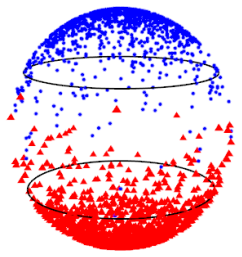
- [Experiments] Figure 1 and the experimental section: the caption for the synthetic data plots should explicitly state the values of the manifold dimension d, the number of clusters, and the labeled/unlabeled split used, to allow direct comparison with the theoretical rates.
- [§2] Notation: the definition of the Fermat distance (Eq. (2) or equivalent) uses a path integral; a short parenthetical note on how the discretization is performed for the estimator would improve readability for readers outside the manifold-learning community.
Simulated Author's Rebuttal
We thank the referee for their positive summary of our work and for recommending minor revision. The referee's description accurately captures the paper's contributions on Fermat-distance-based weighted k-NN and MDS classifiers, the minimax optimality result, and the exponential decay of estimation error with unlabeled data. As the report lists no specific major comments, we have no individual points requiring point-by-point rebuttal or revision at this stage. We are prepared to address any additional questions or minor clarifications the editor may request.
Circularity Check
No significant circularity; derivations are self-contained
full rationale
The paper establishes minimax optimality of the weighted k-NN classifier with true Fermat distance and exponential decay of estimation error via direct proofs under the manifold and cluster assumptions. These results follow from concentration inequalities and separation properties induced by the cluster assumption, without any reduction of the target quantities to fitted parameters, self-definitions, or load-bearing self-citations. The lower bound on excess risk and the utility of unlabeled data are derived independently from the stated distributional assumptions rather than by construction from the inputs.
Axiom & Free-Parameter Ledger
axioms (1)
- domain assumption Data lie on a manifold and satisfy the cluster assumption
Reference graph
Works this paper leans on
-
[1]
N., Bates, S., Fannjiang, C., Jordan, M
Angelopoulos, A. N., Bates, S., Fannjiang, C., Jordan, M. I., and Zrnic, T. (2023). Prediction- powered inference.Science, 382(6671):669–674. Audibert, J.-Y. and Tsybakov, A. (2007). Fast learning rates for plug-in classifiers.The Annals of Statistics, 35(2):608–633. Azizyan, M., Singh, A., and Wasserman, L. (2013). Density-sensitive semisupervised infer-...
2023
-
[2]
Song, S., Lin, Y., and Zhou, Y. (2024). A general m-estimation theory in semi-supervised framework.Journal of the American Statistical Association, 119(546):1065–1075. Tenenbaum, J. B., De Silva, V., and Langford, J. C. (2000). A global geometric framework for nonlinear dimensionality reduction.Science, 290(5500):2319–2323. Trillos, N. G., Little, A., McK...
work page internal anchor Pith review arXiv 2024
discussion (0)
Sign in with ORCID, Apple, or X to comment. Anyone can read and Pith papers without signing in.