Recognition: unknown
Evidence for a Scale-Free Commercial Network in the Indus Valley Civilization: A Power Law Analysis of Harappan Seal Data
Pith reviewed 2026-05-08 05:11 UTC · model grok-4.3
The pith
Harappan unicorn seals show offering stand frequencies following a power law, pointing to a scale-free trade network.
A machine-rendered reading of the paper's core claim, the machinery that carries it, and where it could break.
Core claim
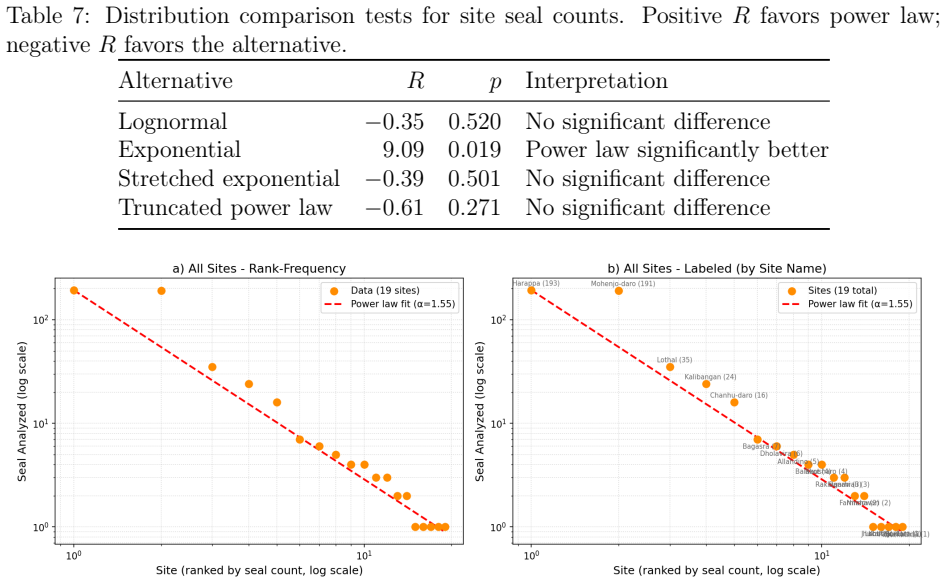
The frequency distribution of offering stand styles on unicorn seals is consistent with a power law (alpha approximately 2.3 to 2.6 from constrained fits, 2.18 from bin means), significantly better than an exponential (R = 37.3, p < 0.001), and the distribution of seal counts across sites likewise follows a power law (alpha approximately 1.55). Both exhibit the heavy-tailed structure of scale-free networks, supporting the view that Harappan trade formed a self-organizing commercial network.
What carries the argument
The information architecture in which the unicorn motif marks the commercial network, the offering stand variant encodes guild identity, and the frequency of stand styles serves as a proxy for guild size within a network-science analysis of seal data.
If this is right
- Harappan trade exhibited the hub-dominated structure typical of scale-free networks.
- The network was self-organizing rather than imposed by a central authority.
- Both guild-size and site-size distributions are consistent with the same underlying network process.
- The civilization's commercial system would have possessed resilience to random shocks but sensitivity to targeted disruption of large nodes.
Where Pith is reading between the lines
- If the scale-free pattern is real, later decline of the civilization could be linked to loss of key trading hubs rather than uniform collapse.
- The same seal-attribute proxy method could be tested on other Bronze Age artifact classes to check for comparable network signatures.
- Exact per-type frequency tables would allow tighter bounds on the exponent and direct comparison with modern trade networks.
Load-bearing premise
That the offering stand variant on unicorn seals encodes guild identity and its frequency distribution serves as a valid proxy for the relative sizes of guilds in a commercial network.
What would settle it
A direct archaeological finding that offering stand variants do not correspond to distinct guilds, or a statistical re-analysis of the complete per-type frequency data that rejects the power-law model at high .
Figures


read the original abstract
We present a quantitative analysis of the frequency distribution of unicorn seal attributes from the Harappan Civilization (c.\ 2600--1900 BCE), reinterpreting published typological data through the lens of network science. We propose an information architecture for Harappan seals in which the unicorn motif serves as a commercial network marker, the offering stand variant encodes guild identity, and the script conveys transactional and administrative metadata. Under this interpretation, the frequency distribution of offering stand styles -- a proxy for guild size -- is consistent with a power law ($\alpha \approx 2.3$--$2.6$ from constrained reconstruction; bin-mean estimate $\alpha \approx 2.18$), significantly outperforming an exponential fit ($R = 37.3$, $p < 0.001$; exponential independently ruled out via goodness-of-fit bootstrap, $p < 0.001$), with no alternative heavy-tailed model fitting significantly better. The distribution of seal counts across archaeological sites similarly follows a power law ($\alpha \approx 1.55$, KS $D = 0.094$, $p = 0.019$ vs.\ exponential). Both distributions exhibit the heavy-tailed, hub-dominated structure characteristic of scale-free networks. These findings suggest that Harappan trade was organized as a self-organizing, scale-free commercial network, with implications for understanding the civilization's resilience and eventual decline. Analysis of the complete unfiltered per-type frequency data independently confirms power law structure ($p = 0.71$), validating the guild scale-free hypothesis across both constrained and complete methodologies. Exact per-type frequency data would further refine these estimates.
Editorial analysis
A structured set of objections, weighed in public.
Referee Report
Summary. The paper claims that reinterpreting Harappan unicorn seal data—with the unicorn motif as a commercial network marker and offering stand variants as proxies for guild identity—shows the frequency distribution of offering stand styles follows a power law (α ≈ 2.3–2.6 constrained; bin-mean α ≈ 2.18), significantly outperforming exponential (R=37.3, p<0.001; KS/bootstrap p<0.001), and seal counts across sites also follow a power law (α ≈ 1.55). This is presented as evidence that Harappan trade formed a self-organizing scale-free commercial network.
Significance. If the proxy mappings hold, the result would provide quantitative evidence for scale-free network organization in a Bronze Age civilization, with potential implications for understanding trade resilience, hub-dominated structures, and factors in societal decline. The statistical comparisons (power-law preference over exponential, no better heavy-tailed alternatives) represent a strength in the empirical analysis.
major comments (2)
- [Proposed information architecture (abstract and interpretation sections)] The central claim that the observed power laws indicate a 'self-organizing, scale-free commercial network' depends on the unvalidated proxy that offering stand variants encode guild identity and frequencies proxy guild sizes (with unicorn as network marker). This mapping is introduced as a reinterpretive lens but lacks cross-validation with other Harappan artifacts, inscriptions, or settlement data, so the statistical results alone do not establish the network interpretation.
- [Results and discussion of complete unfiltered data] § on results for unfiltered per-type data: the claim that p=0.71 on complete data 'validates the guild scale-free hypothesis' requires clarification, as this p-value indicates consistency with power law but does not independently confirm the guild/network proxy without additional anchoring evidence.
minor comments (1)
- [Abstract and methods] The abstract and text use terms like 'constrained reconstruction' and 'bin-mean estimate' for the exponent without a brief methods summary; adding one sentence on these approaches would improve clarity for readers outside network science.
Simulated Author's Rebuttal
We thank the referee for their constructive review of our manuscript on the Harappan seal data. We address each major comment below with point-by-point responses. Revisions have been made to clarify interpretive framing and avoid overstatement, while preserving the core statistical findings.
read point-by-point responses
-
Referee: [Proposed information architecture (abstract and interpretation sections)] The central claim that the observed power laws indicate a 'self-organizing, scale-free commercial network' depends on the unvalidated proxy that offering stand variants encode guild identity and frequencies proxy guild sizes (with unicorn as network marker). This mapping is introduced as a reinterpretive lens but lacks cross-validation with other Harappan artifacts, inscriptions, or settlement data, so the statistical results alone do not establish the network interpretation.
Authors: We agree that the information architecture is a proposed interpretive lens rather than an independently validated model, and that the statistical results are conditional on this mapping. The manuscript presents the power-law consistency as quantitative support for scale-free structure under this reinterpretation of the typological data, not as standalone proof of the network. We have revised the abstract and discussion to explicitly describe the guild/network interpretation as a hypothesis consistent with the observed distributions, and to note the absence of direct cross-validation with other artifact classes or inscriptions. This framing aligns with the paper's emphasis on reinterpreting published data through network science. revision: partial
-
Referee: [Results and discussion of complete unfiltered data] § on results for unfiltered per-type data: the claim that p=0.71 on complete data 'validates the guild scale-free hypothesis' requires clarification, as this p-value indicates consistency with power law but does not independently confirm the guild/network proxy without additional anchoring evidence.
Authors: The referee correctly identifies an overstatement in the original wording. The p = 0.71 result from the KS test on the complete unfiltered per-type data shows that the distribution is statistically consistent with a power law (failure to reject the null), but it does not independently validate the guild or network proxy. We have revised the results section to state that this analysis confirms power-law structure in the unfiltered data, providing additional support for the scale-free pattern under the proposed architecture, while clarifying that proxy validation remains tied to the interpretive framework rather than being established by the p-value alone. revision: yes
- The absence of cross-validation with additional Harappan artifacts, inscriptions, or settlement data to independently confirm the proposed mappings of unicorn motifs and offering stand variants.
Circularity Check
No circularity: empirical power-law fits to observed frequencies with no self-referential reduction
full rationale
The paper's core analysis consists of fitting power-law and exponential models to empirical frequency counts of offering-stand styles and seal counts across sites, then comparing goodness-of-fit statistics (R, KS, bootstrap p-values). These steps are standard statistical procedures applied to external archaeological data; the resulting exponents are outputs of the fit, not inputs that presuppose the scale-free conclusion. The interpretive mapping (unicorn motif as network marker, offering stand as guild proxy) is explicitly presented as a proposed lens rather than a theorem derived from prior equations or self-citations. No load-bearing self-citations, uniqueness theorems, or ansatzes appear in the provided text, and the claim remains contingent on the proxy's validity rather than reducing to a definitional tautology. The analysis is therefore self-contained as an observational test against external benchmarks.
Axiom & Free-Parameter Ledger
free parameters (2)
- power law exponent for offering stands =
2.3-2.6
- power law exponent for site seal counts =
1.55
axioms (2)
- domain assumption Offering stand variants on unicorn seals encode guild identity
- domain assumption Unicorn motif serves as a commercial network marker
invented entities (1)
-
Scale-free commercial network structure for Harappan trade
no independent evidence
Reference graph
Works this paper leans on
-
[1]
Albert, R., Jeong, H., & Barab \'a si, A.-L. (2000). Error and attack tolerance of complex networks. Nature , 406(6794), 378--382
2000
-
[2]
Alstott, J., Bullmore, E., & Plenz, D. (2014). powerlaw: A Python package for analysis of heavy-tailed distributions. PLoS ONE , 9(1), e85777
2014
-
[3]
Ansumali Mukhopadhyay, B. (2023). Semantic scope of Indus inscriptions comprising taxation, trade and craft licensing, commodity control and access control: archaeological and script-internal evidence. Humanities and Social Sciences Communications , 10, 972. https://doi.org/10.1057/s41599-023-02320-7
-
[4]
Axtell, R. L. (2001). Zipf distribution of U.S. firm sizes. Science , 293(5536), 1818--1820
2001
-
[5]
& Albert, R
Barab \'a si, A.-L. & Albert, R. (1999). Emergence of scaling in random networks. Science , 286(5439), 509--512
1999
-
[6]
Barab \'a si, A.-L. (2003). Scale-free networks. Scientific American , 288(5), 60--69
2003
-
[7]
R., & Newman, M
Clauset, A., Shalizi, C. R., & Newman, M. E. J. (2009). Power-law distributions in empirical data. SIAM Review , 51(4), 661--703
2009
-
[8]
Jamison, G. M. (2017). The Organization of Indus Unicorn Seal Production: A Diachronic Comparative Study of Style, Skill, and Sociopolitical Organization . Ph.D.\ dissertation, University of Wisconsin--Madison
2017
-
[9]
Kenoyer, J. M. (2000). Wealth and socio-economic hierarchies of the I ndus V alley civilization. In J. Richards & M. Van Buren (Eds.), Order, legitimacy, and wealth in early states (pp. 90--112). Cambridge University Press
2000
-
[10]
Possehl, G. L. (2002). The Indus Civilization: A Contemporary Perspective . AltaMira Press
2002
discussion (0)
Sign in with ORCID, Apple, or X to comment. Anyone can read and Pith papers without signing in.