Recognition: unknown
Weak Moment Methods for Statistical Inference: with an Application to Robust Estimation
Pith reviewed 2026-05-08 05:39 UTC · model grok-4.3
The pith
Weak moment estimators derived from kernel pairs are automatically locally robust in any identifiable parametric model.
A machine-rendered reading of the paper's core claim, the machinery that carries it, and where it could break.
Core claim
The central result is that weak moment estimators are automatically locally robust in the sense of Hampel: their score is bounded and redescending, their influence function has a closed form, and their gross error sensitivity is finite in every identifiable parametric model -- all inherited from the kernel's decay, with no ad hoc truncation. The kernel plays the role of Huber's tuning constant, but as a structural component of the model rather than a post-hoc modification.
What carries the argument
Weak moment matching based on distribution-kernel pairs (T, phi), where T is a tempered distribution and phi a Schwartz kernel; the kernel decay supplies the robustness properties directly.
If this is right
- The Cauchy location model admits consistent weak-moment estimators even though no classical moment estimator exists.
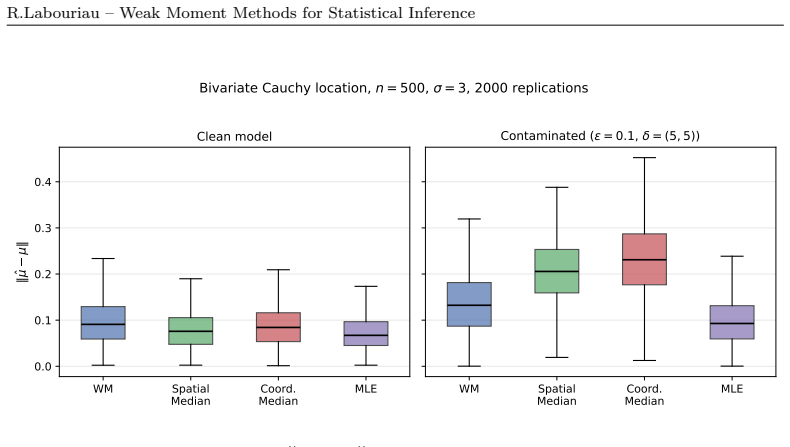
- In the bivariate t_3 location-scale model the weak-moment scale estimator converges at the parametric rate while the MLE breaks down under contamination.
- Monte Carlo comparisons show weak-moment estimators match or outperform Huber's M-estimators and other robust benchmarks on contaminated data.
- Parametric inference proceeds directly from weak expectations; density reconstruction via Tikhonov inversion is available but optional.
Where Pith is reading between the lines
- The closed-form influence function opens the possibility of analytic robustness calculations in new parametric families without simulation.
- The structural role of the kernel suggests that robustness level can be adjusted by kernel choice rather than by adding a separate tuning parameter.
- The non-parametric reconstruction route may be combined with the parametric estimators to obtain hybrid procedures that remain robust while estimating densities.
Load-bearing premise
The companion representation of every probability measure by a distribution-kernel pair makes weak moments of all orders exist unconditionally.
What would settle it
A concrete calculation showing that the influence function of a weak-moment estimator for the Cauchy location parameter is unbounded or non-redescending under the given kernel would disprove the automatic-robustness claim.
Figures
read the original abstract
A companion paper develops a framework in which probability measures are represented by distribution-kernel pairs (T,phi) with T a tempered distribution and phi a Schwartz kernel, so that weak moments of all orders exist unconditionally. The present paper turns this into a methodology for statistical inference: estimation via weak moment matching, weak characteristic functions, weak cumulants, and regularised density reconstruction via Tikhonov inversion. A key feature is that parametric inference proceeds directly from weak expectations without reconstructing the underlying density; reconstruction is an additional route, useful when density-level inference is the goal. The central result is that weak moment estimators are automatically locally robust in the sense of Hampel: their score is bounded and redescending, their influence function has a closed form, and their gross error sensitivity is finite in every identifiable parametric model -- all inherited from the kernel's decay, with no ad hoc truncation. The kernel plays the role of Huber's tuning constant, but as a structural component of the model rather than a post-hoc modification. The framework is worked out for the Cauchy location model (where no classical moment estimator exists), a Student t_3 location-scale model, a bivariate Cauchy location model, and a bivariate t_3 location-scale model. Monte Carlo comparisons show that weak moment estimators match or outperform classical robust benchmarks under contamination; in the bivariate t_3 case the MLE scale estimate breaks down while the weak moment estimator converges at the parametric rate. Although the paper focuses on parametric models, the reconstruction route is inherently non-parametric and opens a path to weak density estimation without parametric assumptions.
Editorial analysis
A structured set of objections, weighed in public.
Referee Report
Summary. The manuscript develops a methodology for statistical inference based on weak moments, using a representation of probability measures as tempered distribution-Schwartz kernel pairs (T, phi) from a companion paper. This enables weak moments of all orders to exist unconditionally. The central claim is that estimators obtained by weak moment matching (and related weak characteristic functions or cumulants) are automatically locally robust in Hampel's sense: their scores are bounded and redescending, the influence function admits a closed form, and the gross error sensitivity is finite for every identifiable parametric model, all inherited directly from the kernel decay without ad hoc truncation. The kernel functions structurally like a tuning constant. The framework is applied to the Cauchy location model, Student t_3 location-scale model, and their bivariate extensions, with Monte Carlo comparisons to classical robust estimators under contamination.
Significance. If the central robustness derivation holds, the work is significant for providing a structural route to robustness in heavy-tailed parametric models where classical moments do not exist. Credit is due for the closed-form influence function, the demonstration that the weak-moment estimator retains parametric rate in the bivariate t_3 case where the MLE scale breaks down, and the opening of a non-parametric density-reconstruction route via Tikhonov inversion. The Monte Carlo evidence, while promising, would need fuller documentation to fully support the practical claims.
minor comments (3)
- The Monte Carlo section should report the full experimental setup, including sample sizes, number of replications, exact contamination mechanisms (e.g., point-mass or mixture proportions), and tabulated performance metrics with standard errors for all compared estimators.
- Add an explicit statement of the regularity conditions (beyond identifiability) under which the closed-form influence function and finite GES hold for arbitrary parametric models; the abstract claim for 'every identifiable parametric model' would benefit from a short general argument or counter-example discussion.
- Clarify the dependence on the companion paper: state which axioms or results are imported verbatim versus re-derived here, and ensure the present manuscript is self-contained for readers who have not yet read the companion.
Simulated Author's Rebuttal
We thank the referee for the constructive report and the recommendation of minor revision. We are pleased that the significance of the structural robustness result, the closed-form influence function, and the parametric-rate performance in the bivariate t_3 case are recognized. We address the sole point raised about Monte Carlo documentation below.
read point-by-point responses
-
Referee: The Monte Carlo evidence, while promising, would need fuller documentation to fully support the practical claims.
Authors: We agree that additional documentation will strengthen the presentation. In the revised manuscript we will expand the simulation section to report: the number of Monte Carlo replications (1000), the random seed for reproducibility, the precise contamination schemes (mixture proportions and outlier locations), and full tables of bias, variance, and MSE for every estimator and model. Implementation details of the weak-moment matching procedure will also be clarified. revision: yes
Circularity Check
Moderate dependence on companion paper for core robustness claim
specific steps
-
self citation load bearing
[Abstract]
"A companion paper develops a framework in which probability measures are represented by distribution-kernel pairs (T,phi) with T a tempered distribution and phi a Schwartz kernel, so that weak moments of all orders exist unconditionally. ... The central result is that weak moment estimators are automatically locally robust in the sense of Hampel: their score is bounded and redescending, their influence function has a closed form, and their gross error sensitivity is finite in every identifiable parametric model -- all inherited from the kernel's decay, with no ad hoc truncation."
The Hampel robustness properties (bounded/redescending score, closed-form IF, finite GES) are asserted to follow automatically from the kernel decay property of the (T, phi) representation. This representation and its decay implications are supplied only by the cited companion paper from the same author; the present manuscript provides no independent derivation or external verification of that inheritance step.
full rationale
The paper's central result—that weak moment estimators inherit bounded redescending scores, closed-form influence functions, and finite gross-error sensitivity directly from kernel decay—rests on the representation framework introduced in a companion paper by the same author. This creates a self-citation load-bearing step for the automatic robustness property, even though the present work develops the estimation methodology, examples, and Monte Carlo comparisons independently. The derivation does not reduce to a pure tautology or fitted input, and the kernel is treated as a fixed structural element rather than tuned post hoc, so the circularity is partial rather than total. No other patterns (self-definitional equations, ansatz smuggling, or renaming) are visible from the provided text.
Axiom & Free-Parameter Ledger
free parameters (1)
- Schwartz kernel phi
axioms (1)
- domain assumption Probability measures can be represented by distribution-kernel pairs (T, phi) with T a tempered distribution and phi a Schwartz kernel so that weak moments of all orders exist unconditionally.
invented entities (1)
-
weak moments
no independent evidence
Forward citations
Cited by 2 Pith papers
-
Transversality and Geometric Regularisation in Distributional Statistical Models
Kernels serve as geometric regularizers ensuring generic transversality of kernel-induced feature maps to high-codimension degeneracy strata in parametric distributional models, via a weak transversality theorem from ...
-
Notes on Transversality and Statistical Degeneracies in Distributional Models
Statistical degeneracies in distributional models are geometric failures of transversality conditions on a kernel-induced feature map.
Reference graph
Works this paper leans on
-
[1]
B. H. Armstrong (1967). Spectrum line profiles: the Voigt function. Journal of Quantitative Spectroscopy and Radiative Transfer,7(1), 61– 26 R.Labouriau – Weak Moment Methods for Statistical Inference 88
1967
-
[2]
A. E. Beaton and J. W. Tukey (1974). The fitting of power series, mean- ing polynomials, illustrated on band-spectroscopic data.Technometrics, 16, 147–185
1974
-
[3]
Cavalier (2008)
L. Cavalier (2008). Nonparametric statistical inverse problems.Inverse Problems,24(3), 034004
2008
-
[4]
H. W. Engl, M. Hanke, and A. Neubauer (1996).Regularization of In- verse Problems. Kluwer, Dordrecht
1996
-
[5]
J. B. S. Haldane (1948). Note on the median of a multivariate distribu- tion.Biometrika,35(3/4), 414–417
1948
-
[6]
F. R. Hampel (1974). The influence curve and its role in robust estima- tion.JASA,69, 383–393
1974
-
[7]
F. R. Hampel, E. M. Ronchetti, P. J. Rousseeuw, and W. A. Stahel (1986).Robust Statistics: The Approach Based on Influence Functions. Wiley
1986
-
[8]
L. P. Hansen (1982). Large sample properties of generalized method of moments estimators.Econometrica,50(4), 1029–1054
1982
-
[9]
P. J. Huber (1964). Robust estimation of a location parameter.Ann. Math. Stat.,35, 73–101
1964
-
[10]
P. J. Huber and E. M. Ronchetti (2009).Robust Statistics, 2nd ed. Wiley
2009
-
[11]
Distributional Statistical Models: Weak Moments, Cumulants, and a Central Limit Theorem
R. Labouriau (2026). Distributional Statistical Models: Weak Mo- ments, Cumulants, and a Central Limit Theorem. arXiv preprint, arXiv:2604.20634v1. First paper in a series on distributional statistical models
work page internal anchor Pith review Pith/arXiv arXiv 2026
-
[12]
Meister (2009).Deconvolution Problems in Nonparametric Statistics
A. Meister (2009).Deconvolution Problems in Nonparametric Statistics. Springer. 27 R.Labouriau – Weak Moment Methods for Statistical Inference
2009
-
[13]
W. K. Newey and D. McFadden (1994). Large sample estimation and hypothesis testing. In R. F. Engle and D. L. McFadden (eds.),Handbook of Econometrics, Vol. IV, Chapter 36, pp. 2111–2245. Elsevier
1994
-
[14]
A. W. van der Vaart (2000).Asymptotic Statistics. Cambridge Univer- sity Press. A Proof of Proposition 3.1 We verify the standard regularity conditions for GMM consistency and asymptotic normality (see, e.g., [8, 13, 14]) and show that they are satisfied automatically by the Schwartz property of the kernel. Setting.Letφ∈ S(R) withφ >0, letJ={j 1, . . . , ...
2000
discussion (0)
Sign in with ORCID, Apple, or X to comment. Anyone can read and Pith papers without signing in.