Recognition: unknown
Buying the Right to Monitor:Editorial Design in AI-Assisted Peer Review
Pith reviewed 2026-05-08 05:03 UTC · model grok-4.3
The pith
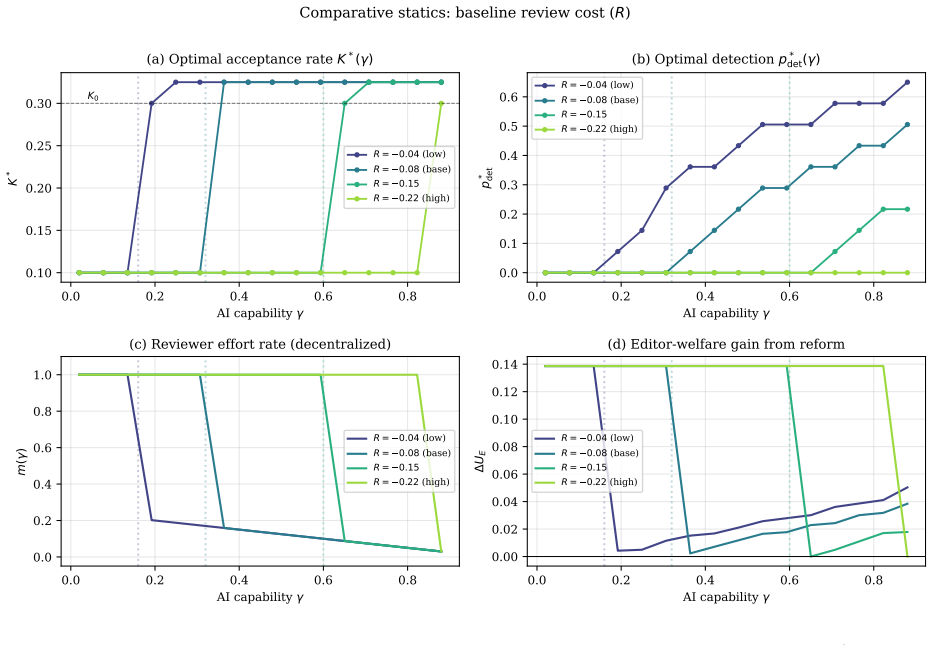
When AI capability crosses a critical threshold, reviewer effort collapses discontinuously and editors must switch from tightening to loosening acceptance standards.
A machine-rendered reading of the paper's core claim, the machinery that carries it, and where it could break.
Core claim
In the three-sided equilibrium model, AI adoption by reviewers produces a discontinuous collapse in evaluative effort once capability crosses a critical level. This transition generates a welfare misalignment in which authors benefit from a weakened rat race while editors suffer degraded signal informativeness. The editor's constrained optimum therefore reverses: before the threshold, tighten acceptance standards to curb rent-dissipating polishing; after the threshold, loosen standards while investing in AI detection, since further tightening amplifies dissipative polishing without improving selection. The sign reversal is shown to be a structural consequence of the effort collapse under log
What carries the argument
The discontinuous collapse in reviewer effort at the AI capability threshold, which under log-concave quality distributions triggers the sign reversal in optimal editorial policy between tightening and loosening acceptance standards.
If this is right
- Authors receive a welfare gain from the reduced competition in polishing submissions.
- Editors incur a welfare loss from the lower informativeness of review signals.
- Pre-transition, editors optimally tighten acceptance standards to limit rent-dissipating author polishing.
- Post-transition, editors optimally loosen acceptance standards while investing in AI detection.
- Loosened selectivity and monitoring investment function as complementary policy instruments after the transition.
Where Pith is reading between the lines
- The same threshold logic may appear in other evaluative markets where both submitters and evaluators can adopt generative AI.
- Journals could gain by coordinating detection investments across outlets to raise the effective cost of undetected AI use.
- Long-run author adaptation might shift toward forms of differentiation that AI polishing cannot easily replicate.
- Empirical measurement of review detail or length before and after AI tool diffusion could test the predicted effort collapse.
Load-bearing premise
Reviewer effort drops sharply and discontinuously once AI tools reach a critical capability level, and this drop occurs specifically because manuscript quality follows a log-concave distribution.
What would settle it
Empirical data showing that reviewer effort declines only gradually or remains stable as AI writing tools improve, or that tightening acceptance standards after widespread AI adoption still improves selection without increasing author polishing, would falsify the predicted discontinuity and policy reversal.
Figures


read the original abstract
Generative AI acts as a disruptive technological shock to evaluative organizations. In academic peer review, it enters both sides of the market: authors use AI to polish submissions, and reviewers use it to generate plausible reports without exerting evaluative effort. We develop a three-sided equilibrium model to analyze this dual adoption and derive a counterintuitive managerial implication for journal policy. We show that when AI capability crosses a critical threshold, reviewer effort collapses discontinuously. This transition creates a welfare misalignment: authors benefit from a weakened ``rat race,'' while editors suffer from degraded signal informativeness. Characterizing the editor's optimal constrained response, we identify a strict policy reversal. Before the AI transition, editors should tighten acceptance standards to curb rent-dissipating author polishing. After the transition, conventional intuition fails: editors must loosen acceptance standards while investing in AI detection, because further tightening only amplifies dissipative polishing without improving sorting. We prove analytically that this sign reversal is a structural consequence of the reviewer effort collapse under log-concave quality distributions. Ultimately, addressing AI in evaluative systems requires treating monitoring and loosened selectivity as complementary design instruments.
Editorial analysis
A structured set of objections, weighed in public.
Referee Report
Summary. The manuscript develops a three-sided equilibrium model of academic peer review in which authors and reviewers can adopt generative AI. It derives that reviewer effort collapses discontinuously once AI capability exceeds a critical threshold (under log-concave quality distributions), producing a welfare misalignment between authors and editors. The editor's optimal policy exhibits a strict sign reversal: tighten acceptance standards before the threshold to deter dissipative author polishing; loosen standards and invest in AI detection afterward, because further tightening amplifies polishing without restoring signal quality. The reversal is shown to be a structural consequence of the effort collapse rather than an imposed feature.
Significance. If the equilibrium characterization and threshold derivation hold, the paper supplies a clean analytical account of how AI disrupts evaluative organizations and yields a counterintuitive, policy-relevant prediction that monitoring and reduced selectivity become complements after the transition. The use of log-concave distributions to obtain the discontinuity is a standard, falsifiable modeling choice that strengthens the result's robustness.
major comments (2)
- [Introduction / Model section] The abstract and introduction state that the sign reversal follows from the reviewer-effort collapse under log-concave distributions, but the manuscript does not display the explicit equilibrium conditions or the definition of the AI-capability threshold (e.g., the point at which the reviewer's best-response effort jumps). Without these equations, it is impossible to confirm that the reversal is not an artifact of the threshold construction itself.
- [Editor optimization / Proposition on policy reversal] The claim that 'further tightening only amplifies dissipative polishing without improving sorting' after the transition is central to the policy reversal. The paper should provide the comparative-static result (or the relevant derivative) showing that the editor's marginal return to selectivity changes sign exactly at the effort-collapse point.
minor comments (2)
- [Throughout] Notation for the three-sided game (author, reviewer, editor) and for AI capability should be introduced once and used consistently; several symbols appear to be redefined between the model and the policy section.
- [Abstract and Conclusion] The abstract refers to 'strict policy reversal' and 'structural consequence'; these phrases are repeated in the conclusion but would benefit from a short roadmap sentence indicating which proposition contains the proof.
Simulated Author's Rebuttal
We thank the referee for the careful and constructive comments. We address each major point below and will revise the manuscript accordingly to improve clarity on the equilibrium characterization and the policy reversal.
read point-by-point responses
-
Referee: [Introduction / Model section] The abstract and introduction state that the sign reversal follows from the reviewer-effort collapse under log-concave distributions, but the manuscript does not display the explicit equilibrium conditions or the definition of the AI-capability threshold (e.g., the point at which the reviewer's best-response effort jumps). Without these equations, it is impossible to confirm that the reversal is not an artifact of the threshold construction itself.
Authors: We agree that the explicit equilibrium conditions and threshold definition merit a more prominent statement early in the paper. In the revision we will insert a brief paragraph in the introduction (and cross-reference in the model section) that states the reviewer's best-response effort as the solution to the first-order condition equating marginal cost to the marginal informativeness gain under AI augmentation, and defines the AI-capability threshold as the infimum of capability levels at which this interior solution ceases to exist under log-concavity of the quality distribution. This will make transparent that the discontinuity is an endogenous outcome of the optimization problem rather than an imposed feature. revision: yes
-
Referee: [Editor optimization / Proposition on policy reversal] The claim that 'further tightening only amplifies dissipative polishing without improving sorting' after the transition is central to the policy reversal. The paper should provide the comparative-static result (or the relevant derivative) showing that the editor's marginal return to selectivity changes sign exactly at the effort-collapse point.
Authors: We thank the referee for highlighting the need for an explicit comparative-static display. The proof of the reversal already shows that the editor's marginal value of tightening changes sign at the collapse point because post-collapse signal quality is invariant to further reviewer effort. In the revised version we will add the explicit derivative of the editor's objective with respect to the acceptance threshold in the statement of the relevant proposition, demonstrating that the derivative is positive before the threshold (where effort still responds) and negative afterward (where only polishing costs rise). This will directly confirm the sign change occurs exactly at the effort discontinuity. revision: yes
Circularity Check
No significant circularity in derivation chain
full rationale
The paper presents a three-sided equilibrium model deriving discontinuous reviewer effort collapse and a policy sign reversal as structural consequences of equilibrium conditions under log-concave quality distributions. The abstract states the reversal is proven analytically from these conditions rather than imposed by definition, fitted parameters, or self-citation. No load-bearing self-citations, ansatzes smuggled via prior work, or renamings of known results are indicated; the model is self-contained with independent analytical content.
Axiom & Free-Parameter Ledger
axioms (1)
- domain assumption Quality distributions are log-concave
Reference graph
Works this paper leans on
-
[1]
The Economics of Caste and of the Rat Race and Other Woeful Tales
Akerlof, George A. (1976). “The Economics of Caste and of the Rat Race and Other Woeful Tales”. In: Quarterly Journal of Economics90.4, pp. 599–617. Bergemann, Dirk and Stephen Morris (2019). “Information Design: A Unified Perspective”. In:Journal of Economic Literature57.1, pp. 44–95. Cai, Jing et al. (2023). “Monitoring, Moral Hazard, and the Costs of I...
-
[2]
polish- adjusted threshold
Hence da∗/dm≥0 . Since cA is strictly increasing, cA(a∗(m))is weakly increasing inm. D. Proof of Lemma 2 Q=E[θ|¯s ret >τ K] with ¯sret |θ∼N(M(θ+β¯a),Σ 2(M)/Nret), where Nret =N[m+ (1−m)(1−p det)] is the retained sample size andM=M(m,p det)is the effective effort share. Monotonicity in M.For fixed Nret, the signal-to-noise ratio is SNR(M) =M 2Nret Var(θ)/Σ...
1961
discussion (0)
Sign in with ORCID, Apple, or X to comment. Anyone can read and Pith papers without signing in.