Recognition: unknown
Finite-time Lyaponov analysis of a trained reservoir computer
Pith reviewed 2026-05-08 05:03 UTC · model grok-4.3
The pith
Finite-time Lyapunov exponent distributions in trained reservoir computers faithfully reproduce the dynamical regimes of the original low-dimensional chaotic systems.
A machine-rendered reading of the paper's core claim, the machinery that carries it, and where it could break.
Core claim
Although such distinct regimes are difficult to characterize within the high dimensional reservoir space, their FTLE distributions are faithfully reproduced. This establishes FTLE analysis as a systematic and reliable framework for uncovering transition mechanisms in learned reservoir dynamics, particularly for interior crises where direct identification of unstable periodic orbit collisions in the reservoir space is infeasible.
What carries the argument
The finite-time Lyapunov exponent (FTLE) distribution, which acts as a statistical fingerprint of local expansion rates over finite times and distinguishes the underlying chaotic regimes without requiring explicit location of periodic orbits in the high-dimensional map.
If this is right
- FTLE distributions enable identification of interior crises and intermittency transitions inside reservoir computers without locating unstable periodic orbits.
- Prediction accuracy alone is insufficient; FTLE statistics provide an independent check that the reservoir has captured the original system's transition mechanisms.
- The same FTLE probe can be applied to reservoirs trained on other low-dimensional maps to verify regime fidelity.
- High-dimensional learned systems can be analyzed for dynamical faithfulness using only finite-time exponent statistics rather than full state-space reconstruction.
Where Pith is reading between the lines
- Reservoir training hyperparameters could be tuned by monitoring how closely the resulting FTLE distributions match a target system's known statistics.
- The approach might extend to other recurrent architectures used for chaotic forecasting, offering a general diagnostic for learned dynamics.
- In applications such as fluid flow or climate modeling, FTLE monitoring could flag when a reservoir begins to lose fidelity near critical transitions.
- Direct comparison of FTLE histograms before and after training offers a quantitative measure of how much the reservoir embedding alters the original chaos.
Load-bearing premise
The training process on the low-dimensional chaotic system preserves its essential expansion and folding features so that the reservoir's high-dimensional dynamics produce matching FTLE distributions without major distortion.
What would settle it
Computing the FTLE distribution on the trained reservoir during a known interior crisis of the logistic map and finding it statistically different from the original map's distribution would falsify the claim of faithful reproduction.
Figures


read the original abstract
We use finite-time Lyapunov exponent (FTLE) distributions to probe transition mechanisms in high-dimensional reservoir maps trained on low-dimensional chaotic dynamics across multiple regimes. While trained reservoirs accurately predict critical transitions and regime shifts, conventional analyses based on time series or bifurcation structure provide limited mechanistic insight, since distinct pathways in high dimensions can yield similar outputs. We show that FTLE statistics overcome this limitation. This is particularly important for interior crises, where direct identification of unstable periodic orbit collisions in the reservoir space is infeasible. Using the logistic map as a canonical example exhibiting intermittency, fully developed chaos, and crisis-induced transitions, we demonstrate that although such distinct regimes are difficult to characterize within the high dimensional reservoir space, their FTLE distributions are faithfully reproduced. This establishes FTLE analysis as a systematic and reliable framework for uncovering transition mechanisms in learned reservoir dynamics.
Editorial analysis
A structured set of objections, weighed in public.
Referee Report
Summary. The manuscript proposes finite-time Lyapunov exponent (FTLE) distributions as a diagnostic tool to uncover transition mechanisms in high-dimensional reservoir computers trained on low-dimensional chaotic systems. Using the logistic map as a test case across intermittency, fully developed chaos, and interior-crisis regimes, it claims that although direct characterization of regimes is difficult in the reservoir state space, the FTLE distributions of the trained reservoir faithfully reproduce those of the original map, thereby establishing FTLE analysis as a systematic framework for learned reservoir dynamics.
Significance. If the central claim of faithful reproduction without significant distortion holds, the work would supply a concrete mechanistic probe for high-dimensional learned dynamical systems where conventional time-series or bifurcation diagnostics are insufficient, especially for crises. The approach could generalize to other reservoir or recurrent architectures and help distinguish internal dynamical pathways that produce similar outputs.
major comments (3)
- [Abstract] Abstract: the assertion that FTLE distributions are 'faithfully reproduced' is unsupported by any quantitative comparison (e.g., Kolmogorov-Smirnov distance, histogram overlap, or maximal-FTLE error) between the reservoir and the logistic map in each regime.
- [Abstract / Methods] The manuscript provides no reservoir parameters (size, spectral radius, training procedure, readout error) or verification that the trained map's output time series reproduces the logistic map with low error, leaving open the possibility that high-dimensional internal dynamics distort the leading FTLE distribution.
- [Abstract] Abstract: the potential distortion of finite-time Lyapunov statistics by additional expanding/contracting directions in the high-dimensional Jacobian of the untrained reservoir is not addressed with any diagnostic (e.g., comparison of the full Lyapunov spectrum or embedding-dimension checks).
minor comments (2)
- [Title] Title: 'Lyaponov' is misspelled; it should read 'Lyapunov'.
- [Abstract] Abstract: the phrase 'parameter-free' or equivalent claims about the FTLE framework should be clarified if any fitted quantities (e.g., reservoir hyperparameters) enter the analysis.
Simulated Author's Rebuttal
We thank the referee for the constructive comments on our manuscript. We address each major comment point by point below, indicating where revisions will be made to strengthen the presentation.
read point-by-point responses
-
Referee: [Abstract] Abstract: the assertion that FTLE distributions are 'faithfully reproduced' is unsupported by any quantitative comparison (e.g., Kolmogorov-Smirnov distance, histogram overlap, or maximal-FTLE error) between the reservoir and the logistic map in each regime.
Authors: We agree that the abstract claim would be strengthened by quantitative support. The manuscript demonstrates reproduction through direct visual comparison of the FTLE histograms and their key statistical features (support, peaks, and tails) across the three regimes in the figures. To provide a more rigorous validation, we will add quantitative metrics such as Kolmogorov-Smirnov distances between the distributions, histogram overlap measures, and errors in the maximal FTLE values for each regime in the revised manuscript. revision: yes
-
Referee: [Abstract / Methods] The manuscript provides no reservoir parameters (size, spectral radius, training procedure, readout error) or verification that the trained map's output time series reproduces the logistic map with low error, leaving open the possibility that high-dimensional internal dynamics distort the leading FTLE distribution.
Authors: The referee correctly notes that these details require clearer presentation. While the training procedure is described at a high level, we will expand the Methods section in the revision to include explicit reservoir size, spectral radius, training algorithm details, and readout error values. We will also add verification that the reservoir output time series reproduces the logistic map with low error (e.g., via RMSE or correlation metrics) to confirm that the leading FTLE is not distorted by poor reproduction. revision: yes
-
Referee: [Abstract] Abstract: the potential distortion of finite-time Lyapunov statistics by additional expanding/contracting directions in the high-dimensional Jacobian of the untrained reservoir is not addressed with any diagnostic (e.g., comparison of the full Lyapunov spectrum or embedding-dimension checks).
Authors: This is a substantive point about the high-dimensional Jacobian. The manuscript focuses on the leading FTLE because it captures the dominant chaotic expansion relevant to the reproduced low-dimensional dynamics, and the reservoir is designed such that non-leading directions are typically strongly contracting. However, we did not provide explicit diagnostics for the full spectrum. In the revised manuscript, we will include a brief analysis or note on the full Lyapunov spectrum (or at least the second-largest exponent) and discuss embedding considerations to rule out significant distortion of the finite-time statistics. revision: yes
Circularity Check
No significant circularity; FTLE applied as independent diagnostic to reservoir map
full rationale
The paper trains a reservoir computer on the logistic map and then computes finite-time Lyapunov exponent distributions directly from the Jacobian of the resulting high-dimensional reservoir map. These distributions are compared empirically to the known FTLE statistics of the original low-dimensional system across regimes. No derivation step reduces a claimed prediction to a fitted input by construction, nor does any load-bearing premise rest on self-citation chains or imported uniqueness theorems. The central assertion that FTLE statistics faithfully reproduce transition mechanisms is presented as an observed outcome of the analysis rather than a definitional or tautological equivalence.
Axiom & Free-Parameter Ledger
axioms (2)
- domain assumption Reservoir computers trained on low-dimensional chaotic time series can produce high-dimensional maps whose stability properties are diagnostically accessible via FTLE statistics.
- standard math Finite-time Lyapunov exponents are well-defined and statistically meaningful for high-dimensional discrete maps.
Reference graph
Works this paper leans on
-
[1]
4 3 . 6 3 . 8 4 . 0 µ
-
[2]
4 3 . 6 3 . 8 4 . 0 ε
-
[3]
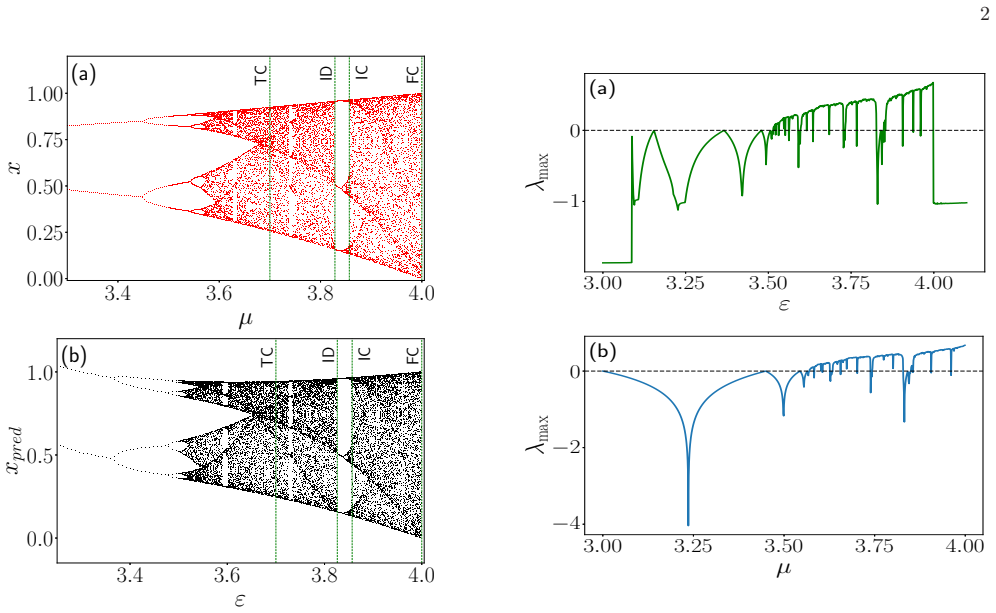
0 xpred TC FC IC ID(b) FIG. 1. RC mimicking the dynamical regimes of logistic map: Bifurcation plot of (a) logistic map and (b) trained RC map (Eq. 3). TC, ID, IC, FC denote typical chaos, intermittent dynamics, interior crisis, fully developed chaos, respect ively. the statistical properties of the maximal FTLEs and show that their distributions provide ...
-
[4]
00 3 . 25 3 . 50 3 . 75 4 . 00 ε − 1 0 λ max (a)
-
[5]
00 3 . 25 3 . 50 3 . 75 4 . 00 µ − 4 − 2 0 λ max (b) FIG. 2. Largest asymptotic Lyapunov exponent as a function of the bifurcation parameter (Eq. 1). While the asymptotic exponent correctly identifies chaotic and non-chaotic regi ons, it can not classify the distinct dynamical states, motivati ng the use of finite-time Lyapunov exponent distributions. (a) t...
-
[6]
00 0 . 25 0 . 50 λ 10− 2 100 ln P (λ, 33) (a)
-
[7]
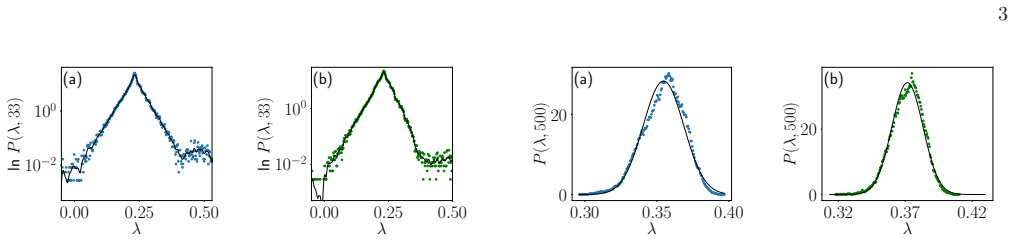
00 0 . 25 0 . 50 λ 10− 2 100 ln P (λ, 33) (b) FIG. 3. Probability density of finite-time Lyapunov exponen ts at interior crisis computed from segments of length N = 33 using 200000 iterations. (a) Logistic map at µ = 3 . 8568007; the solid black curve denotes the kernel density estimate fo r the smooth approximation of the probability density functi on. (b...
-
[8]
30 0 . 35 0 . 40 λ 0 20P (λ, 500) (a)
-
[9]
32 0 . 37 0 . 42 λ 0 20P (λ, 500) (b) FIG. 4. FTLE resemblance in typical chaos regime: Prob- ability density of FTLEs computed from segments of length N = 500 using 200000 iterations in the typical chaos regime for (a) logistic map at µ = 3 . 7 with the solid black curve denoting the kernel density estimate for the smooth approxi - mation of the probabil...
-
[10]
0 P (λ, 3) (b) − 0. 2 0. 4 1 . 0 1 . 6 λ 0 2P (λ, 3) (e) − 0. 1 0. 5 1 . 2 λ 0 10P (λ, 15) (c) − 0. 1 0. 5 1 . 2 λ 0 5 10P (λ, 15) (f) FIG. 5. (a) - (c) Probability density estimation of FTLEs at µ = 4 (fully developed chaos) for the logistic map from segments of length a) N = 2, b) N = 3, c) N = 15 showing different number of spikes. (d) - (f) Probability...
-
[11]
fully developed chaos
0 xpred (b) FIG. 6. (a) Time series of the logistic map at µ = 1 + √ 8 − 10− 4 depicting intermittent behavior due to subduction. (b) Time series of the trained RC map at ε = 3 . 8261 also mani- festing intermittent dynamics. by the trained reservoir map at the same parameter value (Fig. 4(a) and (b)). The distribution deviates sharply from a Gaussian sha...
-
[12]
1 0 . 2 0 . 3 λ 10− 1 100 ln P (λ, 300) (b) Slope = − 10. 28
-
[13]
Characteristic distributions of finite-time lyapunov exponents,
0 0 . 2 0 . 4 λ 10− 1 101 ln P (λ, 300) (d) Slope = − 12. 68 FIG. 7. (a) Probability density estimation of FTLEs at µ = 1 + √ 8 − 10− 4 for the logistic map for subduction from segments of length N = 300. (b) Straight line fit to the expo- nential tail to compute the scaling exponent for logistic ma p. (c) Probability density estimation of FTLEs at ε = 3 ....
discussion (0)
Sign in with ORCID, Apple, or X to comment. Anyone can read and Pith papers without signing in.