Learning to Decipher from Pixels: A Case Study of Copiale
Pith reviewed 2026-07-01 09:46 UTC · model grok-4.3
The pith
An end-to-end neural model can map handwritten cipher images directly to plaintext without any intermediate symbol transcription.
A machine-rendered reading of the paper's core claim, the machinery that carries it, and where it could break.
Core claim
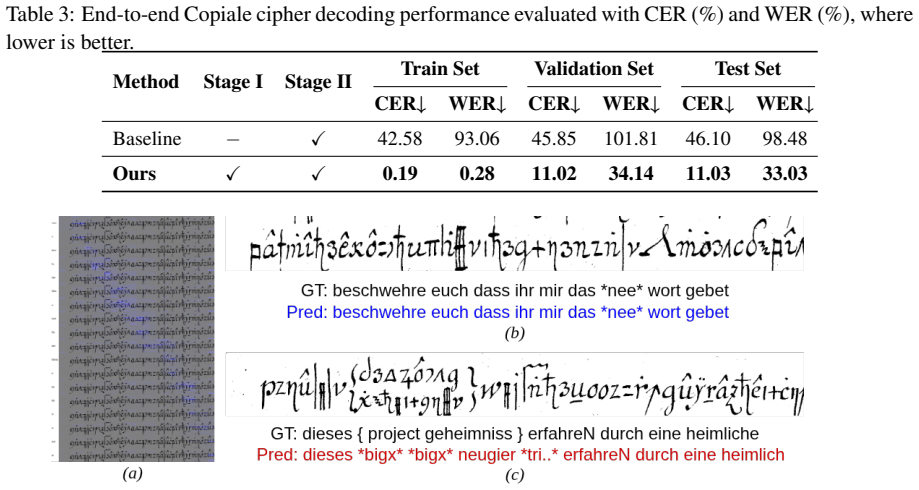
The central claim is that transcription-free image-to-plaintext decipherment is both feasible and effective for historical substitution ciphers. Using the Copiale cipher as a case study, the authors introduce the first text-line-level dataset of cipher images aligned with German plaintext and show that pretraining on generic handwriting data followed by cipher-specific fine-tuning substantially raises decipherment accuracy compared to baselines.
What carries the argument
An end-to-end neural network that learns to map raw cipher image lines directly to plaintext sequences, trained first on broad handwriting data and then fine-tuned on aligned Copiale image-plaintext pairs.
If this is right
- Decipherment workflows for historical manuscripts can skip the transcription stage entirely.
- Accuracy on substitution ciphers improves when generic handwriting pretraining precedes cipher-specific fine-tuning.
- The same end-to-end image-to-plaintext pipeline offers a scalable alternative to transcription-first methods.
- New line-level datasets pairing cipher images with known plaintext enable supervised training for other ciphers.
Where Pith is reading between the lines
- The approach might extend to other substitution ciphers if similar aligned line-level datasets can be created.
- Combining the direct image model with existing cryptanalytic techniques could raise overall recovery rates on unknown keys.
- Testing the model on full-page images rather than isolated lines would reveal whether layout context further aids decipherment.
Load-bearing premise
The model can learn the symbol-to-letter mappings purely from pixel patterns in the image-plaintext pairs without needing explicit symbol segmentation or transcription.
What would settle it
Evaluating the trained model on held-out Copiale cipher lines and finding that the generated plaintext matches the ground truth at rates no better than a random baseline or a simple frequency-matching method would falsify the central claim.
Figures

read the original abstract
Historical encrypted manuscripts require both paleographic interpretation of cipher symbols and cryptanalytic recovery of plaintext. Most existing computational workflows rely on a transcription-first paradigm, in which handwritten symbols are transcribed prior to decipherment. This intermediate step is labor-intensive, error-prone, and not always aligned with the goal of direct plaintext recovery. We propose an end-to-end, transcription-free approach that directly maps handwritten cipher images to plaintext. Using the Copiale cipher as a case study, we introduce the first text-line-level dataset pairing cipher images with German plaintext. We show that pretraining on generic handwriting data followed by cipher-specific fine-tuning substantially improves decipherment accuracy. Our results demonstrate that transcription-free image-to-plaintext decipherment is both feasible and effective for historical substitution ciphers, offering a simplified and scalable alternative to traditional pipelines. https://github.com/leitro/Decipher-from-Pixels-Copiale
Editorial analysis
A structured set of objections, weighed in public.
Referee Report
Summary. The paper proposes an end-to-end, transcription-free pipeline that maps handwritten cipher images directly to plaintext for historical substitution ciphers. Using the Copiale cipher as a case study, the authors release the first line-level dataset of cipher images aligned with German plaintext and report that pretraining on generic handwriting data followed by cipher-specific fine-tuning yields substantial gains in decipherment accuracy.
Significance. If the experimental results hold, the work would demonstrate a viable simplification of existing cryptanalytic workflows by removing the transcription stage, which is labor-intensive and error-prone. The release of the aligned line-level dataset constitutes a concrete, reusable contribution to the digital humanities and historical cryptanalysis communities.
major comments (2)
- [Abstract] Abstract: the central claim that pretraining followed by fine-tuning 'substantially improves decipherment accuracy' is stated without any quantitative metrics, baseline comparisons, error rates, or dataset statistics. This absence prevents verification of whether the reported improvement is load-bearing for the feasibility conclusion.
- [Abstract] Abstract: the feasibility demonstration rests on the assumption that the new line-level dataset supplies reliable image-to-plaintext alignments for supervised training, yet no description of alignment creation, validation, or error rate is supplied, leaving the quality of the supervised signal unassessable.
Simulated Author's Rebuttal
We thank the referee for the constructive comments on the abstract. We address each point below and will revise the manuscript to incorporate additional quantitative details and dataset information for improved clarity and verifiability.
read point-by-point responses
-
Referee: [Abstract] Abstract: the central claim that pretraining followed by fine-tuning 'substantially improves decipherment accuracy' is stated without any quantitative metrics, baseline comparisons, error rates, or dataset statistics. This absence prevents verification of whether the reported improvement is load-bearing for the feasibility conclusion.
Authors: We agree that the abstract would be strengthened by including quantitative support for the claim. The body of the manuscript reports the relevant experimental results, including accuracy metrics, baseline comparisons, and dataset statistics. In the revised version we will update the abstract to include key figures such as the observed accuracy gains from pretraining plus fine-tuning, along with baseline error rates. revision: yes
-
Referee: [Abstract] Abstract: the feasibility demonstration rests on the assumption that the new line-level dataset supplies reliable image-to-plaintext alignments for supervised training, yet no description of alignment creation, validation, or error rate is supplied, leaving the quality of the supervised signal unassessable.
Authors: The manuscript provides a description of the line-level dataset and alignment process in the dedicated Dataset section. To make this information more immediately accessible, we will revise the abstract to include a concise statement on how the alignments were created and validated. revision: yes
Circularity Check
No significant circularity; empirical results independent of inputs
full rationale
The paper reports an empirical ML pipeline (pretraining on generic handwriting data then fine-tuning on a new line-level Copiale image-to-plaintext dataset) whose central claim is validated by experimental accuracy metrics rather than any derivation chain. No equations, fitted parameters renamed as predictions, or self-citation load-bearing steps appear in the provided abstract or description; the approach relies on standard supervised learning assumptions that are externally testable via the released dataset and code.
Axiom & Free-Parameter Ledger
axioms (1)
- domain assumption A neural network can learn a direct mapping from cipher symbol images to plaintext letters without an intermediate symbolic transcription or segmentation step.
Reference graph
Works this paper leans on
-
[1]
InProceedings of the 4th Workshop on Building and Using Comparable Corpora: Comparable Corpora and the Web, pages 2–9
The copiale cipher. InProceedings of the 4th Workshop on Building and Using Comparable Corpora: Comparable Corpora and the Web, pages 2–9. Kevin Knight, Be ´ata Megyesi, and Christiane Schae- fer. 2012. The secrets of the copiale cipher.Jour- nal for Research into Freemasonry and Fraternal- ism, 2(2):314. Jan Koh ´ut and Michal Hradi ˇs. 2025. Practical f...
2012
-
[2]
InEuro- pean Conference on Computer Vision, pages 330–
Structured analysis and comparison of al- phabets in historical handwritten ciphers. InEuro- pean Conference on Computer Vision, pages 330–
-
[3]
Xusen Yin, Nada Aldarrab, Be ´ata Megyesi, and Kevin Knight
Springer. Xusen Yin, Nada Aldarrab, Be ´ata Megyesi, and Kevin Knight. 2019. Decipherment of historical manuscript images. In2019 International Confer- ence on Document Analysis and Recognition (IC- DAR), pages 78–85. IEEE
2019
discussion (0)
Sign in with ORCID, Apple, or X to comment. Anyone can read and Pith papers without signing in.