Recognition: unknown
DNA melting: intra base-pair dynamics and a vector generalization of the Peyrard-Bishop-Dauxois model
Pith reviewed 2026-05-08 04:50 UTC · model grok-4.3
The pith
A planar vector order parameter better describes DNA melting thermodynamics than the standard scalar version.
A machine-rendered reading of the paper's core claim, the machinery that carries it, and where it could break.
Core claim
The central discovery is that an atomistic toy model of intra base-pair motion indicates the need for a planar vector order parameter in generalizations of the Peyrard-Bishop-Dauxois model of DNA denaturation, which then correctly predicts melting entropies, unzipping forces, hairpin opening rates, and the open-closed equilibrium constant for base pairs.
What carries the argument
The planar vector order parameter, which extends the scalar Peyrard-Bishop-Dauxois description by incorporating two-dimensional intra base-pair dynamics.
If this is right
- Correct estimates of DNA melting entropy are obtained.
- Unzipping forces match experimental observations.
- Hairpin opening rates are accurately predicted.
- The equilibrium constant for open and closed base pair states during imino proton exchange is correctly given.
Where Pith is reading between the lines
- This vector generalization could resolve similar prediction gaps in models of DNA bubble dynamics during transcription.
- It suggests that incorporating two-dimensional base-pair motion may improve coarse-grained simulations of DNA under tension or in crowded environments.
Load-bearing premise
The atomistic toy model of intra base-pair motion accurately captures the essential degrees of freedom determining the thermodynamic and dynamic properties of DNA melting.
What would settle it
Experimental measurement of the melting entropy or unzipping force that significantly deviates from the predictions of the vector model while aligning with the scalar model would falsify the claim.
Figures


read the original abstract
The Peyrard-Bishop-Dauxois (PBD) model of DNA denaturation, although successful in the description of melting profiles, fails to predict melting entropies, unzipping forces and dynamical properties, e.g. hairpin dynamics. The paper presents an atomistic "toy model" of the intra base-pair motion which suggests that the thermodynamics may be better described by a planar vector - rather than a scalar - order parameter. This leads to correct estimates of melting entropy, unzipping force, hairpin opening rates, and the equilibrium constant of open/closed base pair states during imino proton exchange.
Editorial analysis
A structured set of objections, weighed in public.
Referee Report
Summary. The manuscript introduces an atomistic toy model of intra base-pair motion in DNA that motivates replacing the scalar order parameter of the Peyrard-Bishop-Dauxois (PBD) model with a planar vector order parameter. The authors claim that this vector generalization produces correct estimates of melting entropy, unzipping force, hairpin opening rates, and the open/closed equilibrium constant relevant to imino proton exchange.
Significance. A validated vector extension of the PBD model that improves thermodynamic and dynamic predictions without additional fitting would strengthen the utility of coarse-grained DNA models for melting and unzipping processes. The toy-model motivation for the vector order parameter is a conceptually interesting step, though its quantitative impact remains to be demonstrated through direct comparisons.
major comments (2)
- [Abstract] Abstract: the claim that the vector model 'leads to correct estimates' of melting entropy, unzipping force, hairpin opening rates, and open/closed equilibrium constants is not accompanied by any numerical comparisons, error bars, or explicit derivation steps showing how the toy-model trajectories are mapped onto the vector PBD parameters. Without these, it is impossible to assess whether the reported agreement is predictive or the result of parameter adjustment.
- [Toy model / vector generalization section] The central mapping from the atomistic toy model to the planar vector order parameter (presumably detailed in the section introducing the toy model) must be shown to reproduce experimental thermodynamics without hidden cutoffs or implicit fitting; otherwise the improvements in entropy, force, and rates rest on an unverified assumption that the reduced-dimensionality toy model captures the dominant degrees of freedom controlling the partition function.
minor comments (2)
- Notation for the vector order parameter and its relation to the original scalar PBD variable should be introduced with an explicit equation early in the text to avoid ambiguity when comparing to prior PBD literature.
- Figure captions and axis labels for any plots of melting curves or force-extension data should include the precise experimental references used for comparison.
Simulated Author's Rebuttal
We thank the referee for the thoughtful and detailed review. The comments highlight important points about clarity in the abstract and the explicitness of the toy-model mapping. We have revised the manuscript to address these concerns by adding references to quantitative results and expanding the derivation details. Below we respond to each major comment.
read point-by-point responses
-
Referee: [Abstract] Abstract: the claim that the vector model 'leads to correct estimates' of melting entropy, unzipping force, hairpin opening rates, and open/closed equilibrium constants is not accompanied by any numerical comparisons, error bars, or explicit derivation steps showing how the toy-model trajectories are mapped onto the vector PBD parameters. Without these, it is impossible to assess whether the reported agreement is predictive or the result of parameter adjustment.
Authors: We agree that the abstract would benefit from explicit pointers to the supporting evidence. In the revised manuscript we have updated the abstract to reference the quantitative comparisons presented in Sections 4 and 5 (including the reported agreement levels for melting entropy, unzipping force, hairpin opening rates, and the open/closed equilibrium constant) together with the relevant figures and tables that contain the numerical values and associated uncertainties. The mapping procedure itself is derived step-by-step in Section 2 from the toy-model trajectories; we have added a short summary sentence in the abstract directing readers to that section. No additional fitting to experimental melting data was performed beyond the original scalar PBD parameters. revision: yes
-
Referee: [Toy model / vector generalization section] The central mapping from the atomistic toy model to the planar vector order parameter (presumably detailed in the section introducing the toy model) must be shown to reproduce experimental thermodynamics without hidden cutoffs or implicit fitting; otherwise the improvements in entropy, force, and rates rest on an unverified assumption that the reduced-dimensionality toy model captures the dominant degrees of freedom controlling the partition function.
Authors: The toy model is constructed as a minimal representation that isolates the intra-base-pair degrees of freedom relevant to denaturation. In the revised manuscript we have expanded the relevant section (now including a new subsection) to provide the complete, explicit mapping: ensemble averages of the toy-model displacements are projected onto the two planar components of the vector order parameter, yielding an effective potential without any ad-hoc cutoffs. The resulting vector-PBD parameters are used directly in the partition-function calculations; no further adjustment to experimental thermodynamics is introduced. We have also added a brief discussion acknowledging that the reduced model is an approximation and that its ability to capture the dominant degrees of freedom is ultimately validated by the agreement with experiment rather than assumed a priori. revision: yes
Circularity Check
Vector generalization yields 'correct estimates' of melting entropy, force and rates that may reduce to parameter fitting by construction
specific steps
-
fitted input called prediction
[Abstract]
"This leads to correct estimates of melting entropy, unzipping force, hairpin opening rates, and the equilibrium constant of open/closed base pair states during imino proton exchange."
The vector-order-parameter model is introduced via the toy model and then asserted to produce the very thermodynamic and dynamic quantities that the original PBD model cannot predict. Without an explicit statement that the toy-model parameters or the vector mapping were fixed independently of these target observables, the 'correct estimates' are statistically forced by the choice of inputs, reducing the claimed improvement to a fit renamed as a prediction.
full rationale
The abstract states that the atomistic toy model suggests a planar vector order parameter, which then 'leads to correct estimates' of quantities the scalar PBD model fails to predict. This matches the fitted-input-called-prediction pattern: the central claim of improved thermodynamics is presented as a derived result, yet the provided text gives no independent, unfitted benchmarks or parameter-free derivation to show the estimates are genuine predictions rather than adjustments chosen to reproduce the target experimental values (entropy, unzipping force, hairpin rates, open/closed equilibrium). No self-citations, self-definitional equations, or ansatz smuggling are visible in the given material, so the circularity is partial and localized to the success claim. Full equations would be required to confirm or refute a stronger reduction.
Axiom & Free-Parameter Ledger
Reference graph
Works this paper leans on
-
[1]
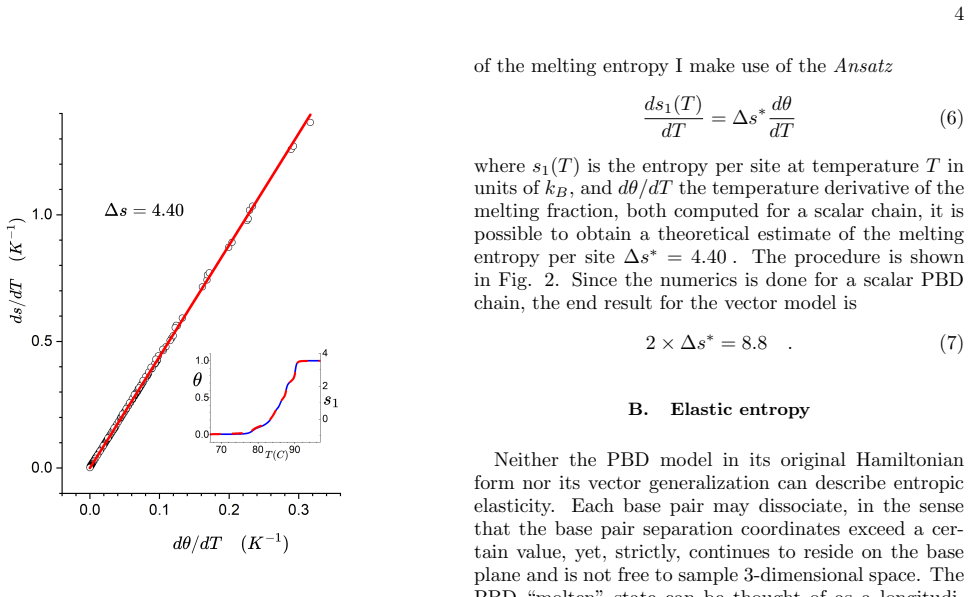
for a salt concentration of 0.075 M, consistent with the data used in the previous section; lower values were reported at higher salt concentrations and vice versa. Combining the above estimate of 3-d elastic entropy with the result of the previous section, I obtain a value of ∆s= 2×∆s ∗ + ∆sel = 9.78.(9) This is roughly in line with experiments reporting...
-
[2]
unzipping
can be well understood [12] in terms of the stem nearest-neighbor enthalpies and entropies given in [23] and a self-avoiding walk polymer model of the loop. The complete thermodynamic and kinetic problem is a com- plex one, involving both DNA and polymer statistical mechanics, diffusion properties of ss-DNA, as well as in- dermediate states formed during ...
-
[3]
Statistical Mechanics of a Nonlinear Model for DNA Denaturation
M. Peyrard and A.R. Bishop, “Statistical Mechanics of a Nonlinear Model for DNA Denaturation”, Phys. Rev. Lett.62, 2755 (1989); T. Dauxois, M. Peyrard and A. R. Bishop, “Entropy driven DNA denaturation”, Phys. 8 Rev. E47, R44 (1993)
1989
-
[4]
Or- der of the phase transition in models of DNA thermal denaturation
N. Theodorakopoulos, T. Dauxois and M. Peyrard, “Or- der of the phase transition in models of DNA thermal denaturation”, Phys. Rev. Lett.85, 6 (2000)
2000
-
[5]
Thermodynamic instabilities in one dimension: corre- lations, scaling and solitons
T. Dauxois, N. Theodorakopoulos and M. Peyrard, “Thermodynamic instabilities in one dimension: corre- lations, scaling and solitons”, J. Stat. Phys.107, 869 (2002)
2002
-
[6]
Denaturation of heterogeneous DNA
D. Cule and T. Hwa, “Denaturation of heterogeneous DNA”, Phys. Rev. Lett.79, 2375(1997)
1997
-
[7]
Melting of genomic DNA: predic- tive modeling by nonlinear lattice dynamics
N. Theodorakopoulos, “Melting of genomic DNA: predic- tive modeling by nonlinear lattice dynamics”, Phys. Rev. E82, 021905 (2010)
2010
-
[8]
The ther- mal denaturation of DNA studied with neutron scatter- ing
A. Wildes, N. Theodorakopoulos, J. Valle-Orero, S. Cuesta-L´ opez, J-L Garden and M. Peyrard, “The ther- mal denaturation of DNA studied with neutron scatter- ing”, Phys. Rev. Lett.106, 048101 (2011); “Structural correlations and melting of B-DNA”, Phys. Rev. E83, 061923 (2011)
2011
-
[9]
Stacking energies in DNA
S. G. Delcourt and R. D. Blake, “Stacking energies in DNA”, J. Biol. Chem.266, 15160 (1991)
1991
-
[10]
SantaLucia, H
J. SantaLucia, H. T. Allawi, and P. A. Seneviratne, Biochemistry35, 3555 (1996); this work, mainly on oligopolymer structures, explicitly validates the result of
1996
-
[11]
on the value of the average melting entropy of long polymers
-
[12]
Probing single-stranded DNA conformational flexibility using fluorescence spectroscopy
M. C. Murphy, I. Rasnik, W. Cheng, T. M. Lohman, and T. Ha, “Probing single-stranded DNA conformational flexibility using fluorescence spectroscopy”, Biophys. J. 86, 2530 (2004)
2004
-
[13]
Entropic elasticity of lambda phage DNA
C. Bustamante, J. F. Marko, E. D. Siggia, and S. B. Smith, “Entropic elasticity of lambda phage DNA”, Sci- ence265, 1599 (1994)
1994
-
[14]
Elastic properties and secondary structure formation of single- stranded DNA at monovalent and divalent salt condi- tions
A. Bosco, J. Camunas-Soler and F. Ritort, “Elastic properties and secondary structure formation of single- stranded DNA at monovalent and divalent salt condi- tions”, Nucleic Acids Res.42, 2064 (2014)
2064
-
[15]
Theodorakopoulos,The Statistical Physics of DNA, World Scientific (2020)
N. Theodorakopoulos,The Statistical Physics of DNA, World Scientific (2020)
2020
-
[16]
Me- chanical separation of the complementary strands of DNA
B. Essevaz-Roulet, U Bockelmann, and F. Heslot, “Me- chanical separation of the complementary strands of DNA”, PNAS94, 11935(1997)
1997
-
[17]
Mesoscopic modeling of DNA denaturation rates: Sequence dependence and experimental comparison
O. Dahlen and T. S. van Erp, “Mesoscopic modeling of DNA denaturation rates: Sequence dependence and experimental comparison”, J. Chem. Phys.142235101 (2015)
2015
-
[18]
Improving the mesoscopic modeling of DNA denaturation dynamics
M. Marty-Roda, O. Dahlen, T. S. van Erp and S. Cuesta- L´ opez, “Improving the mesoscopic modeling of DNA denaturation dynamics”, Physical Biology15, 066001 (2018)
2018
-
[19]
A single mode of DNA base-pair opening drives imino proton exchange
M. Gueron, M. Kochoyan, J-L Leroy, “A single mode of DNA base-pair opening drives imino proton exchange”, Nature328, 89 (1987); J-L Leroy, M. Kochoyan, T. Huynh-Dinh and M. Gueron, “Characterization of base- pair opening in deoxynucleotide duplexes using catalyzed exchange of the imino proton”, J. Mol. Biol.200, 223 (1988)
1987
-
[20]
Bubbles, clusters and denatura- tion in genomic DNA: modeling, parametrization, effi- cient computation
N. Theodorakopoulos, “Bubbles, clusters and denatura- tion in genomic DNA: modeling, parametrization, effi- cient computation”, J. Nonl. Math. Phys.18, Suppl. 2, 429 (2011)
2011
-
[21]
A self-consistent phonon theory of hydrogen bond melting
Y. Gao and E. W. Prohofsky, “A self-consistent phonon theory of hydrogen bond melting”, J. Chem. Phys.80, 2242 (1984)
1984
-
[22]
Sequence-dependent mechanics of single DNA molecules
M. Rief, H. Clausen-Schaumann and H.E. Gaub, “Sequence-dependent mechanics of single DNA molecules”, Nature Structural Biology6, 346 (1999)
1999
-
[23]
Sequence Dependent Rigidity of Single Stranded DNA
N. L. Goddard, G. Bonnet, O. Krichevsky, and A. Libch- aber, “Sequence Dependent Rigidity of Single Stranded DNA”, Phys. Rev. Lett.85, 2400 (2000)
2000
-
[24]
Mod- eling DNA beacons at the mesoscopic scale
J. Errami, M. Peyrard and N. Theodorakopoulos, “Mod- eling DNA beacons at the mesoscopic scale”, European Physical Journal E,23, 397 (2007)
2007
-
[25]
Kinet- ics of conformational fluctuations in DNA hairpin-loops
G. Bonnet, O. Krichevsky, and A. Libchaber, “Kinet- ics of conformational fluctuations in DNA hairpin-loops”, PNAS95, 8602 (1998)
1998
-
[26]
Thermodynamics and NMR of Internal GT Mismatches in DNA
H. T. Allawi and J. SantaLucia, “Thermodynamics and NMR of Internal GT Mismatches in DNA”, Biochemistry 36, 10581 (1997)
1997
-
[27]
Opening rates of DNA hairpins: Experiment and model
J. Hanne, G. Zocchi, N. K. Voulgarakis, A. R. Bishop, and K. Ø. Rasmussen, “Opening rates of DNA hairpins: Experiment and model”, Phys. Rev. E76, 011909 (2007)
2007
-
[28]
Nanomechanical measurements of the sequence-dependent folding land- scapes of single nucleic acid hairpins
M. T. Woodside, W. M. Behnke-Parks, K. Larizadeh, K. Travers, D. Herschlag, S. M. Block, “Nanomechanical measurements of the sequence-dependent folding land- scapes of single nucleic acid hairpins”, PNAS103, 6190 (2006)
2006
-
[29]
Loop De- pendence of the Dynamics of DNA Hairpins
Y. Shen, S. V. Kuznetsov, and A. Ansari, “Loop De- pendence of the Dynamics of DNA Hairpins”. J. Phys. Chem. B105, 12202(2001)
2001
discussion (0)
Sign in with ORCID, Apple, or X to comment. Anyone can read and Pith papers without signing in.