Recognition: unknown
Beyond the Final Label: Exploiting the Untapped Potential of Classification Histories in Astronomical Light Curve Analysis
Pith reviewed 2026-05-08 05:07 UTC · model grok-4.3
The pith
Incorporating the full history of changing classification probabilities improves accuracy and balance in astronomical light curve classification.
A machine-rendered reading of the paper's core claim, the machinery that carries it, and where it could break.
Core claim
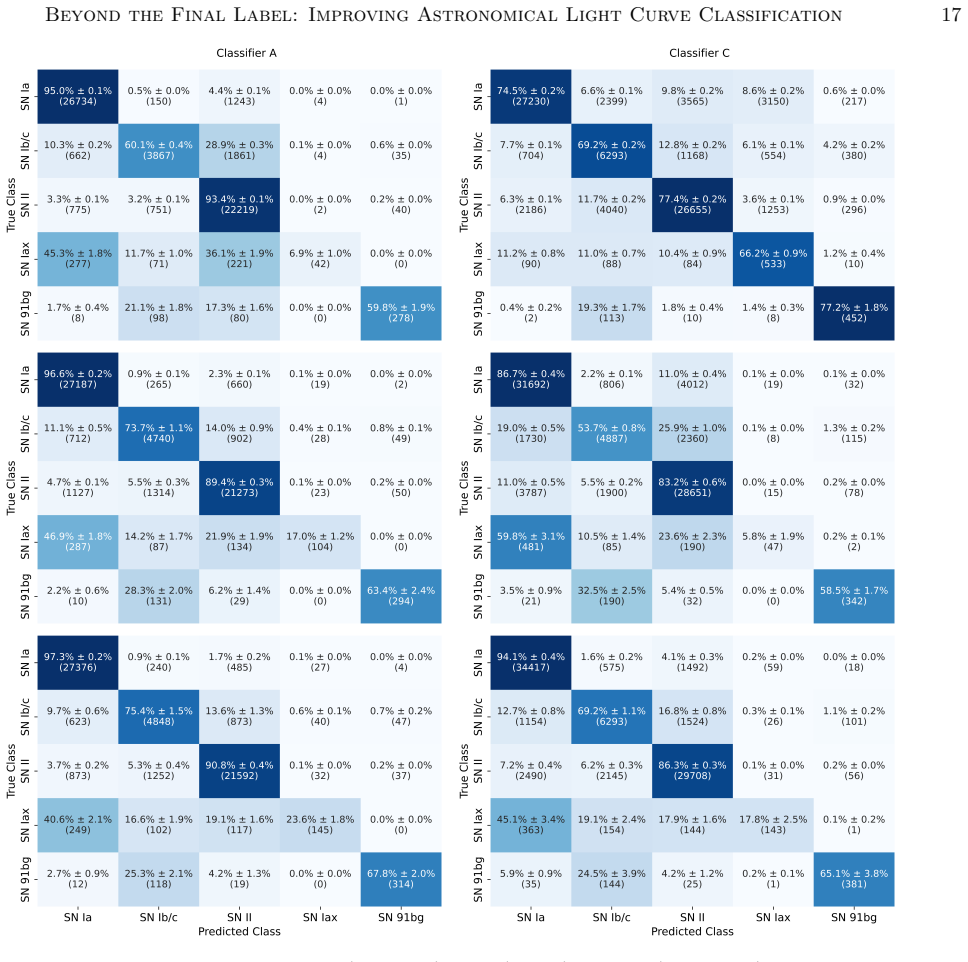
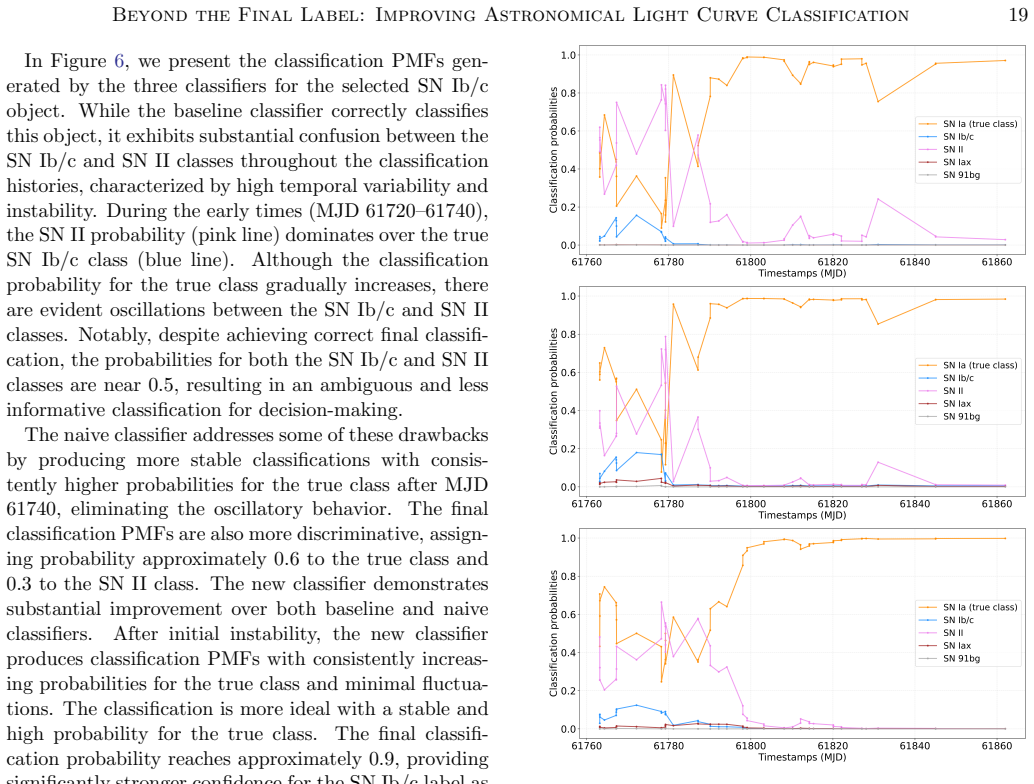
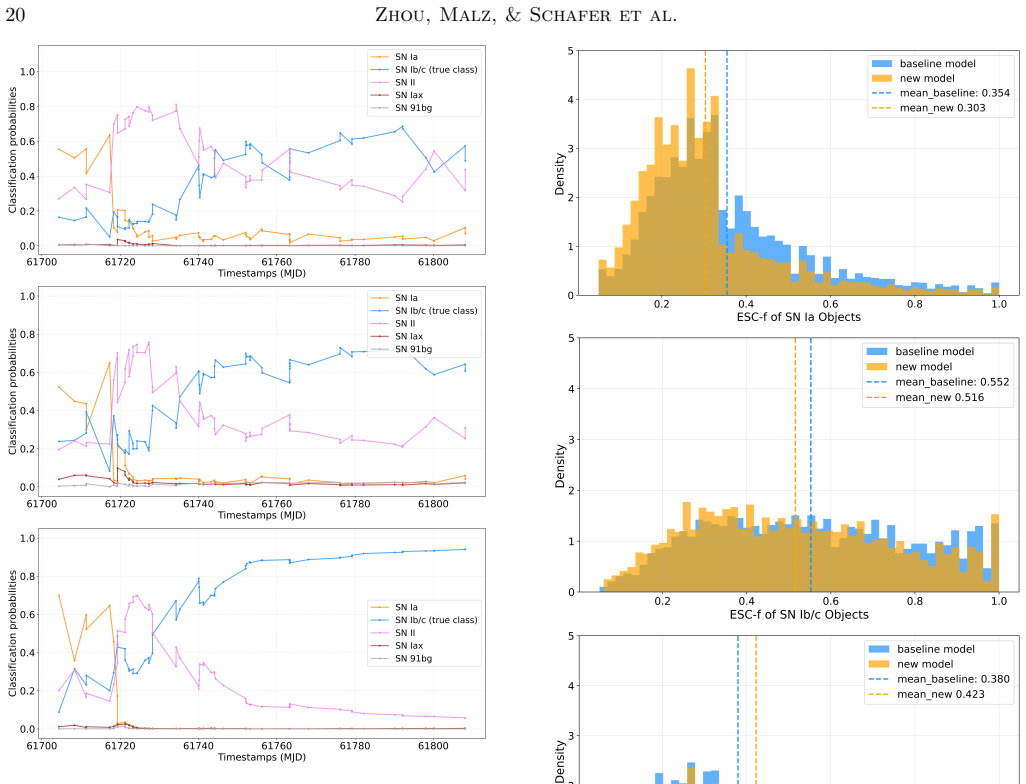
Using synthetic light curves and the running classification outputs from the ELAsTiCC challenge, a recurrent neural network equipped with additive attention processes the temporal sequence of probability vectors and produces higher classification accuracy and more balanced precision-recall performance than the challenge's published classifiers; the same evolving distributions are further used to define Wasserstein-based metrics that quantify stability, accuracy under limited data, and early-classification quality.
What carries the argument
A recurrent neural network with additive attention that ingests the time series of classification probability vectors produced by other models.
If this is right
- The proposed recurrent-attention model outperforms the final-label classifiers submitted to the ELAsTiCC challenge.
- Wasserstein-distance metrics on evolving probability distributions quantify classifier stability and early-classification ability on incomplete light curves.
- Re-using sequences of probability outputs allows existing classifiers to be enhanced without retraining on raw flux data.
- The framework supports more reliable target selection for follow-up observations in streaming surveys such as LSST.
Where Pith is reading between the lines
- The same history-based approach could be applied to real LSST alert streams to rank objects for immediate spectroscopic follow-up.
- If the benefit persists across different survey cadences, the method might reduce the need to maintain multiple independent raw-data classifiers.
- The Wasserstein metrics could be adopted as standard supplements to confusion matrices when evaluating any time-evolving classifier.
Load-bearing premise
The temporal evolution of classification probability vectors carries usable extra signal beyond what is already present in the final label and the raw light-curve data.
What would settle it
Training and testing the same recurrent-attention architecture on only the final probability vector of each light curve (removing all earlier time steps) would show no improvement over the original ELAsTiCC classifiers.
Figures




read the original abstract
The Legacy Survey of Space and Time (LSST) on the Vera C. Rubin Observatory will generate a massive collection of time series (light curves) of the measured flux of transient and variable astronomical objects. With each new flux observation, light curve classifiers need to generate updated probability distributions over candidate classes, which will then be shared with the global community for the purpose of identifying interesting targets for follow-up observations as well as less time-sensitive analysis applications. Using the synthetic light curves and classification results of participating classifiers from the Extended LSST Astronomical Time-series Classification Challenge (ELAsTiCC), we investigate a novel framework to enhance existing light curve classifications by incorporating their classification histories and the temporal evolution of these histories. To demonstrate the potential of this approach, we introduce a model that combines a recurrent neural network and an additive attention module, which shows improved classification accuracy and more balanced precision-recall performance compared to existing classifiers from the challenge. Furthermore, at this stage, most, if not all, of the existing classifiers are evaluated by their final classification results on complete light curves; we propose new metrics that evaluate the stability, accuracy, and early classification performance of a classifier's predictions when using limited data by considering the Wasserstein distance between the temporally evolving classification probability distributions. Our metrics offer a more comprehensive perspective for model assessment by supplementing classical methods such as the confusion matrix and precision-recall.
Editorial analysis
A structured set of objections, weighed in public.
Referee Report
Summary. The paper claims that incorporating the temporal history of classification probability vectors from existing ELAsTiCC challenge classifiers, via an RNN combined with an additive attention module, yields improved final classification accuracy and more balanced precision-recall performance on synthetic LSST light curves. It further proposes new evaluation metrics based on the Wasserstein distance between evolving probability distributions to assess stability, accuracy, and early-classification behavior, arguing these supplement standard confusion-matrix and PR-curve analyses.
Significance. If the claimed gains are shown to arise specifically from modeling temporal evolution rather than static ensembling, the approach could provide a lightweight post-processing layer that improves distributed classifiers without requiring raw light-curve access—an attractive property for LSST-scale operations. The Wasserstein-based metrics address a genuine gap in evaluating how classification quality evolves with accumulating observations.
major comments (2)
- [Abstract] Abstract: the central claim of improved accuracy and balanced PR performance is asserted without any numerical results, ablation tables, training details, or statistical significance tests, preventing assessment of effect size or robustness.
- [Model Architecture / Experimental Results] Model description and experimental setup: no control experiment is reported that replaces the RNN with a time-agnostic aggregator (final probability vector, mean, or concatenation) while keeping the rest of the architecture fixed. Without this comparison the contribution of temporal dynamics cannot be isolated from simple ensemble effects on the base classifiers' outputs, which is load-bearing for the paper's thesis that classification histories contain untapped temporal signal.
minor comments (2)
- [Abstract] The abstract refers to 'existing classifiers from the challenge' but does not specify which subset of ELAsTiCC submissions was used or how their probability histories were aligned in time.
- [Metrics section] The proposed Wasserstein-distance metrics are introduced conceptually but the manuscript should supply explicit formulas, normalization choices, and example computations on the ELAsTiCC data to make them reproducible.
Simulated Author's Rebuttal
We thank the referee for their constructive and insightful comments, which have helped clarify key aspects of our work. We respond to each major comment below and indicate the corresponding revisions to the manuscript.
read point-by-point responses
-
Referee: [Abstract] Abstract: the central claim of improved accuracy and balanced PR performance is asserted without any numerical results, ablation tables, training details, or statistical significance tests, preventing assessment of effect size or robustness.
Authors: We agree that the original abstract would benefit from quantitative support for its claims. In the revised manuscript we have updated the abstract to report specific performance metrics, including the accuracy gain and the improvement in balanced precision-recall relative to the ELAsTiCC baseline classifiers, together with a concise reference to the Wasserstein-based evaluation. Training details and statistical significance are now summarized briefly in the abstract with pointers to the relevant tables and figures in the main text. revision: yes
-
Referee: [Model Architecture / Experimental Results] Model description and experimental setup: no control experiment is reported that replaces the RNN with a time-agnostic aggregator (final probability vector, mean, or concatenation) while keeping the rest of the architecture fixed. Without this comparison the contribution of temporal dynamics cannot be isolated from simple ensemble effects on the base classifiers' outputs, which is load-bearing for the paper's thesis that classification histories contain untapped temporal signal.
Authors: The referee correctly identifies that a direct comparison to time-agnostic baselines is necessary to isolate the contribution of temporal modeling. The original manuscript did not contain such controls. We have therefore added a dedicated ablation study in which the RNN is replaced by static aggregators (mean pooling of the probability sequence, use of the final vector only, or concatenation of all vectors) while the attention module and downstream classifier remain unchanged. These experiments demonstrate additional gains from sequential processing beyond static ensembling. The new results, tables, and discussion are included in the revised experimental section. revision: yes
Circularity Check
No circularity: empirical model on external data with no self-referential derivations
full rationale
The paper describes an empirical ML approach trained on sequences of classification probability vectors from the external ELAsTiCC challenge dataset. It proposes an RNN+additive attention architecture and Wasserstein-based metrics for temporal stability, with performance claims resting on direct comparisons to challenge baselines. No equations, first-principles derivations, or predictions are present that reduce by construction to fitted parameters, self-definitions, or self-citation chains. The central improvement claim is isolated to held-out evaluation on synthetic light curves and does not invoke uniqueness theorems or ansatzes from prior author work.
Axiom & Free-Parameter Ledger
axioms (1)
- domain assumption Synthetic light curves and classifier outputs from the ELAsTiCC challenge are representative of real astronomical observations
Reference graph
Works this paper leans on
-
[1]
Abell, P. A., Allison, J., Anderson, S. F., et al. 2009 Allam Jr, T., Bahmanyar, A., Biswas, R., et al. 2018, arXiv preprint arXiv:1810.00001
-
[2]
2017, in International conference on machine learning, PMLR, 214–223
Arjovsky, M., Chintala, S., & Bottou, L. 2017, in International conference on machine learning, PMLR, 214–223
2017
-
[3]
2007, UCI machine learning repository, Irvine, CA, USA
Asuncion, A., Newman, D., et al. 2007, UCI machine learning repository, Irvine, CA, USA
2007
-
[4]
Neural Machine Translation by Jointly Learning to Align and Translate
Bahdanau, D. 2014, arXiv preprint arXiv:1409.0473
work page internal anchor Pith review arXiv 2014
-
[5]
2023, in Practice and experience in advanced research computing 2023: Computing for the common good, 173–176
Towns, J. 2023, in Practice and experience in advanced research computing 2023: Computing for the common good, 173–176
2023
-
[6]
2019, The Astronomical Journal, 158, 257 —
Boone, K. 2019, The Astronomical Journal, 158, 257 —. 2021, The Astronomical Journal, 162, 275
2019
-
[7]
1991, Communications on pure and applied mathematics, 44, 375
Brenier, Y. 1991, Communications on pure and applied mathematics, 44, 375
1991
-
[8]
2024, Astronomy & Astrophysics, 689, A289 de Soto, K
Cabrera-Vives, G., Moreno-Cartagena, D., Astorga, N., et al. 2024, Astronomy & Astrophysics, 689, A289 de Soto, K. M., Villar, V. A., Berger, E., et al. 2024, The Astrophysical Journal, 974, 169 ELAsTiCC Team, et al. 2023, The DESC ELAsTiCC Challenge, https://portal.nersc.gov/cfs/lsst/ DESC TD PUBLIC/ELASTICC/, ,
2024
-
[9]
2021, Journal of Machine Learning Research, 22, 1 F¨ orster, F., Cabrera-Vives, G., Castillo-Navarrete, E., et al
Flamary, R., Courty, N., Gramfort, A., et al. 2021, Journal of Machine Learning Research, 22, 1 F¨ orster, F., Cabrera-Vives, G., Castillo-Navarrete, E., et al. 2021, The Astronomical Journal, 161, 242
2021
-
[10]
M., Tan, C
Foumani, N. M., Tan, C. W., Webb, G. I., & Salehi, M. 2024, Data mining and knowledge discovery, 38, 22
2024
-
[11]
2000, Machine learning, 41, 315
Gama, J., & Brazdil, P. 2000, Machine learning, 41, 315
2000
-
[12]
F., Coughlin, M
Healy, B. F., Coughlin, M. W., Mahabal, A. A., et al. 2024, The Astrophysical Journal Supplement Series, 272, 14 Hloˇ zek, R., Malz, A., Ponder, K., et al. 2023, The Astrophysical Journal Supplement Series, 267, 25
2024
-
[13]
1997, Neural computation, 9, 1735 Ivezi´ c,ˇZ., Kahn, S
Hochreiter, S., & Schmidhuber, J. 1997, Neural computation, 9, 1735 Ivezi´ c,ˇZ., Kahn, S. M., Tyson, J. A., et al. 2019, The Astrophysical Journal, 873, 111
1997
-
[14]
2020, Advances in neural information processing systems, 33, 6696
Kidger, P., Morrill, J., Foster, J., & Lyons, T. 2020, Advances in neural information processing systems, 33, 6696
2020
-
[15]
Adam: A Method for Stochastic Optimization
Kingma, D. P., & Ba, J. 2014, arXiv preprint arXiv:1412.6980
work page internal anchor Pith review arXiv 2014
-
[16]
Auto-Encoding Variational Bayes
Kingma, D. P., & Welling, M. 2013, arXiv preprint arXiv:1312.6114
work page internal anchor Pith review arXiv 2013
-
[17]
R., Thorpe, M., Slepcev, D., & Rohde, G
Kolouri, S., Park, S. R., Thorpe, M., Slepcev, D., & Rohde, G. K. 2017, IEEE signal processing magazine, 34, 43
2017
-
[18]
2019, The Astronomical Journal, 158, 171
Malz, A., Hloˇ zek, R., Allam, T., et al. 2019, The Astronomical Journal, 158, 171
2019
-
[19]
I., Dai, M., Ponder, K
Malz, A. I., Dai, M., Ponder, K. A., et al. 2025, Astronomy & Astrophysics, 694, A130
2025
-
[20]
2021, The Astronomical Journal, 161, 107 M¨ oller, A., Peloton, J., Ishida, E
Matheson, T., Stubens, C., Wolf, N., et al. 2021, The Astronomical Journal, 161, 107 M¨ oller, A., Peloton, J., Ishida, E. E. O., et al. 2021, MNRAS, 501, 3272 M¨ uller, A. 1997, Advances in applied probability, 29, 429
2021
-
[21]
Kowalski, M. 2025, AMPEL workflows for LSST: Modular and reproducible real-time photometric classification, , , arXiv:2501.16511. https://arxiv.org/abs/2501.16511
-
[22]
2019, Astronomy & Astrophysics, 627, A21
Pasquet, J., Pasquet, J., Chaumont, M., & Fouchez, D. 2019, Astronomy & Astrophysics, 627, A21
2019
-
[23]
2019, Advances in neural information processing systems, 32
Paszke, A., Gross, S., Massa, F., et al. 2019, Advances in neural information processing systems, 32
2019
-
[24]
T., Bellm, E
Patterson, M. T., Bellm, E. C., Rusholme, B., et al. 2018, Publications of the Astronomical Society of the Pacific, 131, 018001 Peyr´ e, G., Cuturi, M., et al. 2019, Foundations and Trends®in Machine Learning, 11, 355 Pitt-Google Broker. 2025, Pitt-Google Broker, https://pitt-broker.readthedocs.io/en/latest/, ,
2018
-
[25]
2026, arXiv preprint arXiv:2603.29511 S´ anchez-S´ aez, P., Reyes, I., Valenzuela, C., et al
Pruzhinskaya, M., Kornilov, M., Dodin, A., et al. 2026, arXiv preprint arXiv:2603.29511 S´ anchez-S´ aez, P., Reyes, I., Valenzuela, C., et al. 2021, The Astronomical Journal, 161, 141
-
[26]
arXiv preprint arXiv:2101.10318 , year=
Shukla, S. N., & Marlin, B. M. 2021, arXiv preprint arXiv:2101.10318
-
[27]
F., Cutri, R
Skrutskie, M. F., Cutri, R. M., Stiening, R., et al. 2006, AJ, 131, 1163
2006
-
[28]
Song, H., Rajan, D., Thiagarajan, J., & Spanias, A. 2018, Proceedings of the AAAI Conference on Artificial Intelligence, 32, doi:10.1609/aaai.v32i1.11635
-
[29]
2020, Proceedings of the AAAI Conference on Artificial Intelligence, 34, 930
Tan, Q., Ye, M., Yang, B., et al. 2020, Proceedings of the AAAI Conference on Artificial Intelligence, 34, 930
2020
-
[30]
2017, Advances in neural information processing systems, 30
Vaswani, A., Shazeer, N., Parmar, N., et al. 2017, Advances in neural information processing systems, 30
2017
-
[31]
2021, Topics in optimal transportation, Vol
Villani, C. 2021, Topics in optimal transportation, Vol. 58 (American Mathematical Soc.)
2021
-
[32]
Wolpert, D. H. 1992, Neural networks, 5, 241
1992
-
[33]
G., Adelman, J., Anderson Jr, J
York, D. G., Adelman, J., Anderson Jr, J. E., et al. 2000, The Astronomical Journal, 120, 1579
2000
-
[34]
2019, in In Proceedings of the 28th International Joint Conference on Artificial Intelligence (IJCAI-2019), pp
Zhang, Y. 2019, in In Proceedings of the 28th International Joint Conference on Artificial Intelligence (IJCAI-2019), pp. 4369-4375, Macao, China. 26Zhou, Malz, & Schafer et al
2019
-
[35]
Zhou, Z., Malz, A., Schafer, C., et al. 2026, Beyond the Final Label: Exploiting the Untapped Potential of Classification Histories in Astronomical Light Curve Analysis, vv1.0, Zenodo, doi:10.5281/zenodo.18748762. https://doi.org/10.5281/zenodo.18748762
discussion (0)
Sign in with ORCID, Apple, or X to comment. Anyone can read and Pith papers without signing in.