Recognition: unknown
Information transfer enhanced by non-reciprocity in a model of turning flocks
Pith reviewed 2026-05-08 04:45 UTC · model grok-4.3
The pith
Active torques added to turning flock models create non-reciprocity that makes information transfer speed depend on turning rate.
A machine-rendered reading of the paper's core claim, the machinery that carries it, and where it could break.
Core claim
By incorporating active torques motivated by birds' adaptive injection of rotational energy, the model leads to a non-reciprocal modified Korteweg-de Vries equation with dissipation in the continuum limit. This equation's structure allows the information transfer speed to be expressed as a function of the turning angular velocity, thereby improving transfer during turns and aligning with the biological requirement for rapid information exchange when flocks turn sharply.
What carries the argument
The non-reciprocal modified Korteweg-de Vries equation with dissipation obtained in the continuum limit, which encodes how active torques tie information propagation speed to the flock's turning angular velocity.
If this is right
- Information transfer speed and efficiency increase during turning events.
- The interactions become non-reciprocal due to the active torques.
- Transfer speed becomes a function of the turning angular velocity.
- The model reproduces the faster information exchange required when real flocks turn under threat.
- Cohesion is better maintained through the enhanced propagation.
Where Pith is reading between the lines
- Models without active torques would likely underestimate the transfer speeds needed for rapid collective responses.
- The same non-reciprocal mechanism could be tested in other groups that adjust rotation adaptively, such as fish schools.
- Controlled simulations that vary turning rate while holding other parameters fixed would directly check the predicted speed dependence.
Load-bearing premise
The added active torques accurately capture birds' adaptive rotational energy injection while the one-dimensional continuum limit still represents information transfer in real flocks.
What would settle it
A measurement in live bird flocks of whether information transfer speed scales with turning angular velocity exactly as predicted by the derived non-reciprocal equation.
Figures


read the original abstract
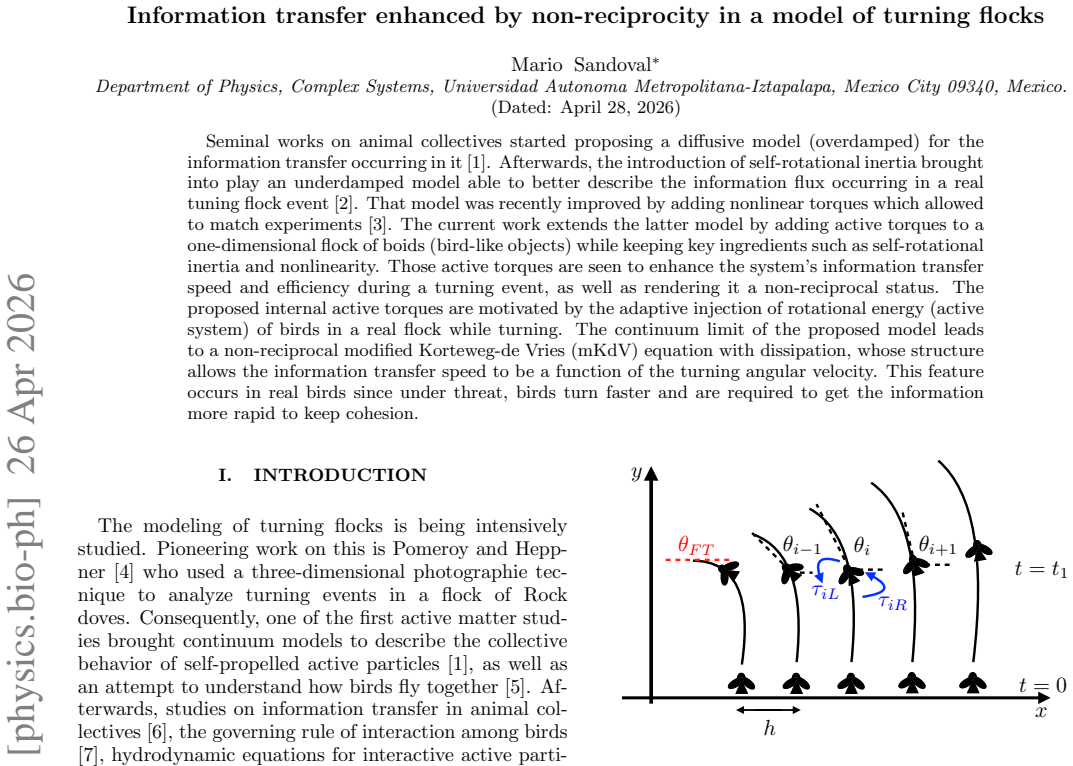
Seminal works on animal collectives started proposing a diffusive model (overdamped) for the information transfer occurring in it \cite{Vicsek}. Afterwards, the introduction of self-rotational inertia brought into play an underdamped model able to better describe the information flux occurring in a real tuning flock event \cite{Atta}. That model was recently improved by adding nonlinear torques which allowed to match experiments \cite{cavagna2025}. The current work extends the latter model by adding active torques to a one-dimensional flock of boids (bird-like objects) while keeping key ingredients such as self-rotational inertia and nonlinearity. Those active torques are seen to enhance the system's information transfer speed and efficiency during a turning event, as well as rendering it a non-reciprocal status. The proposed internal active torques are motivated by the adaptive injection of rotational energy (active system) of birds in a real flock while turning. The continuum limit of the proposed model leads to a non-reciprocal modified Korteweg-de Vries (mKdV) equation with dissipation, whose structure allows the information transfer speed to be a function of the turning angular velocity. This feature occurs in real birds since under threat, birds turn faster and are required to get the information more rapid to keep cohesion.
Editorial analysis
A structured set of objections, weighed in public.
Referee Report
Summary. The manuscript extends a one-dimensional boid model for turning flocks by incorporating active torques, motivated by adaptive rotational energy injection in birds, while retaining self-rotational inertia and nonlinear torques from prior work. The central claim is that the continuum limit of this discrete model produces a non-reciprocal dissipative modified Korteweg-de Vries (mKdV) equation whose structure makes the information transfer speed a function of the turning angular velocity. This is argued to enhance the speed and efficiency of information propagation during turning events, render the dynamics non-reciprocal, and align with real flock behavior where faster turns under threat require quicker information transfer to maintain cohesion.
Significance. If the derivation holds, the work supplies a mechanistic hydrodynamic description in which non-reciprocity and angular-velocity-dependent information speed emerge directly from the active-torque terms rather than from parameter fitting. This strengthens the link between microscopic active-matter rules and macroscopic collective information dynamics, offers a testable prediction for flock experiments, and contributes to the broader study of non-reciprocal active systems.
major comments (1)
- Continuum-limit derivation: the manuscript must supply the explicit intermediate steps from the discrete equations (including the active-torque contributions) to the final non-reciprocal dissipative mKdV equation, together with a demonstration that the information-transfer speed depends on angular velocity through the equation structure and not through an auxiliary parameter choice. This step is load-bearing for the central claim.
minor comments (2)
- Abstract: the description of the model extension, continuum limit, and biological motivation is compressed; separating these elements would improve readability.
- References: verify that all cited works (Vicsek, Atta, cavagna2025) appear with complete bibliographic details.
Simulated Author's Rebuttal
We thank the referee for their careful reading of the manuscript, positive assessment of its significance, and recommendation for minor revision. We agree that clarifying the continuum-limit derivation is essential to support the central claims and will revise the manuscript accordingly.
read point-by-point responses
-
Referee: Continuum-limit derivation: the manuscript must supply the explicit intermediate steps from the discrete equations (including the active-torque contributions) to the final non-reciprocal dissipative mKdV equation, together with a demonstration that the information-transfer speed depends on angular velocity through the equation structure and not through an auxiliary parameter choice. This step is load-bearing for the central claim.
Authors: We will expand the derivation section in the revised manuscript to include all explicit intermediate steps. Beginning from the discrete equations of motion for the boids (including self-rotational inertia, nonlinear torques, and the newly introduced active-torque terms), we will show the continuum limit procedure step by step, identifying precisely how the active-torque contributions generate the non-reciprocal terms in the resulting dissipative modified KdV equation. We will also add an explicit demonstration that the information-transfer speed is determined by the angular velocity through the structure of the derived PDE itself, without dependence on auxiliary parameter tuning. These additions will be incorporated into the main text (with possible supplementary material for lengthy algebra) to make the mechanistic origin transparent. revision: yes
Circularity Check
No significant circularity detected
full rationale
The paper introduces active torques as an explicit modeling extension to a prior boid model (with self-rotational inertia and nonlinearity), performs a continuum limit to obtain a non-reciprocal dissipative mKdV equation, and states that the information-transfer speed then follows as a function of turning angular velocity from the resulting PDE structure. This is a standard forward derivation from discrete rules to continuum equation; the angular-velocity dependence is not presupposed by definition or by fitting a parameter that is later relabeled as a prediction. Prior citations (Vicsek, Atta, cavagna2025) supply background but are not invoked as uniqueness theorems or load-bearing justifications for the new result. No self-definitional loop, fitted-input-as-prediction, or ansatz-smuggling via self-citation is present in the claimed chain.
Axiom & Free-Parameter Ledger
invented entities (1)
-
active torques
no independent evidence
Reference graph
Works this paper leans on
-
[1]
It is also worth mentioning that a spin model with added non-reciprocity in the way of a step function has been reported very re- cently [15]
at the individual level to the flock. It is also worth mentioning that a spin model with added non-reciprocity in the way of a step function has been reported very re- cently [15]. The current work can also be seen as a 1D spin model made non-reciprocal due to adaptive active torques. II. TURNING FLOCK MODEL ConsiderNboids (bird-like-objects) initially pe...
-
[2]
Vicsek, A
T. Vicsek, A. Czir´ ok, E. Ben-Jacob, I. Cohen, and O. Shochet, Phys. Rev. Lett.75, 1226 (1995)
1995
-
[3]
Attanasi, A
A. Attanasi, A. Cavagna, L. Del Castello, I. Giardina, T. S. Grigera, A. Jeli, S. Melillo, L. Parisi, O. Pohl, E. Shen, and M. Viale, Nature Physics10, 691 (2014)
2014
-
[4]
Spin-waves without spin-waves: A case for soliton propagation in starling flocks,
A. Cavagna, G. Cimino, J. Crist´ ın, M. Fiorini, I. Gia- rdina, A. Giustiniani, T. S. Grigera, S. Melillo, R. A. Palombella, L. Parisi, A. Ponno, M. Scandolo, and Z. S. Stamler, “Spin-waves without spin-waves: A case for soliton propagation in starling flocks,” (2025), arXiv:2505.19665 [cond-mat.stat-mech]
-
[5]
Pomeroy and F
H. Pomeroy and F. Heppner, The Auk109, 256 (1992)
1992
-
[6]
Toner and Y
J. Toner and Y. Tu, Phys. Rev. Lett.75, 4326 (1995)
1995
-
[7]
Sumpter, C
D. Sumpter, C. Buhl, D. Biro, and I. Couzin, Theory in Biosciences127, 177 (2008)
2008
-
[8]
Ballerini, N
M. Ballerini, N. Cabibbo, R. Candelier, A. Cavagna, E. Cisbani, I. Giardina, V. Lecomte, A. Orlandi, G. Parisi, A. Procaccini, M. Viale, and V. Zdravkovic, Proceedings of the National Academy of Sciences105, 1232 (2008)
2008
-
[9]
Bertin, M
E. Bertin, M. Droz, and G. Gregoire, Journal of Physics A: Mathematical and Theoretical42, 445001 (2009)
2009
-
[10]
Bialek, A
W. Bialek, A. Cavagna, I. Giardina, T. Mora, E. Sil- vestri, M. Viale, and A. M. Walczak, Proceedings of the National Academy of Sciences109, 4786 (2012)
2012
-
[11]
Cavagna, L
A. Cavagna, L. Del Castello, I. Giardina, T. Grigera, A. Jelic, S. Melillo, T. Mora, L. Parisi, E. Silvestri, M. Viale, and A. M. Walczak, Journal of Statistical Physics158, 601 (2015)
2015
-
[12]
Yang and M
X. Yang and M. C. Marchetti, Phys. Rev. Lett.115, 258101 (2015)
2015
-
[13]
Collective turns in spin- less flocks,
J. Lizarraga and M. de Aguiar, “Collective turns in spin- less flocks,” (2025), arXiv:2511.17804 [nlin.AO]
-
[14]
C. W. Reynolds, SIGGRAPH Comput. Graph.21, 25?34 (1987)
1987
-
[15]
I. G. Ros, L. C. Bassman, M. A. Badger, A. N. Pier- son, and A. A. Biewener, Proceedings of the National Academy of Sciences108, 19990 (2011)
2011
-
[16]
Bandini, D
G. Bandini, D. Venturelli, S. A. M. Loos, A. Jelic, and A. Gambassi, Journal of Statistical Mechanics: Theory and Experiment2025, 053205 (2025)
2025
-
[17]
Fermi, J
E. Fermi, J. Pasta, and S. Ulam,Studies of the Nonlin- ear Problems, Los Alamos Report LA-1940 (Los Alamos National Laboratory, 1955)
1940
-
[18]
N. J. Zabusky, inNonlinear Partial Differential Equa- tions, edited by W. AMES (Academic Press, 1967) pp. 223–258
1967
-
[19]
Brandenbourger, X
M. Brandenbourger, X. Locsin, E. Lerner, and C. Coulais, Nature Communications117, 1 (2019)
2019
-
[20]
Veenstra, G
J. Veenstra, G. Oleksandr, G. Xiaofei, S. Anahita, C. Ventura Meinersen, and C. Coulais, Nature627, 528 (2024)
2024
-
[21]
Sandoval and L
M. Sandoval and L. Aparicio, Journal of Physics: Con- densed Matter38, 015101 (2025)
2025
-
[22]
J. L. Bona, W. G. Pritchard, and L. R. Scott, Philosoph- ical Transactions of the Royal Society of London. Series A, Mathematical and Physical Sciences302, 457 (1981)
1981
discussion (0)
Sign in with ORCID, Apple, or X to comment. Anyone can read and Pith papers without signing in.